
 Thabo Nkosi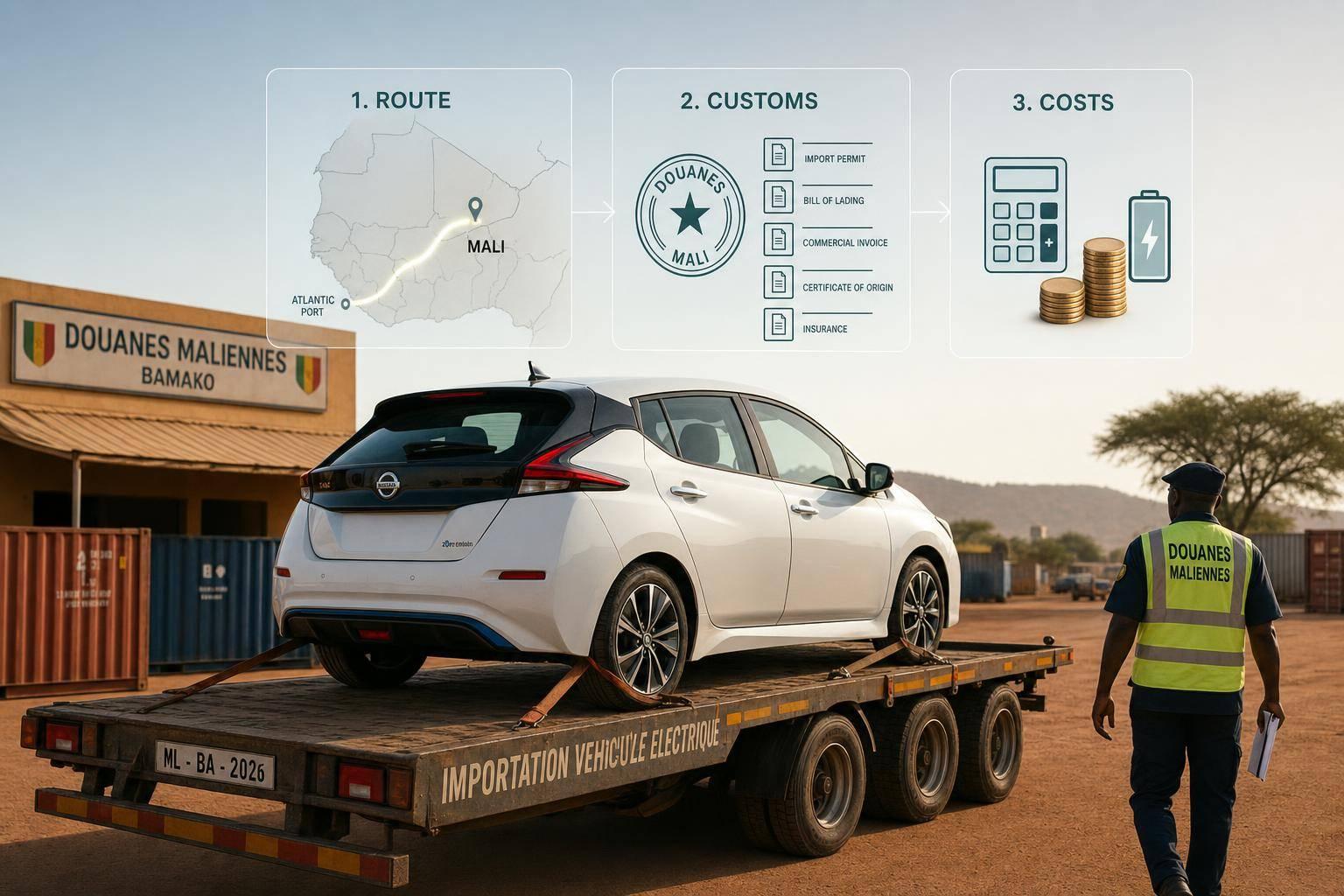
If your car is a fully electric vehicle under 10 years old, you may pay 0% customs duty and 0% VAT in Mali. That is the main number to check before you buy.
If I were planning this import, I’d focus on five things first: vehicle age, full-EV status, route through Dakar or Abidjan, total shipping plus inland transport, and matching paperwork. In the article, the sample BYD Dolphin lands at about $28,100, with taxes at $0 for a qualifying EV, but with shipping, port, transit, and admin charges still in the bill.
Here’s the short version:
- Only 100% electric vehicles get the full tax break
- The EV should be under 10 years old
- Mali customs uses CIF value for import assessment
- Most cars move through Dakar or Abidjan, then by road into Mali
- You still pay for freight, insurance, inland trucking, port fees, and small customs charges
- Your file should include the invoice, Bill of Lading, transit papers, import filing, and final customs declaration
- If the VIN, battery details, or propulsion type do not match across documents, clearance can stall
A simple way to think about it: the tax break can lower the bill a lot, but bad paperwork or missed transit costs can eat into those savings fast. The rest of the article walks through cost planning, documents, customs steps, and registration in Mali.
1. How EV Imports Work in Mali
Import routes, importer types, and customs value basics
Imported EVs usually come into Mali through Dakar or Abidjan, then move by road to Bamako. During transit, the shipment stays duty-suspended under transit papers until it reaches Malian customs for clearance. The Dakar corridor is the route used most often. That matters because corridor rules can affect both clearance timing and total landed cost.
After transit status is sorted out, the next piece is the importer and the shipping terms. Individuals can import EVs for personal use. Businesses can import passenger cars or light commercial vehicles. With DDP, most shipping and customs work sits with the seller or freight provider. With FOB, the buyer handles those steps.
For customs valuation, Mali uses CIF. That means customs looks at the vehicle price, plus insurance and freight, up to the port of entry.
How Mali taxes electric cars at the border
Qualifying BEVs clear the border duty-free and VAT-free. Hybrids get partial duty relief. Vehicles that do not qualify pay the standard import charges.
Next, turn those rules into a full landed-cost estimate.
sbb-itb-99e19e3
2. How to Calculate the Full Landed Cost
Vehicle price, shipping, inland transport, and insurance
If a BEV qualifies for Mali’s tax relief, most of your landed cost comes from shipping and related fees rather than import taxes.
The vehicle price is just the starting point. To get the full landed cost, add ocean freight, inland trucking, port handling, and insurance. It helps to budget each item on its own: ocean freight, marine insurance, inland trucking, and port handling.
Marine insurance usually costs 1%–2% of the vehicle’s value. Port handling and admin fees can also add up fast, sometimes reaching several thousand U.S. dollars.
Import duty, VAT, regional levies, and administrative fees
For the remaining fees, use CIF – cost, insurance, and freight – as the base value.
Mali gives a 100% exemption from customs duty and VAT for fully electric vehicles under 10 years old. So what do you still need to pay? Mainly statistical fees, regional levies, and administrative charges.
Sample landed-cost table for a real EV model
Example: BYD Dolphin routed through Dakar.
| Cost Category | BYD Dolphin (Est.) | Notes |
|---|---|---|
| Vehicle Price (FOB) | $23,000 | Supplier price |
| Ocean Freight | $1,800 | Shipping to Port of Dakar |
| Marine Insurance | $350 | 1%–2% of vehicle value |
| Inland Trucking (Dakar → Bamako) | $1,500 | Overland transport through Senegal |
| Port Handling & Admin Fees | $800 | Terminal and processing charges |
| Customs Duty | $0 | 100% exempt for fully electric vehicles |
| VAT | $0 | 100% exempt for fully electric vehicles |
| Statistical Fee & Regional Levies | $650 | Statistical and regional charges |
| Total Landed Cost (Est.) | $28,100 (16,860,000 XOF) | Excludes local registration |
A few things can throw off your budget. Dakar demurrage is one of them. Currency movement between USD and XOF is another. Even a small shift can change your final number, so line up these cost estimates with the paperwork needed for customs clearance.
3. Documents and Import Requirements
Vehicle, shipping, and ownership documents
Start with the core paperwork: the invoice, original registration or manufacturer’s certificate, packing list, and Bill of Lading. These papers back up customs value and help with the exemption review. Before you buy, check that the VIN, battery specs, propulsion type, and seller details match the invoice and the listing.
Once those papers are in place, submit the Malian import paperwork before the shipment arrives.
Malian import paperwork and customs declarations
File the Intention of Importation before arrival. Then use Dakar transit papers to move the vehicle from Senegal into Mali. After the transit file is cleared, the final customs declaration can be submitted for release in Mali.
Here’s a simple breakdown of who handles each document:
| Document | Purpose | Handled By |
|---|---|---|
| Purchase Invoice | Proof of value and ownership | Seller |
| Bill of Lading | Evidence of contract of carriage | Shipping Line |
| Intention of Importation | Local administrative requirement | Importer → Malian Authorities |
| Transit Papers | Covers Dakar-to-Mali overland movement | Port/Customs at Dakar |
| Customs Declaration | Final import release and tax assessment | Customs Broker/Agent |
From purchase through clearance, all of these documents need to match.
EV-specific compliance, valuation, and eligibility checks
The file must show that the vehicle is fully electric, not a plug-in hybrid. Include a certificate of conformity, battery safety information, and proof of propulsion type from the manufacturer or inspection authority.
It also helps to be a bit obsessive here. The invoice, Bill of Lading, packing list, and battery documents should all show the same details. If one record says one thing and another says something else, customs can hold the car or review the declared value again.
With the paperwork lined up, the next step is to open the import process and move the vehicle through transit.
4. Step-by-Step Process: From Purchase to Customs Clearance
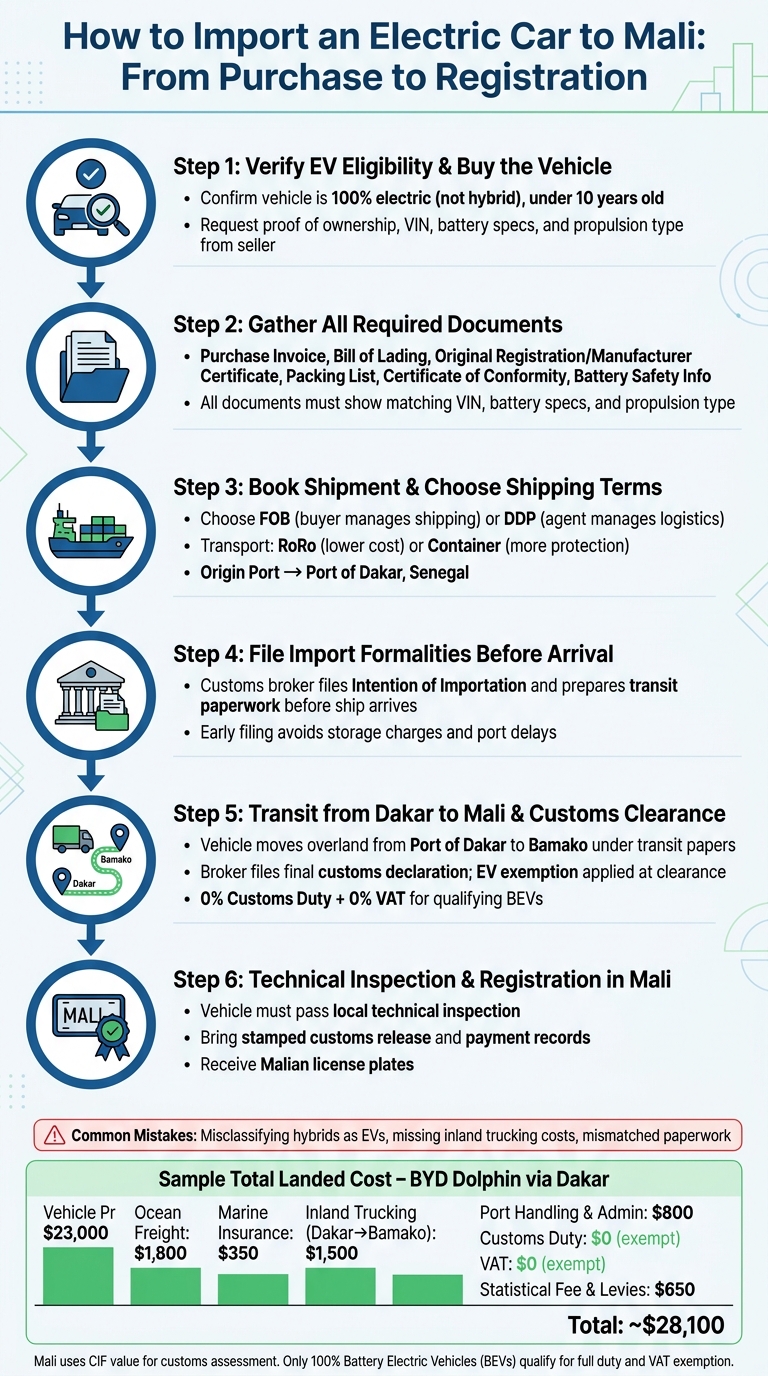
How to Import an Electric Car to Mali: Step-by-Step Process & Costs
Steps 1–3: Buy the EV, gather documents, and book shipment
If you’re buying a used EV, check that it still qualifies before you send payment. Ask the seller to confirm they can provide proof of ownership and the car’s technical specs. Also verify that the vehicle is fully electric, since the exemption applies only to fully electric vehicles. Once that’s clear, you can move on to shipping and transit paperwork.
When your documents are ready, choose the shipping term and transport method. FOB means you take care of shipping and insurance from the origin port. DDP means the agent handles logistics and customs for you.
For transport:
- RoRo is usually the lower-cost option
- Container shipping gives the vehicle more protection
Because Mali is landlocked, vehicles usually go through the Port of Dakar in Senegal and then continue inland to Mali. After the shipment is booked, the broker can open the import file before the vehicle arrives.
Steps 4–5: Open import formalities, move the car in transit, and clear customs
Once the vehicle is on the way, your customs broker should file the import documents and prepare the transit paperwork before the ship arrives. Getting this done early can help you avoid storage charges and port delays.
After the vehicle is cleared at the port, it moves in transit to Mali. Your broker then files the final declaration, and customs inspects the vehicle and checks the declared value. This is the point where the EV exemption should be applied at clearance.
Small mismatches in paperwork can slow everything down. Make sure the vehicle documents, purchase papers, and shipping documents all line up.
Step 6: Technical inspection and registration in Mali
After customs releases the vehicle, it must pass a local technical inspection before it can be registered. Bring the stamped customs release and payment records.
Once the car passes inspection, you can finish registration and get your Malian license plates. A local logistics partner who knows the transport authority process can make this last part much easier.
5. Common Problems, Cost Checks, and Key Takeaways
Mistakes that cause delays or extra charges
Most cost overruns come from three simple issues: the wrong vehicle class, missed inland transport, and paperwork that doesn’t line up.
The most common mistake is treating a hybrid like a full EV. In Mali, only 100% electric vehicles qualify for 0% VAT and 0% customs duty. Hybrids get only partial reductions. That one detail can change the numbers fast.
Another problem shows up in shipping quotes. A low quote can look good at first, then fall apart once delivery-side charges appear. You need to budget inland trucking from Dakar to the final delivery point in Mali, because that part is often left out.
Then there’s the paperwork. If the VIN, propulsion proof, and battery specs don’t match, customs can reclassify the vehicle and add extra charges. It’s the kind of issue that feels small until it slows everything down.
How to lower risk before committing to a purchase
The lowest-cost imports usually begin with a verified quote, not the final invoice.
Ask for a written pre-purchase quote that confirms two things: the car is fully electric, and the landed cost includes inland transport. Don’t rely on assumptions or vague wording.
Before you send payment, verify the EV status and make sure Dakar transit and inland delivery are both included in the quote . A few checks up front can save a lot of money later.
Conclusion: Key numbers, documents, and steps to remember
If you avoid those three failure points, the process becomes much easier to manage.
Qualifying 100% EVs pay 0% VAT and 0% customs duty in Mali. That can cut total acquisition cost by 25% to 35% compared with a similar gasoline vehicle. But those savings only show up when the vehicle is eligible, the documents match, and the transit-to-clearance sequence is confirmed before the shipment moves.
FAQs
How can I prove my car is a full EV?
Provide documents that clearly show the car is fully electric. The key point is simple: the details need to match across every document.
Include:
- The commercial invoice listing the vehicle as electric
- The Certificate of Origin listing the vehicle as electric
- Battery specifications
- Battery safety documents or battery spec sheets
- Any required safety certifications or a Certificate of Conformity (CoC)
- VIN records that match the bill of lading, invoice, and customs forms
If one document says EV but another uses vague or different wording, that can slow things down. The VIN, vehicle type, and battery details should line up cleanly across all paperwork.
What costs are not covered by the tax exemption?
Mali exempts fully electric vehicles from customs duties and VAT, but that doesn’t mean the import bill drops to zero.
You still need to cover other import-related costs. In most cases, that includes shipping, marine insurance, port handling, inland transportation, customs brokerage, and banking fees tied to wire transfers, letters of credit, and currency conversion.
A couple of line items tend to show up almost every time:
- Customs brokerage: often about $400
- Banking fees: usually $200–$300
Those extra charges can add up fast, so it’s smart to factor them in early instead of looking only at the duty and VAT exemption.
How long does customs clearance usually take?
Customs clearance in Mali isn’t handled under one fixed timeline. In most cases, it takes several days to a few weeks, based on the quality of your paperwork and how fast local offices process the file.
The best way to cut delays and avoid storage fees is simple: submit every document on time and make sure the details are correct. If you want a smoother process, a customs broker can help move things along and deal with compliance issues when the vehicle arrives.