
 Thabo Nkosi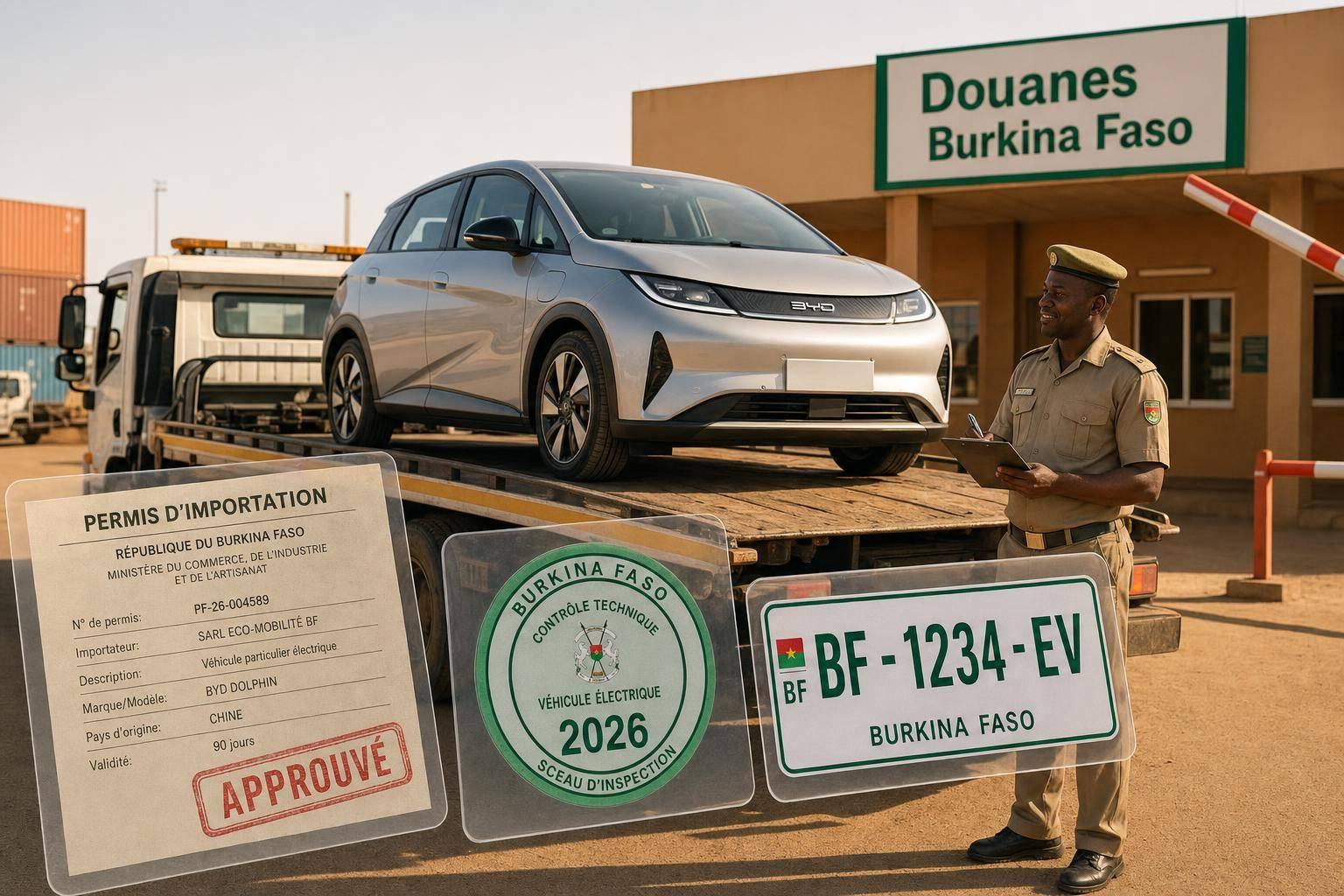
If I were importing an EV into Burkina Faso in 2026, I’d plan for four things first: prior import approval, pre-shipment inspection, CIF-based taxes, and post-clearance registration. Miss any one of them, and the car can sit at port while fees keep adding up.
Here’s the short version:
- I’d get Ministry of Commerce, Industry, and Handicrafts approval before shipping
- If the vehicle value is above FCFA 1,000,000 (about $1,565), I’d arrange COTECNA pre-shipment inspection
- I’d calculate taxes from the CIF value: vehicle price + freight + insurance
- I’d budget for customs duty, 18% VAT, statistical levy, broker fees, port charges, inland haulage, inspection, registration, and plates
- I’d expect a used EV to face extra cost risk if customs applies an age surcharge
- I’d use XOF for official payments, even if I planned my budget in U.S. dollars
A sample budget in the article shows how fast costs build:
- A new BYD Atto 3 at $32,000 ends up around $49,217 landed
- A used 2022 VW ID.3 at $14,000 ends up around $24,467 landed
- In both cases, VAT is 18% of CIF + duties, which makes freight cost matter more than many buyers expect
One more thing: paperwork errors are often the main problem, not shipping time. If the VIN, invoice, bill of lading, export papers, and inspection record do not match, clearance can stop.
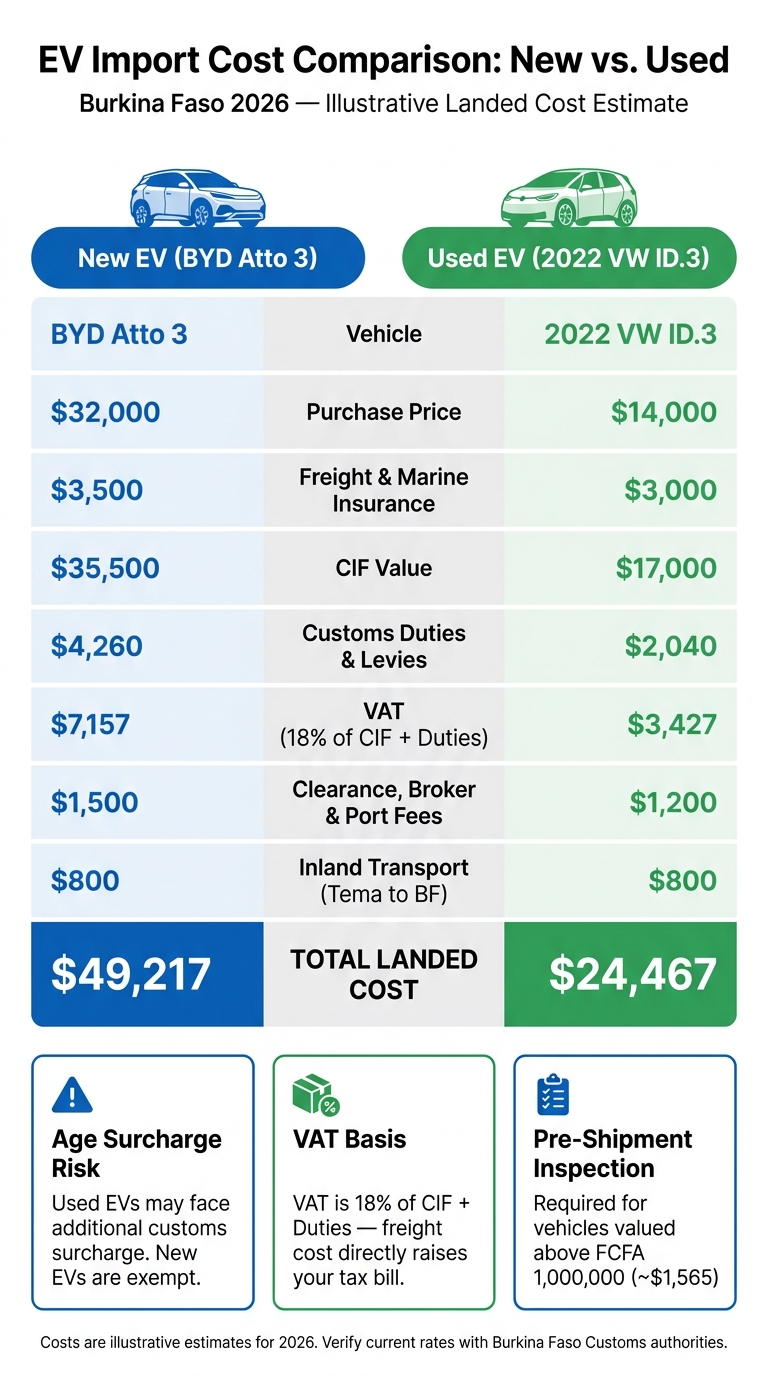
New vs. Used EV Import Cost to Burkina Faso 2026
Quick comparison
| Item | New EV | Used EV |
|---|---|---|
| Example vehicle | BYD Atto 3 | 2022 VW ID.3 |
| Purchase price | $32,000 | $14,000 |
| CIF value | $35,500 | $17,000 |
| Total landed cost | $49,217 | $24,467 |
| VAT basis | CIF + duties | CIF + duties |
| Age surcharge risk | No | Yes |
So if I wanted the smoothest path, I’d handle approval first, lock in the shipping papers, check the CIF math, and leave room in the budget for local registration after customs release.
sbb-itb-99e19e3
1. Burkina Faso Import Rules for Electric Cars in 2026
Bringing an electric car into Burkina Faso starts with prior authorization from the Ministry of Commerce, Industry, and Handicrafts. That import permit usually remains valid for six months. There’s also a key checkpoint before the car even ships: if the vehicle is worth more than FCFA 1,000,000 (about $1,565), it must go through a COTECNA pre-shipment inspection. Skip that step, and you could face fines or even have the car turned away at the border.
Those two requirements do more than add paperwork. They shape your timeline and can push your total cost up if anything gets missed.
How CIF Value Determines Duties and Taxes
Burkina Faso Customs bases duties and taxes on the CIF value. That means the vehicle’s purchase price, insurance, and freight up to the point of entry are all included. If inland transport is rolled into the freight charge, that amount also increases the CIF base.
Here’s why that matters: the higher your freight cost, the higher your tax base. So a lower-cost shipping option or a better-fit Incoterm can trim your CIF and help keep your import bill in check.
2026 Tax Structure for Imported Vehicles
Once the CIF value is set, importers need to plan for customs duty, VAT, and a statistical levy. If the EV is used, customs may also apply an age-related surcharge.
| Charge | Applies To | Tax Base |
|---|---|---|
| Customs Duty | All imports | CIF value |
| VAT | All imports | CIF + Duties |
| Statistical Levy | All imports | CIF value |
| Age Surcharge | Used vehicles only | CIF value |
This is the framework to use when building your landed-cost estimate. One practical point: don’t assume an EV tax break applies unless customs gives that confirmation in writing.
Permanent Import vs. Temporary Entry
For anyone planning to keep and use an EV in Burkina Faso for the long haul, permanent import is the normal route. It requires full payment of duties and taxes, plus formal customs clearance before the vehicle can be registered in the country.
Temporary admission is meant for short stays. It is not the usual path for private ownership or for an EV you intend to keep in Burkina Faso.
With the entry route clear, the next step is working out the full landed cost.
2. How to Calculate the Full Landed Cost of a New or Used EV
The purchase price is only the starting point. Before the car even leaves port, you also need to account for freight, insurance, customs charges, and local handling. That’s the only way to get a clear landed-cost figure before the vehicle ships.
Cost Items to Account for Before the Car Arrives
Your shipping budget should include ocean freight and inland transit, along with marine insurance, COTECNA pre-shipment inspection when required, licensed customs broker fees, and port handling charges at Tema.
Some of these costs stay fixed or kick in at certain thresholds. Taxes work differently. Customs duty and VAT increase with CIF, so once the CIF value goes up, the tax bill can climb fast.
Sample Import Cost Calculation: New EV vs. Used EV
The table below shows an illustrative 2026 landed-cost example for a new and a used EV.
| Cost Item | New EV (BYD Atto 3) | Used EV (2022 VW ID.3) |
|---|---|---|
| Vehicle Purchase Price | $32,000 (20,480,000 XOF) | $14,000 (8,960,000 XOF) |
| Freight & Marine Insurance | $3,500 (2,240,000 XOF) | $3,000 (1,920,000 XOF) |
| CIF Value (Tema, Ghana) | $35,500 (22,720,000 XOF) | $17,000 (10,880,000 XOF) |
| Customs Duties & Levies | $4,260 (2,726,400 XOF) | $2,040 (1,305,600 XOF) |
| VAT (18% of CIF + Duties) | $7,157 (4,580,480 XOF) | $3,427 (2,193,280 XOF) |
| Clearance, Broker & Port Fees | $1,500 (960,000 XOF) | $1,200 (768,000 XOF) |
| Inland Transport (Tema to BF) | $800 (512,000 XOF) | $800 (512,000 XOF) |
| Total Landed Cost | $49,217 (31,498,880 XOF) | $24,467 (15,658,880 XOF) |
Here’s the part that catches many buyers off guard: landed cost goes well beyond the sticker price. Duties and VAT grow with CIF, while clearance, broker, and inland transport costs stay fairly flat. That means those fixed charges eat up a larger share of the total budget on a lower-priced used EV.
No confirmed EV-specific relief is included in this estimate.
Once the budget is clear, the next step is preparing the clearance documents.
3. Documents and Customs Clearance Steps
Once the EV is ready to ship, the next place things can go wrong is customs paperwork. And in many cases, paperwork is the main choke point, not the trip itself. A missing form or one small mismatch can slow clearance and lead to storage fees.
Documents to Prepare Before Shipping
Start with the Ministry of Commerce, Industry, and Handicrafts import authorization. It is valid for six months and is required for entry.
You’ll also need the commercial invoice, proof of purchase, bill of lading, and the vehicle’s foreign registration certificate or export certificate. If the importer is an individual, a government-issued ID must be included. If the importer is a business, official registration papers are required.
Vehicles valued above FCFA 1,000,000 need a COTECNA pre-shipment inspection. And if the documents are not in French, local authorities will usually ask for French translations.
When the file is complete, customs can inspect the vehicle and move it through clearance on arrival.
Customs Clearance: From Declaration to Release
After the vehicle arrives at the inland terminal or border post, a licensed customs broker files a formal declaration with the customs office. Customs officials then carry out a physical inspection. They check that the VIN, model year, and vehicle specs match the commercial invoice, bill of lading, and export certificate.
Once that inspection is done, customs calculates duties and taxes based on the CIF value. After payment is confirmed, the customs office issues a release certificate for local use. That certificate shows the vehicle has been legally entered into Burkina Faso.
The smoothest clearances usually come down to one simple thing: the shipping papers, invoice, and VIN must match exactly.
Where Delays and Extra Fees Tend to Occur
The most common cause of delays is a VIN mismatch between the commercial invoice, bill of lading, and export certificate. Even a minor difference can stop the process while customs checks the file.
Another common problem is an undervalued declaration. If customs thinks the declared CIF value is too low, officials can reassess it upward. That means a higher tax bill and a slower release. Incomplete files can also cause trouble, especially when the COTECNA certificate is missing or the import authorization was not secured before shipping. In those cases, storage fees can start piling up while the paperwork is fixed.
The safest move is to keep every shipping document in line with the customs file from day one. After release, the file moves on to registration and plate issuance.
4. Registering the EV in Burkina Faso and Getting License Plates
Once customs clears the vehicle, the next step is local registration. The file usually includes the Carte Grise (registration card), Visite Technique (technical inspection), and Assurance (insurance). After that, submit the documents, pay the local fees, and pick up the plates.
Registration File and Technical Inspection Requirements
To open the registration file, get your customs release papers, proof of sale, and identity documents ready. Before the Carte Grise can be issued, the vehicle must pass a Visite Technique at a local inspection center such as the Centre de Contrôle Technique (CCVA). This inspection checks that the vehicle is roadworthy for registration.
Registration Fees and Plates
Local registration fees, tax stamps, and plate charges are paid in West African CFA francs (XOF). Once your file is accepted, you can collect the registration card and license plates.
5. Final Checklist Before You Import
Use this checklist before you pay a deposit. And before you buy, check the current import rules one more time. Rules can shift, and that small step can save you a headache later.
If your vehicle’s CIF value is over 1,000,000 FCFA (about $1,565), you must arrange a pre-shipment inspection with COTECNA before the vehicle ships.
You should also get your import authorization from the Ministry of Commerce, Industry, and Handicrafts as early as possible. The authorization stays valid for six months, so the timing matters. Your shipment needs to arrive while that permit is still active.
Make sure your paperwork lines up across the board. Have these documents ready:
- Original invoice
- Bill of lading
- Export certificate
Those details should match the pre-shipment inspection data. If they don’t, you could run into delays, extra checks, and port storage fees.
Your landed cost budget should go past the vehicle price alone. It should include CIF, COTECNA, customs duties, Tema port handling, inland transport, Visite Technique, Carte Grise, and plate fees. It’s also smart to leave a few extra days in your timeline for shipping and inland delivery. On paper, everything can look smooth. In practice, delays happen.
One more thing: know your Incoterms. They shape who handles what.
- DDP means duties and delivery are covered
- FOB means you handle freight, clearance, and registration steps yourself
If you’ve checked every item above, you give the EV a much smoother path from purchase to clearance and registration.
FAQs
Can I import a used EV of any age?
No. Burkina Faso does not allow the import of vehicles that are more than 10 years old.
You can still import a used EV if it falls within that age limit. But there’s a catch: older used vehicles often come with higher duties and taxes than newer ones.
That’s why newer models are usually the better pick. They tend to cost less to bring in overall, and they’re often in better shape when it comes to battery safety and cooling system performance.
What if my COTECNA inspection is missing?
If your mandatory COTECNA pre-shipment inspection report is missing, customs clearance will be blocked. For vehicle imports over $1,565, this report is required to confirm safety and technical compliance.
If you don’t get it before the vehicle leaves the country of origin, you can run into delays, processing issues, and storage fees.
How long does EV registration take after customs?
Sources don’t give a set timeline for EV registration in Burkina Faso after customs clearance.
In practice, the timing mostly comes down to your paperwork and how smoothly things move with local authorities. It helps to have every required document ready and free of errors, including the vehicle title, bill of sale, and technical specifications. Even small mismatches can slow the process down.