
 Thabo Nkosi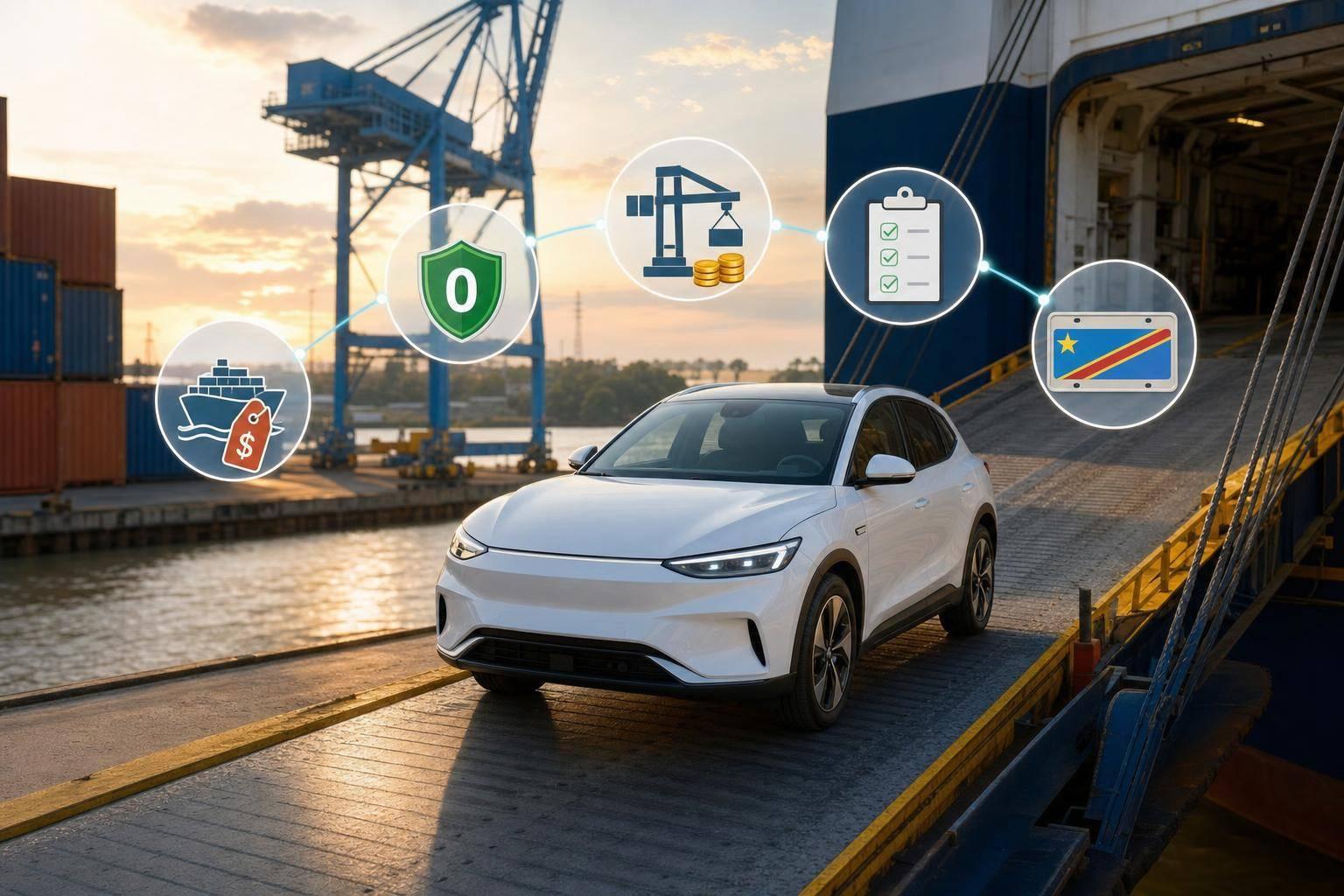
Good news first: if your car is a 100% electric vehicle, DR Congo currently applies 0% customs duty and 0% VAT on import. But you still need to pay for shipping, inspection, port handling, paperwork, and registration.
If I were planning this import in 2026, I’d focus on four things right away:
- Confirm the car is a pure EV
- Build costs from the CIF value: car price + insurance + freight
- Prepare every document before arrival at Matadi
- Budget for post-tax fees, because the tax break does not remove port, OCC, OGEFREM, agent, and registration costs
Here’s the short version in plain English:
- Taxes on qualifying EVs: 0% duty, 0% VAT
- Main extra import costs: OCC inspection, FERI/OGEFREM, port/storage, clearing agent
- Port release example: about $24,200 for a used EV with $22,500 CIF
- Port release example: about $51,170 for a new EV with $48,500 CIF
- Post-clearance road-use costs: about $420 for inspection, registration, plates, and insurance
- Main risk: if DGDA rejects your declared CIF or finds a VIN/document mismatch, your release can stall and storage charges can grow
The process is simple on paper: buy, ship, clear customs, inspect, register. The hard part is getting the file right. One missing paper, a late FERI filing, or a small mismatch between the invoice, title, and bill of lading can hold the car at the Port of Matadi.
Before I ship, I’d make sure I have the invoice, title, bill of lading, insurance, ID or company papers, deregistration papers for a used car, and the FERI/OGEFREM filing done on time. Then I’d ask a licensed clearing agent for an itemized quote based on the vehicle’s CIF.
This guide breaks down the full 2026 path so you can estimate your landed cost, avoid delays, and get the EV legally on the road.
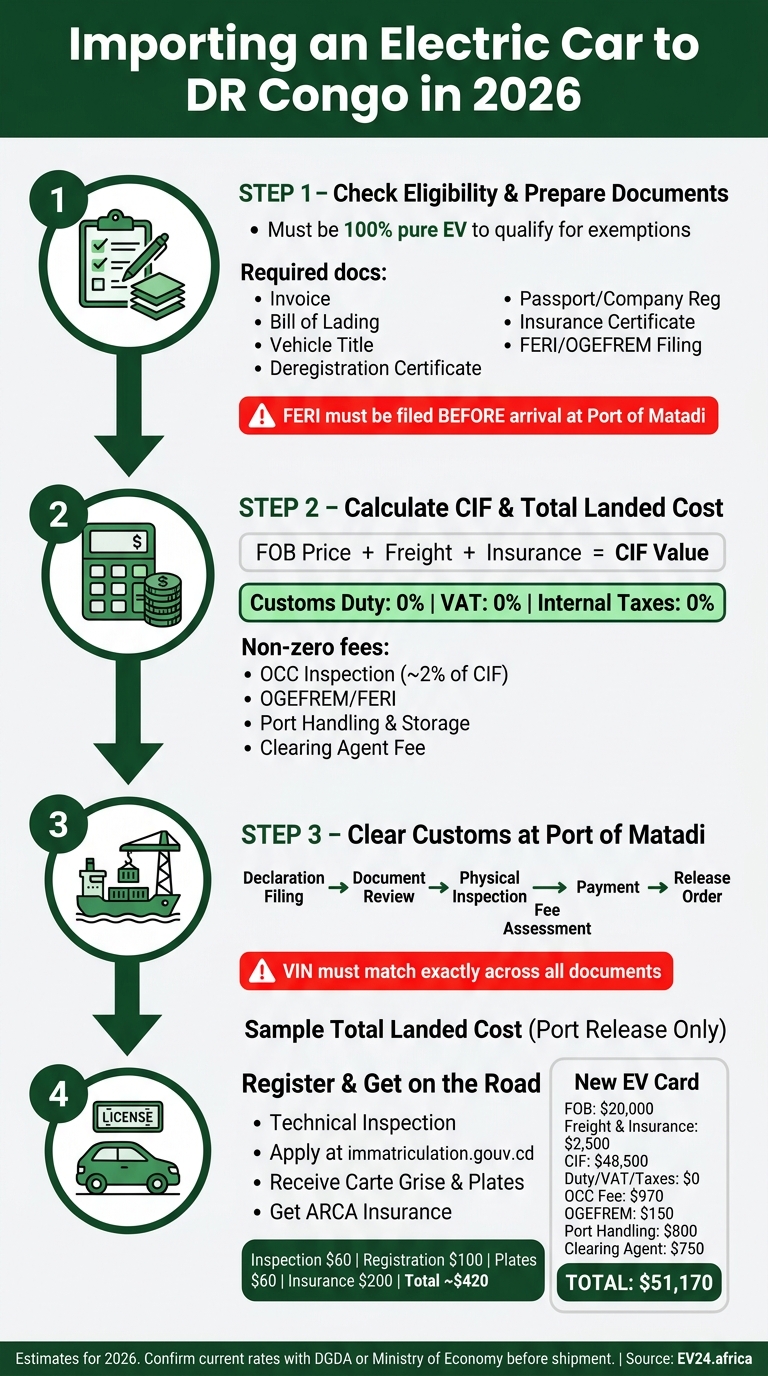
How to Import an Electric Car to DR Congo in 2026: Step-by-Step Cost Guide
Step 1: Check import eligibility and prepare your purchase documents
Before the vehicle leaves the origin country, make sure the EV fits DR Congo’s import rules and gather the paperwork customs will ask for. If you miss this step and the car is already on a ship, the fix can be slow and expensive.
Confirm the EV meets DR Congo import rules
Check the drivetrain before you buy. Only a pure EV gets the full VAT and customs-duty exemption. So yes, it’s worth double-checking the powertrain before money changes hands.
You’ll also want to confirm that the VIN is identical across the title, invoice, and shipping documents. Even a small mismatch can hold up clearance at the Port of Matadi. If you’re buying a used EV, check the export inspection records too, and make sure the vehicle can pass local technical inspection rules.
Once you’ve confirmed the car qualifies, get the paperwork lined up.
Collect the documents customs will require
DGDA and OCC each ask for specific documents during clearance. The safest move is to have the core set ready before the vehicle ships:
| Document | Notes |
|---|---|
| Commercial invoice | Standard sales document |
| Bill of Lading (BoL) | Shipping document for the cargo |
| Vehicle title or original registration | Proof of ownership |
| Deregistration certificate | Required for used vehicles exported from their origin country |
| Passport or company registration | Passport or business registration documents |
| Insurance certificate | Valid coverage for the vehicle |
| FERI/OGEFREM filing | Must be completed before arrival |
FERI/OGEFREM filing needs to be done before the vehicle reaches the Port of Matadi. If it’s filed late, clearance can stall and fines may apply.
With the paperwork set, you can lock in the listing and shipping terms before departure.
Use EV24.africa to find the vehicle and arrange delivery
You can source the vehicle through EV24.africa to compare specs and pricing before buying.
EV24.africa supports DDP for end-to-end delivery, or FOB if you want to handle shipping on your own. From there, use the purchase documents and shipping terms to work out CIF and the full landed cost.
sbb-itb-99e19e3
Step 2: Calculate taxes, duties, and total landed cost
How customs value is set: CIF, reference pricing, and reassessment risk
Start with the invoice, bill of lading, and insurance certificate from Step 1. You’ll use those documents to calculate CIF.
That number matters because DGDA can check your declared CIF against its reference values for vehicles. If your declared amount comes in below those benchmarks, DGDA may adjust the taxable base upward. And when that happens, your total import cost can climb too.
So it’s smart to run these numbers before shipment, not after the car is already on the water. DGDA will use them during clearance.
The main import charges for an electric car
For qualifying 100% electric vehicles, customs duty, VAT, and internal taxes are 0%. That’s the big win.
But that doesn’t mean the car lands for free. You still need to budget for OCC, OGEFREM, port charges, and your clearing agent.
| Charge | Who Collects It | Notes |
|---|---|---|
| Customs Import Duty | DGDA | 0% for 100% EVs |
| VAT | DGDA | 0% for 100% EVs |
| Internal taxes | Ministry of Economy | Exempt for 100% EVs |
| OCC Inspection Fee | OCC | Approx. 1.5%–2% of CIF value |
| OGEFREM / FERI Charges | OGEFREM | Administrative maritime fee |
| Port Handling & Storage | Port of Matadi | Varies by vehicle size and dwell time |
| Clearing Agent Fee | Private agent | Professional service fee |
Sample landed-cost calculation for a new or used EV
These examples show the import cost through port release, not registration. They assume a qualifying 100% EV with 0% duty, 0% VAT, and exempt internal taxes.
Once CIF is locked in, these are the charges that still remain before the vehicle can leave the port.
Used EV example:
| Cost Item | Estimated Cost (USD) | Basis |
|---|---|---|
| FOB price | $20,000 | Market price at origin |
| Freight and insurance | $2,500 | Shipping to Port of Matadi |
| CIF Value | $22,500 | Taxable base |
| Customs Import Duty (0%) | $0 | Exempt for 100% EVs |
| VAT (0%) | $0 | Exempt for 100% EVs |
| Internal taxes | $0 | Exempt for 100% EVs |
| OCC Inspection Fee | $450 | ~2% of CIF |
| OGEFREM / FERI Charges | $150 | Administrative maritime fee |
| Port Handling & Storage | $600 | Varies by vehicle size and dwell time |
| Clearing Agent Fee | $500 | Professional service fee |
| Total Cost to Port Release | $24,200 | Cost before registration |
New EV example:
| Cost Item | Estimated Cost (USD) | Basis |
|---|---|---|
| FOB price | $45,000 | Manufacturer price at origin |
| Freight and insurance | $3,500 | Shipping to Port of Matadi |
| CIF Value | $48,500 | Taxable base |
| Customs Import Duty (0%) | $0 | Exempt for 100% EVs |
| VAT (0%) | $0 | Exempt for 100% EVs |
| Internal taxes | $0 | Exempt for 100% EVs |
| OCC Inspection Fee | $970 | ~2% of CIF |
| OGEFREM / FERI Charges | $150 | Administrative maritime fee |
| Port Handling & Storage | $800 | Varies by vehicle size and dwell time |
| Clearing Agent Fee | $750 | Professional service fee |
| Total Cost to Port Release | $51,170 | Cost before registration |
The tax exemptions make a big dent in the bill, especially when compared with importing a non-EV. Still, OCC fees, port costs, and clearing charges can add a few hundred or even a few thousand dollars, depending on the vehicle and how long it sits at the port.
After that, the process moves to customs clearance with DGDA, OCC inspection, and port release.
Step 3: Clear the car through customs and the port
Once your EV reaches the Port of Matadi, customs clearance starts. If even one document is missing, the car can sit at the port longer than you want.
Submit documents to DGDA, OCC, and port authorities
DGDA manages customs clearance. OCC checks the vehicle. OGEFREM follows the freight paperwork. In plain English, a few different offices are involved, and that can get messy fast.
That’s why it helps to work with a licensed clearing agent. Your agent can file the declaration, line up the inspection, and keep the paperwork moving instead of having you chase each office on your own.
Once the file is lodged, the case moves into inspection, assessment, and release.
Inspection, tax payment, and vehicle release
The clearance process usually goes like this:
- Declaration filing
- Document review
- Physical inspection
- Fee assessment
- Payment
- Release order
DGDA still checks that the vehicle qualifies for the 0% duty and VAT treatment. So your VIN, commercial invoice, and Bill of Lading need to match exactly. A small mismatch can lead to reassessment or a delay.
Port storage fees can start piling up fast. For that reason, send the full shipping file to your clearing agent before the vehicle arrives.
How EV24.africa delivery support helps during customs clearance
EV24.africa can help line up shipping records and arrival timing so your clearing agent has a complete file before the vessel docks. That can cut release delays and help you avoid extra storage fees.
After release, the next move is technical inspection and registration.
Step 4: Register the EV and get it on the road legally
Once DGDA releases the vehicle, you’re in the final stretch. BAE can release the car from the port, but that doesn’t mean it’s ready for public roads yet. You still need the inspection, registration, plates, and insurance before the EV is legal to drive.
Complete the local technical inspection
Take the EV to an accredited inspection center as soon as it’s released. The inspection covers the basics first: lights, brakes, tires, steering, chassis condition, and the VIN. Inspectors also check that the VIN matches your customs papers and ownership documents.
Because it’s an EV, the center may look at a few extra items too. That can include battery pack mounting and insulation, high-voltage cables and connectors, and EV warning lights. Some inspection centers may also ask for battery safety documents. If everything checks out, the center issues a technical inspection certificate (contrôle technique), which you need for registration.
Apply for registration, plates, and insurance
Once you have the inspection certificate, move straight to registration. Put together your file and submit it through the official registration portal, immatriculation.gouv.cd. Applicants upload the documents, pay the assessed fees, and collect the carte grise and license plates after approval.
For a mid-range imported EV, plan for about $420 in post-clearance costs. That usually breaks down like this:
- $60 for the technical inspection
- $100 for the registration certificate
- $60 for license plates
- $200 for annual mandatory liability insurance
Insurance isn’t just a box to check. Buy the policy from an ARCA-licensed insurer and keep the certificate in the vehicle at all times. On top of the minimum required liability cover, it may make sense to look at comprehensive insurance too. EV battery repairs can get expensive fast.
Final document checklist before first road use
Before you drive the vehicle for the first time, make sure these documents are in order and, where needed, kept in the car.
| Document | Issued by | Needed for |
|---|---|---|
| Customs clearance certificate and proof of duties paid | DGDA | Registration file |
| OCC conformity certificate | Office Congolais de Contrôle (OCC) | Registration file |
| Technical inspection certificate | Licensed inspection center | Registration file and roadside checks |
| Commercial invoice/deed of sale | Seller / dealer | Registration file |
| Foreign registration or deregistration papers | Foreign registration authority | Registration file |
| Registration certificate (carte grise) | Road transport / registration authority | Road use |
| Congolese license plates | Road transport / registration authority | Affixed to vehicle |
| Motor liability insurance certificate | ARCA-licensed insurer | Road use |
| Valid driver’s license | Civil / licensing authority | Road use |
Conclusion: Budget accurately and avoid import delays
Importing an EV into DR Congo is manageable if you build your budget from the CIF value and handle each step in the right order. Start with CIF, then work through shipping, customs, and registration one by one.
The 100% VAT and duty exemption can cut the total cost, but you still need to plan for port handling, OCC inspection, clearing, and registration fees.
Make sure names and document numbers match exactly across the bill of lading, vehicle title, bill of sale, and ID. Even a small mismatch can slow clearance at the Port of Matadi and lead to storage charges.
Before you ship, confirm current 2026 rates with DGDA or the Ministry of the Economy and ask a licensed clearing agent for an itemized quote. Verify the full cost before shipment, and you can cut the risk of delays, storage fees, and budget overruns.
FAQs
Do hybrids qualify for the EV tax exemption?
Generally, no. In the Democratic Republic of the Congo, tax incentives are mainly aimed at 100% electric vehicles, not hybrids.
Some government measures do mention lower import duties for traditional, hybrid, and electric vehicles. But hybrids don’t seem to get the same broad exemption offered to fully electric vehicles.
Before you import, confirm the vehicle’s classification and duty rate with a customs broker. That extra check can save you a headache at customs.
What happens if customs disputes my CIF value?
If customs challenges your CIF value, they may set it above the amount you declared. That can lead to extra back duties and financial penalties. In more serious situations, customs may even seize the vehicle.
A smart way to lower that risk is to do a pre-appraisal before you file the formal customs declaration. Send in your invoice, bill of lading, and original registration papers ahead of time. That gives customs a chance to review the paperwork early, helps lock in an agreed value, and can prevent delays at clearance.
How long does EV clearance and registration usually take?
In the Democratic Republic of the Congo, customs clearance timelines can vary. One big reason is that several agencies take part in the process, and the SEGUCE Single Window system can be hard to work through. Pre-shipment inspections can add more time too. On top of that, rule changes can slow things down if documents need to be updated or checked again.
Once customs clearance is done, the vehicle must be registered with the DGI RDC. The paperwork here is extensive, and the process also calls for electronic authentication. That’s why many importers use a registered Importer of Record. It can help cut down on paperwork issues and lower the chance of delays or filing problems.