
 Thabo Nkosi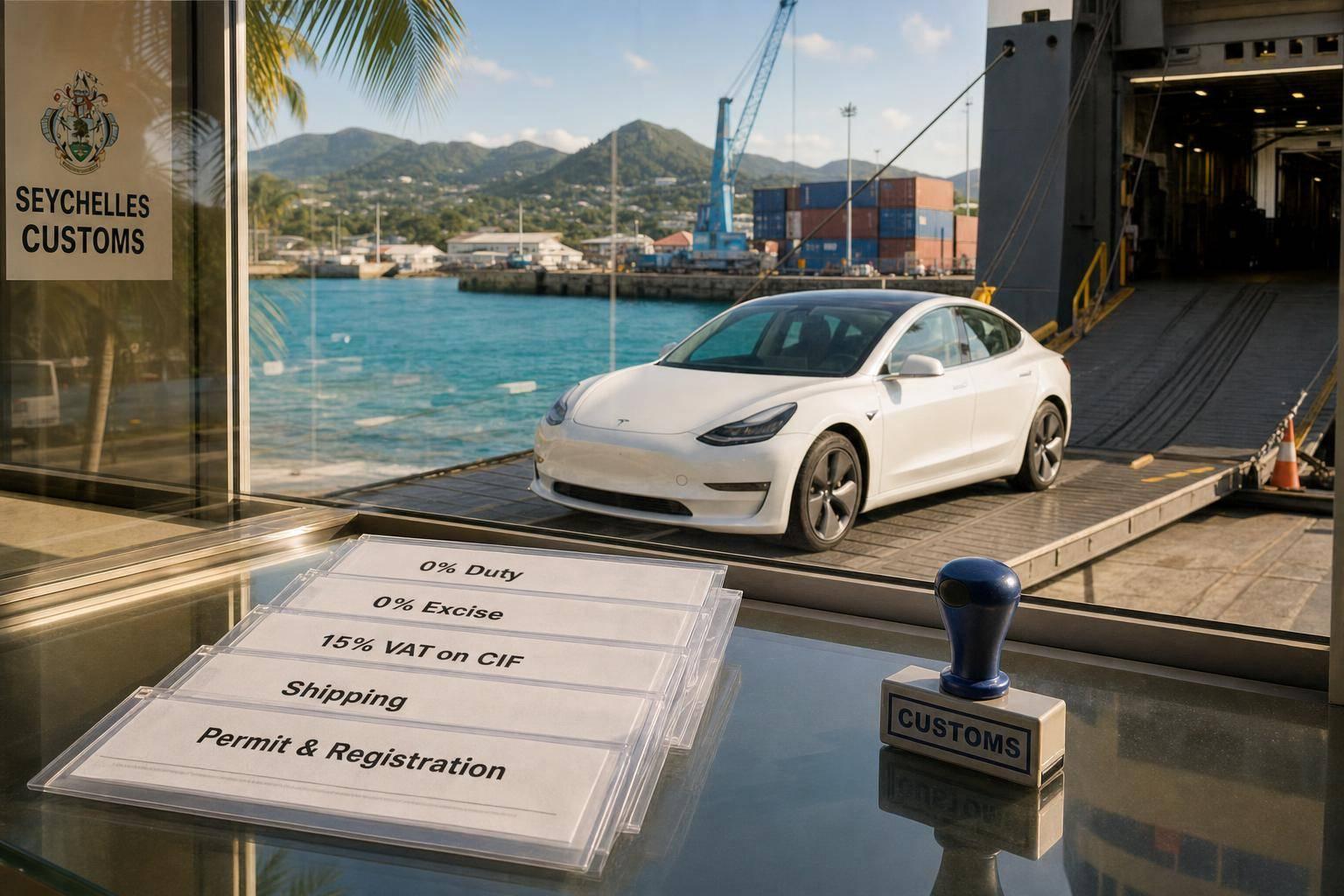
If you import a fully electric car into Seychelles in 2026, you may pay 0% customs duty, 0% excise tax, and 15% VAT on the CIF value. That cuts the tax bill a lot, but it does not mean the car lands for free.
If I were budgeting this import, I’d focus on six cost areas right away:
- Vehicle price
- Freight
- Marine insurance
- VAT at 15%
- Port and customs clearance fees
- Registration, testing, and licensing
A few rules can make or break the import:
- Right-hand drive is required
- You need an approved import permit before shipping
- Used vehicles face age and eligibility limits
- Full EVs, hybrids, and plug-in hybrids are not taxed the same way
In plain terms, a fully electric car is usually the lowest-tax option. A hybrid can cost more at entry because extra taxes or levies may still apply. And even with EV tax relief, your final bill still includes shipping, handling, VAT, and post-clearance fees.
Here’s the short version: check eligibility first, confirm the vehicle is classified as a full EV, calculate CIF, add 15% VAT, then add port and registration costs. That’s the path from purchase to road use in Seychelles.
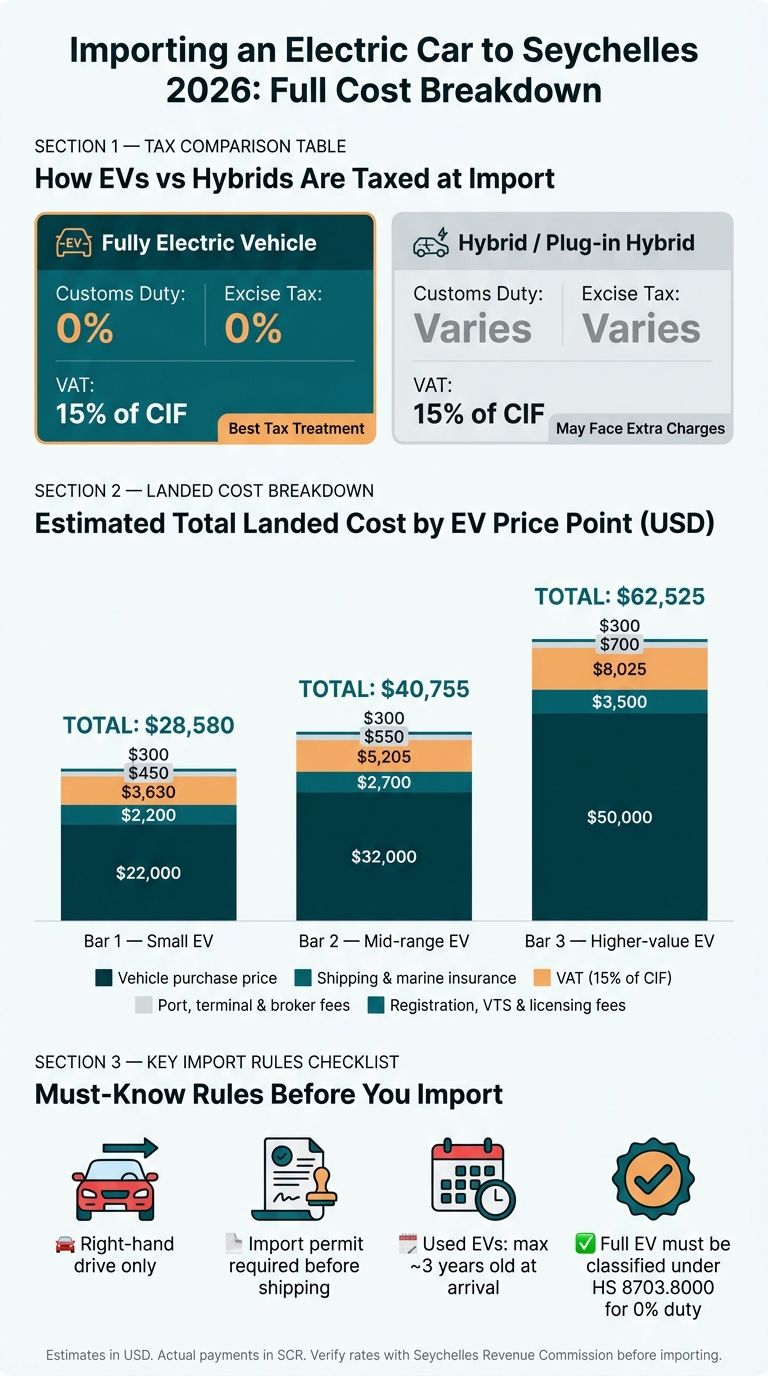
Electric Car Import Costs to Seychelles 2026: EV vs Hybrid Tax Breakdown
Quick Comparison
| Vehicle type | Customs duty | Excise tax | VAT | Notes |
|---|---|---|---|---|
| Fully electric vehicle | 0% | 0% | 15% | Best tax treatment if it qualifies |
| Hybrid / plug-in hybrid | Varies | Varies | 15% | May face extra import charges |
If you want a rough planning figure, the article’s sample totals range from about $28,580 for a small EV to $62,525 for a higher-value EV, based on price, shipping, VAT, and import-related fees.
Below, I’ll walk through the key checks, costs, and fees without repeating every line item from the full guide.
sbb-itb-99e19e3
1. Check Whether Your EV Qualifies Before You Ship
Import permit, right-hand drive, and vehicle eligibility rules
Seychelles accepts only right-hand-drive vehicles. If the EV is left-hand drive, it won’t qualify for import.
Used EVs face an age limit of about three years at arrival, and some passenger-car rules are tighter. If you’re buying used, check the manufacture date against the shipping timeline before you commit.
Used EV imports are allowed only in limited situations. Returning residents or graduates aged 18 and over may be allowed to import a used vehicle only once. Private buyers should confirm they qualify before purchase. Dealers bringing in vehicles for resale should also expect to need a dealer’s license along with the import permit.
An approved import permit from the Ministry of Finance, National Planning and Trade is required before shipment; a provisional permit is not enough. Apply early so there’s time for approval and for fixing any issues if something comes back.
Check the powertrain type before you buy. Full EVs, plug-in hybrids, and mild hybrids can face different tax treatment. That label decides whether the vehicle gets the full EV incentive or a different tax rate.
Documents to prepare before customs clearance
Have these documents ready.
| Document | What It Must Show | Who Provides It |
|---|---|---|
| Commercial invoice | Vehicle cost, VIN, model, year of manufacture, engine capacity, fuel/EV type, supplier details | Seller or dealer |
| Proof of payment | Bank transfer slip or remittance statement matching the invoice value | Your bank |
| Approved import permit | Final permit (not provisional) from the Ministry of Finance/Trade | Ministry of Finance |
| Bill of lading | EV description, loading port, destination port, consignee name | Shipping line |
| Export certificate | Confirms the vehicle was legally registered and cleared for export in the origin country | Origin country authority |
| Freight invoice | Shipping cost, used to calculate CIF value for duty and VAT | Freight forwarder |
| Marine insurance details | Coverage and value, also used in CIF calculation | Insurance provider |
| Auction sheet / condition report | Full condition overview for used vehicles | Auction house or inspector |
These papers also support customs valuation. The invoice sets the customs value and must show the full transaction amount in the payment currency. Customs may compare it with your proof of payment, so the figures need to match. If they don’t, you could face a reassessment or a delay.
Your clearing agent in Seychelles will use these documents to prepare the Bill of Entry – the formal customs declaration – listing the HS code, vehicle details, and value basis. Make sure the vehicle is marked correctly as fully electric or hybrid, because that decides which customs tax treatment applies. Send one complete digital file to your clearing agent before shipment. Once that file is complete, customs can clear the vehicle and the landed-cost calculation can start.
With eligibility checked and paperwork lined up, the next step is the duty and VAT treatment that applies to the EV.
2. Import Duties, Taxes, and EV Incentives in Seychelles
What fully electric vehicles may pay at import
Once your vehicle is cleared for import, the next thing to look at is the customs bill. For fully electric vehicles under HS 8703.8000, customs duty is 0% and excise tax is 0%. VAT of 15% still applies to the CIF value.
That tax treatment can make a big difference. But it doesn’t mean the car lands in Seychelles with no extra costs attached. You still need to budget for:
- Freight
- Port handling
- Clearance charges
So even with 0% customs duty and 0% excise, the final amount paid at import will be more than just VAT.
One more thing: vehicle classification matters a lot. A small mistake in how the car is classified can change the taxes due. Because of that, it’s smart to confirm the current 2026 schedule with the Seychelles Revenue Commission before you buy.
How hybrids are taxed differently from full EVs
Hybrids don’t get the same tax treatment as full EVs. They still face excise tax and, in some cases, an environment levy, although those rates are lower than what applies to non-EV imports.
For budgeting, full EVs are usually easier to map out. In most cases, VAT is the main tax cost. With hybrids, the picture is less simple because import charges can still add up fast.
That gap matters when you’re comparing the total landed cost of a full EV against a hybrid.
3. How to Calculate Your Real Landed Cost
Your landed cost is the full cost to get the vehicle into Seychelles. That means the car price, shipping, insurance, port charges, taxes, and clearance fees. A simple way to keep it straight is to split everything into two buckets: what you pay before the car arrives and what you pay when it arrives. After that, you can add registration and licensing on top.
Costs before arrival: vehicle price, freight, and marine insurance
Your pre-arrival costs make up the CIF value – Cost, Insurance, and Freight. This is the customs value used to calculate VAT.
Start with the vehicle invoice price in the seller’s currency. Then convert it to Seychelles rupees (SCR) using the exchange rate close to your shipment date, and add a 2%–3% buffer in case the rate moves against you. From there, add inland transport to the export port. Then add ocean freight, based on your shipper’s quote. After that, add marine insurance, which is usually budgeted at 0.3%–0.5% of CIF.
So the pre-arrival subtotal looks like this:
invoice price + inland transport + ocean freight + marine insurance = CIF value.
Costs at arrival: clearance, port fees, and customs handling
Even if you get tax relief, arrival costs still show up. Once CIF is set, the next round of charges starts at the port.
At this stage, budget for VAT, port and terminal charges, customs broker fees, and storage if your documents arrive late. That last one can sting. Port storage can climb fast when paperwork is delayed.
| Cost Stage | Cost Item | Basis |
|---|---|---|
| Before arrival | Vehicle invoice price | Seller’s invoice |
| Before arrival | Inland transport to export port | Flat fee or distance-based |
| Before arrival | Ocean freight | Shipper’s quote |
| Before arrival | Marine cargo insurance | ~0.3%–0.5% of CIF |
| At arrival | VAT (15%) | Applied to the CIF-based customs value plus any duty and excise |
| At arrival | Port/terminal handling & harbor dues | Per freight tonne / per gross ton |
| At arrival | Customs broker/clearing agent fee | Fixed or tiered |
| At arrival | Storage (if documents are delayed) | Per day at port |
Add the two subtotals together to get your landed cost before registration. Use that number as your import budget before you move on to registration, licensing, and any extra levies.
4. How to Register Your EV After Customs Release
Once customs releases the vehicle and you have the Bill of Entry, the next stop is the Seychelles Licensing Authority (SLA). You need both registration and a road fund license before the EV can legally go on public roads. One step comes first: VTS testing. SLA won’t finish the process without it.
Registration documents and payment steps
Before going to SLA, take the EV to the Vehicle Testing Station (VTS). VTS handles the roadworthiness inspection. For an EV, inspectors may also look at the drivetrain and the high-voltage safety labels. If the vehicle passes, VTS issues a Pass Certificate, and SLA needs that certificate before it can issue the license.
The VTS examiner must also stamp and sign your vehicle registration application form. After that, submit the required paperwork to SLA:
- Import permit
- Bill of Entry
- Proof of purchase
- Government ID
If the vehicle came in through a dealer, SLA may also ask for proof of purchase from that dealer.
Once SLA checks the documents, you’ll need to pay the registration fee and any HS-code levy. SLA then assigns a registration number. After that, you can apply for the road fund license using the Pass Certificate and your insurance policy. At that point, your remaining out-of-pocket amount comes down to the post-clearance fee schedule.
Registration fees, licensing charges, and other levies to budget for
SLA’s current fee schedule puts the vehicle registration fee at SCR 100 for all motor vehicles. SLA also applies a levy based on the HS code, so it’s worth checking whether your EV’s customs classification adds another charge at registration.
The road fund license is billed by vehicle class and engine capacity. SLA’s published rates are SCR 2.50 per cc for private and public motor vehicles, with a minimum charge of SCR 1,000. For commercial motor vehicles up to 5 tons, the rate is SCR 2.00 per cc, also with a minimum of SCR 1,000. Since EVs don’t fit neatly into the usual engine-capacity model, confirm how SLA plans to rate EVs in 2026 before you set your budget.
If you want a preferred plate number, SLA charges a non-refundable SCR 2,000 reservation fee.
| Fee Item | Amount | Notes |
|---|---|---|
| Vehicle registration fee | SCR 100 | One-time fee for all motor vehicles. |
| HS Code levy | Varies | Payable at registration, based on the vehicle’s customs classification. |
| Road fund license – private/public motor vehicle | SCR 2.50 per cc, minimum SCR 1,000 | Annual; confirm EV classification with SLA. |
| Road fund license – commercial motor vehicle up to 5 tons | SCR 2.00 per cc, minimum SCR 1,000 | Annual. |
| Registration number reservation (optional) | SCR 2,000 | Non-refundable. |
| VTS testing fee | Varies by vehicle type | Set under Road Transport Act schedules. |
Add these post-import charges to your landed cost before moving on to the worked examples in the next section.
5. Cost Examples and a Final Budget Checklist for 2026
Landed-cost examples for a small, mid-range, and higher-value EV
Now let’s put the numbers together.
These examples show how the full budget can look in practice for three EV price points. They are illustrative 2026 estimates in USD and assume a qualifying fully electric vehicle gets 0% customs duty and 0% excise tax, while 15% VAT still applies to the CIF value. Actual payments are made in Seychelles rupees (SCR), but USD makes side-by-side planning much easier.
| Cost Item | Small EV (est.) | Mid-range EV (est.) | Higher-value EV (est.) |
|---|---|---|---|
| Vehicle purchase price | $22,000 | $32,000 | $50,000 |
| Shipping & marine insurance | $2,200 | $2,700 | $3,500 |
| CIF subtotal | $24,200 | $34,700 | $53,500 |
| Customs duty (incentive) | $0 | $0 | $0 |
| Excise tax (incentive) | $0 | $0 | $0 |
| VAT – 15% of CIF | $3,630 | $5,205 | $8,025 |
| Port, terminal, and broker fees | $450 | $550 | $700 |
| Registration, VTS, and first licensing fees | $300 | $300 | $300 |
| Total landed cost (estimate) | $28,580 | $40,755 | $62,525 |
The big takeaway is simple: VAT is the main tax cost here because it’s charged on CIF. So if freight or insurance goes up, your final bill goes up too.
A comparable hybrid comes in much higher because excise and environmental levies still apply.
Conclusion: Key costs to confirm before you import
Use the totals above as a reality check for any supplier or shipping quote. Then double-check the few inputs that have the biggest effect on your final number.
- Confirm the EV qualifies for 0% duty and 0% excise, and verify the HS code.
- Check the current customs, excise, and VAT rules with Seychelles Customs or a licensed broker so you’re working from the latest schedule.
- Get written quotes for shipping and marine insurance, then plug those exact figures into your CIF math. That matters because freight and insurance directly change the VAT amount.
- Set aside money for post-customs costs: registration fee (SCR 100), levy based on HS code, road fund license (minimum SCR 1,000 for private vehicles), plus any number plate or inspection charges.
Use this checklist to catch costs that often show up only after the vehicle arrives.
FAQs
How do I prove a car qualifies as a full EV?
Provide a Certificate of Conformity and documents that clearly show the vehicle’s powertrain is 100% electric.
When you register the vehicle at the Vehicle Testing Station, officials will check these documents along with your import paperwork. Make sure the manufacturer’s certificate and technical specifications plainly state that the car is fully electric. That small detail can help you avoid classification mistakes during customs clearance and registration.
What if my import permit is delayed?
A delayed import permit can slow down customs clearance and rack up extra port storage fees, plus other charges. One of the most common reasons? Paperwork problems like missing forms, incomplete details, or information that doesn’t match across documents.
To help avoid delays, send in your documents early, keep an eye on your shipment, and respond fast if customs asks for more information. Working with a customs broker can also help move clearance along and sort out compliance issues before they turn into bigger problems.
How much extra should I budget beyond VAT?
In Seychelles, 100% electric vehicles usually come with no VAT and no customs duty. So in most cases, you don’t need to set aside extra money for VAT-related taxes.
That said, the car still isn’t landing for free.
You should still plan for other import costs, including:
- Shipping and insurance
- Port and document handling
- Registration and testing fees
Registration is about $25, and you may also have to pay HS code-based levies plus any optional license plate reservation.
Related Blog Posts
- Cape Verde EV Import Regulations 2025: Customs, Tax & Permit Info
- Buy Electric Cars in Côte d’Ivoire: 2025 Guide to Prices, Models & Delivery
- How to Import an Electric Car to Senegal in 2026: EV Import Costs & Requirements
- How to Import an Electric Car to Mauritius in 2026: Taxes, Incentives & Registration