
 Younes Rabeh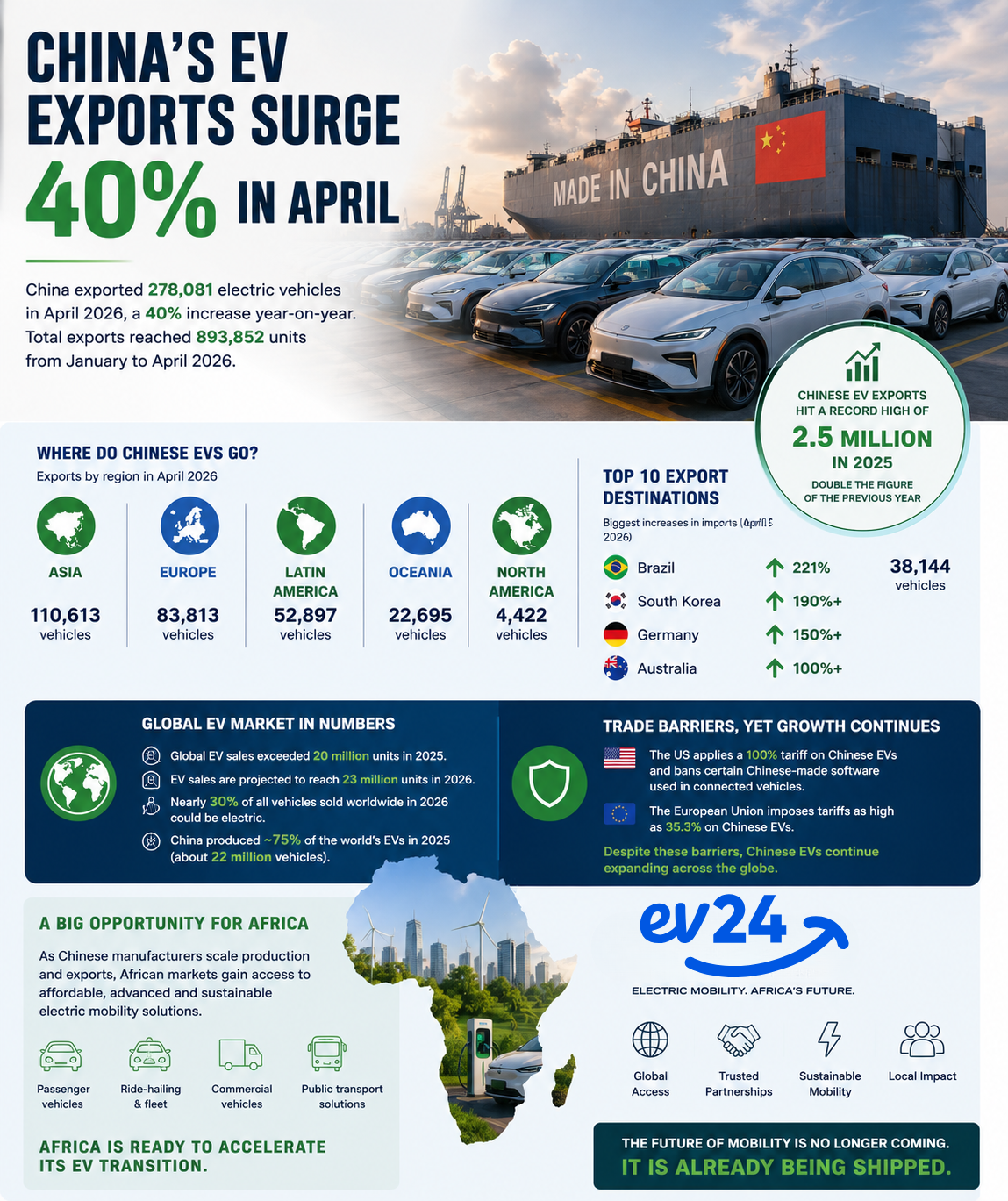
The global electric vehicle (EV) industry continues to accelerate at an unprecedented pace. According to the latest customs data compiled by Bloomberg, China’s electric vehicle exports reached 278,081 units in April 2026, marking a remarkable 40% year-on-year increase.
This impressive performance reinforces China’s position as the world’s undisputed leader in electric mobility manufacturing and highlights the growing demand for affordable, technologically advanced electric vehicles across international markets.
For Africa, this trend represents far more than a statistical milestone. It signals a unique opportunity to accelerate the continent’s transition toward sustainable transportation, energy independence, and cleaner urban mobility.
China Continues to Dominate Global EV Production
China has spent the last decade building the world’s most advanced electric vehicle ecosystem.
Today, the country produces approximately 75% of all electric vehicles manufactured globally. According to the International Energy Agency (IEA), China manufactured nearly 22 million electric vehicles in 2025 alone.
Chinese manufacturers such as BYD, Geely, Changan, Leapmotor, Dongfeng, Wuling, GAC, Zeekr, Xpeng, AITO, Deepal, and Avatr have rapidly expanded beyond their domestic market and are now competing globally through innovation, battery technology, intelligent driving systems, and highly competitive pricing.
The latest export figures demonstrate that this momentum is only strengthening.
Between January and April 2026, Chinese EV exports reached 893,852 vehicles, putting the industry on track for another record-breaking year.
Where Are Chinese Electric Vehicles Going?
The latest export data reveals the geographical distribution of Chinese EV demand:
Asia
- 110,613 vehicles imported in April 2026
Asia remains the largest destination for Chinese electric vehicles, benefiting from geographic proximity, growing urbanization, and government support for electric mobility.
Europe
- 83,813 vehicles imported
Despite increased tariffs imposed by the European Union, demand for Chinese EVs continues to grow due to their competitive value proposition and technological sophistication.
Latin America
- 52,897 vehicles imported
Latin America is emerging as one of the fastest-growing EV markets globally, with Brazil leading the charge.
Oceania
- 22,695 vehicles imported
Australia and New Zealand continue to increase EV adoption, driven by rising fuel costs and sustainability goals.
North America
- 4,422 vehicles imported
Although significantly lower due to trade restrictions and tariffs, Chinese manufacturers continue to explore opportunities in selected North American market segments.
Brazil Leads Global Growth
Among the world’s largest importers of Chinese electric vehicles, Brazil recorded the most impressive growth.
Imports surged by 221% compared to the previous year, reaching 38,144 vehicles.
Other major markets also experienced significant growth:
- South Korea: +190%
- Germany: +150%
- Australia: +100%
These figures demonstrate that global consumers increasingly recognize Chinese EVs as reliable, innovative, and cost-effective alternatives to traditional automotive brands.
Trade Barriers Are Not Slowing China’s EV Expansion
Despite growing geopolitical tensions, Chinese EV exports continue to reach record levels.
The United States currently imposes a 100% tariff on Chinese electric vehicles and has introduced restrictions on certain connected vehicle technologies.
Meanwhile, the European Union applies additional tariffs reaching up to 35.3% on selected Chinese EV imports.
Yet demand continues to grow.
The reason is simple: Chinese manufacturers have achieved economies of scale unmatched anywhere else in the world.
This allows them to offer:
- Longer driving ranges
- Advanced battery technologies
- Intelligent driving systems
- Premium features
- Competitive pricing
As a result, many emerging markets increasingly view Chinese electric vehicles as the most practical solution for accelerating electrification.
Why Africa Stands to Benefit the Most
While Europe and North America debate tariffs, Africa has a unique opportunity to benefit from the global EV transformation.
Many African countries face common transportation challenges:
- Rising fuel prices
- High vehicle operating costs
- Urban pollution
- Energy security concerns
- Limited public transportation infrastructure
Electric mobility directly addresses many of these challenges.
As Chinese manufacturers continue expanding production capacity, African consumers gain access to:
More Affordable Electric Vehicles
In recent years, entry-level EV prices have fallen dramatically.
Models such as the BYD Dolphin, Geely Panda Mini, Dongfeng Nammi, Wuling Bingo, Leapmotor T03, and Changan Lumin are making electric mobility accessible to a broader audience than ever before.
Lower Operating Costs
Electric vehicles typically cost significantly less to operate than conventional gasoline vehicles.
For fleet operators, ride-hailing platforms, delivery companies, and logistics providers, these savings can transform profitability.
Improved Energy Independence
Many African countries spend billions of dollars annually importing fossil fuels.
Electric mobility enables greater use of locally produced electricity, including renewable energy sources such as solar and wind.
New Economic Opportunities
The EV ecosystem creates opportunities beyond vehicle sales, including:
- Charging infrastructure
- Battery maintenance
- Fleet management
- Renewable energy integration
- Technical training
- Vehicle financing
- After-sales services
Africa’s EV Market Is Entering a New Phase
Several African countries are already taking significant steps toward electrification.
Countries such as Morocco, Rwanda, Kenya, Ethiopia, Ghana, South Africa, Côte d’Ivoire, Senegal, and Tanzania are seeing increasing interest from both public and private sector stakeholders.
Governments are exploring policy incentives while private operators are investing in electric fleets, charging infrastructure, and renewable energy solutions.
At the same time, Chinese manufacturers are becoming increasingly interested in African markets due to their long-term growth potential.
The Role of EV24 in Africa’s Electric Mobility Transition
As Africa’s leading electric mobility marketplace, EV24 is helping bridge the gap between global EV innovation and African demand.
Through its network spanning 54 African countries, EV24 connects businesses, governments, fleet operators, and individual buyers with a growing portfolio of electric mobility solutions.
From passenger vehicles and ride-hailing fleets to commercial vans, charging infrastructure, financing solutions, and after-sales support, EV24 is helping accelerate the continent’s transition toward cleaner and more sustainable transportation.
Looking Ahead
The International Energy Agency estimates that global electric vehicle sales will reach 23 million units in 2026, representing nearly 30% of all vehicle sales worldwide.
With China leading production and exports, and Africa increasingly embracing sustainable mobility, the next decade could redefine transportation across the continent.
The question is no longer whether electric vehicles will become mainstream in Africa.
The question is how quickly the transition will happen.
One thing is certain: the vehicles driving Africa’s electric future are already leaving Chinese ports today.
EV24 – Driving Africa’s Electric Future.