
 Thabo Nkosi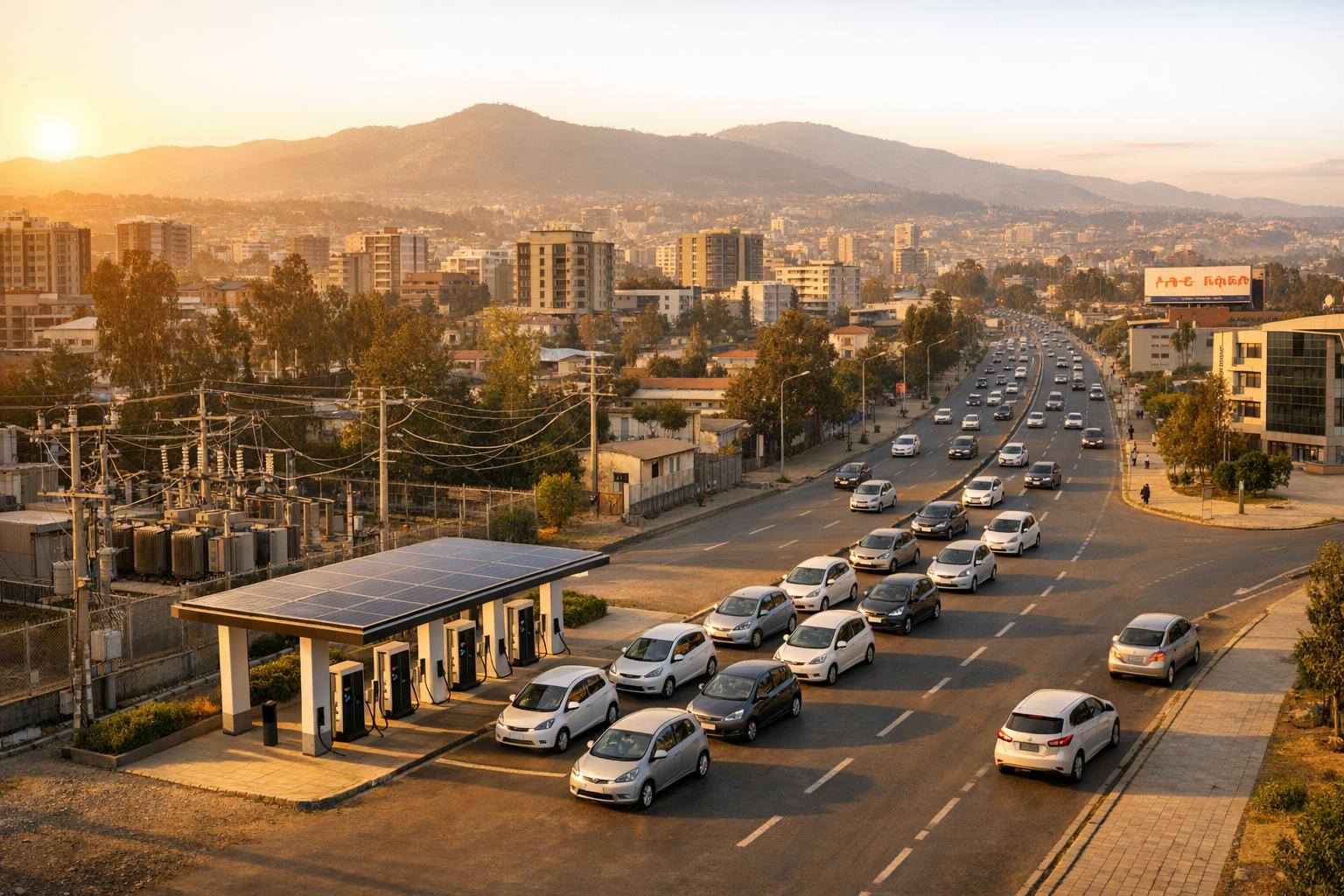
Ethiopia is reshaping its transportation landscape with an ambitious shift to electric vehicles (EVs). In January 2024, the country became the first to ban the import of gasoline and diesel vehicles, aiming to cut its $4.5 billion annual fuel import bill and leverage its renewable energy capacity. By early 2026, Ethiopia had 100,000 EVs on its roads, making up 8.3% of its registered vehicles – double the global average. However, challenges such as limited charging infrastructure, affordability issues, and low electricity access in rural areas hinder progress. The government has reduced EV import taxes to as low as 0% for locally assembled units and plans to expand EV assembly plants and charging stations. Despite these efforts, reaching the goal of 500,000 EVs by 2030 will require addressing infrastructure gaps, power outages, and financing barriers.
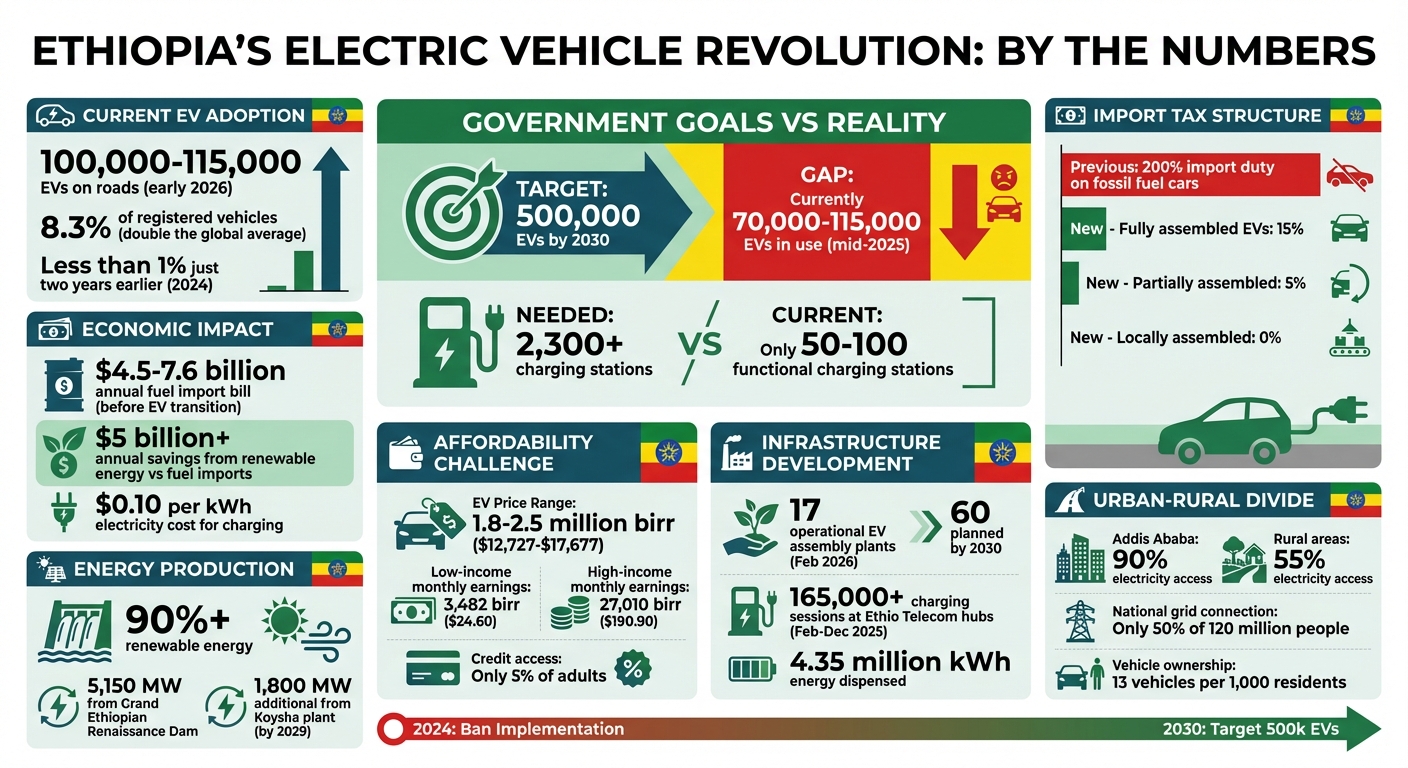
Ethiopia’s Electric Vehicle Transition: Key Statistics and Goals 2024-2030
Government Policies and Programs for Electric Vehicles
Ban on Gasoline and Diesel Vehicle Imports
In January 2024, Ethiopia made a bold move by banning the import of gasoline and diesel vehicles, completely reshaping its automotive market. To encourage the adoption of electric vehicles (EVs), the government introduced a new tariff system. Instead of the previous 200% import duty on fossil fuel cars, the new structure imposes just 15% on fully assembled EVs, 5% on partially assembled units, and 0% on completely knocked-down kits assembled locally. This shift has made EVs, like the Chinese-made BYD Seagull (priced around $23,000), more accessible than used gasoline sedans.
This policy wasn’t just about affordability – it was also a response to Ethiopia’s economic challenges. Fuel imports were draining over $5 billion annually, a key factor in the country’s 2023 sovereign debt default. The government saw EVs as a way to ease this financial burden and stabilize foreign currency reserves. As Bareo Hassen Bareo, Ethiopia’s State Minister for Transport and Logistics, explained:
"Our transition to EVs is aimed at ensuring our energy sovereignty. As a net importer of fuel, we are affected by global supply and price fluctuations. In contrast, EVs use electricity, which we produce locally and can price ourselves".
This tariff overhaul has also set the stage for a surge in local EV manufacturing.
Support for Local EV Manufacturing
By eliminating tariffs on locally assembled EVs, the government has created fertile ground for industrial growth. As of February 2026, Ethiopia had 17 operational EV assembly plants, with plans to expand to 60 by 2030. One standout example is the Belayneh Kindie Group (BKG), which pivoted from fossil fuel vehicles to EV production. By early 2026, BKG had delivered 150 electric minibuses and 100 large buses to Addis Ababa’s city government.
To further boost the industry, Directive No. 1034/2024 requires vehicle importers and assemblers to invest in charging infrastructure. The government also offers support through financing, technical assistance, and research initiatives. One such initiative includes exploring domestic lithium deposits to support battery production by 2029.
These measures align with Ethiopia’s broader goals of economic growth and environmental sustainability.
Environmental and Economic Goals
Ethiopia is leveraging its abundant renewable energy resources to achieve both environmental and financial objectives. Locally produced electricity, priced at about $0.10 per kilowatt-hour, powers EVs at a fraction of the cost of gasoline. The government plans to channel electricity from the Grand Ethiopian Renaissance Dam, which generates 5,150 megawatts, into the transportation sector, significantly cutting operating costs.
Colin McKerracher, Head of Clean Transport at BloombergNEF, highlighted the strategy’s appeal:
"The Ethiopia story is fascinating. What you’re seeing in places that don’t make a lot of vehicles of any type, they’re saying: ‘Well, look, if I’m going to import the cars anyway, then I’d rather import less oil. We may as well import the one that cleans up local air quality and is cheaper to buy’".
sbb-itb-99e19e3
Ethiopia’s Electric Vehicle Market Today
EV Sales and Market Expansion
Since the 2024 import ban on internal combustion engine (ICE) vehicles, Ethiopia’s electric vehicle (EV) market has seen rapid growth. By early 2026, estimates suggest there are between 100,000 and 115,000 EVs on Ethiopian roads, representing about 8.3% of all registered vehicles. This is a significant leap from less than 1% just two years earlier.
Chinese automakers, particularly BYD and Chang’an, dominate this growing market. At Hallel Cars, a prominent showroom in Addis Ababa, BYD models like the Seagull and Yuan Up make up nearly all inventory. Moges Negash, the Sales and Marketing Manager at Hallel Cars, highlighted the trend:
"The majority of our customers are those making the switch from fuel cars to EVs".
Competitive pricing has played a major role in this shift. For instance, the BYD Seagull has made EVs more accessible to middle-income buyers. This growth has been further supported by favorable tariffs and policies promoting local manufacturing. While the Ethiopian government has set a goal of 500,000 EVs on the road by 2032, challenges like affordability and limited infrastructure still need to be addressed to sustain this momentum.
Consumer Adoption Challenges
Despite these strides, several hurdles make EV adoption difficult for many Ethiopians. Affordability is a key issue in a country where average monthly earnings range from $24 to $190. Although EVs have become cheaper compared to used ICE vehicles, their initial cost remains prohibitive for a large portion of the population.
Other barriers include limited access to formal credit – only about 5% of Ethiopian adults can access loans – and cultural attitudes toward vehicle depreciation. Additionally, there is a lack of skilled mechanics trained to service EVs, and concerns over the cost of long-term battery replacement persist. Anteneh Tesfaye, Founder and CEO of Shega, described the challenges of owning an EV in Ethiopia:
"To use an EV, you have to really design your life intentionally so that you don’t get stuck on the road. You can’t do spontaneous things because accessibility for charging is not like accessibility for fuel".
These issues are even more pronounced in rural areas, where infrastructure is less developed.
City vs. Countryside Market Differences
EV adoption is largely concentrated in Addis Ababa. The capital enjoys 90% electricity access and hosts most of the country’s roughly 500 public charging stations. In contrast, rural areas face significant challenges, with electricity access at just 55% and frequent power outages. Government efforts have primarily focused on urban areas, leaving rural regions without the same level of EV infrastructure. Furthermore, Ethiopia’s motorization rate is among the lowest globally, with only 13 vehicles per 1,000 residents, meaning vehicle ownership itself is rare.
To address these disparities, innovative solutions are being explored. These include solar-powered charging stations and battery-powered tricycles for areas without reliable grid power. Yizengaw Yitayih, a Sustainable Mobility Expert at the Transport Ministry, emphasized the importance of external support:
"If we get international loans or grants, we can expand charging stations to rural communities, thereby advancing the adoption of electric vehicles throughout the country".
Charging Stations and Power Supply
Charging Station Network
Ethiopia’s charging infrastructure is primarily concentrated in Addis Ababa, with Ethio Telecom leading the way. In February 2025, the company launched its first two fast-charging hubs along the Bole–Megenagna corridor. By December 2025, they added a third AI-powered station, increasing their total capacity to charge up to 48 vehicles simultaneously. These stations are equipped with ultra-fast chargers delivering up to 600 kW, capable of fully charging compatible vehicles in about 15 minutes.
From February to December 2025, Ethio Telecom’s two hubs handled over 165,000 charging sessions, dispensing around 4.35 million kWh of energy. Private companies are also stepping in. For example, Master Trading Plc has installed 120-volt fast chargers near the Bole-Japan area, which can serve four vehicles at once. Marathon Motors, owned by renowned athlete Haile Gebrselassie, opened a charging station in 2024 to support locally assembled Hyundai EVs. To address range anxiety for long-distance travelers, the government has introduced a strategy to place charging stations every 50 to 120 kilometers (31 to 75 miles) along major transport routes.
This growing network is supported by Ethiopia’s plentiful renewable energy resources, making EV adoption more feasible.
Clean Energy and Electricity Costs
Ethiopia’s energy production is over 90% renewable, aligning well with its push for electric vehicles. A key driver of this clean energy is the Grand Ethiopian Renaissance Dam (GERD), which generates 5,150 MW and produces 15,500 GWh of electricity annually. By early 2025, the GERD project was 97.6% complete. Another significant project, the Koysha hydropower plant, is under construction and expected to add 1,800 MW by 2029.
This renewable energy focus helps Ethiopia save over $5 billion annually on fossil fuel imports. By replacing imported fuel with locally generated electricity, the country not only conserves foreign currency but also moves closer to its environmental goals. Charging payments are handled digitally, primarily through the telebirr SuperApp via QR-code transactions, with most stations operating on a pay-per-kWh basis.
However, despite these advantages, there are still hurdles to expanding the infrastructure nationwide.
Infrastructure Expansion Obstacles
The disparity between urban and rural areas highlights the challenges of scaling EV infrastructure. While cities like Addis Ababa are seeing progress, rural areas face significant grid limitations. Currently, only 50% of Ethiopia’s 120 million people are connected to the national grid, with most unconnected residents living in rural regions. Frequent power outages exacerbate these issues. As Yizengaw Yitayih, a Sustainable Mobility Expert at the Ministry of Transport, explained:
"In places like Dubancho, the lack of mains power has made EV expansion a herculean task".
Delays in connecting new charging stations to the grid by the Ethiopian Electric Utility (EEU) further slow progress. To address these challenges, innovative solutions like solar-powered charging stations and battery-swapping systems for electric tricycles are being explored in areas with unreliable grid access. The government is also pursuing international loans and grants to extend the charging network beyond urban centers. Sahrela Abdullahi, Director General of the Petroleum and Energy Authority, emphasized:
"Leveraging existing facilities [gas stations] can help expand the network more rapidly".
Ethiopia’s fossil fuel car ban is a vision of the future | Zero: The Climate Race
Government Goals vs Market Challenges
Ethiopia’s government has set its sights on an ambitious goal: getting 500,000 electric vehicles (EVs) on the road by 2030. But there’s a significant gap between this vision and the current reality. By mid-2025, despite the import of over 100,000 EVs following the 2024 fuel-powered vehicle ban, only 70,000 to 115,000 EVs were in use. The push for EV adoption is largely driven by the need to cut down on the $7.6 billion spent annually on fuel imports. However, the lack of adequate infrastructure has made this transition far from smooth, with the limited charging network being a major roadblock.
Currently, Ethiopia has only 50 to 100 functional charging stations, while the Ministry of Transport and Logistics estimates the need for over 2,300 stations to support the growing number of EVs. Economist Samson Berhane highlighted the challenges:
"Very few people are willing to take the risk of buying electric cars due to the lack of infrastructure, shortage of mechanics specialized in EV maintenance and the flooding of the market with Chinese brands".
Affordability is another critical hurdle. EV prices range from 1.8 million birr ($12,727) to 2.5 million birr ($17,677). In contrast, low-income earners make an average of 3,482 birr ($24.60) per month, while high-income earners bring in around 27,010 birr ($190.90). The lack of formal credit systems makes financing even more difficult, and EVs reportedly depreciate ten times faster than their fuel-powered counterparts.
The government is banking on the Grand Ethiopian Renaissance Dam (GERD) to provide renewable electricity at approximately $0.10 per kWh, a rate much lower than the average in the United States. However, frequent power outages and grid instability have discouraged many early adopters. Some have even sold their EVs at a loss and switched back to gasoline-powered vehicles. Climate entrepreneur Sam Rosmarin underscored the issue:
"From a consumer standpoint, is the country ready to support these EVs? No, there’s only a handful of chargers".
To address these challenges, the government has introduced several measures. These include launching 17 EV assembly plants, with plans to expand to 60 by 2030, and offering significant import tax reductions: 15% for fully built vehicles, 5% for semi-assembled units, and 0% for locally assembled parts. However, without tackling the infrastructure gaps, maintenance skill shortages, and financing difficulties, the 2030 target risks remaining an ambitious dream rather than a feasible reality.
FAQs
How can Ethiopians charge EVs during power outages?
Ethiopians have a way to charge electric vehicles (EVs) even during power outages by using solar-powered charging stations or individual solar panels. This approach taps into the country’s abundant renewable energy resources. The government is actively working to expand EV infrastructure, with plans to install charging stations at intervals of 50–120 kilometers. They’re also exploring solar energy solutions to decrease dependence on the main power grid. These initiatives, coupled with possible incentives like carbon credits, aim to make EV charging more reliable, particularly in rural regions where electricity disruptions are more common.
What financing options exist for buying an EV in Ethiopia?
In Ethiopia, there are several ways to make electric vehicles (EVs) more accessible. One standout option is the Utopia Green Fund, which streamlines the process of acquiring EVs through a dedicated app. The government also supports adoption by offering interest-free leasing programs for both individuals and small businesses. On top of that, import duties on EVs have been significantly lowered, ranging from just 5% to 20%, to help reduce costs. These measures, combined with traditional bank loans and leasing options, aim to tackle affordability challenges and encourage more people to embrace EVs in the country.
Will EVs become practical outside Addis Ababa soon?
Ethiopia is grappling with several hurdles in making electric vehicles (EVs) a feasible option beyond the capital, Addis Ababa. The scarcity of charging stations, inconsistent electricity supply, steep EV prices, and a shortage of skilled mechanics create significant barriers, particularly in rural areas. Although the government has introduced policies, such as banning the import of gas-powered vehicles, to encourage EV adoption, these efforts are just the beginning. For EVs to become a practical choice across the country, substantial progress in infrastructure, affordability, and maintenance support will be essential – areas that are still in their infancy.