
 Thabo Nkosi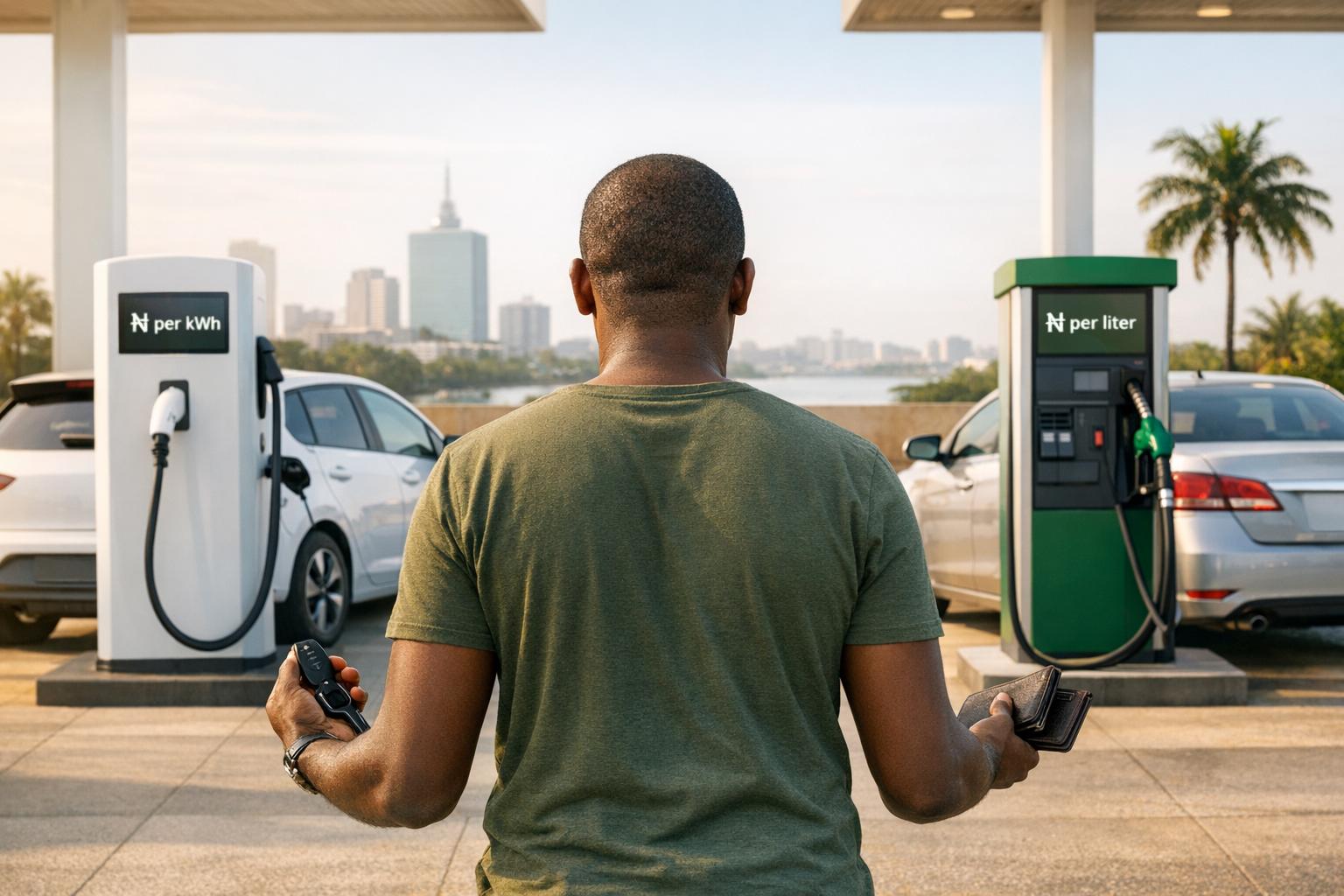
Electric or petrol car – which is better for your wallet in Nigeria? Here’s a quick breakdown:
- Fuel Costs: Petrol costs ₦850/liter on average, translating to ₦85/km. EVs cost ₦41.9/km with grid electricity.
- Purchase Prices: EVs are pricier upfront (₦24M–₦62M) due to import duties, while petrol cars range from ₦18M–₦150M+.
- Maintenance: EVs are cheaper to maintain (₦50K–₦100K/year) versus petrol cars (₦150K–₦300K/year).
- Long-Term Savings: EVs save ₦421K–₦871K annually on energy and maintenance.
- Challenges for EVs: Limited charging infrastructure and high battery replacement costs (~₦10M).
Quick Comparison
| Factor | Electric Vehicles (EVs) | Petrol Cars |
|---|---|---|
| Purchase Price | ₦24M–₦62M | ₦18M–₦150M+ |
| Energy Cost (per km) | ₦41.9 | ₦85 |
| Annual Maintenance | ₦50K–₦100K | ₦150K–₦300K |
| Charging/Fueling Access | Limited (Lagos, Abuja) | Nationwide |
| Resale Value | Niche Market | High Demand |
Bottom Line: EVs offer long-term savings but require reliable electricity and access to charging infrastructure. Petrol cars are more widely supported but costlier to fuel and maintain. Choose based on your location, budget, and energy access.
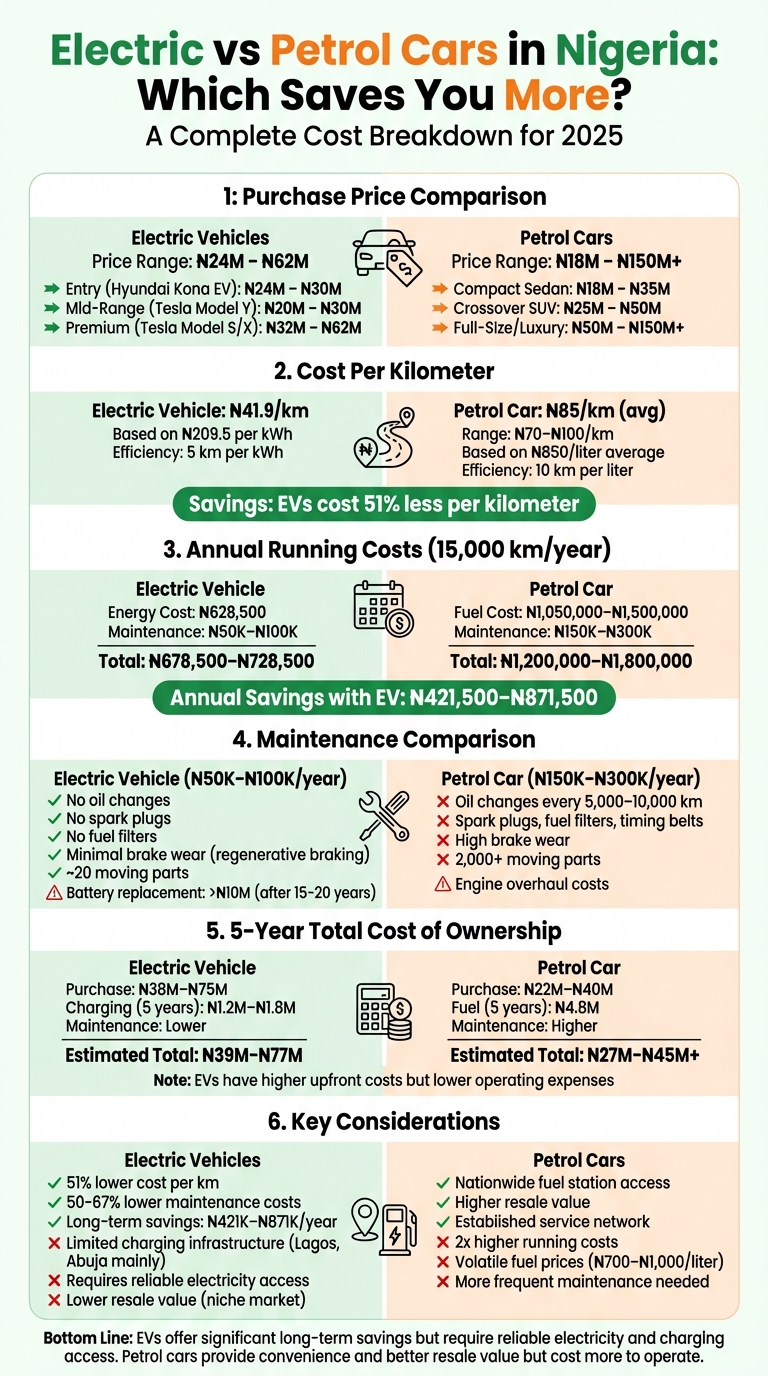
Electric vs Petrol Cars Cost Comparison Nigeria 2025
Purchase Price Comparison
Electric Vehicle Prices in Nigeria
In Nigeria, the cost of electric vehicles (EVs) starts with the manufacturer’s price but increases significantly due to import duties and levies, which can add up to 70% of the base price. This means the final price can nearly double by the time the vehicle reaches the buyer. As Younes Rabeh from African EV Market News puts it:
"The sticker price of a new car is often just the beginning. Import duties and levies can sometimes nearly double the manufacturer’s original price before the car even reaches the dealership."
A major contributor to EV costs is the battery, which makes up about 40% of the total price. Entry-level EVs like the Hyundai Kona EV are priced between ₦24 million and ₦30 million, while the Tesla Model Y ranges from ₦20 million to ₦30 million. For premium models, prices climb higher: the Tesla Model S costs between ₦32 million and ₦62 million, and the Tesla Model X ranges from ₦36 million to ₦60 million.
Petrol Car Prices in Nigeria
Petrol-powered vehicles in Nigeria also face import duties, but they are more readily available through traditional dealerships. Compact sedans like the Toyota Corolla and Hyundai Elantra range from ₦18 million to ₦35 million. Crossover SUVs, including the Kia Seltos and Honda HR-V, are priced between ₦25 million and ₦50 million. For full-size SUVs like the Toyota Land Cruiser, prices start at ₦50 million and can exceed ₦120 million.
The fluctuating exchange rate of the Naira against the dollar heavily influences vehicle prices since most cars are imported. Additionally, buyers should factor in about 10% extra for on-the-road expenses, which include registration fees (₦150,000), insurance (3–5% of the vehicle’s value), and dealer fees (₦100,000).
Purchase Price Comparison Table
The table below highlights the price ranges for popular petrol and electric vehicle models across different segments:
| Vehicle Segment | Popular Petrol Models | Petrol Price Range | Popular EV Models | EV Price Range |
|---|---|---|---|---|
| Compact/Sedan | Toyota Corolla, Hyundai Elantra | ₦18M – ₦35M | Hyundai Kona EV | ₦24M – ₦30M |
| Crossover SUV | Kia Seltos, Honda HR-V | ₦25M – ₦50M | Tesla Model Y | ₦20M – ₦30M |
| Full-Size/Luxury | Toyota Land Cruiser, Lexus RX | ₦50M – ₦150M+ | Tesla Model S/X | ₦32M – ₦62M |
This table shows that some entry-level EVs, such as the Tesla Model Y, are priced competitively with mid-tier petrol crossovers. However, the EV market in Nigeria currently offers fewer options compared to the wide range of petrol vehicles available. While the purchase price is a critical factor, the total cost of ownership also depends on fuel or charging expenses and maintenance costs. These aspects will be analyzed in the following sections to provide a clearer picture of overall affordability.
sbb-itb-99e19e3
Fuel and Charging Costs
Electricity Costs for Charging EVs
Charging an electric vehicle (EV) in Nigeria is noticeably less expensive per kilometer than fueling a petrol car. With the current Band A electricity tariff set at ₦209.5 per kWh, an EV that averages 5 km per kWh costs about ₦41.9 per kilometer. For a 60 kWh battery, a full charge comes to roughly ₦12,570, offering a driving range of about 300 km.
Most EV owners in Nigeria prefer charging at home, usually overnight, leveraging the national grid or alternative power sources like solar inverter systems. Michael Ngiri, an Admin at Wheelmax, highlights this advantage:
"Electricity costs are typically lower than petrol prices per kilometer travelled. However, calculate this based on your electricity source (grid tariff vs. generator running costs). The savings here can be substantial over time."
This cost efficiency is most apparent when using grid or solar power. However, charging with a generator can significantly reduce or eliminate these savings.
Petrol Costs for Fueling Cars
Petrol prices in Nigeria currently range from ₦700 to ₦1,000 per liter, with an average price of around ₦850 per liter. For a car that achieves 10 km per liter, this translates to fuel costs of ₦70.0–₦100.0 per kilometer, averaging about ₦85.0 per kilometer. A 50-liter fill-up costs approximately ₦42,500 and provides a driving range of about 500 km.
These costs are subject to frequent changes due to Nigeria’s fluctuating fuel market and currency exchange rates, making petrol cars less predictable in terms of long-term budgeting compared to EVs, which benefit from relatively stable electricity tariffs.
Fuel vs Charging Cost Comparison Table
| Cost Component | Electric Vehicle (EV) | Petrol Car (ICE) |
|---|---|---|
| Energy Unit Price | ₦209.5 per kWh | ₦700 – ₦1,000 per Liter |
| Avg. Efficiency | ~5 km / kWh | ~10 km / Liter |
| Cost per Kilometer | ~₦41.9 | ~₦70.0 – ₦100.0 |
| Annual Cost (15,000 km) | ~₦628,500 | ~₦1,050,000 – ₦1,500,000 |
| Full "Tank" Cost | ~₦12,570 (60 kWh) | ~₦42,500 (50 Liters) |
For a typical urban driver covering 15,000 km annually, EV owners can expect to spend about ₦628,500 on electricity, while petrol car owners will face costs between ₦1,050,000 and ₦1,500,000 on fuel. This results in potential yearly savings of ₦421,500 to ₦871,500 for EV drivers. However, these savings are heavily dependent on access to affordable electricity from the grid or solar power. Charging with a generator can erode these benefits.
Next, we’ll dive into maintenance costs to paint a clearer picture of overall ownership expenses.
Maintenance Expenses
Electric Vehicle Maintenance Costs
Electric vehicles in Nigeria come with much lower routine maintenance needs compared to petrol cars. They eliminate the hassle of oil changes, spark plug replacements, timing belts, and fuel filters. On average, annual maintenance costs range between ₦50,000 and ₦100,000, covering basics like tire rotations and filter changes.
Thanks to regenerative braking systems, brake wear is significantly reduced. Brake fluid and coolant generally need replacement only every two to five years. Additionally, major components like the battery pack often come with a 5-year/100,000 km manufacturer warranty.
The biggest potential expense for EV owners is battery replacement, which can cost over ₦10 million. However, these batteries are built to last 15–20 years while maintaining 80–90% of their original capacity. Replacement tires, which cost around ₦200,000 for a full set, can last up to five years. However, rough roads and the heavier weight of EVs may cause faster tire wear.
This reduced need for routine maintenance aligns with the overall lower operating costs of EVs, as mentioned earlier.
Petrol Car Maintenance Costs
Petrol vehicles, on the other hand, demand more frequent and intensive maintenance. Owners need to budget for oil and filter changes every 5,000–10,000 km, along with periodic replacements of spark plugs, fuel filters, timing belts, and exhaust components. These services quickly add up, with annual maintenance costs typically falling between ₦150,000 and ₦300,000.
Brake pads and rotors also wear out faster in petrol cars, as they rely entirely on friction braking instead of regenerative systems. As these vehicles age, they are prone to expensive repairs, and frequent trips to mechanics can further increase both time and financial costs.
Maintenance Cost Comparison Table
Here’s a breakdown of the key differences between maintaining EVs and petrol cars:
| Maintenance Item | Electric Vehicle (EV) | Petrol Car (ICE) |
|---|---|---|
| Oil & Filter Changes | Not Required | Required (Every 5,000–10,000 km) |
| Spark Plugs/Fuel Filters | Not Required | Required Periodically |
| Brake Wear | Low (Regenerative Braking) | High (Friction Braking) |
| Moving Parts | Minimal (~20) | Extensive (2,000+) |
| Annual Cost | ₦50,000 – ₦100,000 | ₦150,000 – ₦300,000 |
| Major Potential Cost | Battery Replacement (>₦10M) | Engine Overhaul / Transmission |
Electric vehicles clearly lead the way in terms of maintenance savings, with annual costs that are 30%–50% lower than those of petrol cars. Jelani Aliyu, Director General of the National Automotive Design and Development Council (NADDC), aptly sums it up:
"The car requires less maintenance than petrol-powered cars".
While the cost of battery replacement is substantial, the long warranties and 15–20 year lifespan of EV batteries mean most owners won’t have to worry about this expense during their ownership.
Government Policies and Incentives
Current Policies Affecting EV and Petrol Car Costs
Government policies significantly influence the affordability of vehicles in Nigeria, especially when comparing electric vehicles (EVs) and petrol cars. A major development is the EV Transition and Green Mobility Bill 2025, which passed its second reading in the Senate as of March 2026. This bill lays out Nigeria’s first structured plan for reducing reliance on petrol and diesel vehicles. Unlike simpler approaches like purchase rebates, this legislation focuses on fostering local manufacturing. It mandates foreign automakers to collaborate with local assemblers and establish domestic production facilities. These plants must produce at least 5,000 units annually within three years to qualify as licensed assemblers. Non-compliance carries hefty penalties, including up to ₦500 million in fines and vehicle confiscation for unlicensed imports, while breaching local content rules could lead to fines of up to ₦250 million.
To support EV adoption, the government is also requiring fuel stations to install EV charging points, offering tax incentives to encourage this shift. The aim is to transform traditional fuel stations into dual-purpose "energy hubs" that serve both EVs and petrol vehicles. These measures are part of a broader strategy to support Nigeria’s move toward electric mobility. According to 234Drive:
"The bill tries to solve three problems at once: emissions, forex drain from fuel, and weak local auto manufacturing."
In contrast, policies for petrol vehicles remain largely static. No new incentives have been introduced, and the government is considering stricter import controls and higher tariffs to curb fuel-related foreign exchange losses. This is particularly relevant as transportation accounts for about 30% of emissions in key cities like Lagos, Kano, and Port Harcourt.
Potential Future Policy Changes
The 2025 bill marks a shift from Nigeria’s unsuccessful 2019 attempt to phase out petrol cars by 2035. This time, the focus is on building infrastructure and fostering local manufacturing rather than imposing abrupt restrictions. By 2030, assemblers will need to source 30% of their components locally, ensuring a gradual and sustainable transition. Senator Titus Zam highlighted the urgency of this policy shift, stating:
"Nigeria risks falling behind if it does not codify EV policy now."
To address concerns about "upstream emissions" – the environmental impact of using a gas- and diesel-powered grid for EV charging – the government is also exploring solar-powered charging hubs. This initiative could help reduce EV operating costs while advancing environmental objectives. As 234Drive pointed out:
"The bill is a necessary step, it aligns Nigeria with what other emerging markets are doing, and it gives investors clarity."
Policy Impact Comparison Table
| Policy Feature | Electric Vehicles (EVs) | Petrol/Diesel Cars (ICE) |
|---|---|---|
| Import Duties/Rules | High fines (₦500M) for unlicensed imports; local assembly focus | Possible tighter controls and higher tariffs to limit imports |
| Incentives | Tax breaks for installing chargers; local assembly tax incentives | Few new incentives; focus on reducing subsidy reliance |
| Local Content | 30% local component requirement by 2030 | Established market, but moving toward local production requirements |
| Infrastructure | Mandatory EV charging points at fuel stations | Extensive network of existing filling stations |
| Production Target | Minimum 5,000 units per year for licensed assemblers | No specific new production targets mentioned |
Conclusion
Recommendations for Nigerian Consumers
After examining the costs of purchase, fueling, and maintenance, it’s clear that choosing between an electric vehicle (EV) and a petrol car in Nigeria depends heavily on your circumstances and future plans.
For EVs, having a reliable electricity source is non-negotiable. Whether you’re connected to a stable Band A grid, have invested in a dependable solar system, or use a robust inverter setup, consistent charging is essential. Without it, owning an EV could become more of a hassle than a convenience. Reliable charging not only ensures your car is always ready to go but also helps you save significantly on operating costs.
Before committing to an EV, check if your city has specialized EV servicing options. Currently, brands like Jet Motors and Hyundai provide EV services in major hubs like Lagos and Abuja. However, outside these areas, finding mechanics trained to handle EVs could be a challenge, as most are skilled in petrol engine repairs.
For those concerned about range anxiety or frequent power outages, hybrids offer a middle ground. They reduce fuel consumption and emissions but come with a potential downside: battery replacements, which can cost upwards of ₦600,000.
If you’re thinking about resale value, petrol cars still dominate the used car market in Nigeria. They tend to retain their value better, thanks to widespread service options and easily available spare parts. If you plan to sell your vehicle within five years, this could be a key factor in your decision, as EVs currently appeal to a smaller, niche market.
For those ready to explore electric mobility, platforms like EV24.africa simplify the process. They provide listings for new and used EVs from brands like Tesla, BYD, Hyundai, and Toyota. With transparent pricing, financing options, and delivery services across Nigeria, this platform is a helpful resource for navigating the EV market.
Total Cost of Ownership Summary Table
Here’s a breakdown of the estimated costs of ownership over five years:
| Cost Category | Petrol Car (5-Year Estimate) | Electric Vehicle (5-Year Estimate) |
|---|---|---|
| Purchase Price (New) | ₦22M – ₦40M | ₦38M – ₦75M |
| Import Duty | ~70% | ~5% |
| Fuel/Charging Cost | ~₦4.8M (₦80,000/month) | ~₦1.2M – ₦1.8M (electricity) |
| Maintenance | High (oil, filters, engine repairs) | Low (brakes, tires, cabin filters) |
| Resale Value | High / Easy to sell | Low / Niche market |
| Infrastructure Access | Universal (fuel stations everywhere) | Limited (Lagos, Abuja hubs) |
| Primary Risk | Rising fuel prices (₦700+ per liter) | Battery replacement / Charging access |
Electric vs Petrol Car Challenge in Lagos – Who Wins?
FAQs
When do EV savings in Nigeria offset the higher purchase price?
In Nigeria, owning an electric vehicle (EV) often balances out the higher upfront cost within 3 to 5 years. This timeframe largely depends on factors such as fuel prices, charging costs, and the lower maintenance requirements of EVs. Over the long run, these savings can make EVs a more economical option compared to traditional petrol-powered cars.
How much does charging an EV cost if I rely on a generator or solar?
Charging an EV with solar power involves an upfront investment in a solar generator and panels. Once installed, the ongoing costs are minimal because sunlight doesn’t cost a dime. On the other hand, fuel-powered generators come with recurring expenses tied to fuel prices and consumption, which can add up significantly each year. Over time, solar power can dramatically lower charging expenses, offering a much more cost-effective solution compared to relying on fuel-powered alternatives.
What should I check before buying an EV outside Lagos or Abuja?
Before buying an EV in areas outside Lagos or Abuja, think about a few key factors. First, check if there are enough charging stations nearby, as this can make a big difference in convenience. Next, consider how frequent power outages might disrupt home charging. Lastly, look into the costs of maintenance and repairs in your location. These aspects can play a major role in determining how practical and affordable it is to own an EV in less developed areas.