
 Thabo Nkosi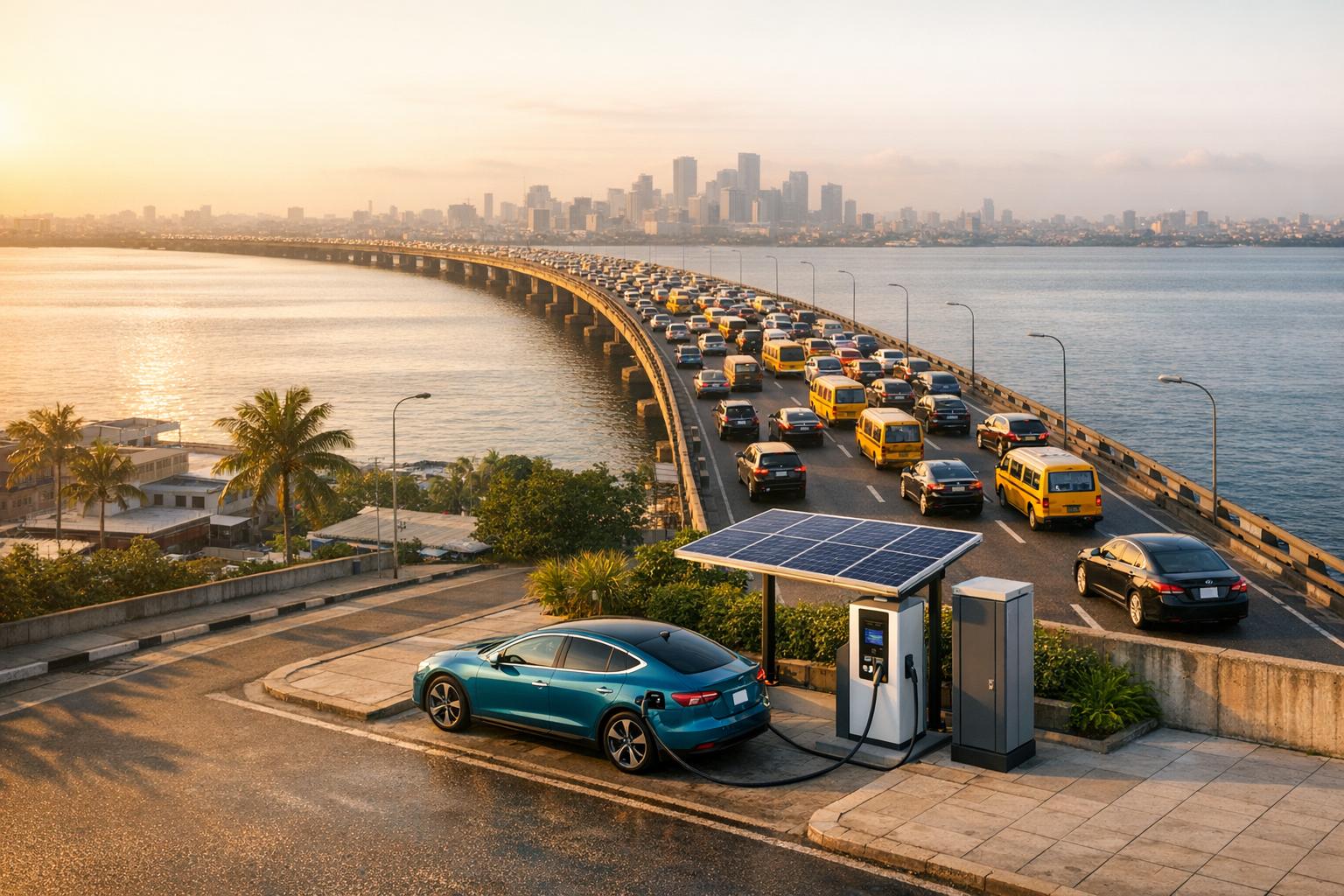
Electric cars in Lagos face two major hurdles: traffic congestion and unreliable power supply. The city’s gridlock drains EV batteries quickly, especially with air conditioning, while frequent power outages make charging difficult. Despite these challenges, EVs offer significant cost savings due to lower fuel and maintenance expenses. For instance, charging an EV costs about ₦30,000 weekly compared to ₦150,000–₦180,000 for gasoline. However, limited charging infrastructure and high upfront costs remain barriers. Solutions like solar-powered charging stations, battery swapping, and government policies are helping address these issues, making EVs a growing option for Lagos residents.
How Lagos Traffic Affects Electric Vehicle Performance
Stop-and-Go Traffic: Effects on Battery and Range
Navigating Lagos traffic presents unique challenges for electric vehicles (EVs). One major issue is the toll taken on the battery by constant air conditioning use, which is essential in Lagos’s tropical heat. Studies show that running the AC can drain about 1% of the battery every three minutes. This constant need for climate control significantly impacts battery life and range.
When LagRide introduced 100 electric vehicles to Lagos in September 2024, they claimed these EVs had a range of 333 kilometers per charge, which seemed sufficient for a full day of driving. However, by November 2025, drivers faced a different reality, often needing two full charges daily. The situation was worsened by long charging queues, with up to 30 vehicles waiting at popular charging stations like those on Victoria Island.
Interestingly, EVs do have a slight edge in heavy traffic thanks to regenerative braking. This system recovers energy every time the vehicle decelerates or stops, making it particularly useful in stop-and-go situations. Still, the overall performance struggles in Lagos traffic highlight the importance of designing EVs specifically for urban environments.
Electric Cars That Handle Urban Traffic Well
Some EV models have been tailored to address the demands of city driving. For instance, the Hyundai Kona Electric, assembled locally in Lagos by Stallion Group, offers a real-world range of up to 482 kilometers on its 64 kWh battery. Its high ground clearance also makes it a practical choice for Lagos’s uneven and often challenging road conditions.
The University of Lagos (UNILAG) has also made strides in adapting EVs to urban settings. In 2023, the university introduced a fleet of 14-seater Ogata EV buses equipped with rooftop solar panels to extend battery life. Operating at a maximum speed of 30 kilometers per hour (about 19 miles per hour), these buses have proven effective in congested areas. Within just one year, the fleet grew from 10 to 20 buses, and student fares were halved from ₦200 to ₦100. With a range of 70 kilometers per charge, these buses demonstrate how solar technology can help EVs perform better in traffic-heavy urban environments.
sbb-itb-99e19e3
Power Supply Problems: Charging Electric Cars in Lagos
Lagos Power Outages: Frequency and Impact
While electric vehicles (EVs) are designed to handle Lagos’s traffic challenges, the city’s unreliable power supply remains a major roadblock to their adoption.
Nigeria’s national grid struggles to meet demand, generating only 4,000–4,500 MW daily – far below the estimated 30,000 MW needed. In Lagos, many households receive as little as four hours of electricity per day, making it nearly impossible for EV owners to maintain a consistent charging routine.
Transport economist Lanre Bakare highlights the issue: "We cannot talk about electric vehicles in a country where many households still struggle to get four hours of electricity per day".
This creates a serious challenge for EV owners. Charging an electric car requires 3–7 kWh daily, which is equivalent to the electricity consumption of 2–3 households. Without reliable grid access, owners are forced to invest in alternative solutions like solar inverter systems or high-capacity generators to keep their vehicles running. To make matters worse, the grid’s inefficiency results in transmission losses of 40–45%, meaning nearly half of the power generated never reaches consumers.
Alternative Charging Options for Lagos EV Owners
With the grid unable to meet demand, EV owners in Lagos have turned to alternative charging methods to keep their vehicles operational. Many install Level 2 chargers at home, pairing them with solar inverter systems or generators. Meanwhile, companies like LUG West Africa are stepping in with plans to establish 250 solar-powered charging stations by 2026, offering a solution for those unable to charge at home.
Imran Hamzat, Executive Chairman and Managing Director of LUG West Africa, emphasized the importance of public charging infrastructure: "Not all EV owners will be able to charge their vehicles at home, making roadside and public charging points essential to prevent breakdowns and ensure smooth mobility".
Other options include battery swapping stations and public charging networks. These networks provide AC charging at ₦300 per kWh and DC fast charging at ₦500 per kWh, offering quicker solutions when home charging isn’t feasible. Battery swapping, already adopted by electric motorbike companies in Lagos, has proven effective. Additionally, networks like Qoray Mobility offer AC and DC fast-charging stations in hotels and business districts, complete with backup power systems to ensure reliability.
These solutions highlight the need for a reimagined power infrastructure in Lagos to support the growing EV market and address the city’s energy challenges effectively.
Electric vs Petrol Car Challenge in Lagos – Who Wins?
Cost Comparison: Electric vs. Gasoline Cars in Lagos
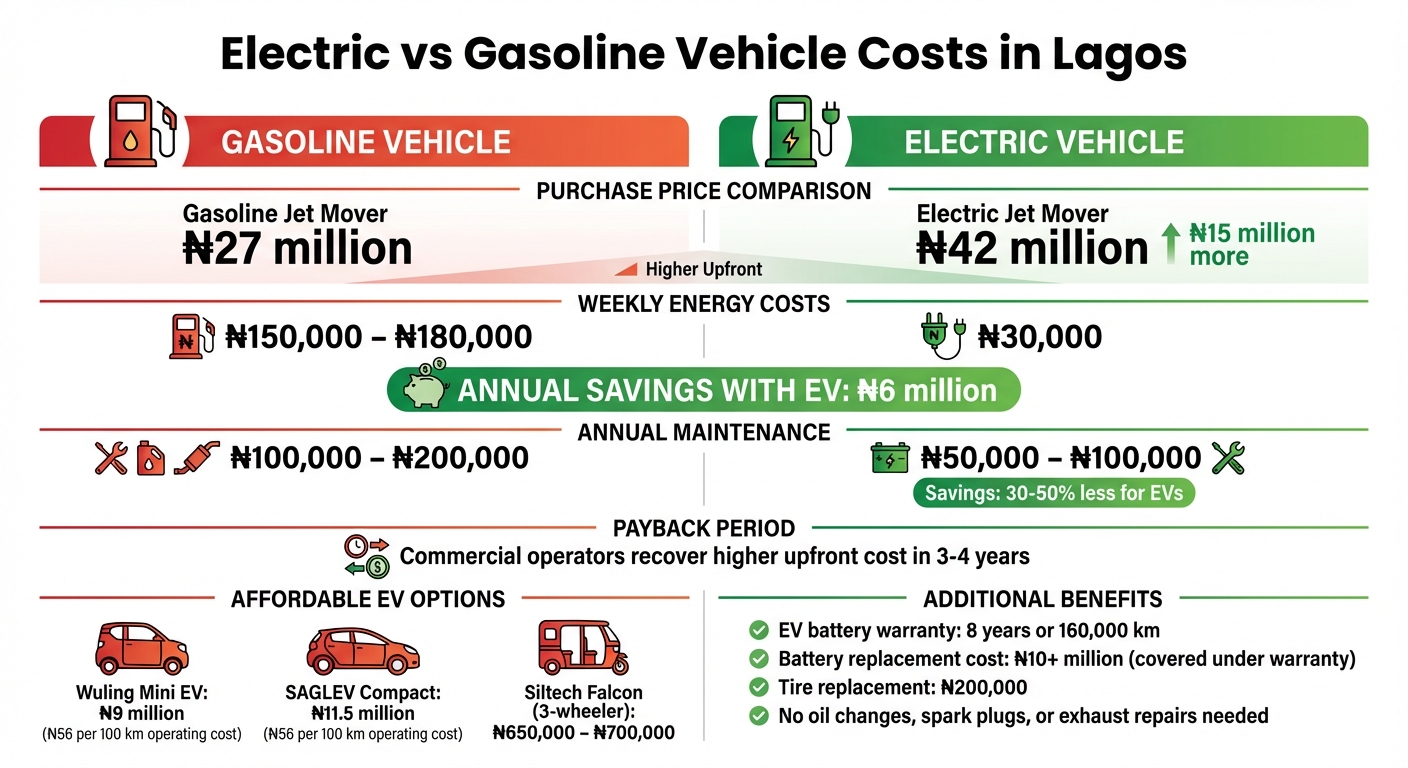
Electric vs Gasoline Vehicle Costs in Lagos: Complete Comparison
Total Ownership Costs in Lagos
In Lagos, the price difference between gasoline and electric vehicles is striking. A gasoline-powered Jet Mover is priced at ₦27 million, while its electric counterpart costs an additional ₦15 million, bringing the total to ₦42 million. But focusing solely on the upfront price misses the bigger picture.
Electric vehicles (EVs) shine when it comes to weekly energy costs. While gasoline vehicles require ₦150,000–₦180,000 per week at the current fuel price of ₦1,160 per liter, EVs cost just ₦30,000 weekly. This translates to ₦6 million in annual savings.
Maintenance costs are another area where EVs come out ahead. Annual EV maintenance in Nigeria ranges from ₦50,000 to ₦100,000, which is 30–50% less than gasoline-powered vehicles. This is because EVs eliminate the need for oil changes, spark plug replacements, and exhaust system repairs. Even tire replacement for EVs costs about ₦200,000, a manageable expense.
| Expense Category | Gasoline Vehicle | Electric Vehicle |
|---|---|---|
| Weekly Energy Cost | ₦150,000 – ₦180,000 | ₦30,000 |
| Annual Maintenance | ₦100,000 – ₦200,000 | ₦50,000 – ₦100,000 |
| Brake Replacement | Frequent | Rare (regenerative braking) |
These reduced operating and maintenance costs make EVs a practical choice even in Lagos’ demanding market. While battery replacement costs can exceed ₦10 million, most EV manufacturers provide warranties covering 8 years or 160,000 km, offering peace of mind.
Long-Term Savings for Drivers and Fleet Operators
Beyond the immediate savings, EVs deliver impressive long-term financial benefits for both individual drivers and fleet operators. For commercial drivers, the annual savings of over ₦6 million can cover the higher purchase price within 3–4 years.
Arinze Chinazom, CEO of Autogirl Limited, explains: "An EV driver could save upwards of ₦6 million compared to a petrol driver – enough to offset a higher upfront purchase cost within 3–4 years for commercial operators".
These savings not only help drivers maintain profitability but also enable them to offer competitive fares.
Fleet operators see even faster returns, thanks to combined fuel and maintenance savings. The recent duty exemptions on EV imports, effective January 2024, further improve the financial outlook for businesses assembling or importing EVs in Nigeria.
For those on a tighter budget, there are affordable EV options that still promise low running costs. The Wuling Mini EV, priced at approximately ₦9 million, and the SAGLEV Compact, at ₦11.5 million, are excellent choices. Both models boast operating costs as low as ₦56 per 100 km. For last-mile transportation, the Siltech Falcon electric three-wheeler, priced between ₦650,000 and ₦700,000, offers an economical alternative to traditional vehicles.
Making Electric Vehicles Work in Lagos: Next Steps
How EV24.africa Supports Electric Vehicle Adoption
EV24.africa is tackling one of the biggest hurdles to electric vehicle (EV) adoption: the upfront cost. By connecting buyers to both new and used EVs from trusted brands like BYD, Tesla, Hyundai, and Geely, they make EV ownership more accessible. Their online platform offers clear pricing and flexible financing options, simplifying the process for Lagos residents. From browsing detailed vehicle specs to comparing models and arranging delivery across Nigeria, everything can be done from home.
The vehicles featured on EV24.africa are designed to handle Lagos’ unique traffic conditions. With ranges between 300 km and 500 km per charge, these EVs are well-suited for the city’s stop-and-go traffic. Beyond fuel savings, buyers also benefit from lower long-term maintenance costs, making EVs an attractive option.
These advancements in the marketplace are creating momentum for the policy and infrastructure upgrades that will further support EV adoption.
Government Policies and Infrastructure Needed
The Nigerian government is laying the groundwork for EV adoption with the EV Transition Bill 2025. This legislation requires foreign automakers to work with local assemblers and source at least 30% of components locally by 2030. Additionally, it mandates fuel stations along major corridors to install EV charging points, a move that could significantly ease range anxiety for drivers.
In line with these efforts, LUG West Africa is stepping up to address the infrastructure gap. In January 2026, the company, led by Managing Director Imran Oladimeji Hamzat, announced plans to install 250 EV charging stations across Lagos. These stations will incorporate seven monocrystalline solar panels each, generating the 240 volts needed for charging without relying on the national grid. LUG West Africa also plans to establish a local assembly plant for these components, starting in 2026.
"Nigeria has witnessed a significant rise in electric vehicle adoption. Between 2020 and 2025, the country recorded an estimated 400 percent increase in electric vehicles." – Imran Hamzat, Executive Chairman and Managing Director, LUG West Africa
However, charging stations alone won’t solve the bigger challenges. Redirecting a portion of Nigeria’s $10 billion annual fuel subsidies toward improving the power grid and integrating renewable energy is essential. Introducing Time-of-Use tariffs, which incentivize off-peak charging, could also help ensure a stable power supply for EV owners.
These combined efforts in policy and infrastructure are crucial for creating an environment where EVs can thrive in Lagos.
Conclusion: Can Electric Cars Succeed in Lagos?
When innovative business solutions align with forward-thinking policies and improved infrastructure, EVs have a real chance to succeed in Lagos. Solar-powered charging stations and government-backed initiatives are already paving the way for a cleaner, more efficient urban mobility system. While EV registration numbers remain modest for now, the city’s frequent stop-and-go traffic and the benefits of regenerative braking and extended battery ranges point to immense potential for growth.
FAQs
How can I charge an EV at home with frequent outages?
To keep your EV charged at home despite frequent power outages, look into solar-powered systems or backup energy solutions. A solar charging setup can harness sunlight to power your vehicle, while a home battery storage unit can store electricity for use during outages. Both options offer a dependable way to keep your EV ready to go, even when the grid is unreliable. Plus, they provide an eco-friendly alternative to traditional power sources.
What EV range do I really need for daily Lagos driving?
A daily range of around 300 km per charge is generally sufficient for navigating Lagos, even with its notorious traffic and the current state of charging infrastructure. This range handles the frequent stop-and-go conditions of the city’s roads while offering enough flexibility for typical commutes and errands.
Is an EV still cheaper if I rely on generators or public charging?
Electric vehicles (EVs) can remain a cost-effective choice, even when factoring in the use of generators or public charging stations. However, in Lagos, unreliable electricity and the expenses tied to charging infrastructure can chip away at those savings. Exploring options like solar-powered charging stations could help tackle these challenges and make EV ownership more affordable. In the end, the overall cost-effectiveness hinges on electricity rates, preferred charging methods, and practical solutions to manage power supply limitations.