
 Thabo Nkosi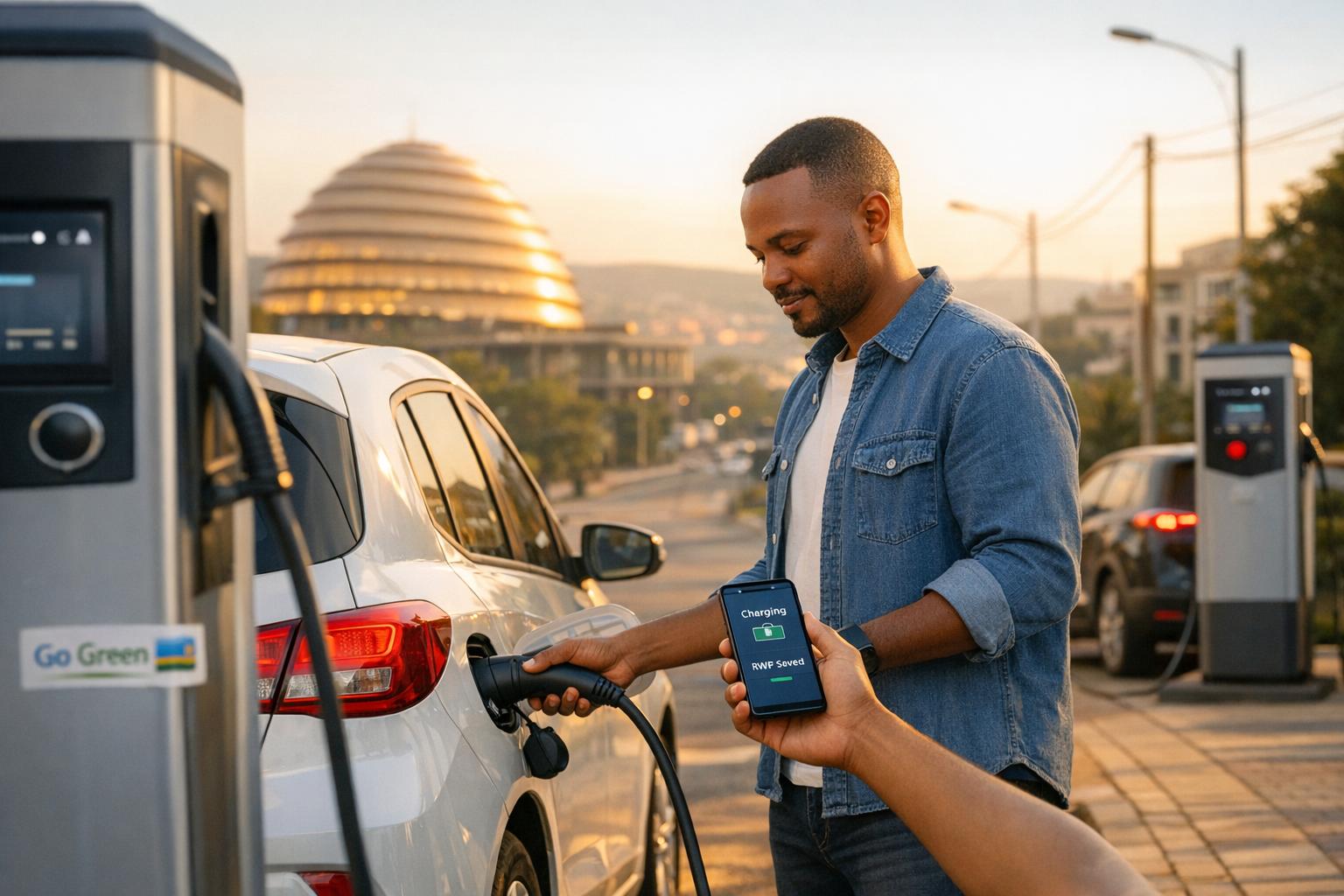
Charging an electric car in Kigali offers both cost advantages and challenges. While EV owners save up to 80% on fuel and maintenance compared to gasoline vehicles, the city’s charging infrastructure is still developing. Kigali has around 200 charging stations, mostly concentrated in urban areas, with limited options outside the city. Home charging is cheaper – costing about $0.10/kWh – but requires an upfront investment of $220–$2,200 for installation. Public charging is slightly more expensive but convenient for quick stops.
Key points:
- Cost Savings: Charging an EV for 62 miles costs ~$1.77, compared to $7.20 for gasoline.
- Infrastructure: Kigali has 35 car charging stations, with ultra-fast chargers available at key hubs.
- Challenges: Sparse rural infrastructure and grid strain during peak hours.
- Government Support: Tax exemptions and reduced electricity rates make EV ownership affordable.
Despite hurdles, Kigali’s EV ecosystem is growing, with plans to expand charging access nationwide and integrate smart charging solutions.
Inside KABISA: Rwanda’s EV Revolution | WIB Documentary
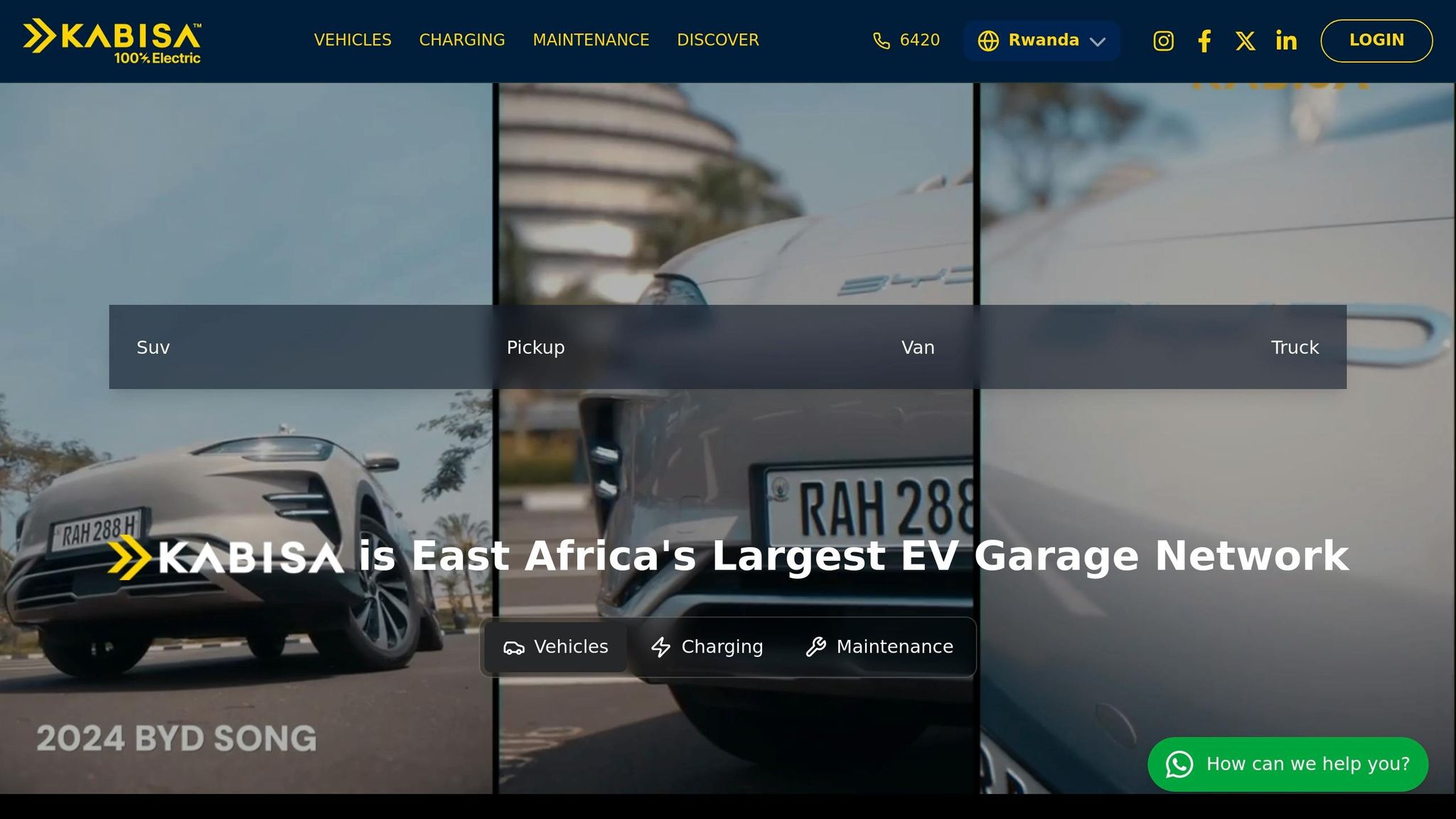
Kigali’s EV Charging Infrastructure
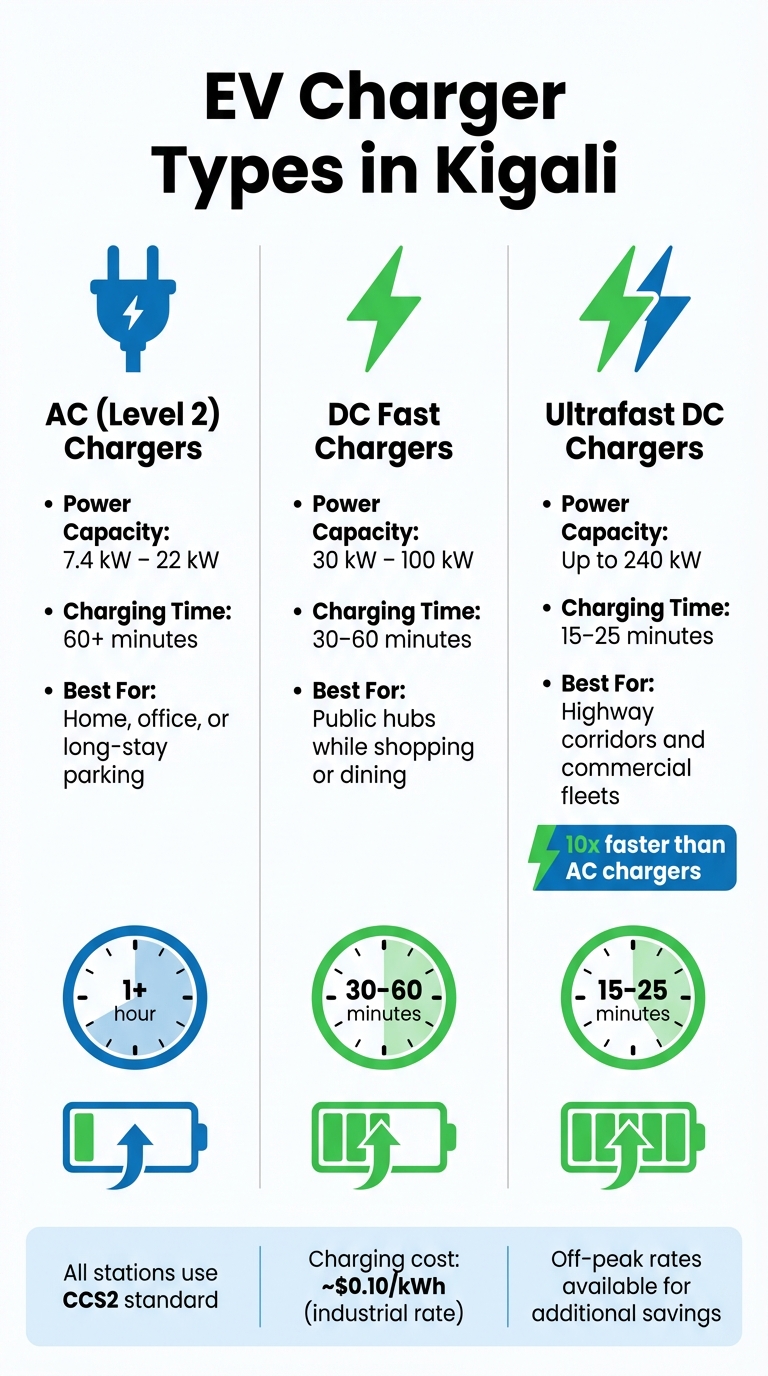
EV Charger Types in Kigali: Speed, Power and Cost Comparison
Kigali is home to nearly 200 EV charging stations, with 35 dedicated to electric cars and 165 for motorbikes. While most stations are concentrated in the capital, the network is steadily growing to accommodate both private drivers and commercial fleets.
To make charging more accessible, many stations are being integrated into existing fuel station networks. For instance, Kabisa and SP Rwanda have collaborated to install seven charging points at SP stations. These developments highlight Kigali’s ongoing commitment to advancing sustainable transportation.
Main Charging Locations
Key charging locations in Kigali are designed to meet the daily needs of EV owners. A major milestone was achieved in February 2025 when Kabisa launched Rwanda’s first ultrafast charging hub at the SP Kanombe station. Conveniently located near Kigali International Airport and the Free Trade Zone, this hub supports busy trade and trucking routes [1,11]. Equipped with a 240 kW supercharger and six bays, it can charge vehicles in under 25 minutes [1,11].
"We’re proud to welcome all EVs to the first Kabisa Supercharger and see it as an important step in our progress towards an ultra-fast, convenient network across the entire region." – Pophia Muhoza, Managing Director, Kabisa
Another notable development is EVPLUGIN‘s integrated charging station in Kacyiru, the first of its kind in Rwanda. Kabisa currently operates the largest public charging network in the country, with 26 public charging points as of February 2025. The government is actively supporting this expansion by providing rent-free land on government-owned properties and incorporating charging infrastructure into building codes and urban planning [1,12].
Available Charger Types
Understanding the types of chargers available is crucial for EV drivers planning their routes. Kigali offers three main types of chargers, each catering to different needs.
- Standard AC chargers (7.4 kW to 22 kW) are ideal for home or office use, taking over an hour for a full charge.
- DC fast chargers, like the EVPLUGIN EPL 100, can recharge vehicles in 30–60 minutes, making them suitable for quick stops.
- Ultrafast DC chargers deliver up to 240 kW, charging most vehicles in just 15 to 25 minutes – about 10 times faster than standard AC chargers.
Here’s a breakdown of the charger types:
| Charger Type | Power Capacity | Typical Charging Time | Best Use Case |
|---|---|---|---|
| AC (Level 2) | 7.4 kW – 22 kW | 60+ minutes | Home, office, or long-stay parking |
| DC Fast | 30 kW – 100 kW | 30–60 minutes | Public hubs while shopping or dining |
| Ultrafast DC | Up to 240 kW | 15–25 minutes | Highway corridors and commercial fleets |
All stations in Kigali use the Combined Charging System (CCS2), ensuring compatibility for cross-border travelers. Charging costs are capped at the industrial electricity rate of approximately $0.10/kWh, which is about half the standard commercial rate. Off-peak rates provide even more savings for EV owners [1,15].
Home Charging: Costs and Setup
Installation Costs
Setting up a home charging station in Kigali can cost anywhere from 300,000 to 800,000 RWF ($220–$590 USD) for modern homes that already have adequate electrical capacity. However, if your home requires a full electrical panel upgrade or significant wiring changes, costs can surpass 3,000,000 RWF ($2,200+ USD).
Here’s a breakdown of the main expenses:
- Charger units (Level 2, 7 kW): 650,000–3,250,000 RWF
- Wiring and permits: 200,000–700,000 RWF
- Panel upgrades: 700,000–2,800,000 RWF
To ensure safety and compliance, installations must be handled by a RURA-certified electrician. For residential setups, a Class A electrician is required, while high-power installations may need a Class B professional. Licensing fees, which range from 30,000 to 100,000 RWF, are typically included in professional installation quotes.
Before buying a charger on your own, check with your vehicle dealer. Some dealers, such as CFAO Mobility, include a 7 kW wall charger and portable adapter with new EV purchases.
Home charging is significantly more economical than public stations – 30% to 50% cheaper. Electricity for home charging is billed at an industrial rate of about $0.10/kWh, which is about half the standard commercial rate. Additionally, imported charging equipment is VAT-exempt until June 30, 2028. Many EV owners also use smart charging apps to schedule charging during off-peak hours, further lowering costs. While the initial investment may seem steep, the convenience and long-term savings make home charging a worthwhile choice for many.
Owner Experiences with Home Charging
Despite the upfront costs, EV owners in Kigali report significant benefits from home charging. Take Paul Frobisher Mugambwa, for example. After switching from a gasoline vehicle, his monthly fuel expenses dropped from $150 to just $40 once he installed a home charging station. Charging overnight has also eliminated the need for frequent trips to public stations, making his daily routine far more convenient.
The type of charger you need depends on how far you drive each day. If your daily commute is under 37 miles, a Level 1 charger (standard outlet) may suffice, as it provides about 2.5–3 miles of range per hour. For those driving over 40 miles daily, a Level 2 charger is recommended. These chargers can fully recharge most EVs overnight with about 90% efficiency.
With Kigali’s electrical grid expected to operate at 136% of its maximum load capacity by 2024, using smart charging during off-peak hours not only saves money but also supports grid stability. Home charging is proving to be a practical, cost-effective solution for Kigali’s growing community of EV owners.
Charging Costs and Financial Impact
Public vs. Home Charging Costs
In Kigali, the cost difference between public and home EV charging is striking. Home charging tends to be 30% to 50% cheaper than using public stations. This is largely due to industrial electricity rates, which make home charging an economical choice and significantly reduce daily operating expenses.
When you compare EVs to gasoline-powered vehicles, the savings become even more apparent. For instance, charging an EV for 62 miles costs approximately $1.77 (based on 15 kWh at $0.118 per kWh). In contrast, fueling a gasoline car for the same distance costs about $7.20 (6 liters at $1.20 per liter). Gasoline ends up being nearly four times as expensive.
These cost advantages extend across various types of EVs. Electric motorcyclist Byiringiro Cassien shared:
"It cost me only Rwf2000 a day for charging… I consume above Rwf5000 of fuel per day [on a gasoline motor]".
For a typical EV owner driving 18,641 miles annually, the math is compelling: they would spend about $531 on charging compared to $2,160 on gasoline, saving roughly $1,629. High-mileage drivers could save as much as $3,801 per year. These numbers highlight the long-term financial benefits for EV owners in Kigali.
Government incentives further sweeten the deal, helping reduce both initial and ongoing costs.
Government Incentives
Rwanda’s government has introduced several measures to make EV ownership more affordable. One of the most impactful is the VAT exemption on imported EV charging equipment, which will remain in place until June 30, 2028. This policy lowers the upfront cost of setting up home charging infrastructure, promoting the growth of the charging network discussed earlier in this article.
Another major benefit is the industrial electricity rate offered for EV charging, which directly reduces operational costs for owners. While fully electric vehicles still enjoy substantial tax breaks, hybrid vehicles face an 18% VAT and age-based excise duties as of 2025.
On top of that, EV owners in Rwanda pay an annual road tax of just 50,000 RWF (around $37 USD). Combined with lower maintenance needs – since EVs don’t require oil changes, timing belt replacements, or exhaust system repairs – the overall cost of ownership remains far lower than that of gasoline vehicles. These policies reflect Rwanda’s commitment to advancing cleaner energy solutions and promoting sustainable transportation options.
sbb-itb-99e19e3
Challenges and Grid Reliability
Grid Capacity and Power Outages
Kigali’s electrical grid is under growing pressure due to the increasing adoption of EVs. Studies reveal the grid can only support about 1.5% penetration of private electric vehicles when drivers use standard 10 kW chargers. If chargers are upgraded to 20 kW, the grid’s capacity drops further, accommodating just 1% of EVs.
The strain becomes evident when examining transformer performance. With 10 kW chargers, 2 out of 18 transformers exceed 80% capacity. When charging power increases to 20 kW, this number jumps to 7 transformers operating between 82.3% and 91.8% capacity. The situation worsens with uncoordinated charging, as most drivers plug in their vehicles after work, causing evening demand spikes. This not only disrupts grid reliability but also erodes driver confidence in the system’s ability to meet their needs.
To prevent power interruptions during peak demand, critical substations need an additional 6 MW capacity. Without these upgrades, EV owners face significant challenges, particularly when traveling between urban centers and rural areas where charging infrastructure is already sparse. These grid limitations create a ripple effect, impacting daily charging habits and leaving drivers uncertain about their ability to complete trips reliably.
Smart Charging Solutions
Smart charging systems offer a way to ease the strain on Kigali’s grid. By shifting energy use to off-peak hours, these systems help smooth out demand spikes and prevent grid overloads. Research indicates this approach can lower stress on the grid by up to 15%.
One notable example of progress is the upgrade at the Nyabugogo multi-modal transit hub in October 2025. Backed by the World Bank, this $7.7 million project includes 18 chargers, an 800 kW rooftop solar system, and integrated battery storage. This setup powers electric buses while reducing reliance on the national grid. Similarly, the Kabisa ultra-fast charging hub at SP Kanombe, launched in February 2025, features 240 kW chargers supported by robust infrastructure from Ireme Invest, the Rwanda Green Fund, and the Rwanda Energy Group.
For electric motorcycles, battery swapping has emerged as a practical alternative. Kigali now boasts over 165 swapping stations, allowing riders to exchange depleted batteries for fully charged ones in minutes. This approach spreads energy demand across the day, avoiding the sharp spikes caused by traditional charging. To further encourage grid-friendly practices, the government offers reduced electricity tariffs during off-peak hours, capped at industrial rates. These measures collectively aim to make EV adoption more sustainable while addressing the challenges of grid reliability.
Convenience and Accessibility
Owner Feedback on Charging Access
EV owners in Kigali have shared a mix of experiences when it comes to accessing charging stations. Most of the infrastructure is concentrated in urban areas, especially at shopping malls, office complexes, and petrol stations. Popular locations include the Kabisa EV House on KN 77 Street and the SP station in Kanombe, which have become reliable spots for charging.
In April 2025, Kabisa launched its EV House, a facility spearheaded by Managing Director Pophia Muhoza. This hub offers charging and maintenance services for all EV owners, regardless of where they purchased their vehicles. Some owners, like Ola Muhammed, have embraced public charging to the point of skipping home charging entirely. Muhammed, an EV owner and brand ambassador, shared:
"Thanks to the sweet perks and promos from KABISA, I haven’t even needed to charge my new BYD at home, saving me significant costs".
But the story changes once you step outside Kigali. Hategekimana Jean Baptiste, an electric motorcyclist, voiced his frustration:
"We still have few charging stations only in Kigali, you can’t move out of Kigali, you can struggle when it powers off".
This urban-rural gap poses a challenge for EV owners planning trips beyond the city. Sparse infrastructure outside Kigali forces drivers to carefully calculate their vehicle range before traveling. These disparities in charging access directly shape how owners plan their daily routes and manage their battery power.
Impact on Daily Driving
For those sticking to city commutes, EVs prove to be highly efficient. Ola Muhammed shared that a round trip from Gacicuro to downtown Kigali – roughly 40 minutes – used just 2% of his battery. Even a longer journey, like the 2.5-hour drive from Musanze to Gacicuro, consumed only 17% of his charge. This level of efficiency reassures owners that city driving can be done without the constant worry of running out of power.
Kabisa’s ultra-fast charging hub near Kigali International Airport has been a game changer for commercial vehicles, allowing trucks to charge up to 10 times faster. Meanwhile, electric motorcycle riders benefit from 32 Ampersand-operated battery swap stations, which enable quick battery exchanges and save riders around $840 annually. These solutions highlight Kigali’s efforts to create a practical and evolving EV ecosystem that caters to a variety of vehicle users.
Conclusion
Kigali’s electric vehicle (EV) charging network showcases a mix of progress and hurdles. The city now boasts about 200 charging stations, ranging from standard AC options to ultra-fast 240 kW hubs capable of reducing charging times to just 15–25 minutes. These facilities highlight Rwanda’s commitment to advancing an EV-friendly environment for both personal and commercial users.
For city driving, the experience is largely seamless. EV owners enjoy substantial savings on fuel and maintenance, while short commutes barely dent battery reserves. Government incentives, such as VAT and import duty exemptions, have played a pivotal role in expanding Rwanda’s electric car fleet – from just 19 vehicles in 2020 to roughly 700 by early 2025. However, the benefits within Kigali contrast sharply with challenges in rural areas.
Charging options remain limited outside the capital. Hategekimana Jean Baptiste, an EV owner, points out that the lack of infrastructure in these areas forces drivers to carefully plan their routes to avoid running out of charge. To address this, the government has earmarked over 224 locations for future charging stations, aiming to ensure no driver is more than 31 miles from a charging point. This expansion is crucial for making EVs viable across the country.
Improving reliability is also a priority. Initiatives like integrating solar power and adopting advanced charging technologies are enhancing grid stability and service consistency. With the planned network expansion, Kigali is laying the groundwork for a robust, nationwide EV infrastructure that can support both daily commuters and long-distance travelers.
FAQs
Can I reliably road-trip outside Kigali in an EV?
Yes, taking a long-distance road trip in an EV outside Kigali is entirely doable with careful planning. For instance, a 2,400 km journey from Kigali to Nairobi and back in September 2024 demonstrated both the reliability of electric vehicles and the steady expansion of charging infrastructure across the region. That said, challenges persist, especially in rural areas of Rwanda, where charging options remain limited. Still, ongoing advancements are steadily improving the infrastructure, making extended EV trips more practical by March 2026.
Do I need a home charger, or are public chargers enough?
Whether or not you need a home charger largely depends on how often you drive and the availability of charging stations in Kigali. Public charging stations are increasingly accessible and dependable, making it possible to rely on them for daily use. That said, having a home charger can be a game-changer for convenience. It’s especially useful if you drive frequently or cover long distances, as it allows you to charge your vehicle overnight and minimizes the need to depend on public stations, which might still have some limitations as the network expands.
What should I do if charging is slow or unavailable during peak hours?
If you’re experiencing slow or unavailable charging during peak hours in Kigali, here are a few tips to help:
- Look for alternative stations: Use platforms like EV24.africa to locate nearby charging stations with availability.
- Charge during off-peak times: Opt for late-night or early-morning charging to avoid the rush and potential congestion.
- Try Level 2 chargers: While slower than fast chargers, Level 2 chargers are often easier to access and can still get the job done.