
 Thabo Nkosi
Electric vehicles (EVs) are becoming a key focus in Rwanda’s push to reduce emissions and cut fuel costs. By 2024, the country had imported over 7,000 hybrid and electric cars, but only 7% of these were fully electric. To address this, Rwanda has introduced policies favoring EVs, including tax exemptions until 2028, affordable charging infrastructure, and incentives to discourage older hybrid vehicles.
Here’s what you need to know:
- Cost Savings: Driving an EV costs about $1.77 per 100 km compared to $7.20 for gasoline cars, saving drivers over $800 annually on fuel.
- Tax Benefits: EVs are exempt from import duties, VAT, and excise taxes until mid-2028, making them more affordable.
- Charging Network: Rwanda has 24 public charging stations and 49 battery-swapping stations, with plans to expand to 224 locations.
- EV Prices: Entry-level EVs cost $20,000–$40,000 after tax exemptions, with financing options available through platforms like EV24.africa.
- Maintenance: EVs have lower upkeep costs, with fewer repairs needed compared to traditional cars.
Rwanda is also working on expanding charging infrastructure beyond Kigali and training technicians to support EV adoption. While challenges like limited rural charging stations remain, the government’s incentives and growing infrastructure make EVs an increasingly practical choice for drivers.
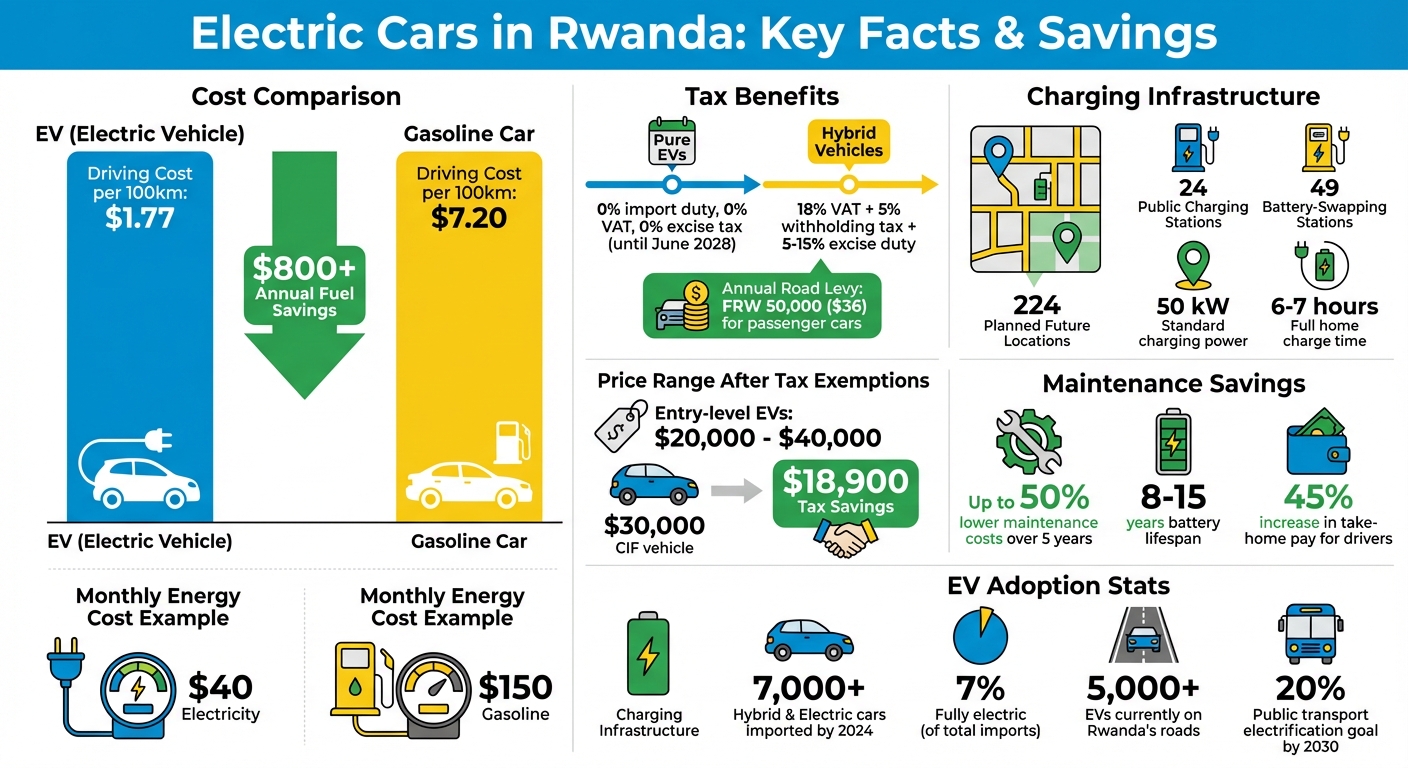
Rwanda Electric Vehicle Costs and Benefits Comparison 2024-2028
Inside KABISA: Rwanda’s EV Revolution | WIB Documentary
sbb-itb-99e19e3
Rwanda’s Electric Vehicle Policies and Incentives
Rwanda is making bold moves to support electric vehicles (EVs) with a range of tax breaks and incentives. Pure electric vehicles enjoy complete tax exemptions until June 30, 2028, making them a more attractive option for buyers. On the other hand, hybrid vehicles face an 18% VAT, a 5% withholding tax, and excise duties that range between 5% and 15%, depending on the vehicle’s age.
The government has been clear about its goals. The Rwanda Ministry of Finance and Economic Planning stated:
"The Government decided to extend incentives on Electric & Hybrid vehicles and Electric motorcycles to pay an import duty rate of zero. This intends to accelerate the transition to Electric Vehicles and reduce greenhouse gas emissions from vehicle transportation."
While maintaining a zero percent import duty for both EVs and hybrids, the government has introduced policies that discourage reliance on older hybrid technologies. This approach aims to nudge consumers toward fully electric options. Below, we’ll dig into the buyer incentives and the regulatory framework for EV charging infrastructure.
Government Incentives for EV Buyers
For those considering an EV in Rwanda, the tax benefits are hard to ignore. EVs are tax-free until mid-2028, while hybrids face higher costs with VAT, withholding taxes, and excise duties based on the car’s age. Vehicles with a cost, insurance, and freight (CIF) value under $60,000 are subject to a reduced East African Community external tariff of 25%. Additionally, annual road levies are quite reasonable – ranging from FRW 50,000 (around $36) for passenger cars to FRW 150,000 (about $109) for larger trucks.
The Ministry of Finance and Economic Planning reviews these incentives every year, ensuring they stay aligned with the country’s EV adoption rates and environmental goals. Importers must provide detailed documentation, including manufacturing dates and emissions data, to qualify for these benefits. By lowering both upfront and long-term costs, these measures make EV ownership more accessible to Rwandans.
Regulations for EV Infrastructure Development
Rwanda isn’t stopping at buyer incentives; it’s also laying the groundwork for a strong EV charging network. The government has made land available rent-free for charging stations, capped EV charging tariffs at 50% of standard electricity rates, and exempted charging equipment from major taxes until June 2028.
Companies in the e-mobility sector benefit from a reduced corporate income tax rate of 15% (compared to the standard 30%), while investments over $50 million can qualify for a seven-year tax holiday. Businesses operating in Special Economic Zones enjoy further perks, such as tax-free imports of EV manufacturing and assembly equipment with fast-tracked regulatory approvals. By July 2025, Rwanda had already established 24 public charging stations and 49 battery swap stations, with plans to expand to 224 strategic locations based on geospatial mapping.
This growing infrastructure is essential to make EVs a practical choice for daily use, ensuring drivers have reliable access to charging and battery-swapping facilities.
Electric Car Prices in Rwanda
Current EV Price Ranges
Rwanda’s tax policies have made electric vehicles (EVs) much more affordable for buyers. Thanks to zero-duty policies, the government has significantly reduced the cost of EV ownership. For example, an electric car with a cost, insurance, and freight (CIF) value of $30,000 would typically incur around $18,900 in taxes, including a 25% import duty, 20% excise tax, and 18% VAT. With these taxes waived, the total cost drops from $48,900 to about $30,000. This makes entry-level EVs, priced between $20,000 and $40,000 after incentives, a competitive option compared to traditional fuel-powered cars, especially when factoring in long-term savings. Vehicles with CIF values under $60,000 benefit the most from these exemptions, while those above this threshold are subject to a 25% East African Community external tariff.
Beyond purchase costs, EVs offer lower operating expenses, further boosting their appeal. Buyers also have access to financing support through platforms like EV24.africa, making EV ownership even more accessible.
EV24.africa: Clear Pricing and Financing Options
EV24.africa plays a key role in simplifying the purchase process for Rwandan EV buyers. The platform sources vehicles directly from suppliers in China, Europe, North America, and Japan, ensuring that Rwanda’s tax exemptions are fully applied. They handle all customs paperwork and provide official pro-forma invoices and detailed vehicle quotations, which banks can use to evaluate loans. This makes financing more straightforward for buyers.
Popular EV models available through EV24.africa include the Volkswagen ID.4, BYD Dolphin, and Tesla Model 3. Buyers can choose from various payment methods, including bank transfers, mobile money, and even cryptocurrency. Additionally, the platform collaborates with local banks to offer specialized green loans, which may come with lower interest rates for eco-friendly purchases. Standard financing documents are required. All pricing includes logistics management, with vehicles delivered across Rwanda via Roll-on/Roll-off shipping or container transport.
Charging Infrastructure in Rwanda
Public and Private Charging Stations
As of August 2025, Kigali had a total of 24 public charging stations for vehicles (offering both AC and DC charging), 4 dedicated motorcycle chargers, and 49 battery-swapping stations conveniently located at shopping malls, offices, and gas stations. To further support the growth of electric vehicles (EVs), the government has earmarked 224 potential sites across the country for new charging hubs. This growing network reflects Rwanda’s focus on sustainable mobility and its efforts to encourage EV adoption.
Charging infrastructure isn’t limited to Kigali. It’s expanding to major highways, making it easier for EV owners to travel longer distances. Popular destinations like Lake Kivu (about 81 miles from Kigali) and Akagera National Park (roughly 84 miles away) are now more accessible for modern EVs. However, drivers are advised to check station availability ahead of time. The Ministry of Infrastructure has laid out a master plan to ensure that no EV will need to travel more than 31 miles without encountering a charging station.
"People want to buy EVs, but the limited number of charging stations, particularly outside Kigali, undermines consumer confidence."
– Srinivas Cheruvu, Managing Director of CFAO Mobility Rwanda
To help EV owners plan their trips, tools like PlugShare provide real-time information on station locations, availability, and connector types. Most standard public charging stations in Rwanda offer power outputs of up to 50 kW. Additionally, local startups such as Ampersand have introduced battery-swapping stations for electric motorcycles, significantly reducing downtime for commercial riders.
Beyond public networks, EV owners also benefit from reliable home charging solutions, adding convenience to their daily routines.
Home Charging Setup and Electricity Costs
Rwanda’s push for accessible charging options extends to home setups, providing EV owners with practical solutions for daily use. When purchasing an EV, buyers typically receive a 7-kW wall-mounted charger and a 3.3-kW portable adapter installed at their homes. A full charge at home takes around 6–7 hours, while the portable adapter can be used with any standard socket for added flexibility.
"When a car is sold, CFAO install a 7‑kilowatt charger in the customer’s premises and provides a 3.3‑kilowatt portable adapter that can be used to charge anywhere provided there is a socket."
– Srinivas Cheruvu, Managing Director of CFAO Mobility Rwanda
The cost of charging is kept affordable thanks to government subsidies. EV owners pay electricity rates based on the industrial tariff, which is lower than standard residential rates. Furthermore, equipment for charging stations – such as batteries and hardware – is exempt from import duties, excise duties, and VAT. With over 50% of Rwanda’s electricity coming from renewable sources like hydroelectric and solar power, EV charging is not only cost-effective but also environmentally friendly. For example, a hybrid Outlander owner in Kigali shared that they reduced their monthly energy costs from $150 for petrol to just $40 for electricity.
Owning and Using Electric Cars in Rwanda
Maintenance Tips for Electric Vehicle Owners
Electric vehicles (EVs) require less upkeep compared to traditional cars – no oil changes, spark plugs, timing belts, or exhaust system repairs to worry about. Over five years, maintenance costs can be up to 50% lower. Service centers like Kabisa make things even easier, offering repairs that are about 30% cheaper and providing 24/7 emergency support with skilled technicians.
The heart of EV maintenance lies in battery care. Most EV batteries last between 8 and 15 years, with manufacturers typically covering them under warranties for 8 years or up to 99,420 miles (160,000 km). To maximize battery lifespan, follow these tips:
- Keep the charge level between 20% and 80% for daily use.
- Avoid charging to 100% or draining the battery to 0% too often.
- Park in shaded or indoor areas to avoid heat buildup.
If you’re considering a used EV, always ask for a battery health report to gauge its remaining capacity.
"An EV battery gradually loses capacity, similar to a smartphone." – Jean-Claude N., Kigali-based EV technician
Routine checks are still essential. Monitor tire pressure since underinflated tires can reduce battery range. Inspect battery connectors and cooling systems regularly. And don’t overlook regenerative braking – it helps conserve brake components, especially on Rwanda’s hilly roads. While battery replacement is rare within the first decade, costs can range from $5,000 to over $13,000, depending on the model.
"Replacing a battery is costly, but with proper care, most Rwandan EV drivers won’t need to think about it for at least a decade." – Francois Habimana, EV fleet manager in Kigali
By adopting these maintenance habits, EV owners can protect both their wallets and the environmental benefits that come with driving electric.
EV Owner Experiences in Rwanda
Owning an EV in Rwanda has its perks and challenges, shaped by both the vehicles themselves and the country’s evolving infrastructure.
For many owners, the cost savings are undeniable. Monthly energy expenses drop significantly – going from $150 for petrol to just $40 for electricity, even with daily commutes of about 4.3 miles (7 km). This shift can increase take-home pay by up to 45%, translating to roughly $840 saved annually on fuel and maintenance.
Yet, there are hurdles. Charging stations are mostly concentrated in Kigali, making long-distance travel tricky. Hilly regions like Musanze and Huye can drain batteries faster, although regenerative braking helps recover some energy on downhill stretches. Additionally, uneven roads and high speed bumps pose issues for EVs with low ground clearance, such as the e-Golf.
"We still have few charging stations only in Kigali, you can’t move out of Kigali, you can struggle when it powers off." – Hategekimana Jean Baptiste, electric motorcyclist
To address the shortage of skilled EV technicians, Carnegie Mellon University Africa now offers specialized courses, equipping locals with the expertise to maintain and repair these vehicles. Despite the challenges, Rwanda now boasts over 5,000 electric vehicles on its roads. Many drivers rely on apps like PlugShare to locate charging stations and plan their routes efficiently.
While the infrastructure is still catching up, the growing number of EVs and the enthusiasm of their owners highlight the potential of electric mobility in Rwanda.
Conclusion: The Future of Electric Vehicles in Rwanda
Rwanda is setting the pace for sustainable transportation in East Africa. A sharp rise in electric vehicle imports highlights a growing shift toward greener mobility solutions.
The financial benefits of electric vehicles are hard to ignore. EVs drastically cut operating costs compared to gasoline-powered vehicles, while also boosting energy independence by tapping into Rwanda’s renewable hydropower and solar energy instead of relying on imported fossil fuels.
These economic perks align perfectly with Rwanda’s broader vision for sustainable mobility. Expanding the charging infrastructure is a top priority. The government has already identified 224 future charging locations to extend access beyond Kigali, and companies like Kabisa and Ampersand are actively working to install new stations. Additionally, the ambitious goal of electrifying 20% of public transport by 2030 marks a significant step toward transforming the way people travel.
Platforms like EV24.africa are making this transition smoother by simplifying the process of owning an electric vehicle. They handle everything – from sourcing EVs from China, Europe, Japan, and North America to managing customs clearance and local registration. With transparent pricing, financing options, and delivery services across cities like Kigali, Butare, and Gisenyi, EV24.africa is bridging the gap between advanced technology and everyday consumers.
"With continued investment in infrastructure and government incentives, EV adoption could become a key component of Rwanda’s sustainable transportation and energy security goals." – EV24.africa
To build on this momentum, addressing the high upfront costs of EVs and expanding charging networks in rural areas will be crucial. With strong government support, abundant renewable energy, and growing consumer interest, Rwanda is well-positioned to redefine transportation and pave the way for a cleaner, greener future.
FAQs
How do I qualify for Rwanda’s EV tax exemptions?
To take advantage of Rwanda’s tax exemptions for electric vehicles (EVs), here’s what you need to do:
- Import a fully electric vehicle (EV): This qualifies you for zero import duty, VAT, and excise tax. The policy is valid until June 30, 2028.
- Meet the price cap: Ensure the EV falls within the price limits outlined in the policy.
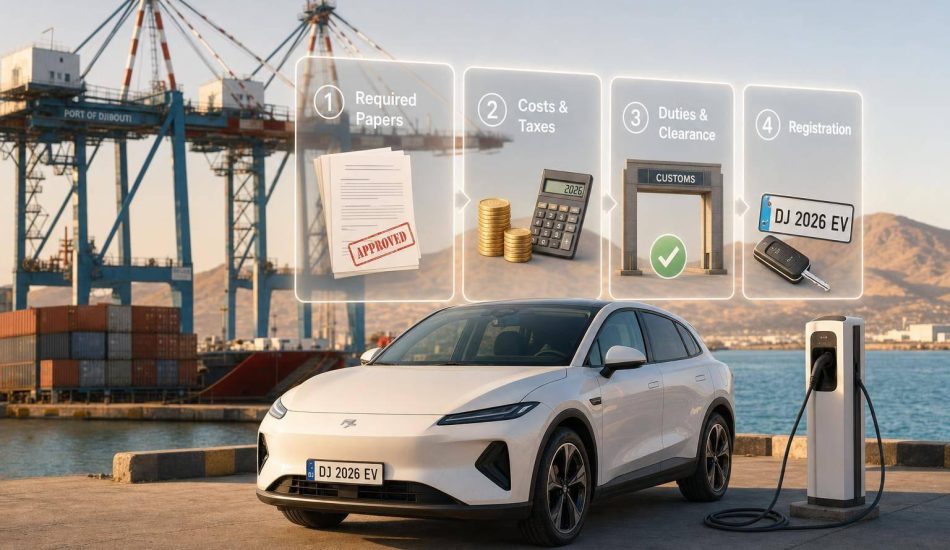
- Prepare the required documents: These include a commercial invoice, Import Declaration Form (IDF), and Tax Identification Number (TIN).
- Complete customs clearance: Use Rwanda’s One Single Electronic Window system to streamline the process.
By following these steps, you can make the most of Rwanda’s EV-friendly tax incentives.
Can I road-trip outside Kigali with today’s charging network?
Yes, taking a road trip outside Kigali with an electric vehicle is entirely doable. Rwanda is steadily building up its EV charging network, making it easier for drivers to venture farther. In fact, a recent electric vehicle trip from Kigali to Nairobi demonstrated that long-distance travel is achievable using the existing charging infrastructure in the region. This development showcases how EVs are becoming a practical option for journeys beyond Kigali.
What should I check before buying a used EV in Rwanda?
Before purchasing a used EV in Rwanda, there are several crucial factors to keep in mind. First, assess the availability of charging stations, particularly if you plan to travel outside urban areas where access might be limited. Next, check the battery health of the vehicle, as it directly impacts both the driving range and overall reliability.
It’s also essential to verify all import and ownership documents to confirm that taxes and duties have been fully settled. Additionally, thoroughly inspect the car’s condition, paying attention to tires, brakes, and electrical systems. To avoid unexpected problems, consider taking the car for a test drive or having a professional mechanic evaluate it. This extra step could save you from costly repairs down the line.