
 Thabo Nkosi
If you drive frequently, electric cars (EVs) can save you hundreds of thousands of shillings over time, despite their higher upfront cost. Petrol cars are cheaper to buy but cost significantly more to fuel and maintain. With fuel prices at KES 184.52 per liter and EV charging as low as KES 8 per kWh, the math favors EVs for long-term savings.
Key Takeaways:
- Fuel vs Charging Costs: Petrol cars cost KES 15.38/km, while EVs cost as low as KES 1.20/km.
- Purchase Price: Petrol cars start at KES 1.5M, while EVs like the Nissan Leaf start at KES 1.2M for used models.
- Maintenance: EVs require fewer repairs (no oil changes or spark plugs), saving you KES 88,000/year on average.
- Break-Even Point: Frequent drivers can recover the higher EV price in 3-4 years.
Quick Comparison:
| Category | Petrol Cars | Electric Cars |
|---|---|---|
| Cost per km | KES 10–20 | KES 1.20–3.20 |
| Annual Fuel/Charge | KES 267,420+ | KES 18,000–48,000 |
| Maintenance | Higher (frequent servicing) | Lower (fewer parts to replace) |
| Purchase Price | KES 1.5M–3M | KES 1.2M–10M |
| Depreciation | Slower (39% in 3 years) | Faster (52% in 3 years) |
| Tax Benefits | 25%-35% import duty + VAT | 0% import duty + zero-rated VAT |
Who Should Buy an EV?
- Frequent Drivers: Taxi operators or commuters covering 15,000+ km/year will save the most.
- Home Chargers: Charging at home during off-peak hours (KES 8/kWh) maximizes savings.
- Long-Term Owners: Keep your EV for 5+ years to offset the upfront cost.
Who Should Stick to Petrol Cars?
- Occasional Drivers: If you drive less than 10,000 km/year, fuel costs may not justify the EV premium.
- Short-Term Owners: Planning to sell in under 3 years? Petrol cars depreciate less.
Bottom line: Electric cars are a smart financial choice for high-mileage drivers and long-term ownership, while petrol cars remain practical for occasional use or short-term ownership.
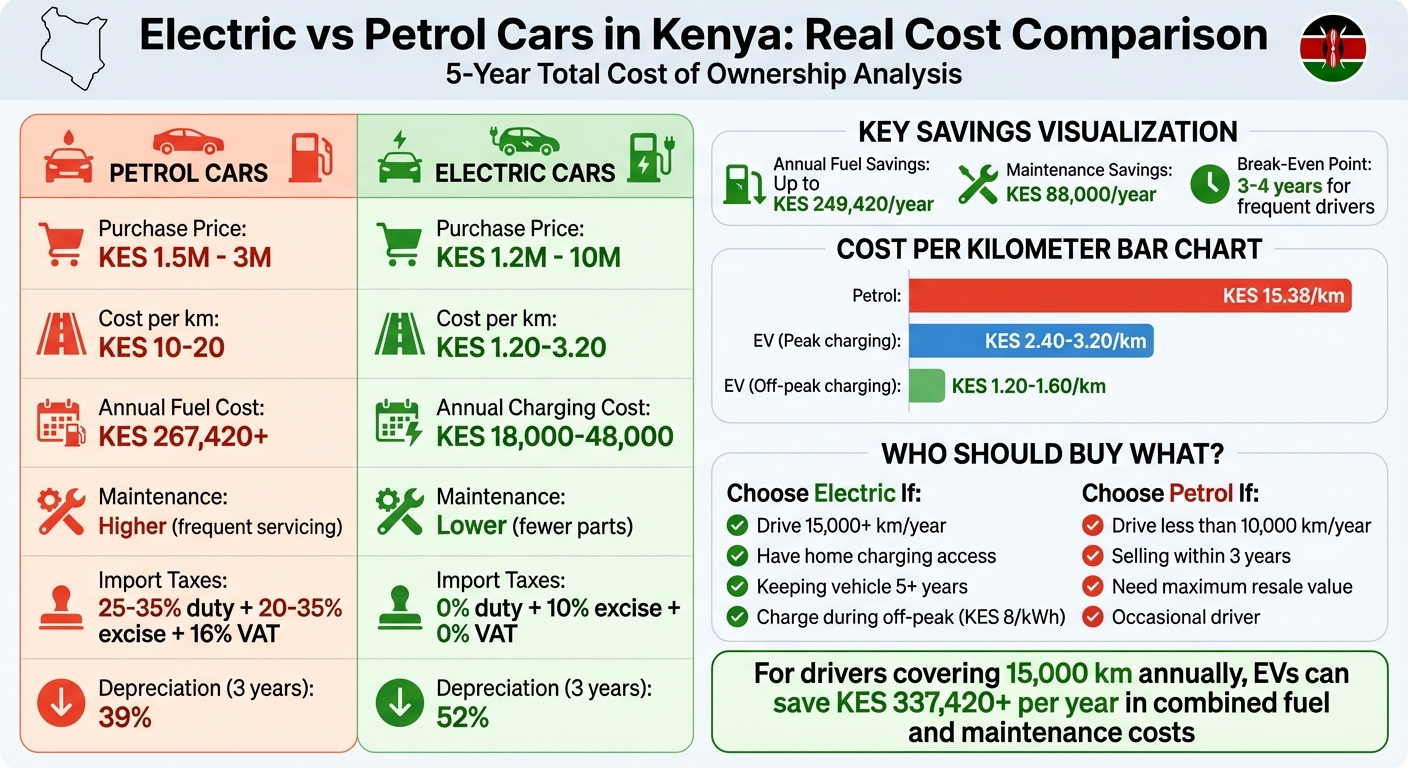
Electric vs Petrol Cars in Kenya: 5-Year Cost Comparison
How practical is having an electric car in Kenya?
sbb-itb-99e19e3
Purchase Price Comparison
The upfront cost is often the biggest challenge for Kenyan buyers when considering an electric vehicle (EV). Petrol cars like the Toyota Vitz and Nissan Note typically fall within the KSh 1.5 million to KSh 3 million range, while EVs have traditionally been more expensive. However, this price gap has been narrowing, thanks to favorable government tax policies and the growing availability of used EV imports. Here’s a closer look at current market pricing for both entry-level and mid-range models.
Popular Model Prices
Entry-level EVs are now priced competitively with mid-range petrol cars. For instance, a used Nissan Leaf, primarily imported from Japan, costs between KSh 1.2 million and KSh 1.7 million. This puts it in the same price bracket as many popular petrol hatchbacks. Additionally, locally assembled models like the Autopax Air Yetu start at KSh 1.7 million for the standard version and KSh 2 million for the Pro version.
Mid-range EVs provide even more variety. The BYD Dolphin is priced between KSh 2.5 million and KSh 2.8 million, while the MG ZS EV ranges from KSh 2.9 million to KSh 3.5 million. For those looking to spend a bit more, the Hyundai Kona Electric is available in the KSh 3.5 million to KSh 4.2 million range. On the higher end, premium models from Tesla and BMW exceed KSh 10 million, making them less attainable for the average buyer.
The used EV market is also becoming increasingly appealing. Compared to petrol cars, used EVs are often a year newer and have roughly 30,000 fewer miles on the odometer. This makes them an attractive option for buyers looking to save money without sacrificing quality. These price comparisons are further shaped by Kenya’s unique import tax structure, which is detailed below.
Import Taxes and Duties
Kenya’s tax policies significantly favor EVs, making them more affordable. EVs benefit from 0% import duty and zero-rated VAT, which eliminate major cost drivers. In contrast, petrol cars face 25%-35% import duties, 20%-35% excise duty, and 16% VAT, adding up to 80%-100% of their landed cost.
James Mwangi of AutoMag.co.ke highlights this advantage:
"The 0% Import Duty and Zero-rated VAT are the primary reasons EVs are becoming a more financially viable option."
That said, EVs are still subject to a 10% excise duty, compared to the 20% to 35% excise duty on petrol cars. Both types of vehicles also incur a 3.5% Import Declaration Fee and a 2% Railway Development Levy. These tax savings on EVs can amount to hundreds of thousands of shillings, significantly reducing their initial price premium.
Fuel vs Charging Costs
Electric cars substantially lower daily operating expenses in Kenya. While petrol prices are influenced by international market trends and currency fluctuations, electricity rates in the country are more stable and affordable. As of February 15, 2026, Super Petrol in Nairobi is priced at KSh 178.28 per liter. In contrast, Kenya’s special e-mobility tariff allows EV owners to charge at KSh 8 per kWh during off-peak hours and KSh 16 per kWh during peak hours. Let’s break down how these costs compare in practical terms, focusing on annual fuel expenses for petrol vehicles versus EVs.
Annual Petrol Costs
A typical Kenyan driver covering 15,000 km annually in a petrol car averaging 10 km per liter would consume around 1,500 liters of fuel. At the current Nairobi price of KSh 178.28 per liter, this adds up to approximately KSh 267,420 per year. If petrol prices increase to KSh 200 per liter, which is a plausible scenario given the volatility of fuel prices, the annual cost could rise to around KSh 300,000.
Annual Electricity Costs for EVs
Electric vehicles typically consume 15–20 kWh per 100 km. For the same 15,000 km annual distance, this translates to a total electricity usage of about 2,250 to 3,000 kWh. Charging exclusively during off-peak hours at KSh 8 per kWh results in annual costs of KSh 18,000–24,000, while charging during peak hours at KSh 16 per kWh increases the total to KSh 36,000–48,000. Bernard Ngugi, Managing Director of Kenya Power, highlighted the company’s readiness to support EV adoption:
"As part of our implementation plan, we are developing appropriate infrastructure and building internal capacity to enable us to support the use of electric vehicles across the value chain".
Cost Per Kilometer Breakdown
When comparing cost per kilometer, petrol cars are significantly more expensive, ranging from KSh 10–20 per km. On the other hand, EVs charged during off-peak hours cost only KSh 1.20–1.60 per km, and even during peak hours, the cost remains lower at around KSh 2.40–3.20 per km. The table below provides a clear comparison:
| Cost Component | Petrol Vehicle | Electric Vehicle (Peak) | Electric Vehicle (Off-Peak) |
|---|---|---|---|
| Cost per Kilometer | KSh 10 – KSh 20 | KSh 2.40 – KSh 3.20 | KSh 1.20 – KSh 1.60 |
| Annual Cost (15,000 km) | KSh 150,000 – KSh 300,000 | KSh 36,000 – KSh 48,000 | KSh 18,000 – KSh 24,000 |
| Energy Rate | KSh 178.28 per Liter | KSh 16 per kWh | KSh 8 per kWh |
The stark difference in operating costs underscores the financial advantage of electric vehicles, which becomes even more apparent when considering the total cost of ownership over five years, discussed in the next section.
Maintenance and Service Costs
Electric vehicles (EVs) stand out when it comes to maintenance costs. With far fewer moving parts compared to petrol cars, EVs eliminate the need for engine oil, spark plugs, timing belts, or exhaust system repairs. This simplicity translates into lower servicing bills and fewer trips to the mechanic.
EV Maintenance Requirements
For EVs, maintenance revolves around a few key areas: battery health, tire rotations, brake pad checks, and the occasional windshield wiper replacement. Thanks to regenerative braking, brake pad wear is minimized, and there’s no need for engine oil changes or spark plug replacements. The main long-term concern for EV owners is battery health, but manufacturers typically provide warranties that cover several years or a set mileage. In Kenya, while the network of EV-specialized technicians is still growing, it’s becoming easier to access routine maintenance services, though it’s not yet as widespread as petrol car mechanics.
Petrol Car Service Requirements
Petrol cars, on the other hand, demand regular servicing to stay in good condition. Oil and filter changes are necessary every 5,000–10,000 km. Additionally, they require periodic replacements of spark plugs, air filter cleanings, cooling system flushes, and timing belt adjustments. While economy models like the Nissan March or Toyota Vitz are known for their affordable parts and the availability of mechanics across Kenya, they still incur consistent maintenance costs that EVs avoid. The extensive presence of both informal "jua kali" mechanics and formal service centers makes petrol car maintenance convenient, but the frequency of required services adds up over time.
5-Year Maintenance Cost Comparison
When viewed over a five-year period, the differences in maintenance costs become even more apparent. Maintenance plays a key role in the total cost of ownership, and EVs eliminate many of the recurring expenses associated with petrol cars. In Kenya, projections estimate that EVs can save about KES 88,000 annually in combined fuel and maintenance costs.
| Maintenance Component | Electric Car (e.g., Nissan Sakura) | Petrol Car (e.g., Nissan March) |
|---|---|---|
| Oil & Filter Changes | Not Required | Required (Every 5,000–10,000 km) |
| Spark Plugs/Ignition | Not Required | Required periodically |
| Brake Pad Wear | Low (due to regenerative braking) | Moderate to High |
| Moving Parts | Minimal (Motor/Drivetrain) | Extensive (Engine/Transmission/Exhaust) |
| Major 5-Year Cost | Battery Health Check/Coolant | Timing Belt/Water Pump/Transmission Service |
| Parts Network | Emerging EV parts networks | Well-established across Kenya |
Combined with lower operational expenses, the reduced maintenance needs of EVs make them an even stronger financial choice.
5-Year Total Cost of Ownership
TCO Components
The 5-Year Total Cost of Ownership (TCO) provides a detailed look at all the expenses tied to owning a vehicle over five years. This includes the purchase price (plus import taxes), registration fees, insurance, maintenance, fuel or charging costs, and the vehicle’s resale value.
For electric vehicles (EVs), lower import duties significantly reduce the overall TCO compared to petrol-powered cars. Additionally, EVs offer notable savings in operational costs – charging an EV costs 30–50% less than refueling with petrol. EV owners also avoid common maintenance expenses like oil changes, spark plug replacements, and exhaust system repairs. These cost advantages make EVs more appealing in the long run. However, insurance premiums for EVs can be up to 30% higher, largely due to concerns about the cost of replacing high-value components like the battery. It’s crucial to select an insurance policy that covers key parts, including the battery pack and charging equipment.
Resale value is another critical TCO factor. While EVs used to depreciate faster than petrol vehicles, advancements in battery technology and the expansion of charging networks have helped narrow this gap. On average, EVs lose about 49.1% of their value over five years, compared to the 60–70% depreciation rate of petrol cars. In Kenya, an EV’s resale value heavily depends on its Battery State of Health (SOH). Maintaining an SOH of 85% or higher can boost resale prospects.
Kenya-Specific Factors to Consider
When it comes to owning a vehicle in Kenya, there’s more to think about than just the upfront costs and maintenance. Local dynamics, including government policies and infrastructure, play a big role in shaping the overall financial picture.
Government Policies and Tax Breaks
Kenya’s tax system gives electric vehicles (EVs) a clear edge. Fully assembled EVs benefit from 0% import duty and zero-rated VAT, along with a flat 10% excise duty. This is a stark contrast to petrol vehicles, which face import duties of 25%-35% and excise duties of 20%-35%. These favorable policies have helped shift EVs from being a niche option to a more mainstream choice in Kenya’s automotive market.
Charging Station Availability
Kenya’s charging infrastructure has grown at an impressive pace. In 2023, there were 67 charging stations, but by early 2025, that number had surged to over 200. The government has ambitious plans to install 10,000 charging stations by 2030. Kenya Power is also stepping up, investing about $1.9 million (258 million KES) over three years to add 45 charging stations in key locations.
For those considering home charging, installing a Level 2 charger costs between KES 50,000 and KES 150,000. Homeowners can also take advantage of off-peak electricity rates from Kenya Power, which charge KES 8 ($0.058) per kWh, significantly lower than the KES 16 ($0.12) per kWh during peak hours. On the other hand, public charging stations typically charge KES 30–50 per kWh, reflecting added service fees and infrastructure costs.
"The biggest mental shift for new EV owners? Realizing you leave home with a ‘full tank’ every morning. Public chargers aren’t for daily use; they’re for topping up on long journeys." – EV24.africa
With the rapid expansion of charging stations and lower operational costs, owning an EV in Kenya is becoming increasingly practical.
EV Financing Options
Financing options for EVs in Kenya have evolved, making ownership more attainable. Partners like M-KOPA and Watu now offer tailored financing solutions. Unlike traditional loans, these programs provide pre-approval before the vehicle even ships from abroad. For instance, EV24.africa has a two-step payment model: you pay an initial deposit of 20% to 40% to secure the vehicle and begin shipping, then settle the remaining balance once the car clears customs at the Port of Mombasa.
The impact of accessible financing is clear. EV sales in Kenya surged 108% between 2022 and 2023, and Q1 2025 saw a 35% increase compared to Q1 2024. Lower taxes on EVs also mean buyers are financing a smaller amount compared to petrol cars of equivalent value. To streamline your loan application, you’ll need six months of bank statements, payslips, your National ID, and KRA PIN.
Kenya’s growing infrastructure and financing options are making EV ownership not just a possibility but an increasingly appealing choice.
Conclusion
Electric cars come with a higher initial price tag but can reduce daily running costs by 30–50%. For instance, an electric car can travel approximately 400 kilometers on KES 1,000 worth of charging, while a petrol car demands significantly higher expenses for the same distance. In Kenya, new EVs start at around KES 2 million, but the savings on fuel and maintenance can greatly impact the overall cost of ownership.
Driving habits play a big role in determining when you’ll break even. Frequent drivers, like taxi operators or commuters with access to home charging, can recover the higher upfront cost more quickly thanks to fuel savings and reduced maintenance needs.
However, there are challenges to consider. EVs tend to depreciate faster – losing about 52% of their value in three years compared to 39% for petrol cars – and often come with higher insurance premiums due to the specialized nature of repairs.
A detailed Total Cost of Ownership (TCO) analysis highlights these points. For regular drivers with home charging and plans to own the vehicle for five years or more, EVs can offset their higher purchase price through significant savings on fuel and maintenance. The five-year TCO comparison shows that frequent drivers benefit the most from the lower operating costs. On the other hand, if you’re an occasional driver or plan to sell the car within three years, a petrol car may still be the more economical option. That said, the gap is narrowing as more affordable EV models, like the Neta EV priced around KES 4.5 million, become available.
Take the time to assess your daily mileage, ensure you have access to charging facilities near your home or workplace, and calculate the costs based on your unique circumstances. Ultimately, the best choice isn’t about which technology is inherently "better" but about what fits your driving needs and lifestyle.
FAQs
How can I estimate my EV break-even time based on yearly mileage?
To figure out how long it will take for your EV to break even, try using a total cost of ownership calculator. These tools let you plug in details like your yearly mileage, electricity rates, and fuel costs. By comparing these expenses over time, the calculator shows when your EV’s ownership costs will equal – or drop below – those of a gasoline car. This gives you a clear picture of when your investment starts to pay off.
What if I can’t charge my EV at home and rely on public chargers?
Relying on public chargers for your electric vehicle (EV) in Kenya takes some careful planning. While the network of public chargers is growing, their availability and reliability can still be hit or miss. Charging during off-peak hours, when rates are about KSh 8 per kWh, might help you save money. However, charging during peak hours or facing additional demand fees could push your costs higher. Additionally, if high-power chargers are either unavailable or occupied, you might face longer charging times, which could chip away at the cost benefits of owning an EV.
How can I check an EV battery’s state of health before buying used?
To evaluate the state of health (SOH) of an EV battery before buying a used vehicle, ask the dealership for a battery health assessment or conduct a diagnostic scan yourself. Keeping an eye on the vehicle’s range and overall performance over time can also give clues about the battery’s condition. For a more detailed understanding, SOH checks or battery health certificates can offer insights into the battery’s current state and expected lifespan.