
 Thabo Nkosi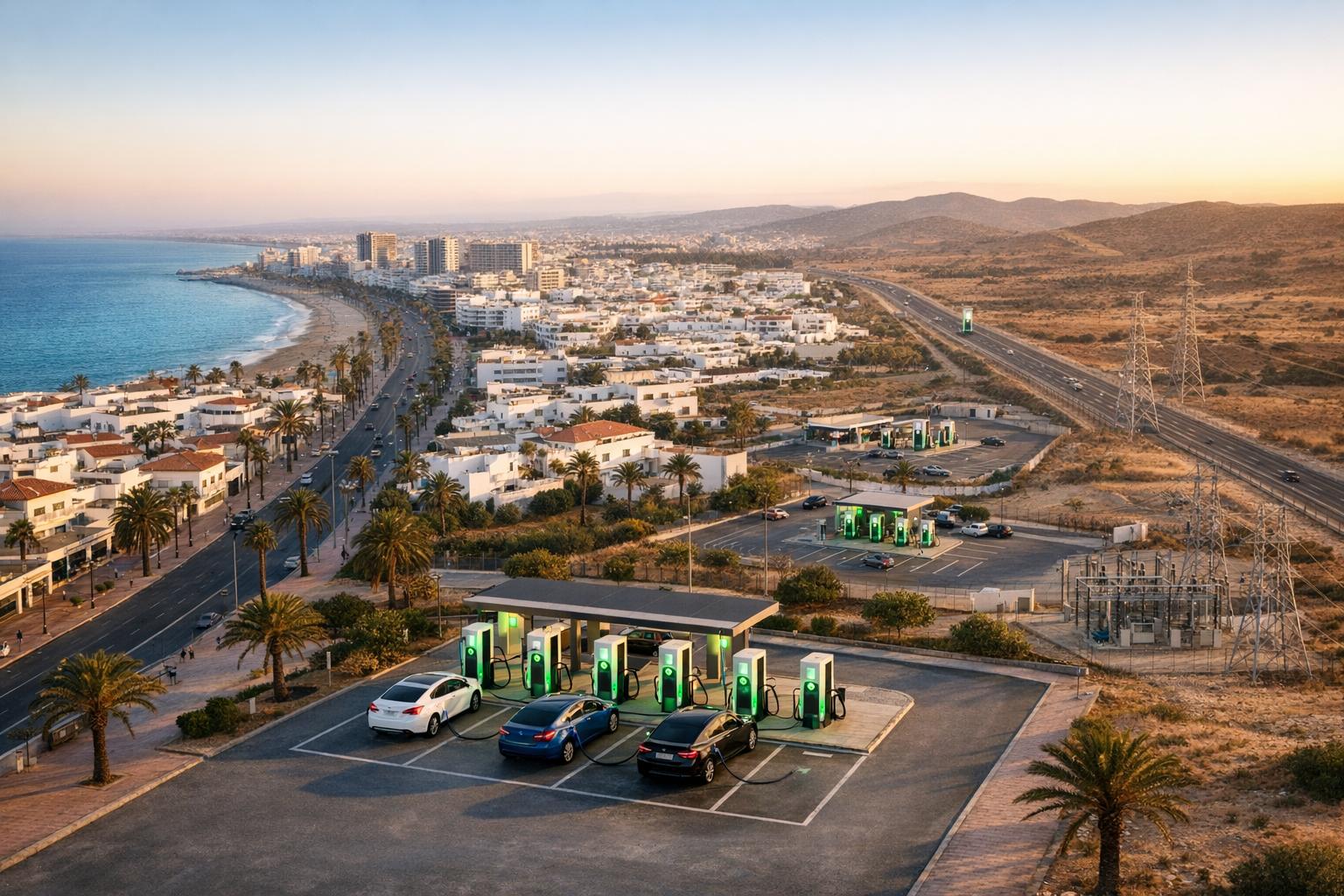
Morocco is making progress in its electric vehicle (EV) charging network, but challenges remain. Here’s a quick look at the current state and future plans:
- Current Infrastructure: By early 2026, Morocco had around 1,000 public charging stations. Urban areas like Casablanca, Marrakech, and Rabat dominate, while rural regions face limited access.
- Types of Chargers: Includes standard AC chargers (7.11–22 kW), fast DC chargers (50–180 kW), and new ultra-fast DC chargers (up to 360 kW).
- 2026 Goal: Add 2,500 stations, focusing on urban hubs and highways.
- 2035 Vision: Expand to 25,000 stations nationwide to support 2.5 million EVs.
- Key Challenges: Uneven distribution, rural access gaps, regulatory hurdles, and reliance on thermal energy for grid power.
Morocco’s efforts to scale its charging network are tied to its goals of reducing CO₂ emissions by 45.5% by 2030 and increasing renewable energy use to 52%. However, rural accessibility and private investment remain critical areas to address.
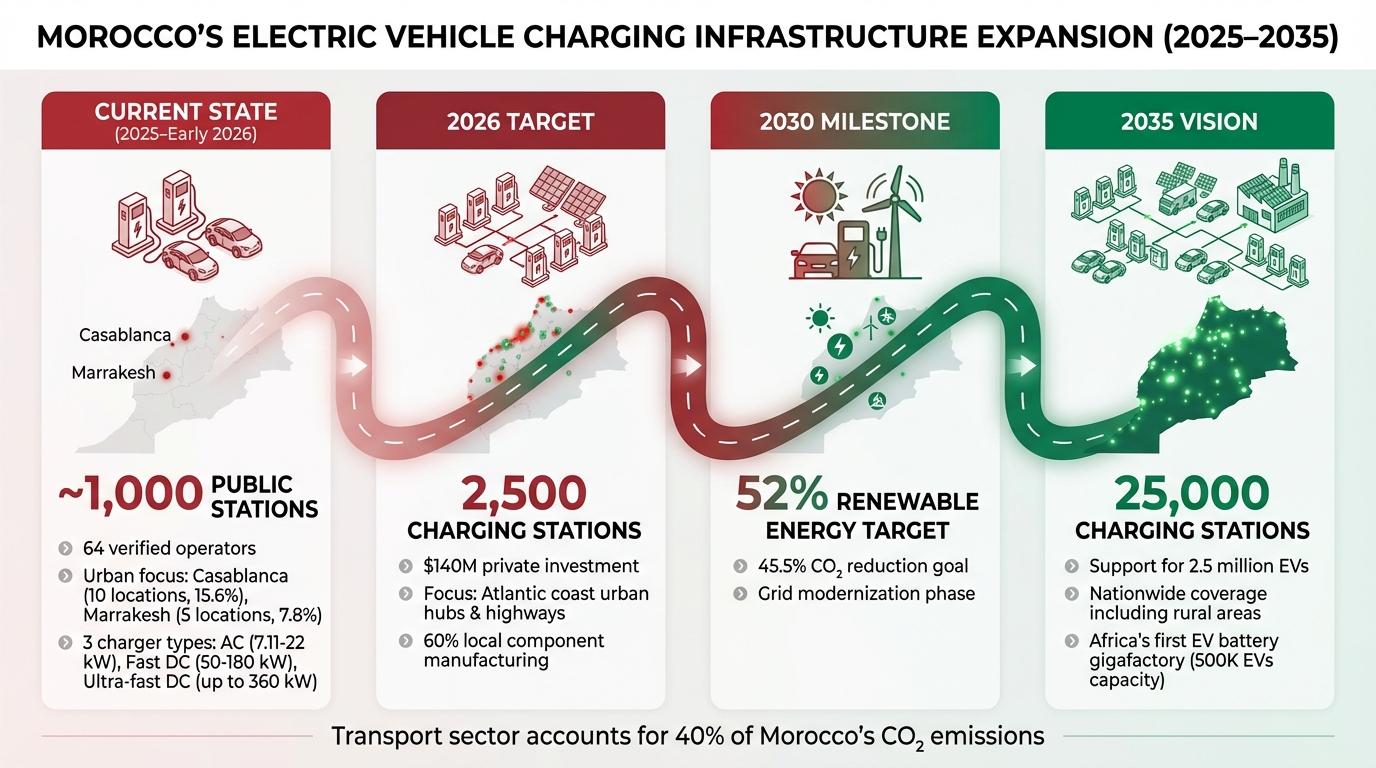
Morocco EV Charging Infrastructure Growth Roadmap 2026-2035
Current State of EV Charging Infrastructure in Morocco
Number and Types of Charging Stations
Morocco’s electric vehicle (EV) charging network is still in its infancy but is steadily growing. By late 2025, the country had around 1,000 public charging stations, predominantly located in urban areas. As of February 2026, 64 verified major charging station operators were active nationwide.
The network includes three main types of chargers:
- Standard AC chargers: Delivering between 7.11 kW and 22 kW, these are commonly found in places where vehicles stay parked for extended periods, such as homes, hotels, and rest stops.
- Fast DC chargers: With power outputs between 50 kW and 180 kW, these are strategically placed at gas stations and along highways for quicker charging.
- Ultra-fast DC chargers: The latest addition, these can deliver up to 360 kW. FASTVOLT launched the first ultra-fast station in January 2026, equipped with a solar canopy generating 60 kWp to reduce reliance on the grid. This station can charge up to six vehicles simultaneously. By early 2026, FASTVOLT had expanded to operate 200 charging connectors across 65 locations nationwide.
Where Charging Stations Are Located
Charging infrastructure in Morocco is heavily concentrated in urban areas, with rural and peri-urban regions lagging behind. Casablanca leads the pack with 10 verified charging locations, accounting for 15.6% of the national total. Marrakesh follows with 5 locations (7.8%), while cities like Fes, Rabat, and Tangier each host 4 locations (6.3%). Agadir and Mohammedia also feature prominently with 3 locations each (4.7%).
This urban-focused development has created so-called "charging deserts" in less populated areas. The Tangier–Agadir highway corridor sees the most activity, while provinces like Béni Mellal and Figuig have little to no coverage. Casablanca’s dominance is further highlighted by its share of national passenger vehicle sales, which stands at 41.1%.
"Morocco has only approximately 1,000 public charging stations in urban areas… this urban-focused strategy risks creating geographical disparities, and hindering nationwide adoption."
– Sara Meskine, School of Science and Engineering, Al Akhawayn University
sbb-itb-99e19e3
Government and Industry Plans for Network Expansion
2026 Targets: 2,500 New Charging Stations
Morocco has set its sights on establishing 2,500 public charging stations by the end of 2026. This effort is concentrated on key urban areas along the Atlantic coast, such as Casablanca, Tangier, and Rabat.
The initiative is spearheaded by the Association Professionnelle de l’Industrie de la Mobilité Électrique (APIME), which was formed in January 2023 to coordinate private-sector contributions with governmental ambitions. APIME collaborates with FENELEC (the national electrical federation) and ONEE (the Moroccan Office for Water and Electricity) to implement the National Plan for Electric Mobility.
Private companies in Morocco have committed $140 million to construct 5,000 charging stations by 2028, with the 2026 target serving as the initial phase of this broader effort. The plan employs a hybrid model: the government takes the lead in infrastructure development initially, with operations gradually transitioning to private entities between 2025 and 2030. Additionally, the strategy emphasizes local production, requiring that 60% of charging station components be manufactured within Morocco to boost domestic industry.
These measures represent the first steps in a much larger vision for the country’s electric mobility future.
2035 Vision: 25,000 Charging Stations
By 2035, Morocco aims to establish a vast network of 25,000 charging stations to support an anticipated 2.5 million electric vehicles on its roads. Achieving this goal will demand ongoing investments from both public and private sectors, with renewable energy serving as the backbone of the initiative.
The country’s target of generating over 52% of its energy from renewable sources by 2030 positions it to offer a sustainable and cleaner charging infrastructure. Morocco is also laying the groundwork for Africa’s first EV battery gigafactory through partnerships with companies like CDG Group, Gotion High-Tech, LG Chem, and Huayou Group. This facility is expected to produce lithium-ion cells and cathode materials for batteries capable of powering 500,000 EVs by 2026.
"Morocco is quietly orchestrating a transportation revolution that could redefine the continent’s mobility landscape… with plans to install 2500 public charging stations."
– Allen Kemigisa, Research & Communications Intern, AfriCGE
UK to Sahara in an EV Camper | Can I Charge in Morocco?
Challenges in Expanding Charging Infrastructure
Expanding Morocco’s charging network is no small feat. Despite ambitious plans, several hurdles remain that could slow progress.
Infrastructure Gaps and Rural Access Problems
Right now, Morocco’s charging stations are clustered along the Atlantic coast, creating vast "charging deserts" in rural areas. The bulk of the network is concentrated in the Casablanca-Rabat-Tangier region, leaving many rural communities without reliable access to charging points for long-distance travel.
Even looking ahead to 2026, the focus remains on urban centers, which could deepen the divide between urban and rural areas. This urban-centric growth risks creating a mobility system where electric vehicles serve city dwellers, while rural populations continue to depend on gasoline-powered cars. Complicating matters, the national grid – still 77.8% reliant on thermal energy – faces challenges in supporting high-power charging stations in remote areas.
These geographic disparities are further exacerbated by regulatory and financial roadblocks.
Funding and Policy Barriers
One of the biggest obstacles is a legal restriction that prohibits third parties from selling electricity directly to consumers. Charging operators have to resort to billing customers for services like parking time instead of charging for electricity consumed. This workaround makes it harder to build a sustainable business model, discouraging private investment in the sector.
There’s also a puzzling disconnect between Morocco’s industrial potential and EV adoption. The country can manufacture 40,000 EVs annually, yet battery electric vehicles accounted for just 0.6% of new car sales in 2024. This gap stems in part from fragmented governance and inconsistent regulations, which complicate the process of setting up and running charging stations. While the government does offer a $0.02 per kWh subsidy for green energy to encourage EV adoption, broader financial incentives remain scarce.
Comparison Table: Current vs. Planned Charging Infrastructure
Here’s a quick look at where the charging infrastructure stands today and where it’s headed:
| Infrastructure Phase | Station Count | Primary Geographic Focus |
|---|---|---|
| Current | ~1,000 | Casablanca, Rabat, Tangier, Agadir-Tangier highway |
| 2026 Target | 2,500 | Urban hubs and major highway corridors |
| 2035 Vision | 25,000 | Nationwide, including rural and secondary roads |
Conclusion: Building the Foundation for EV Growth
Morocco is at a critical juncture as it works toward installing 2,500 charging stations by 2026, with an ambitious vision of 25,000 by 2035. Achieving these milestones will require a united effort from public, private, and international stakeholders.
Public-private partnerships (PPPs) stand out as a key strategy to tackle earlier challenges. In October 2022, the Netherlands Enterprise Agency tasked EVConsult with creating a roadmap that begins with state-led network development and transitions operations to private entities between 2025 and 2030. This approach is already gaining traction, supported by prior commitments from private investors. EVConsult highlighted the broader benefits of this model:
"This approach [PPPs] gives the local economy a boost and offers numerous opportunities to collaborate with other African countries and beyond".
Upgrading the electrical grid and incorporating renewable energy are equally essential. Morocco’s target of sourcing 52% of its energy from renewables by 2030 presents a chance to power EVs with cleaner energy. This not only reduces strain on the grid but also supports faster charging capabilities.
Policy reforms will also play a pivotal role in overcoming regulatory hurdles. Standardizing connector types like CCS2 and adopting protocols such as OCPP can ensure compatibility across systems and attract further investment. Additionally, creating a centralized government body to coordinate efforts and share expertise could streamline development.
The groundwork is being laid, but Morocco’s EV future hinges on maintaining momentum. With the transport sector accounting for 40% of the nation’s CO2 emissions, expanding charging infrastructure – particularly in underserved rural areas – goes beyond convenience. It is a step toward economic resilience and environmental accountability, reinforcing Morocco’s goal to spearhead Africa’s transition to electric mobility.
FAQs
How easy is it to road-trip across Morocco in an EV today?
Road-tripping through Morocco in an electric vehicle (EV) is becoming easier thanks to an expanding network of charging stations in key cities like Casablanca and Marrakesh. These stations now include high-speed chargers, with some offering ultra-fast 360 kW capabilities to accommodate modern EVs. However, venturing beyond urban centers still poses challenges due to limited charging options in remote areas. For now, careful planning is essential for longer journeys, though ongoing investments aim to extend the network, paving the way for more seamless EV travel across the country.
Will chargers outside major cities be reliable by 2026?
By 2026, charging infrastructure outside Morocco’s major cities is set to improve considerably. The plan includes the installation of 2,500 charging stations, with recent advancements like a 360 kW ultra-fast charger highlighting the progress being made. These initiatives are designed to enhance accessibility and encourage the adoption of electric vehicles in less urbanized regions.
What laws are slowing down new charging stations?
Stricter technical inspection laws and tougher import regulations are slowing down the rollout of new charging stations in Morocco. These rules introduce additional compliance hurdles and lengthen administrative processes, creating challenges for efficiently expanding the country’s charging infrastructure.