
 Thabo Nkosi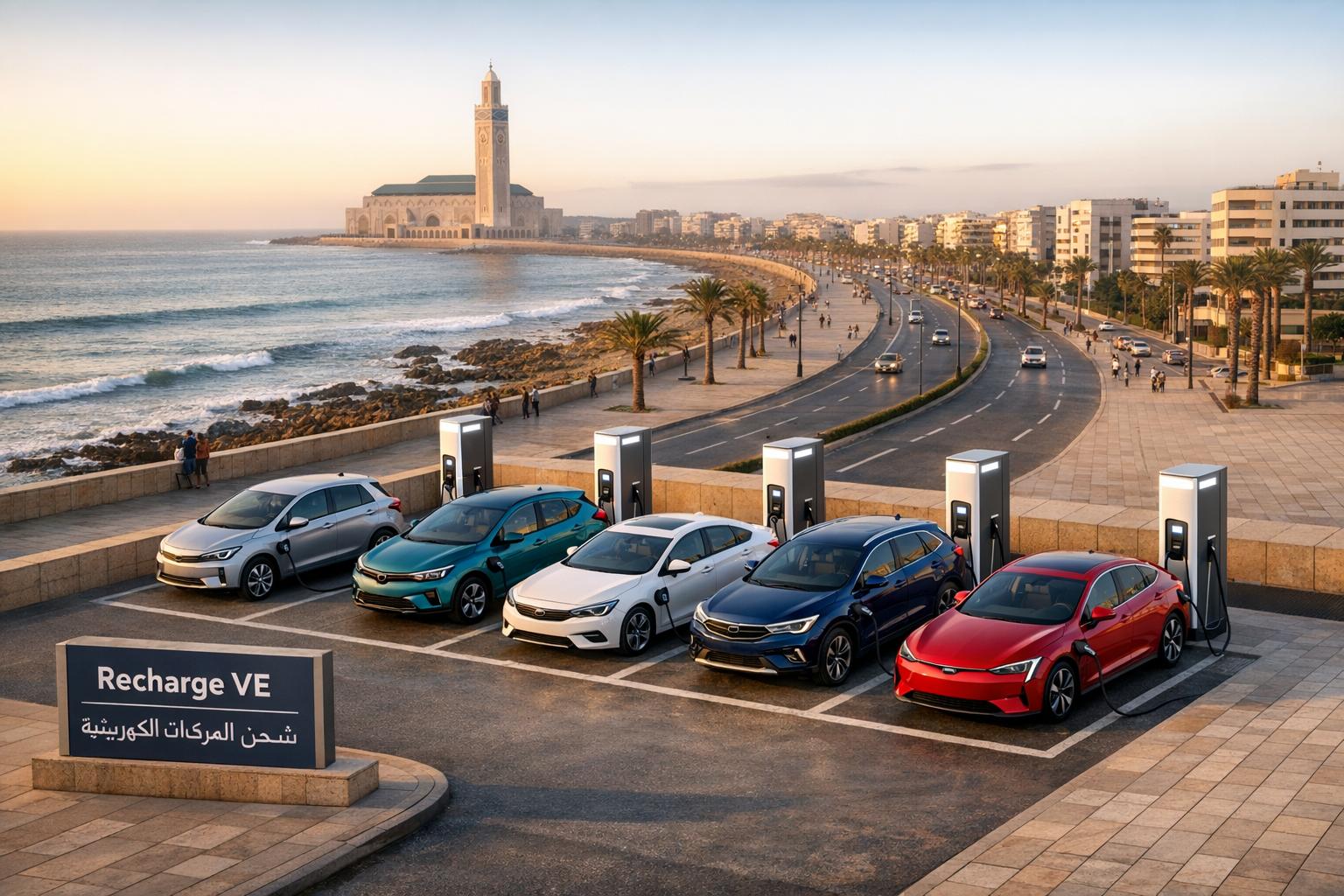
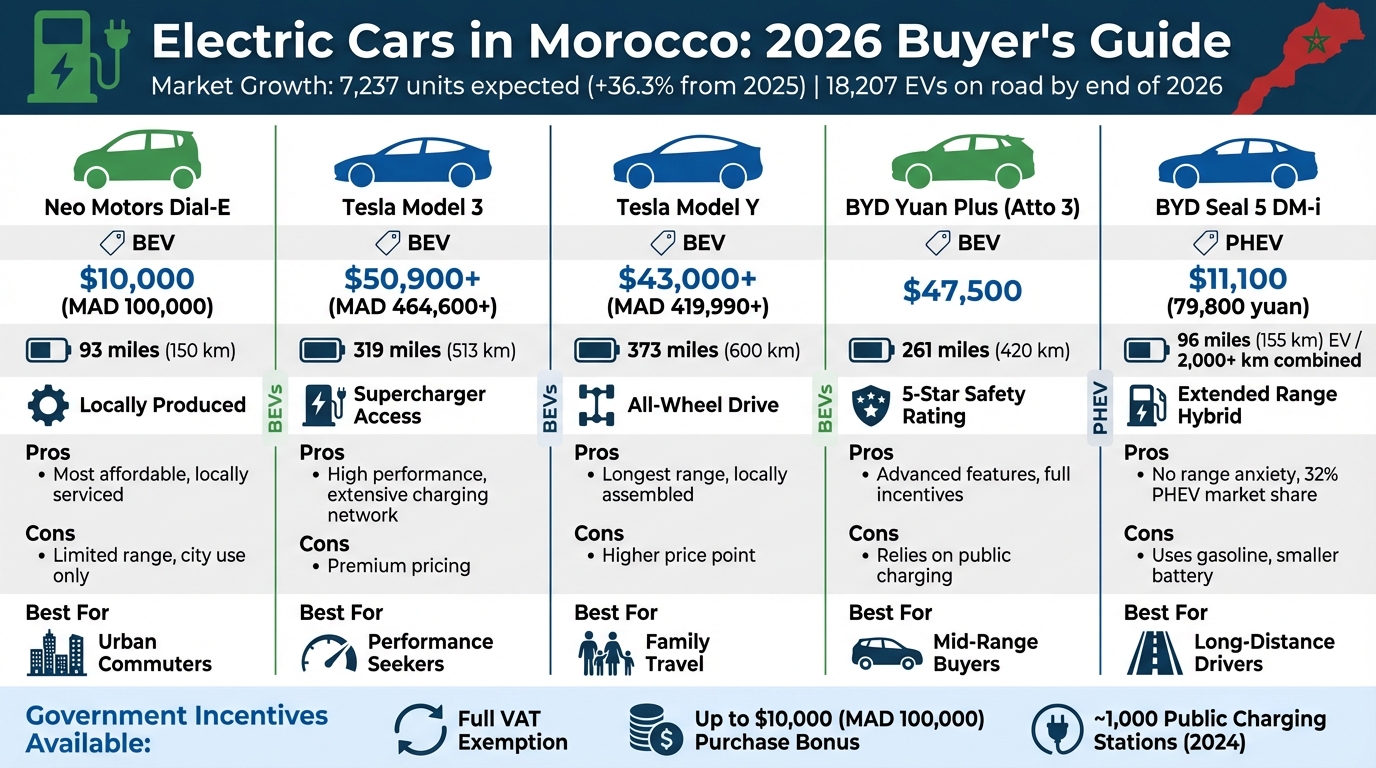
Morocco’s electric vehicle (EV) market is growing fast, with sales expected to reach 7,237 units in 2026 – a 36.3% jump from 2025. The country is also becoming a manufacturing hub, with local production like the Neo Motors Dial-E and Tesla‘s assembly plant in Kenitra. Government incentives, such as VAT exemptions and purchase bonuses up to $10,000, are driving adoption. Charging infrastructure is expanding, with around 1,000 public stations in 2024, supporting an estimated 18,207 EVs on the road by the end of 2026. Here’s a quick look at five EV options available in Morocco this year:
- Neo Motors Dial-E: Affordable city car priced at $10,000, with a 150 km range. Locally made and ideal for urban commuting.
- Tesla Model 3: High-performance sedan starting at $50,900, offering up to 319 miles of range and access to Tesla’s Supercharger network.
- Tesla Model Y: Compact SUV priced from $43,000, with up to 373 miles of range and all-wheel drive for varied terrains.
- BYD Yuan Plus (Atto 3): Mid-range crossover with a starting price of $47,500, offering up to 261 miles of range and advanced safety features.
- BYD Seal 5 DM-i: Plug-in hybrid priced around $11,100, combining electric efficiency with a gasoline engine for over 2,000 km of combined range.
Quick Comparison
| Model | Type | Price (USD) | Range (Electric) | Key Feature |
|---|---|---|---|---|
| Neo Motors Dial-E | BEV | $10,000 | ~93 miles | Affordable, locally produced |
| Tesla Model 3 | BEV | $50,900+ | ~319 miles | Supercharger access |
| Tesla Model Y | BEV | $43,000+ | ~373 miles | All-wheel drive |
| BYD Yuan Plus (Atto 3) | BEV | $47,500 | ~261 miles | Family-friendly features |
| BYD Seal 5 DM-i | PHEV | $11,100 | ~96 miles (EV) | Extended combined range |
Morocco’s EV market offers choices for every budget and need, from affordable city cars to premium options for long-distance travel.
Morocco 2026 Electric Vehicle Comparison: Price, Range, and Features
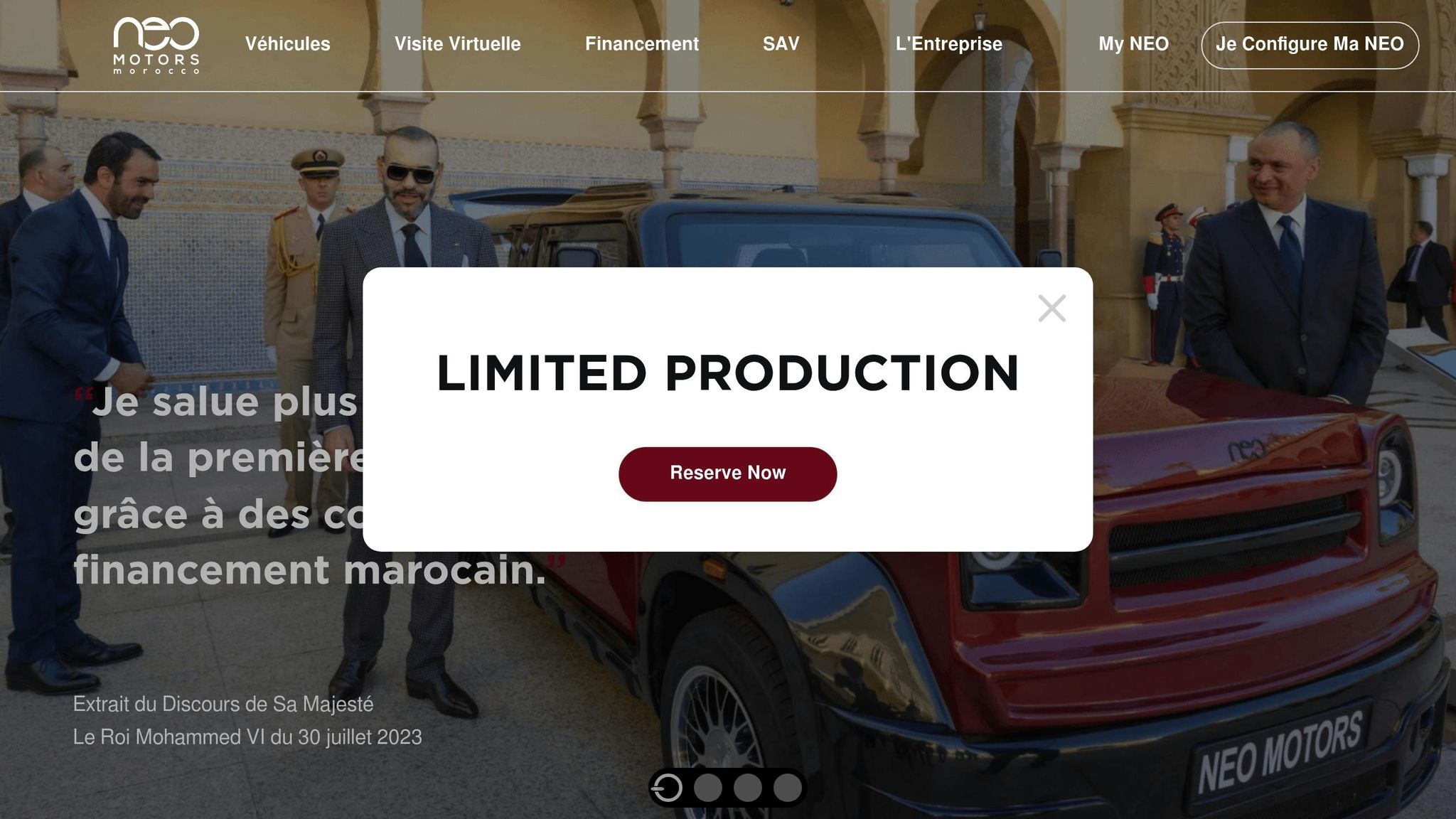
Neo Motors dévoile la première voiture électrique 100% marocaine
sbb-itb-99e19e3
1. Neo Motors Dial-E
The Neo Motors Dial-E began production in January 2026 at a 15,000-square-meter facility in Aïn El Aouda, near Rabat. This compact city car is a milestone achievement, becoming the first African EV to receive European homologation (category L7e-CU), allowing it to be exported to Europe.
Price
The Dial-E is priced between 99,800 and 100,000 MAD (around $10,000 to $10,740). This price point positions it as one of the most affordable entry-level EVs in Morocco. Buyers can also benefit from government incentives, such as full VAT exemptions and corporate purchase bonuses of up to 100,000 MAD, making it even more accessible.
Range
With a range of about 150 km (93 miles) per charge, the Dial-E is designed for short-distance travel and urban commuting. Its battery is fully compatible with Morocco’s existing charging infrastructure, ensuring convenience for daily use in city environments.
Performance
Built for urban settings, the Dial-E can reach speeds of 53 mph and carry loads between 770 and 880 pounds. This makes it a practical choice for light commercial tasks, including deliveries. In late 2025, Neo Motors partnered with logistics companies like La Voie Express and Building Logistique Services to integrate the Dial-E into urban delivery fleets. The company plans to produce 10,000 units annually by 2026. These features highlight its role in reshaping urban mobility in Morocco.
Suitability for Moroccan Conditions
The Dial-E’s compact design is perfect for navigating the narrow streets of cities like Casablanca and Rabat. With 25% to 55% of its components, such as the chassis, wiring, and upholstery, sourced locally, it also supports Morocco’s manufacturing sector. Nassim Belkhayat, CEO of Neo Motors Morocco, emphasized:
"With the Dial-E, we are taking a strategic step: this is not just a vehicle, it is proof that Morocco can produce reliable and exportable electric models".
As Morocco continues its shift toward electric mobility, the Dial-E stands out as an affordable, practical solution tailored to the needs of urban life.
2. Tesla Model 3
Tesla introduced the Model 3 sedan to Casablanca in February 2026. This electric vehicle comes in several configurations, including the Standard Range and Performance trims, catering to a variety of customer preferences.
Price
The Tesla Model 3 Standard Range is priced at approximately MAD 464,600 (around $50,900), while the Performance model comes in at MAD 566,300. These figures highlight its position as a high-end option in the market.
Range
The Standard Range version offers a driving range of 513 km (319 miles) on a 60 kWh battery, while the Performance trim delivers 507 km (315 miles) with an 82 kWh battery. Both models can charge from 10% to 80% in just 30 minutes.
Performance
The Model 3 Performance boasts an impressive 510 hp and 546 lb-ft of torque. It accelerates from 0 to 60 mph in just 3.1 seconds and reaches a top speed of 162 mph. Its dual-motor all-wheel drive system ensures better traction across different road conditions. Standard features include navigation, WiFi, and seamless smartphone integration.
Suitability for Moroccan Conditions
Tesla’s growing Supercharger network makes long-distance travel more convenient. With approximately 1,000 public charging stations available in Morocco as of 2024, the country’s EV infrastructure is steadily improving. However, the Model 3’s ground clearance of 5.5 inches might pose challenges on uneven rural roads or tall speed bumps often found in urban areas. The car is equipped with safety features like Lane Departure Warning and Electronic Stability Control, which are particularly helpful for navigating traffic-heavy cities such as Casablanca and Rabat.
Fred Lambert, Editor in Chief at Electrek, remarked:
"While Tesla will compete against BYD’s more affordable offerings, the brand’s premium positioning and Supercharger network could differentiate it in a market where charging infrastructure remains a challenge".
This blend of performance, technology, and Tesla’s charging network positions the Model 3 as a strong contender in Morocco’s growing electric vehicle market.
3. Tesla Model Y
On February 6, 2026, Tesla officially entered the North African market by launching the Model Y and Model 3 in Morocco. The Model Y, a compact SUV, is available in two versions: Propulsion (rear-wheel drive) and Premium (all-wheel drive). Each caters to different preferences and budgets.
Price
The Model Y Propulsion starts at MAD 419,990 (approximately $43,000), while the Premium version is priced at MAD 549,990 (around $56,000). This pricing positions the Model Y about MAD 30,000 higher than the entry-level Model 3, reflecting its larger size and increased functionality.
Range
The Propulsion model offers an impressive range of 534 km (332 miles), while the Premium version extends this to 600 km (373 miles). Tesla supports these ranges with 24 Supercharger stations strategically placed in major cities like Casablanca, Rabat, Marrakech, Tangier, Fès, and Agadir. These stations operate 24/7, making long-distance travel more convenient.
Performance
The Premium variant stands out with its all-wheel drive system, providing enhanced traction and stability across various terrains. To support its Moroccan customers, Tesla established Tesla Morocco in May 2025, investing MAD 27.5 million to offer official servicing, warranties, and parts through its Casablanca Marina headquarters. This setup ensures that the Model Y is well-suited for Morocco’s varied driving conditions.
Suitability for Moroccan Conditions
The Premium version’s all-wheel drive is an excellent match for Morocco’s diverse landscapes, from coastal roads to mountainous regions. Tesla’s direct-to-consumer online model also simplifies the buying process, allowing customers to configure and order their vehicles without visiting a dealership.
4. BYD Yuan Plus (Atto 3)
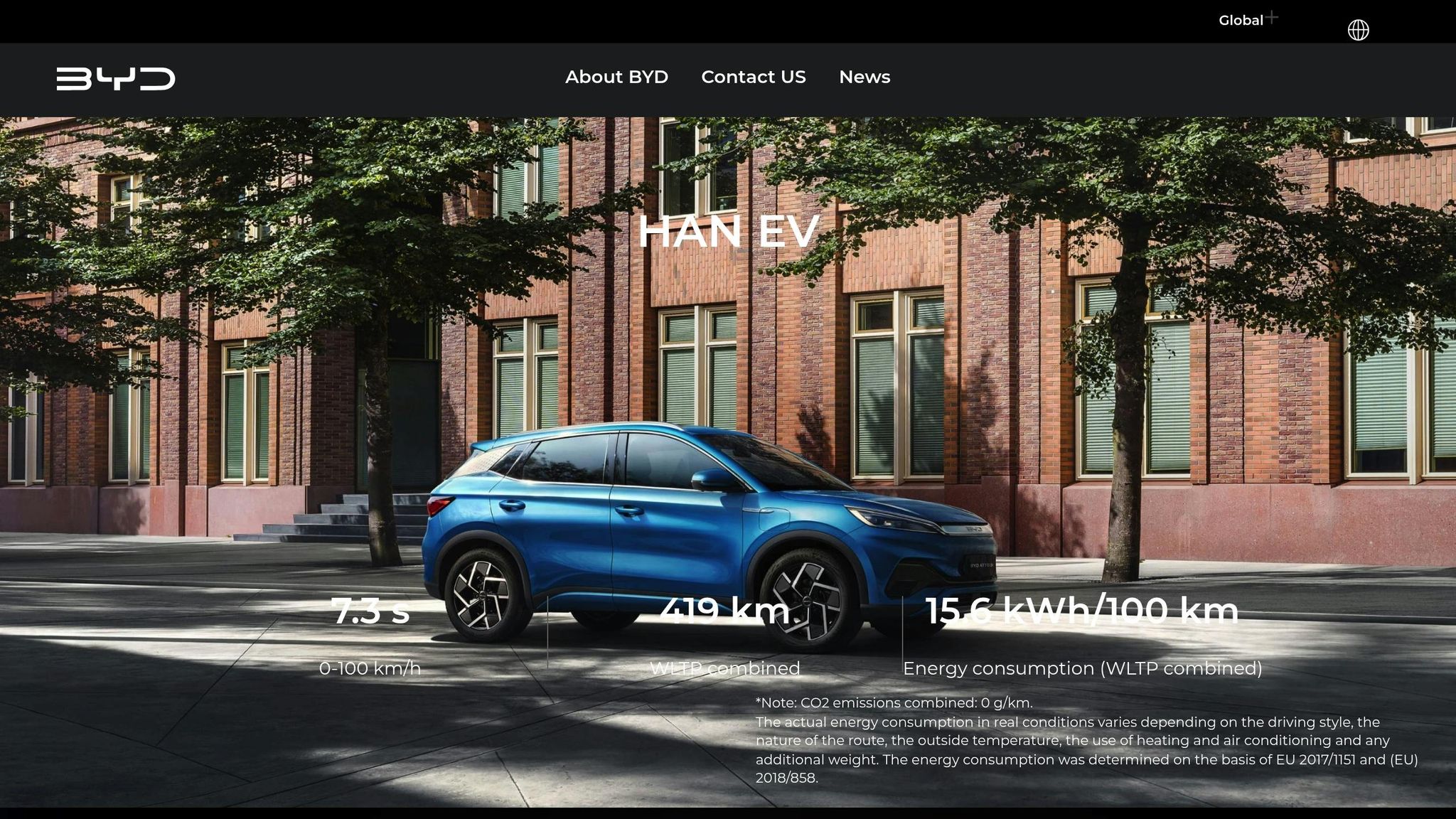
The BYD Yuan Plus, globally recognized as the Atto 3, adds another dimension to Morocco’s growing lineup of electric vehicles, following the footsteps of Tesla and Neo Motors.
This compact family crossover brings BYD’s advanced electric technology to the table. Built on the e-Platform 3.0, it features an 8-in-1 integrated powertrain and a Blade Battery (LFP) embedded in the floor, which enhances both structural rigidity and safety. With a starting FOB price of approximately $47,500, it serves as a mid-range contender in Morocco’s expanding EV market.
Range
The Atto 3 offers two battery configurations to suit different needs. The 49.92 kWh Standard Range model delivers around 345 km (214 miles) on the WLTP cycle, while the 60.48 kWh Extended Range version provides up to 420 km (261 miles). The Extended Range option is especially appealing for those who frequently travel between cities. For recharging, DC fast charging can restore the battery from 30% to 80% in about 30 minutes, while AC charging is ideal for overnight replenishment.
Performance
Under the hood, the Atto 3 is powered by a 150 kW (204 HP) motor, enabling it to accelerate from 0 to 100 km/h in just 7.3 seconds. Its top speed is capped at 160 km/h to optimize energy usage. Safety-wise, the vehicle has earned a 5-star Euro NCAP rating, with scores of 91% for adult occupant protection and 89% for child occupant protection. Its front-wheel drive and multi-link independent rear suspension strike a balance between maneuverability in city driving and stability on less predictable roads.
Adaptation to Moroccan Conditions
The Atto 3 is well-suited for Morocco’s diverse climate. It comes equipped with a standard heat pump system, ensuring efficient battery performance and comfortable cabin conditions in both hot summers and cooler winters. The Blade Battery’s high thermal stability further enhances its reliability in high-temperature scenarios. With a cargo capacity of 440 liters, expandable to 1,338 liters, and CCS2 charging compatibility, it’s versatile enough for daily commutes or longer trips. This combination of range, performance, and adaptability makes the Atto 3 a strong mid-range option for Morocco in 2026.
5. BYD Seal 5 DM-i
The BYD Seal 5 DM-i adds a fresh choice to Morocco’s electric mobility scene as a plug-in hybrid (PHEV). It uses BYD’s fifth-generation DM-i technology, offering drivers a mix of electric efficiency for daily commutes and the convenience of a gasoline engine for longer journeys.
Price
While pricing in Morocco hasn’t been finalized, the 2026 128 km Luxury variant is priced at approximately $11,100 (79,800 yuan) in China. Positioned between other BYD models, the Seal 5 DM-i is aimed at families seeking affordable running costs and versatile functionality.
Range
The Seal 5 DM-i comes with multiple battery options, offering electric-only ranges of 55 km, 128 km, or up to 155 km on the CLTC cycle. The 128 km version features a 15.87 kWh battery, which is 133% larger than earlier models. For urban driving in cities like Casablanca or Rabat, this range easily covers most daily trips. Once the battery runs out, fuel consumption remains low at 3.08 L/100 km (WLTC), and with a 65-liter fuel tank, the combined range exceeds 2,000 km.
Performance
Under the hood, the Seal 5 DM-i combines a 1.5L engine (74 kW) with a 120 kW electric motor. This setup delivers a 0-100 km/h acceleration time of 7.6 seconds and a top speed of 180 km/h. The engine achieves a thermal efficiency of 46.1%. Drivers can switch between four driving modes – Sports, Economy, Standard/Comfort, and Snow – depending on road conditions. The E-CVT transmission, paired with MacPherson independent front suspension and a torsion beam rear layout, ensures a smooth ride on both city streets and rural roads. These features are tailored to meet the demands of Morocco’s varied driving environments.
Suitability for Moroccan Conditions
The Seal 5 DM-i is designed with Morocco’s growing charging infrastructure and diverse terrain in mind. Its 17 kW DC fast-charging capability can recharge the battery from 30% to 80% in about 20 minutes, making it a practical option for urban drivers. The car’s body construction includes 61.2% galvanized steel plates to resist rust, which is especially useful in coastal regions. It features a Blade Battery (LFP) with improved thermal stability and a built-in low-temperature heating system for colder areas. With a trunk capacity of 508 liters and rear seats that fold in a 4/6 split, the Seal 5 DM-i offers plenty of space for family use, making it a practical choice in regions where charging stations are still being developed.
Pros and Cons
Electric cars available in Morocco in 2026 come with their own set of advantages and limitations. Take the Neo Motors Dial-E, for instance. Priced at approximately $10,000 (MAD 100,000), it’s the most budget-friendly option, perfect for city driving. However, its 150 km range means it’s best suited for short commutes within urban areas.
For those seeking more range and performance, the Tesla Model 3 and Model Y stand out. They not only offer access to Tesla’s exclusive Supercharger network but also benefit from local assembly in Kenitra, which improves service and parts availability. Meanwhile, BYD models offer a mix of competitive pricing and advanced features. The Yuan Plus (Atto 3) is particularly attractive, thanks to Morocco’s VAT exemption and reduced customs duties, making it a strong mid-range choice. On the other hand, the BYD Seal 5 DM-i, a plug-in hybrid, addresses range anxiety with its extended combined range but still relies on gasoline. BYD has already proven its appeal, capturing 32% of Morocco’s PHEV market in 2024.
While all these models benefit from government incentives, the country’s charging infrastructure remains limited. Tesla’s Supercharger network gives it an edge, while Neo Motors’ domestic production ensures better access to local services. Below is a quick comparison of the key features and drawbacks of each model:
| Model | Type | Approx. Price | Range | Key Advantage | Key Disadvantage |
|---|---|---|---|---|---|
| Neo Motors Dial-E | BEV | $10,000 (MAD 100,000) | ~150 km | Affordable; locally produced | Limited range; city use only |
| Tesla Model 3 | BEV | Higher entry price | High | Supercharger network access | Premium pricing |
| Tesla Model Y | BEV | Higher entry price | High | Local assembly; Supercharger access | Premium pricing |
| BYD Yuan Plus | BEV | Mid-range | Moderate/High | Advanced features; full incentives | Relies on public charging |
| BYD Seal 5 DM-i | PHEV | Mid-range | Extended combined range | Addresses range anxiety; market leader | Uses gasoline; smaller battery |
Fleet operators also have a lot to gain, with EV purchase bonuses reaching up to MAD 100,000 ($10,000). The passenger EV market is expected to grow by 36.3% in 2026, with projected sales hitting 7,237 units. This outlook explains why both individual buyers and corporate fleets are increasingly turning to these electric options.
Conclusion
Morocco’s 2026 EV market offers a variety of options tailored to different driving needs. For urban commuters on a budget, the Neo Motors Dial-E stands out as an affordable choice. Designed specifically for local conditions, it provides easy access to maintenance and suits city driving perfectly. However, potential buyers should weigh the availability of charging infrastructure if they plan on occasional longer trips.
For those prioritizing long-distance travel, Tesla’s Model 3 and Model Y deliver impressive range and reliable service. With local assembly and a dedicated Supercharger network, Tesla has made strides in supporting Moroccan EV drivers. As Remeredzai Joseph Kuhudzai highlighted:
"Morocco was always going to be the first [African country for Tesla], given its proximity to Europe… Tesla opened a Supercharger network in Morocco a while ago".
Drivers concerned about charging limitations may find the BYD Seal 5 DM-i plug-in hybrid an appealing alternative, easing range anxiety with its hybrid capabilities. Notably, BYD commands a 32% share of Morocco’s plug-in hybrid market. Meanwhile, the BYD Yuan Plus (Atto 3) offers a compelling option for those seeking a fully electric vehicle, combining competitive pricing with advanced features.
FAQs
Which EV is best for long road trips in Morocco?
The Hyundai Ioniq 9 is shaping up to be a great option for long road trips in Morocco by 2026. With a range of 620 km (WLTP) and fast-charging capabilities, it’s designed to handle extended journeys with ease, offering both convenience and efficiency.
Can I charge an EV at home in Morocco?
Yes, you can charge an EV at home in Morocco. The country is working to expand its charging infrastructure, with a goal of installing 2,500 charging stations by 2026 to support the shift to electric vehicles. This development makes home charging a convenient and practical choice for EV owners.
Which incentives can reduce the real purchase price?
In Morocco, several measures are in place to make electric vehicles more affordable. These include a 0% VAT exemption, waived customs duties, and government-backed subsidies for electric bikes. On top of that, investments in charging infrastructure are helping to lower the overall cost of owning an electric vehicle. Together, these initiatives are designed to make electric mobility a more accessible option for consumers.