
 Thabo Nkosi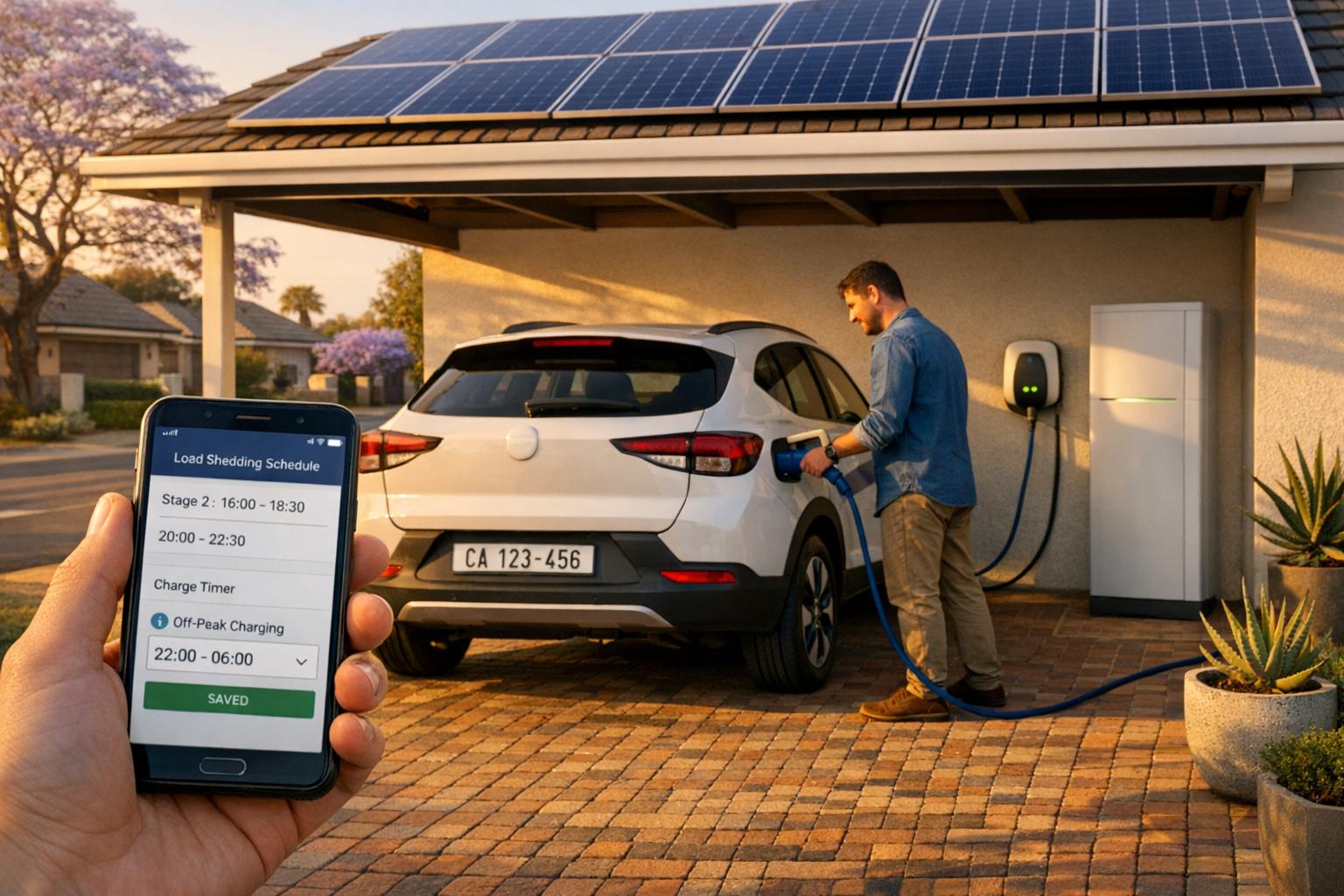
Charging an electric car in South Africa is challenging due to limited infrastructure and frequent load-shedding. Here’s what you need to know to make it work:
- Public Charging: South Africa has around 600 public charging stations, mostly in urban areas like Gauteng, Western Cape, and KwaZulu-Natal. Rural areas have minimal coverage, and load-shedding can disrupt these chargers unless they have battery or solar backups.
- Home Charging: Installing a Level 2 home charger costs $650–$1,770 (R11,000–R30,000) and offers greater reliability. Solar-powered setups, while more expensive upfront ($7,370–$8,850 or R125,000–R150,000), eliminate reliance on the grid during outages.
- Solar-Powered Public Stations: Off-grid solar stations are emerging, ensuring uninterrupted charging even during load-shedding. These are particularly useful for long-distance travel along major highways.
- Cost Savings: Charging at home costs significantly less than gas, with monthly electricity expenses for EVs around $25 (R421) compared to $153 (R2,592) for fuel.
- Tools and Strategies: Apps like EV24.africa and the CHARGE app help locate operational charging stations, while planning around load-shedding schedules or using solar setups ensures consistent charging.
Whether you rely on home charging, public stations, or solar-powered options, careful planning is essential to navigate South Africa’s EV charging challenges.
South Africa’s EV Charging Infrastructure: Current State
Public Charging Stations Are Few and Far Between
South Africa currently has between 500 and 600 public charging stations, with an average of 11 EVs per station projected by late 2024 – up from 7 in mid-2023. However, the issue isn’t just the total number of stations; it’s also about where they’re located. Most chargers are concentrated in Gauteng, Western Cape, and KwaZulu-Natal, leaving rural areas with far fewer options. For instance, as of May 2025, Gauteng boasted 29 free charging stations, while Limpopo had just one. Similarly, provinces like the Northern Cape and North West rely heavily on a small number of strategically placed chargers along highways.
On the bright side, progress has been made along key national routes, making long-distance EV travel more manageable. Highways like the N1, N2, and N3 now feature near-continuous charger coverage. But if you’re heading to smaller towns or remote areas, you’ll still need to plan carefully – home charging often becomes a necessity. Add load-shedding into the mix, and accessing reliable public charging becomes even more challenging.
How Load-Shedding Disrupts EV Charging
Load-shedding poses a major obstacle for grid-dependent charging stations. During scheduled power outages, these stations often go offline, leaving drivers stranded without charging options. As ChargePoint SA explains:
"Public EV charging stations stop working during load shedding. Unlike home charging where you can plan around schedules or use solar backup, public charging offers no control."
To tackle this, some operators are incorporating battery storage and solar power into their setups. For example, in December 2024, CHARGE (formerly Zero Carbon Charge) launched South Africa’s first fully off-grid solar-powered EV charging station on the N12 between Klerksdorp and Wolmaransstad. This facility includes six DC fast chargers and two AC chargers, delivering over 700 kW of combined output through solar panels and battery storage, ensuring uninterrupted operation during grid outages.
Still, most public chargers remain vulnerable to load-shedding. Drivers are encouraged to consult load-shedding schedules and use real-time apps to check station availability. These solutions highlight the importance of planning ahead when relying on public EV chargers in South Africa.
Companies Building South Africa’s Charging Network
Several companies are stepping up to address the gaps in South Africa’s EV charging infrastructure:
- GridCars: This operator manages 350–450 charging points nationwide, with about 85% offering DC fast charging.
- Rubicon: As the second-largest operator and Tesla energy product distributor in South Africa, Rubicon aims to expand its network to 200 stations by February 2026. Between January and February 2026, the company added 11 new charging stations in the Eastern Cape, nine of which support DC fast charging, through a partnership with the Automotive Industry Development Centre (AIDC) Eastern Cape. Hilton Musk, Head of E-Mobility at Rubicon, notes:
"Expansion is important, but it comes at a cost and requires support from various stakeholders."
- Chargify: In partnership with Mercedes-Benz South Africa, Chargify is scaling its network. By late 2023, the two companies had invested $2.4 million (R40 million) in 127 new charging stations. By July 2024, 67 EQ-branded stations were operational, with the rest slated for completion by 2026.
- CHARGE: Focused on solar-powered solutions, CHARGE is building a network of 120 stations for passenger vehicles and another 120 for trucks by 2026. In November 2025, the company began work on two ultra-fast chargers along the N3 corridor, located approximately 112 miles (180 km) from Johannesburg and 124 miles (200 km) from Durban.
Despite these developments, the pace of expansion has slowed in early 2026. Operators are waiting for EV adoption rates to rise while grappling with higher infrastructure costs and bureaucratic challenges. For instance, Rubicon has avoided investing in Pretoria due to the city’s Basic Charge policy, which makes installations financially unviable.
sbb-itb-99e19e3
EV Charging Costs In SOUTH AFRICA | Feat. Alfa Romeo Junior
Home Charging: A Reliable Alternative
With limited public charging options and frequent power outages, home charging has become the go-to solution for many electric vehicle (EV) owners. Setting up a dedicated charging system at home gives you complete control over your charging schedule, sparing you the hassle of searching for public stations or dealing with unexpected grid failures. Two popular options – Level 2 charging and solar-powered setups – can provide dependable charging at home.
Installing a Level 2 Home Charger
A Level 2 charger connects to a 240V circuit and delivers 30–60 km (18–37 miles) of range per hour of charging. That’s a massive upgrade compared to a standard 3-pin socket, which adds just 10–15 km (6–9 miles) per hour and carries a higher fire risk.
To install one, you’ll need a certified electrician to evaluate your home’s Distribution Board (DB), parking setup, and cable routing [17, 19]. The electrician must be registered with the Department of Employment and Labour to ensure your installation meets legal standards. You’ll also need a valid Certificate of Compliance (CoC), which is required for insurance purposes under SANS 10142-1 regulations [17, 18].
Here’s a breakdown of the costs:
- 7kW smart charger unit: $470–$1,060 (R8,000–R18,000)
- Installation labor: $150–$295 (R2,500–R5,000)
- Type B RCD for DC fault detection: $70–$177 (R1,200–R3,000)
- Surge protection: Additional cost to safeguard against voltage spikes after power outages [17, 20].
Altogether, installation costs range from $650–$1,770 (R11,000–R30,000), depending on the complexity [17, 19].
To illustrate the savings, ChargePoint SA analyzed the costs for a BYD Atto 3 owner in Johannesburg. Driving about 745 miles (1,200 km) per month, the owner spent $25 (R421) on electricity at $0.12/kWh (R1.95/kWh), compared to $153 (R2,592) on gas. That’s a monthly savings of $128 (R2,171), meaning the $885 (R15,000) installation cost could be recovered in just seven months.
If you live in an apartment or sectional title property, you’ll need approval from the Body Corporate, which can delay installation by two to six weeks [17, 20]. Planning to own multiple EVs? Consider a three-phase 11kW or 22kW charger, or install a load-management system to prevent breaker trips [17, 19].
For uninterrupted charging during outages, a solar-powered setup is worth considering.
Solar-Powered Charging at Home
Pairing solar panels with battery storage allows you to charge your EV even during power outages. This setup typically includes three key components: solar panels, a hybrid inverter, and lithium-ion batteries [21, 23].
Smart inverters prioritize energy use as follows: first from solar panels, then from battery storage, and finally from the grid. George Mienie, CEO of AutoTrader, uses this system to power his Jaguar I-Pace (90kWh battery). His setup includes a 12kW inverter and lithium-ion batteries. By plugging in at 7:30 AM, he achieves a full charge by noon using a mix of direct sunlight and stored energy. To handle outages, he limits his battery discharge to 50%, ensuring enough reserve power for essential home needs.
"Solar inverters are set up to prioritize the energy drawn from the solar panels first and then from Lithium-ion batteries. And only then… to then pull electricity from the grid." – George Mienie, CEO, AutoTrader
A 5kW solar system with a 10kWh battery costs between $7,370 and $8,850 (R125,000–R150,000). While the upfront cost may seem steep, these systems often pay for themselves in four to six years in South Africa. For EV owners, it’s essential to add 200–400 kWh per month to your system’s capacity to cover your charging needs.
Before sizing your solar array, conduct a home energy audit. High-energy appliances, like water heaters, can make up 30–40% of your electricity use. Switching to heat pumps or solar water heaters can lower your energy demands and reduce the size – and cost – of your solar setup. As with Level 2 chargers, a licensed electrician must provide a CoC to meet insurance requirements.
Public Charging: What to Expect
While home charging offers convenience, public charging plays a crucial role for longer trips and quick top-ups. In South Africa, as of late 2025, there are around 600 public charging stations, with most located in Gauteng, Western Cape, and KwaZulu-Natal. The country maintains about one public charger for every seven registered EVs, which is better than the global average.
However, load-shedding remains a significant challenge. Like home charging, public stations can also lose power during outages unless equipped with backup systems. Premium networks tend to have higher reliability due to battery backups. To avoid unnecessary trips, use mobile charging apps to check real-time availability before heading to a station.
Fast Chargers vs. Standard Chargers
Public chargers are generally divided into two categories: standard AC chargers and DC fast chargers. Each serves a distinct purpose, depending on your charging needs and time constraints.
- Standard AC chargers (7–22 kW) are perfect for longer stops, such as shopping malls, hotels, or workplaces. For instance, a 22 kW AC charger can add about 140 km (87 miles) of range to a Volvo EX30 in an hour. The cost is approximately $0.35/kWh (R5.88/kWh), and some locations – like shopping centers and dealerships – offer free charging. There are at least 64 free public charging spots nationwide as of May 2025.
- DC fast chargers (50–150 kW) are designed for quick stops along highways and at petrol stations. These chargers can add significant range in just 30–60 minutes but are pricier, costing between $0.41 and $0.43/kWh (R7.00–R7.35/kWh). According to Winstone Jordaan, MD of GridCars:
"DC chargers have two purposes: speed and convenience, with current-gen chargers being able to handle 200km in 20 minutes".
| Feature | Standard (AC) Charging | Fast (DC) Charging |
|---|---|---|
| Typical Speed | 7 kW – 22 kW | 50 kW – 150+ kW |
| Charging Time | 4–8 hours for a full charge | 30–60 minutes for a top-up |
| Common Locations | Malls, hotels, workplaces | Highways, petrol stations |
| Cost (per kWh) | ~$0.35 (R5.88) | ~$0.41–$0.43 (R7.00–R7.35) |
| Range Added (Example) | 140 km (87 miles) per hour | 200 km (124 miles) in 20 minutes |
| Best For | Long-stay parking | Road trips or quick stops |
AC chargers are ideal when you have time to spare, like during shopping or overnight stays, while DC fast chargers are better suited for road trips when every minute counts.
Off-Grid Solar Charging Stations
To address reliance on the grid, off-grid solar-powered charging stations are emerging as a game-changer. These stations use solar panels and battery storage to operate independently of the national grid, offering uninterrupted service even during load-shedding. One notable example is South Africa’s first fully off-grid station, opened by Zero Carbon Charge (now called CHARGE) in November 2024. Located on the N12 between Klerksdorp and Wolmaransstad, the station features:
- 480 bifacial solar panels producing 280 kW
- A 546 kWh liquid-cooled battery
- Four ultra-fast DC chargers (up to 480 kW)
- A 250 kVA generator running on hydrotreated vegetable oil (HVO), which cuts emissions by 90% compared to diesel.
"CHARGE Charging stations are powered by solar energy and therefore completely independent from the national grid. They offer a resilient, stable charge regardless of grid instability and unpredictable electricity prices." – Zero Carbon Charge
CHARGE plans to build 120 solar-powered stations for passenger vehicles, spaced roughly 93 miles (150 km) apart along major routes like the N1 and N3. Two new stations are scheduled to open in 2026 – one in the Free State (112 miles/180 km from Johannesburg) and another in KwaZulu-Natal (124 miles/200 km from Durban). These hubs will include 24/7 security, farm stalls, and Wi-Fi. Ultra-fast chargers at these locations can boost your battery from 10% to 80% in about 25 minutes.
For long-distance travelers, these off-grid stations provide peace of mind by eliminating range anxiety. The CHARGE mobile app helps locate stations, check availability, and manage payments seamlessly.
Tools and Strategies for EV Charging in South Africa
Navigating South Africa’s EV charging scene requires a mix of smart digital tools and careful planning. With load-shedding affecting power availability, using the right apps and strategies can make all the difference for EV drivers.
Finding Charging Stations with EV24.africa
EV24.africa is a go-to platform for EV drivers in South Africa, offering real-time updates on station availability, session management, and payment options. Its live map feature helps users locate chargers, check their current status, and plan routes efficiently. If you’re using the CHARGE network’s off-grid solar stations, the CHARGE mobile app is a must-have. It allows you to find nearby stations, confirm availability, and pay directly through the app. To save time, keep the app ready to scan the QR code on the charger for a quick session start.
These tools not only make charging more convenient but also tie into broader strategies for managing load-shedding challenges.
Managing Charging During Load-Shedding
While digital tools are helpful, successfully charging your EV during load-shedding requires some strategic thinking. In cities like Johannesburg, where around 95% of EV owners rely on home charging, understanding load-shedding schedules is crucial. A practical approach is trickle charging – plugging in for short periods (one to two hours) during available power slots. This keeps your battery topped up without waiting for a full overnight session.
Another option is cross-zone charging. If your usual charging station or home is affected by load-shedding, drive to a nearby area or dealership in a different load-shedding zone where power is available. For those seeking even greater reliability, installing a solar + battery storage system at home can be a game-changer. AutoTrader CEO George Mienie suggests configuring your solar inverter to prioritize solar energy first, then battery storage, and finally the grid. He also recommends setting a discharge limit (e.g., 50%) to ensure backup power for essential appliances during outages. To get the most out of your solar setup, plug in during peak sunlight hours (7:30 AM–12:00 PM) to use solar power directly and avoid draining your home battery unnecessarily.
These strategies, combined with the right tools, can help EV drivers stay charged and on the road, even in challenging conditions.
Grid-Connected vs. Off-Grid Charging: A Comparison
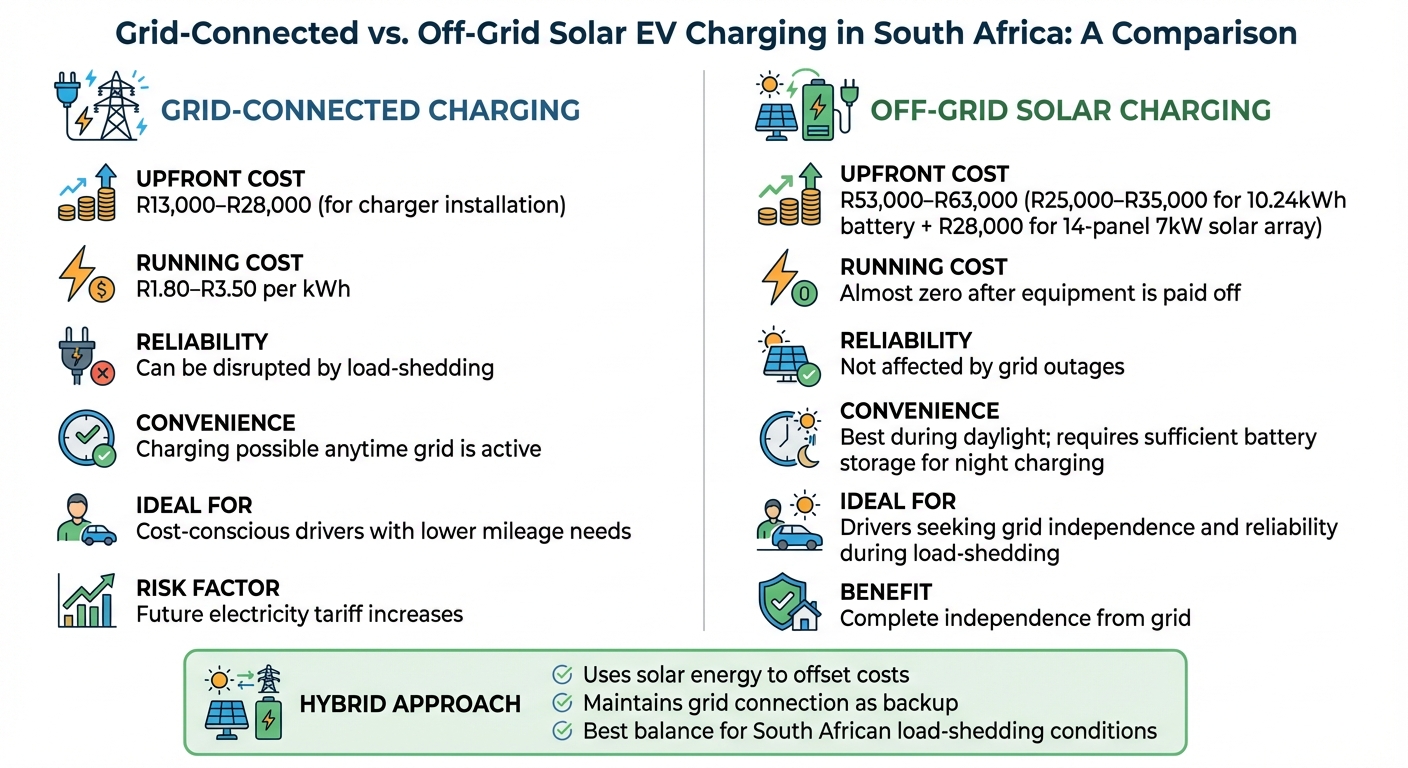
Grid-Connected vs Off-Grid Solar EV Charging Costs and Benefits in South Africa
Deciding between grid-connected and off-grid solar charging comes down to your budget and daily driving needs. Both options involve a trade-off: higher upfront costs versus long-term savings and reliability.
Grid-connected charging is the more straightforward and affordable option to start with. Installing a standard 7kW Level 2 charger typically costs between R13,000 and R28,000. With this setup, you pay residential electricity rates, which usually range from R1.80 to R3.50 per kWh. This makes the cost of running an EV roughly one-third to one-half that of a comparable petrol vehicle. However, load-shedding can disrupt charging for hours unless you have a system that resumes charging automatically when power is restored. Additionally, you’ll need to account for the risk of future electricity tariff increases.
Off-grid solar charging, while requiring a larger upfront investment for batteries and solar panels, provides independence from the grid. For instance, a 10.24kWh battery system – enough to cover the energy needed for an average daily commute of 43km – costs between R25,000 and R35,000. Adding a 14-panel solar array (approximately 7kW) would cost around R28,000, completing the setup. While the initial expense is higher, this approach eliminates reliance on the grid and can ultimately lower long-term costs.
Given South Africa’s frequent load-shedding, understanding these options is essential for ensuring a reliable charging solution.
Advantages and Disadvantages of Each Option
| Feature | Grid-Connected Charging | Off-Grid Solar Charging |
|---|---|---|
| Upfront Cost | Lower (R13,000–R28,000 for charger installation) | Higher (R25,000–R35,000 for battery + R28,000 for panels) |
| Reliability | Can be disrupted by load-shedding | Not affected by grid outages |
| Running Cost | R1.80–R3.50 per kWh, with risk of tariff increases | Almost zero after equipment is paid off |
| Convenience | Charging is possible anytime the grid is active | Best during daylight; requires sufficient battery storage for night charging |
| Ideal For | Cost-conscious drivers with lower mileage needs | Drivers aiming for grid independence and reliability during load-shedding |
In South Africa, many EV owners are opting for a hybrid approach. This setup uses solar energy to offset costs while maintaining a grid connection as a backup for cloudy days or periods of high usage. With load-shedding being a persistent issue, this strategy offers a practical balance between cost savings and reliability, ensuring uninterrupted charging.
Conclusion
Charging an EV in South Africa requires a thoughtful mix of strategies. For most, home charging is the cornerstone – it’s the most cost-effective and convenient solution for daily use. However, frequent load-shedding can complicate things. Pairing solar panels with battery storage offers a way to bypass the grid entirely, though it comes with higher upfront costs. Combining these options – home, public, and solar charging – creates a reliable system that can handle the challenges of load-shedding.
Public charging plays an essential role, particularly for long-distance travel. DC fast chargers are a game-changer for intercity trips, offering quick range boosts. Still, they’re best used as a supplement when home charging isn’t feasible.
Digital tools like EV24.africa make it easier to locate operational charging stations and plan routes. As Hilton Musk, Head of E-mobility at Rubicon, explains:
"It’s not just about electricity; it’s about infrastructure, access, and convenience".
These tools enhance the charging experience by seamlessly connecting drivers to available resources.
South Africa’s charging infrastructure is evolving quickly. With around 600 public charging stations already in place and plans for solar-powered hubs along major highways, the groundwork is being laid for mass EV adoption. Early adopters especially benefit from the current favorable ratio of charging points to vehicles.
The future looks bright. By blending home, public, and solar charging options with careful planning and digital support, EV owners can effectively navigate load-shedding and infrastructure challenges. Staying informed, planning ahead, and adjusting your routine around load-shedding schedules will ensure a smoother EV ownership experience as the infrastructure continues to expand.
FAQs
How do I plan charging around load-shedding?
To keep your EV charged during load-shedding, try scheduling charging sessions during stable power periods, such as off-peak or nighttime hours. Adding solar panels paired with battery storage can be a smart way to maintain charging capability during outages. Alternatively, a backup power source like a UPS can help bridge the gap. By planning ahead and considering renewable energy options, you can minimize disruptions and keep your vehicle ready to go.
Do I really need a Level 2 home charger?
Whether or not you need a Level 2 home charger really comes down to your driving habits. These chargers can add 40–65 miles of range per hour, which makes them perfect for quicker, daily charging. On the other hand, if your commute is short and the slower Level 1 charging (about 2–5 miles per hour) is enough to recharge overnight, that might work just fine. That said, many EV owners find the speed and convenience of a Level 2 charger better suited for regular use.
Is solar EV charging at home worth the upfront cost?
Investing in solar EV charging at home can be a smart choice. On average, it has a payback period of around 4.4 years, making it a cost-effective option in the long run. By generating your own power, you can cut down on electricity bills significantly while also powering your electric vehicle with a cleaner energy source. Over time, this setup not only saves money but also supports a more eco-friendly lifestyle.