
 Thabo Nkosi
African governments are stepping up their efforts to make electric vehicles (EVs) more affordable in 2026. Eight countries – Ethiopia, Rwanda, Ghana, South Africa, Kenya, Mauritius, Zambia, and Zimbabwe – have introduced tax incentives to encourage EV adoption. These policies include import duty cuts, VAT exemptions, and manufacturing tax breaks. Here’s a quick breakdown:
- Ethiopia: Full VAT and excise tax exemptions, plus duty-free imports for EV assembly kits.
- Rwanda: 0% import duty on EVs and charging equipment; VAT waivers on locally assembled EVs.
- Ghana: Zero import duty for public transport EVs and CKD/SKD kits; VAT exemptions for local assembly.
- South Africa: 150% tax deduction for EV manufacturers, but high import duties for consumers.
- Kenya: Zero-rated VAT, no excise duties on EVs, and incentives for commercial EVs.
- Mauritius: Reintroduced excise duties on EVs in 2025, ending earlier tax breaks.
- Zambia: 0% customs duty on EVs and related equipment; excise duty reductions for hybrids.
- Zimbabwe: Reduced import duty on EVs from 40% to 25%; tax rebates for charging stations.
Each country tailors its approach to its economic goals, focusing on either consumer affordability, manufacturing, or infrastructure development. While these incentives lower costs, challenges like limited charging infrastructure and budget constraints remain.
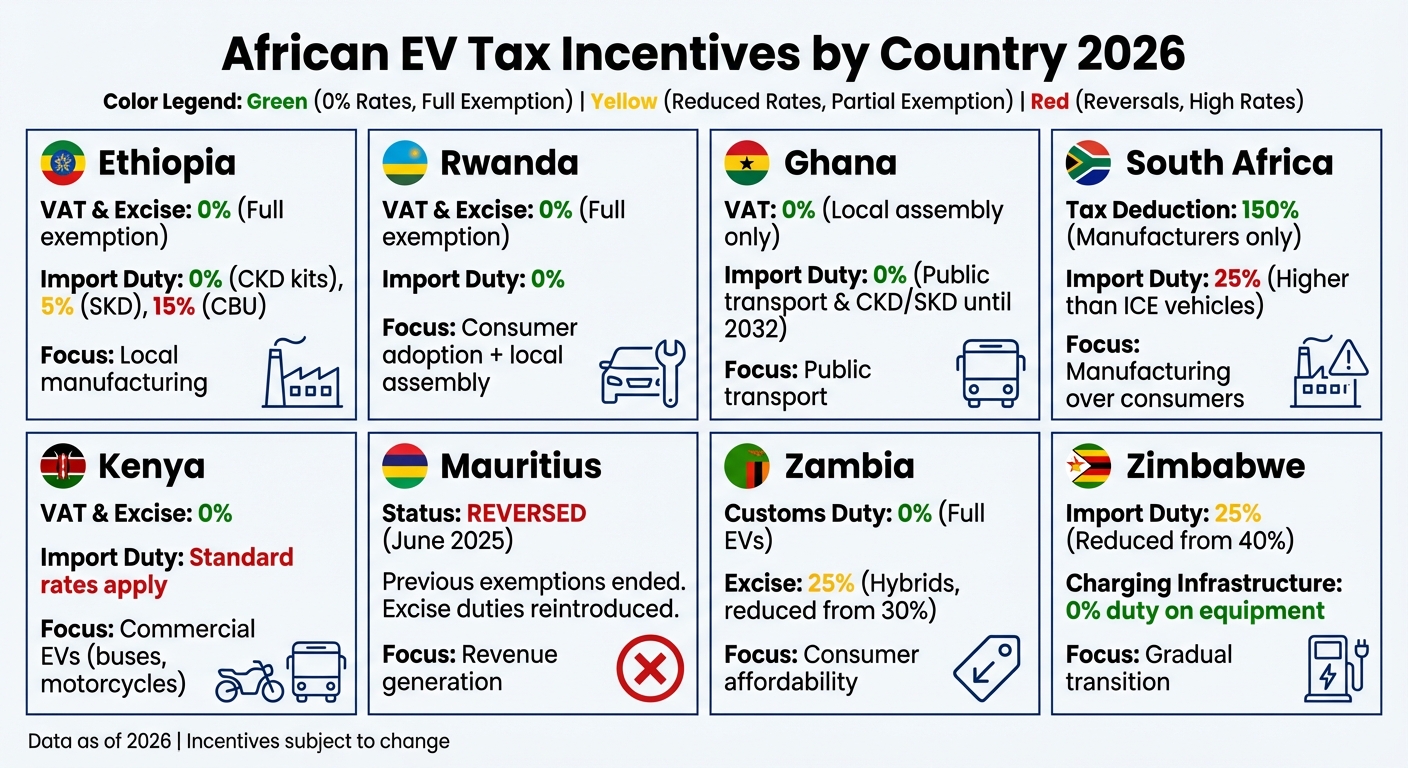
African EV Tax Incentives by Country 2026 Comparison
South African automotive sector at a crossroads amid green car tax incentives
sbb-itb-99e19e3
Types of EV Tax Incentives in Africa
African governments are rolling out various measures to make electric vehicles (EVs) more affordable. The most common strategies include import duty waivers, VAT exemptions, purchase grants, and manufacturing incentives. These policies aim to lower costs at every stage – from importation to the final purchase. Let’s dive into how these incentives differ across regions in Africa.
The approach to EV incentives varies widely by region. In East Africa, countries like Kenya, Rwanda, and Ethiopia focus on consumer-friendly policies. These include waiving VAT on locally assembled EVs and applying zero tax rates to lithium-ion batteries. Meanwhile, Southern and North African nations concentrate on manufacturing incentives, offering tax rebates to attract industrial investment for local EV production. West Africa strikes a balance, combining import duty reductions with incentives to electrify public transit.
"North and southern Africa are focused on manufacturing policies, East Africa leans more towards consumer policies, and West Africa has a mix of approaches." – Mobility Rising
Corporate incentives are also playing a role in driving EV adoption. Governments are increasingly offering tax deductions for companies that invest in EV charging infrastructure or operate EV fleets. Even some countries not highlighted in the regional breakdown have introduced similar benefits, tying tax perks directly to infrastructure development.
Behind these incentives are practical and environmental motivations. Africa imports 40% of the world’s used vehicles from developed countries. Replacing these older, high-emission vehicles with EVs aligns with climate goals and reduces reliance on fossil fuels. With energy costs rising, the transition to EVs offers both environmental and economic advantages, making tax incentives a logical step forward.
| Region | Primary Policy Focus | Key Incentive Types |
|---|---|---|
| North Africa | Manufacturing & Localization | Tax exemptions for fleet/infrastructure investment; consumer rebates |
| East Africa | Consumer Adoption & Assembly | VAT waivers for local assembly; tax deductions for charging infrastructure |
| West Africa | Import Reduction & Public Transit | Import duty cuts; VAT exemptions for public transport EVs |
| Southern Africa | Manufacturing Transition | Subsidies and tax rebates for manufacturers and consumers |
1. Ethiopia
Tax Exemptions
Ethiopia has taken bold steps to make electric vehicles (EVs) more affordable by removing several taxes. Buyers of EVs – whether for private or commercial use – are fully exempt from paying Value Added Tax (VAT), excise tax, and surtaxes. By cutting these internal costs, the government has significantly lowered the financial barriers to EV ownership, making them accessible to a broader segment of the population. But that’s not all – Ethiopia’s approach to import duties further strengthens its push for local EV production.
Import Duty Reductions
To encourage local EV manufacturing, Ethiopia employs a tiered import duty system. Fully assembled EVs (CBU) are taxed at 15%, semi-assembled vehicles (SKD) at just 5%, and completely knocked-down (CKD) kits for local assembly are entirely duty-free. This framework has successfully attracted manufacturers like Marathon Motors and Green Tech Africa, which have invested in local assembly plants. These incentives are part of Ethiopia’s broader plan, which includes clear timelines and ambitious goals for EV adoption.
Timeline and Implementation
Ethiopia’s EV tax incentive policy was officially introduced on September 16, 2022. In a groundbreaking move, the country banned all imports of petrol- and diesel-powered passenger vehicles in January 2024, aiming to curb its $4–5 billion annual expense on refined fossil fuel imports. This policy shift has already had a noticeable impact: EV adoption jumped from less than 1% to nearly 6%, with around 115,000 EVs on the road by late 2025. The government has set its sights on reaching 500,000 electric cars by 2030.
"For the government (of Ethiopia), the growth in EV sales is a vindication of its import policy, which in turn has been made possible by its investments in electricity infrastructure." – Bloomberg
For EV owners, the savings are substantial. Charging an EV costs just $4 per month compared to $27 for gasoline, in a country where the median monthly income is approximately $50. Additionally, Ethiopia’s reliance on hydropower – accounting for nearly 97% of its electricity – provides a renewable energy backbone to support this rapid transition.
2. Rwanda
Tax Exemptions
Rwanda has taken bold steps to promote electric vehicles (EVs) by introducing tax incentives aimed at speeding up the transition to greener transportation. As of February 2025, fully electric vehicles are exempt from VAT, withholding tax, and excise duty. In contrast, hybrid vehicles will begin to incur these taxes starting in 2025.
The government also provides tax breaks for companies investing in EV fleets or charging infrastructure. Additionally, locally assembled EVs benefit from a VAT waiver, lowering retail prices and encouraging domestic manufacturing.
Import Duty Reductions
To further support the EV ecosystem, Rwanda has implemented a 0% import duty on electric vehicles, hybrid vehicles, and electric motorcycles. This zero-duty policy also applies to equipment for charging stations and spare parts, significantly cutting costs across the EV supply chain. The Rwanda Ministry of Finance and Economic Planning has stated that these measures aim to "accelerate the transition to Electric Vehicles and reduce greenhouse gas emissions".
Public vs. Private Vehicle Focus
Rwanda is advancing on multiple fronts, supporting both private EV ownership and the electrification of commercial transport. The country is particularly notable for its focus on electric motorcycles, with companies like Ampersand leading the way in producing locally assembled two-wheelers that are widely used as commercial taxis. The government also conducts an annual review of its EV incentive policies to ensure they remain aligned with environmental objectives and market demands. These efforts create a solid foundation for the strategies that will be explored in the next section.
3. Ghana
Import Duty Reductions
Starting in 2024, Ghana introduced an eight-year waiver on import duties for electric vehicles (EVs), ensuring zero import duty until 2032. This policy specifically targets public transport EVs and semi-knocked down (SKD) or completely knocked down (CKD) kits for local assembly. The aim? To make EV adoption more affordable for fleet operators and encourage local manufacturing. Finance Minister Ken Ofori-Atta emphasized that the measure is meant to "accelerate electric vehicle use in the country, and encourage the domestic manufacturing and assembly of electric vehicles".
While this waiver significantly reduces costs for businesses transitioning to electric mobility, it does not extend to fully built units (FBUs) imported for private use. As a result, privately owned EVs remain less competitive in price compared to those used in public transportation.
Tax Exemptions
Beyond the import duty relief, Ghana has implemented a zero-rate VAT on locally assembled EVs. This tax incentive, introduced in late 2023, directly lowers the cost of domestically produced EVs, making them more accessible to businesses and consumers.
Public vs. Private Vehicle Focus
Ghana’s EV incentives are largely geared toward public and commercial transportation. The government is prioritizing high-capacity electric buses and minibuses to address urban traffic challenges and cut emissions. In January 2026, Minister of Trade, Agribusiness and Industry Elizabeth Ofosu-Adjare announced a partnership with Shenzhen New Jekyll, a Chinese firm, to establish an EV assembly plant in Ghana. She stated, "They are already in Ghana, they have acquired land, and development is far advanced for the factory to begin operations".
This public-transport-first strategy also supports local startups like SolarTaxi, Kofa, and Wahu Mobility. These companies benefit from the SKD/CKD duty waivers, which are not available for fully built EV imports. To further enhance the EV ecosystem, the government is installing charging stations along key routes, including the Accra-Kumasi Expressway. This infrastructure aims to simplify logistics and lower transportation costs. Next, we’ll take a closer look at South Africa’s approach to EV incentives.
4. South Africa
Timeline and Implementation
South Africa has taken a bold step toward developing its domestic EV industry as part of the 2026 reforms across Africa. Starting March 1, 2026, the country introduced EV-focused tax incentives to boost local manufacturing. Over a three-year period, South Africa is dedicating R964 million (around $50.6 million USD) to support EV manufacturing assets, with eligibility extending through March 1, 2036.
Tax Exemptions
A cornerstone of South Africa’s EV policy is the 150% tax deduction for manufacturers investing in facilities and equipment for electric and hydrogen vehicle production. This allows companies to deduct more than the actual cost of their investments. However, there’s a catch: if these assets are repurposed within five years, the deduction drops significantly to 50%.
"With good government policies, we will attract new investment; we will increase and retain investment", said Mikel Mabasa, CEO of the Automotive Business Council.
Import Duty Reductions
While manufacturers benefit greatly, private buyers see fewer advantages. South Africa enforces a 25% import duty on electric vehicles, compared to 18% for internal combustion engine vehicles. This higher duty makes EVs less accessible to consumers. According to the Department of Trade, Industry, and Competition, the focus remains on strengthening local manufacturing rather than offering direct incentives to consumers.
Public vs. Private Vehicle Focus
The government’s strategy prioritizes domestic production over consumer affordability. This approach has already drawn the attention of three Chinese automakers, who have entered into non-disclosure agreements for potential investments totaling $27 billion. Despite limited consumer incentives, EV sales have shown growth, rising from 720 units in 2023 to 1,079 units in just the first three quarters of 2024.
Next, Kenya’s measures aim to bring EVs closer to the everyday consumer.
5. Kenya
Timeline and Implementation
Kenya introduced its National Electric Mobility Policy in February 2026, creating a framework for EV incentives. A standout feature of the policy is the introduction of green reflective plates for fully electric vehicles. Transport Cabinet Secretary Davis Chirchir referred to these plates as a "signature" of Kenya’s commitment to addressing climate change. Starting in July 2026, additional tax breaks for EV components and charging station equipment will come into effect, aiming to make EV adoption more financially appealing.
Tax Exemptions
The policy includes major tax benefits, such as zero-rated VAT and the removal of excise duties on EV buses, bicycles, motorcycles, and lithium-ion batteries. These changes, effective in early 2026, significantly reduce operating costs. For example, driving 100 km (62 miles) in a light electric vehicle costs just $0.62 compared to $6.62 for a petrol vehicle.
Public vs. Private Vehicle Focus
Kenya’s approach emphasizes high-usage commercial vehicles to maximize emission reductions. Electric buses and bodaboda motorcycles (widely used urban motorcycle taxis) are key targets of the policy. EV registrations have seen a dramatic increase, growing from 1,378 in 2022 to over 39,000 by 2025. By the end of 2024, motorcycles made up 4,862 of the 5,924 registered electric vehicles in the country.
To further support EV growth, new commercial buildings are now required to allocate at least 5% of their parking spaces for EV charging infrastructure. The government has also set ambitious goals, including establishing 10,000 public charging stations by 2030 and fully electrifying the public bus fleet by 2027.
6. Mauritius
Timeline and Implementation
Mauritius made a significant policy shift regarding electric vehicles (EVs) in mid-2025. On June 6, 2025, the government moved away from encouraging EV adoption and introduced stricter tax measures instead. This change was part of an effort to address domestic issues like road congestion and the trade deficit.
"These measures are aimed at reducing road congestion and addressing the country’s trade deficit" – Prime Minister Navin Ramgoolam
Previously, buyers of electric cars benefited from a Rs 200,000 rebate under the Negative Excise Duty scheme. However, this program was terminated, and first-time registration fees jumped by 30%, now structured as one-time lifetime charges. These changes significantly reshaped the tax environment for EV buyers.
Tax Exemptions
Before June 2025, fully electric vehicles enjoyed exemptions from Value Added Tax (VAT), customs duties, and internal taxes implemented by the Ministry of the Economy. However, the reintroduction of excise duties in mid-2025 marked a turning point. Road Motor Vehicle License (RMVL) fees also increased, now ranging from Rs 200 to Rs 4,000 based on the type of vehicle.
Import Duty Reductions
Mauritius had previously adopted a progressive reduction in import duties for hybrid vehicles and offered full exemptions for pure electric vehicles. This changed in June 2025, when excise duties were reinstated for both hybrid and electric models. Meanwhile, traditional fuel-powered vehicles now face excise and customs duties ranging from 45% to 100%, depending on the type of vehicle.
"The increased duties and reintroduction of taxes on electric and hybrid cars will slow down the shift toward greener vehicles" – Mrinal Teeluck, Secretary-General of the Motor Vehicle Dealers Association (MVDA)
Public vs. Private Vehicle Focus
The earlier incentive framework covered a wide range of vehicles, from passenger cars – including compact, sedan, and luxury models – to light commercial vehicles like vans and small trucks. Port Louis Harbor remains the main entry point for EV imports, with importers offering services such as customs clearance and registration assistance. However, the 2025 policy reversal has created challenges for importers who had already invested in EV charging infrastructure and trained personnel.
7. Zambia
Tax Exemptions
Zambia has taken a bold step by eliminating customs duties on all electric vehicles, motorcycles, buses, trucks, and related accessories, including charging systems. This means buyers now pay 0% duty on fully electric imports. Additionally, the excise duty on hybrid passenger vehicles was reduced from 30% to 25%. These tax breaks apply to both new and used electric vehicles, which has made second-hand models – like the Nissan Leaf – a viable alternative to traditional internal combustion engine (ICE) vehicles. However, it’s important to note that Value Added Tax (VAT) and standard excise duties are still applicable. This move has created a noticeable shift in market dynamics, as reflected in rising EV registrations and growing interest from the automotive industry.
Timeline and Implementation
The impact of Zambia’s tax incentives is evident in the numbers: EV registrations jumped by 330%, going from 62 in July 2023 to 269 by July 2025. By the end of 2023, Zambia’s total vehicle population reached 823,703 across all categories, with 122,775 motor vehicles imported that year alone.
"The customs duty for fully electric vehicles is 0%. This is a massive saving that makes importing an EV a very smart financial move." – EV24.africa
Global brands like BYD and GWM have entered the Zambian market, with GWM introducing models such as the Ora 03 through local partnerships. Meanwhile, independent dealers are meeting the growing demand for affordable electric vehicles by importing used Nissan Leafs with 40 kWh and 62 kWh batteries from right-hand drive markets. To support this growing EV ecosystem, the Zambian government has also committed $20 million to establish solar-powered charging stations in key urban areas.
8. Zimbabwe
Import Duty Reductions
As of January 1, 2025, Zimbabwe lowered customs duty on fully electric vehicles from 40% to 25%, offering potential savings of around $1,500 on a $10,000 vehicle. However, hybrid vehicles remain subject to the original 40% duty rate. Explaining the decision, Finance Minister Mthuli Ncube stated:
"Cognizant of the need to promote use of eco-friendly vehicles, which will result in reduced carbon emissions, I propose to reduce Customs Duty on Electric Motor Vehicles."
While this reduction is a step forward, Zimbabwe’s 25% duty rate still lags behind nearby countries like Zambia, which has completely eliminated import duties on electric vehicles (0%). For comparison, the cost of a BYD Atto 3 in Zimbabwe is approximately $71,000, significantly higher than $42,000 in South Africa and $31,000 in Hong Kong.
Tax Exemptions
Zimbabwe has also introduced a 0% customs duty on electric tractors to encourage greener farming practices and reduce emissions. Additionally, rebates are available for approved operators importing equipment for solar-powered EV charging stations, addressing the country’s electricity challenges. For example, high-capacity charging stations from BYD in Harare are priced at about $17,000 before rebates.
Timeline and Implementation
Zimbabwe has ambitious plans for its EV market, aiming for a 33% market penetration by 2030. This aligns with broader efforts across Africa to shift toward renewable energy in transportation. Washington Zhakata, Director of Climate Change Management in the Ministry of Environment, Climate and Wildlife, highlighted this urgency:
"The issue of electric vehicles is inevitable. We can’t run away from it. By 2030, we expect a transformation in the transport mix from fossil fuel-based energy to renewable sources."
The incentive framework outlined in the 2025 National Budget remains the key policy driving these changes into 2026. From January to September 2024 alone, Zimbabwe imported vehicles worth $527 million, bringing the total to $3.08 billion over the past six years.
Advantages and Disadvantages
EV tax incentives are a double-edged sword. On one hand, they lower upfront costs for consumers and encourage domestic production. On the other, they face hurdles that could limit their overall effectiveness.
These incentives help reduce barriers for both buyers and investors, making EVs more accessible. However, challenges like market dynamics and financial pressures on governments can complicate their success. For example, the widespread preference for older, cheaper used vehicles often undermines these policies. Additionally, governments are feeling the strain of reduced revenues. Mobility Rising notes:
"African countries are focusing on tax cuts on EVs and components to lower import prices and stimulate local production. However, pressure to raise state revenues has forced some to roll back cuts".
In Kenya, the EV shift could result in an estimated $693 million annual loss in fuel tax revenue by 2043. This financial gap highlights the balancing act governments must navigate.
Another major obstacle is infrastructure. Without a robust charging network, the impact of tax breaks is limited. Kenya has introduced measures like requiring 5% of commercial parking spaces to be designated for EV charging. Yet, the lack of a widespread charging infrastructure remains a significant challenge. Similarly, Ethiopia’s bold move to ban ICE (internal combustion engine) imports aims to accelerate EV adoption, but this policy will need to be backed by substantial investments in charging facilities to succeed.
The most effective strategies take a multifaceted approach. Kenya, for instance, is targeting the commercial sector – focusing on EV buses and motorcycles (bodabodas) – while leveraging its electricity grid, which generates over 90% of its power from renewable sources. By combining affordability, infrastructure development, and domestic production, such strategies lay the groundwork for future policy adjustments and a smoother EV transition.
Conclusion
Examining the policies across these eight nations highlights how tailored strategies can address local market needs. For example, Rwanda’s VAT waivers on locally assembled EVs and tax deductions for charging infrastructure create a supportive environment for both buyers and businesses. Kenya, on the other hand, focuses on the commercial sector, particularly electric buses and motorcycles, to encourage local assembly and spur innovation. Meanwhile, Ethiopia’s full duty exemption for CKD kits has successfully drawn manufacturers like Marathon Motors and Green Tech Africa into the market. These approaches show the importance of aligning tax incentives with broader economic and environmental goals.
For buyers, VAT exemptions on locally assembled vehicles in countries like Kenya, Rwanda, and Ethiopia significantly lower upfront costs. In Southern Africa, Zimbabwe offers a 25% customs duty reduction, providing moderate savings, while Zambia’s 0% duty on fully electric vehicles stands out as the region’s most competitive pricing option. However, even with these tax breaks, high upfront costs remain a challenge for many buyers.
From a business perspective, regional investments should be made strategically. East Africa presents strong opportunities for local assembly and fleet transitions, with countries like Kenya and Rwanda offering tax incentives for companies investing in EV fleets and charging infrastructure. Companies such as BasiGo and Roam have already taken advantage of Kenya’s local assembly incentives to establish their operations. In Southern Africa, South Africa’s 150% manufacturing tax deduction creates potential for large-scale production investments, even though consumer incentives remain limited.
For policymakers, there are lessons to learn from both successes and setbacks. Ethiopia’s outright ban on ICE vehicle sales is ambitious, but experts caution that gradual transitions are better suited to avoid market disruptions. Fiscal pressures are another challenge – some governments have already scaled back tax cuts due to revenue concerns. For instance, Kenya may face an annual $693 million loss in fuel tax revenue by 2043, and Mauritius reversed its EV incentives in mid-2025 due to budget constraints.
The most effective EV incentives in Africa strike a balance between affordability, infrastructure development, and support for local production. Countries like Kenya and Rwanda, which address all three elements – local assembly, commercial vehicle incentives, and infrastructure expansion – are setting the stage for long-term EV adoption.
FAQs
Do these EV tax incentives apply to used imports too?
Most EV tax incentives are designed to promote new vehicle purchases and support investments in local EV manufacturing. The focus is often on encouraging domestic production and boosting the adoption of brand-new electric vehicles. As a result, these incentives rarely extend to second-hand imports, making them less relevant for used EV buyers.
Which country has the biggest savings for private EV buyers in 2026?
South Africa is set to offer the most substantial savings for private electric vehicle (EV) buyers in 2026. The country is introducing a 150% tax deduction on qualifying capital investments tied to electric vehicle and hydrogen production. This incentive is designed to dramatically reduce costs, making EV ownership far more accessible and budget-friendly.
What taxes or fees still apply even after EV incentives?
Even with incentives for electric vehicles (EVs), certain taxes and fees remain unavoidable. These can include import duties – for example, South Africa imposes a 25% duty – along with VAT, ad valorem taxes, and customs duties on EVs. It’s essential to check the specific regulations in your country to get a clear picture of the total cost of owning an EV.