
 Thabo Nkosi
Africa’s electric vehicle (EV) market is growing, but each country has its own approach to regulations, creating challenges and opportunities for businesses and consumers. Here’s a quick look at how South Africa, Kenya, and Nigeria handle EV policies:
- South Africa: High import taxes (25%) make EVs expensive, but a new 150% tax allowance for EV manufacturing starts in March 2026. Infrastructure is improving, yet grid instability remains a problem.
- Kenya: Reduced import duties and tax incentives, like green number plates, make EVs more accessible. Plans for solar-powered charging aim to solve power reliability issues.
- Nigeria: Strict new laws, including fines for unlicensed EV imports, push for local manufacturing. Charging infrastructure is limited, but efforts like solar-powered stations are underway.
Each country is tackling issues like high costs, limited charging stations, and unreliable power, but their strategies vary. For businesses, South Africa’s manufacturing incentives stand out, while Kenya’s tax breaks favor sales. Nigeria’s push for local content could reshape its market, though challenges persist.
Quick Comparison:
| Country | Import Taxes | Incentives | Infrastructure | Challenges |
|---|---|---|---|---|
| South Africa | 25% on EVs | 150% tax allowance for manufacturing | 350+ charging stations; grid issues | High costs, load shedding |
| Kenya | Reduced duties | Tax breaks, green plates, solar plans | Expanding solar charging by 2030 | Power reliability, rural access |
| Nigeria | High fines for unlicensed imports | Local assembly requirements, solar stations | Limited; fuel stations to add chargers | Unreliable grid, workforce readiness |
Understanding these rules is key to navigating Africa’s evolving EV market.
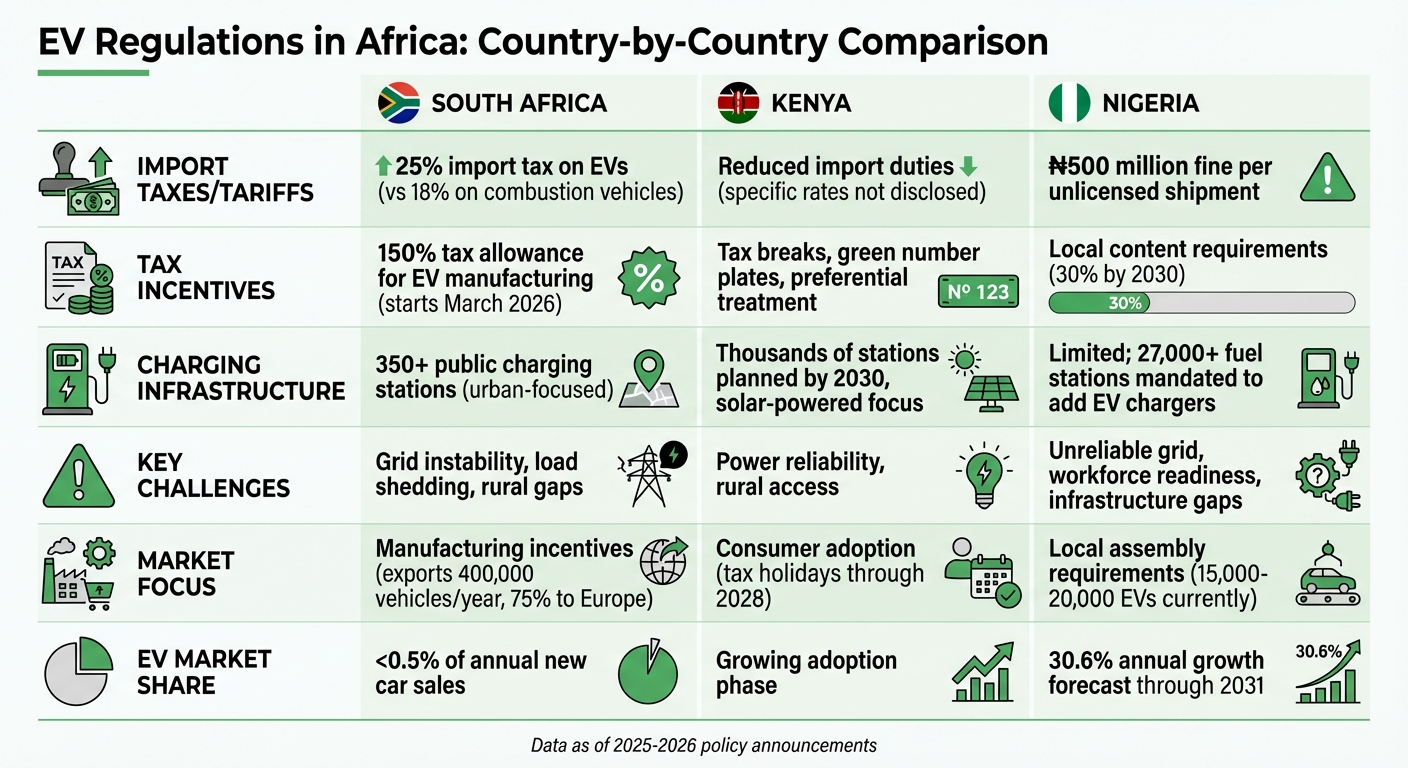
EV Regulations Comparison: South Africa vs Kenya vs Nigeria
1. South Africa
Import Tariffs
South Africa imposes a 25% import tax on electric vehicles (EVs), compared to 18% for internal combustion vehicles – a difference stemming from EU free trade agreements rather than EV-specific policies.
Dr. Norman Lamprecht of the Automotive Industry Export Council explains:
"It’s not about any differentiation between internal combustion vehicles and electric vehicles, but about our free trade agreements."
In addition to import tariffs, vehicles are subject to VAT, CO₂ taxes, and an ad valorem tax of up to 30% on luxury models priced above $50,000. These high costs have discouraged manufacturers like Tesla from entering the South African market.
Although South Africa exports around 400,000 vehicles annually, with 75% going to Europe, the shift in Europe toward phasing out combustion engines by 2030-2035 puts pressure on South Africa to ramp up local EV production. Current tariff and tax policies highlight the urgent need for incentives to support EV manufacturing domestically.
Tax Incentives
To encourage EV production, the government has introduced a 150% investment allowance for new electric vehicle manufacturing investments, starting March 1, 2026. However, consumer-focused measures like tax rebates and subsidies are still under review as authorities weigh options to promote EV adoption locally.
Infrastructure Development
By 2023, South Africa had approximately 350 public charging stations, primarily located in major urban centers like Johannesburg, Cape Town, and Durban. Private companies such as GridCars, Jaguar, and BMW are leading efforts to expand this network. However, challenges like grid instability and load shedding have made charging stations less reliable, reducing consumer confidence.
Charmaine Nkosi, Impact & Sustainability Consultant at VUKA Group, notes:
"South Africa’s efforts to develop its EV infrastructure are commendable, but significant work remains."
To address these issues, some companies are innovating with off-grid, solar-powered charging stations equipped with battery storage. For instance, CHARGE aims to install 120 such stations along major highways. Despite South Africa accounting for about 35% of Africa’s vehicle sales, EVs make up less than 0.5% of annual new car sales, with rural areas lacking charging facilities entirely.
Local Manufacturing Policies
South Africa’s automotive industry is working with organizations like NAAMSA to transition toward sustainable vehicle production over the next two decades. This aligns with global trends and helps safeguard exports to Europe. As Dr. Lamprecht emphasizes:
"With the transition to electric vehicles, we don’t want to lose the 75% of our exports to Europe around 2030-2035. Therefore, we need to start building these vehicles in South Africa."
The 150% investment allowance is part of this strategy, aiming to attract EV manufacturing facilities and ensure South Africa remains competitive in international markets.
sbb-itb-99e19e3
2. Kenya
Import Tariffs
Kenya has reduced import duties on electric vehicles (EVs) to make them more accessible and encourage their adoption. This move places Kenya alongside countries like Ethiopia, Rwanda, Mauritius, Zambia, and Zimbabwe, which have also introduced duty cuts or exemptions for EVs. While the exact tariff rates haven’t been specified, the policy offers a clear cost advantage for EV buyers compared to the higher duties on internal combustion engine vehicles. These tariff reductions pave the way for additional financial policies aimed at increasing EV usage.
Tax Incentives
Kenya’s approach to EVs signals a shift from traditional vehicle incentives, showcasing its focus on a greener future. In early 2026, Kenya introduced the National Electric Mobility Policy, which includes tax benefits and the issuance of green number plates for EVs. These plates help authorities easily identify EVs and apply specific perks, such as tax breaks and dedicated parking spaces. Energy Cabinet Minister Davis Chirchir described these plates as "tools for enforcement" to drive urban transport reforms.
Rose Mutiso, a science advisor at Energy for Growth Hub, emphasized:
"Countries like Kenya, which pair incentives such as tax holidays with reliable policy signals, are far more likely to attract long-term capital and local supply chains for EVs."
These tax incentives are bolstered by plans to enhance the country’s charging network.
Infrastructure Development
Kenya has ambitious plans to establish thousands of EV charging stations by 2030. To address grid reliability issues, the country is exploring off-grid, solar-powered charging solutions, aiming to strengthen its EV infrastructure by 2040. This initiative is a key element of the National Electric Mobility Policy, designed to ensure charging access extends beyond major cities.
China, EVs, and Africa – Why Nigeria Is the First Manufacturing Test Case
3. Nigeria
Nigeria’s regulatory landscape, while grappling with challenges common across Africa, takes a firm stance by imposing hefty fines and enforcing local content requirements to shape its electric vehicle (EV) market.
Import Tariffs
Nigeria is actively transforming its EV sector with focused legislation. The Electric Vehicle Transition and Green Mobility Bill, which moved to its second reading in November 2025 under Senator Orji Uzor Kalu, introduces strict measures for EV imports. Unlicensed importers face a steep ₦500 million fine per shipment. This effort aims to regulate the EV market, which currently includes an estimated 15,000 to 20,000 vehicles. By implementing these rules, Nigeria stands out as one of the few African nations formalizing EV legislation, signaling a significant shift toward green mobility policies.
Local Manufacturing Policies
The 2025 Bill also places demands on foreign automakers, requiring them to set up local assembly plants within three years and ensure that at least 30% of components are sourced locally by 2030. However, achieving this goal raises concerns. Stanley Awelewa, Senior Sales Manager at Tim International Group, expressed skepticism:
"A 30% local content requirement by 2030 may not be realistic given Nigeria’s current infrastructure and workforce constraints."
On the other hand, Sam Faleye, CEO of SAGLEV, emphasized the urgency of these measures:
"This bill is at least 30 years overdue… Nigeria can’t remain a dumping ground for used cars while importing jobs that should exist here."
These policies are expected to drive broader reforms in infrastructure and workforce development.
Infrastructure Development
Currently, Nigeria’s EV charging infrastructure is underdeveloped, with most users depending on private home or office charging. To address this gap, the National Automotive Design and Development Council (NADDC) launched pilot solar-powered charging stations between 2021 and 2024 at institutions like the University of Lagos, the University of Nigeria Nsukka, and Usman Dan Fodio University. The new bill mandates that all fuel stations – over 27,000 registered nationwide – install EV charging points.
However, the path forward is far from smooth. Issues like an unreliable power grid, frequent outages, and high demand charges pose significant challenges. Dapo Adesina, President of the Electric Mobility Promoters Association of Nigeria (EMPAN), cautioned:
"Without collaboration between the Ministry of Power and the private sector, charging deployment could lag far behind expectations."
Despite these hurdles, Nigeria’s EV market is forecasted to grow at an annual rate of 30.6% through 2031.
Advantages and Disadvantages
South Africa emerges as a leader among the three countries when it comes to electric vehicle (EV) infrastructure and incentives. The country benefits from a well-established charging network, bolstered by significant private sector investments and government-driven public transport projects. Additionally, South Africa’s 150% investment claim for its automotive manufacturing sector provides a strong incentive for businesses looking to transition into EV production. This is particularly important as the country works to meet the 2035 EU export requirements, with Europe accounting for 63% of South Africa’s vehicle exports.
Despite these strengths, challenges remain for all three nations. South Africa struggles with grid instability and frequent load shedding, which undermines the reliability of EV charging. Rural areas are especially underserved, with limited or no charging infrastructure. Meanwhile, Kenya and Nigeria face their own hurdles, including underdeveloped infrastructure, inconsistent power supply, and the high costs associated with building robust charging networks. These issues underscore the regulatory and logistical barriers that need to be overcome to drive EV adoption across the continent. Addressing these challenges will require coordinated efforts and innovative solutions.
Conclusion
Africa’s approach to electric vehicle (EV) adoption varies widely across its regulatory landscape, leading to different market outcomes and strategic considerations for businesses and consumers.
For companies, the best strategy depends on their area of focus. Manufacturers may find South Africa appealing due to its upcoming 150% tax deduction for EV production, starting March 1, 2026. This policy could significantly benefit local production facilities. On the other hand, businesses focused on sales and distribution might look to Kenya, where preferential tariffs and tax exemptions extended through 2028 create a favorable environment. Across all three markets, integrating off-grid solar charging solutions could address infrastructure gaps while offering a competitive edge.
Consumers also face unique scenarios depending on the country. In Kenya, existing tax breaks make EV imports more affordable now. Meanwhile, South African buyers should keep an eye on the 2026 budget, as potential reductions in import duties could bring EV prices closer to those of traditional vehicles. In Nigeria, it might be wise for buyers to wait until clearer guidelines emerge around vehicle registration and emissions standards.
Navigating these complex regulations requires reliable, up-to-date information. Platforms like EV24.africa help bridge knowledge gaps by offering centralized insights into real-time policies, tariffs, incentives, and infrastructure across African nations. From South Africa’s production incentives to Kenya’s consumer-friendly tax policies, such tools are essential for making informed decisions.
However, a key challenge persists: the disconnect between production incentives and adoption barriers. South Africa’s support for manufacturing, through its 150% investment allowance, is counteracted by high import duties that discourage consumer adoption. In contrast, Kenya’s alignment of manufacturing incentives with affordability promotes faster market growth. As CHARGE aptly put it:
"You cannot incentivise EV production on one hand and penalise EV adoption on the other".
Understanding these regulatory differences is crucial for businesses and consumers navigating Africa’s evolving EV market. Each country’s policies shape distinct opportunities and hurdles, making informed decision-making more important than ever.
FAQs
Which African country is best for EV buyers right now?
Rwanda stands out as the top destination for electric vehicle (EV) buyers in Africa. The country has eliminated all import duties on EVs and introduced generous tax incentives that will remain in place through 2028. These measures significantly lower the cost of owning an EV.
In contrast, South Africa imposes a hefty 25% import duty on EVs, even though it boasts advanced infrastructure to support them. Kenya, on the other hand, offers VAT exemptions but enforces stricter regulations on imports, which can complicate the process.
Rwanda’s combination of zero import duties and buyer-friendly policies sets it apart, making it the most appealing option for EV enthusiasts on the continent.
How do import taxes and local-content rules affect EV prices?
Import taxes and local-content rules significantly influence the cost of EVs across Africa. Take South Africa, for instance – its 25% import duty adds a hefty premium to EV prices. On the other hand, countries like Rwanda and Malawi have taken steps to make EVs more accessible by reducing or even eliminating these taxes. Additionally, local-content rules, such as South Africa’s incentives for domestic EV production, aim to decrease dependence on imports. Over time, these measures could help bring prices down and encourage the growth of the EV market in the region.
Can solar charging solve unreliable power for EVs in Africa?
Absolutely. Solar charging offers a practical way to tackle unreliable power supplies for electric vehicles (EVs) in Africa. By leveraging the continent’s abundant sunlight, solar-powered charging stations provide a steady and clean energy source. This reduces reliance on often inconsistent national power grids.
Decentralized solutions like Vehicle-to-Grid (V2G) systems and Battery Swap Stations (BSS) add another layer of reliability. These models not only enhance grid stability but also make charging more cost-effective. Together, these approaches pave the way for scaling EV adoption while addressing power reliability issues across Africa.