
 Thabo Nkosi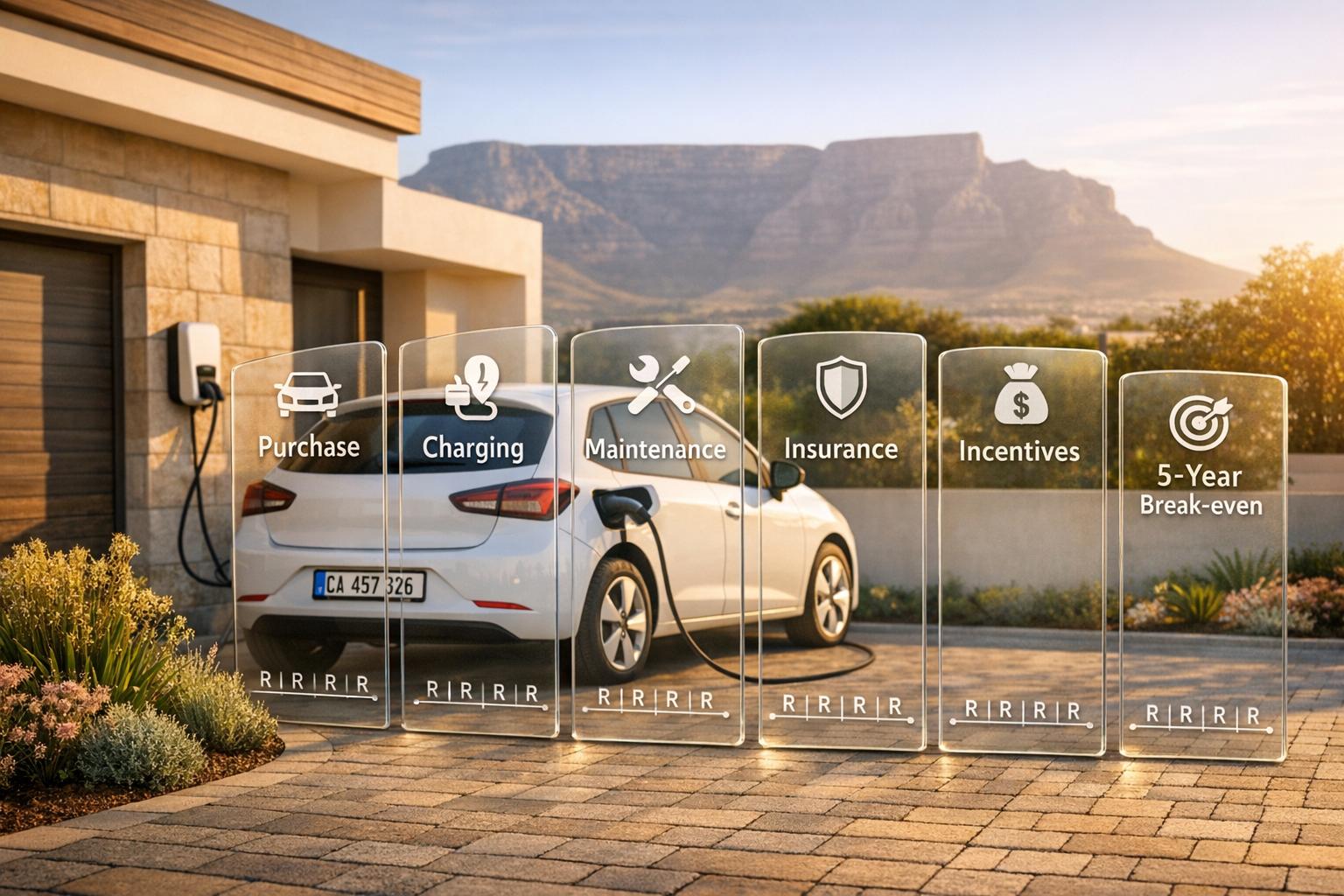
Electric cars in South Africa are becoming more accessible, with lower running costs making them a smart long-term choice. Here’s what you need to know:
- Running Costs: EVs cost R0.93/km, compared to R2.40/km for petrol cars – saving you 61% on fuel. For a daily 50 km commute, that’s about R26,827 annually.
- Upfront Prices: Models like the BYD Dolphin Surf start at R339,900, while highway-capable options like the BYD Dolphin cost R539,900.
- Charging Costs: Home charging is cheaper, costing R2.20–R5.15/kWh, while public fast chargers can be over R7/kWh.
- Maintenance Savings: EVs are simpler to maintain, costing R12,000 over five years, compared to R45,000 for petrol cars.
- Government Incentives: Starting March 2026, manufacturers benefit from tax deductions, with consumer rebates and reduced import duties proposed.
Over five years, an EV like the BYD Atto 3 can save you R143,935 compared to a petrol car, despite a higher upfront cost. Home charging is key to maximizing savings.
SA’s New Cheapest EV Driven, Golf R Confirmed for SA, & New Data Shows Diesel is Top.
sbb-itb-99e19e3
Electric Vehicle Purchase Prices in South Africa
Since 2023, Chinese automakers like BYD, GWM, Dayun, and Dongfeng have shaken up South Africa’s electric vehicle (EV) market. These brands have introduced more affordable options, breaking the dominance of high-end EVs and lowering entry-level prices to a point where middle-income buyers can now seriously consider making the switch.
That said, EVs still face a pricing challenge due to South Africa’s import policies. EVs are subject to a 25% import duty compared to the 18% applied to petrol and diesel vehicles. On top of that, an ad valorem tax ranging from 5.25% to 30% further increases the cost of higher-priced models. These additional costs directly impact the final price tag, influencing potential buyers.
Even with these tax obstacles, the market has grown quickly. By 2024, the number of EV models priced under R1 million had doubled compared to the previous year, offering buyers a wider range of choices. While most of these models are compact hatchbacks designed for city use, crossovers like the BYD Atto 3, priced below R800,000, are now available for those looking for more versatile options. Below, we’ll highlight some of the most affordable EVs priced under R700,000.
Affordable EV Models Under R700,000
Leading the budget-friendly EV market is the BYD Dolphin Surf, priced at R339,900. It comes with a 30kWh battery and a range of 232km. Close behind is the Dayun Yuehu S5 at R399,900, while the Dongfeng Box is available for around R460,000. For buyers seeking highway capability, the BYD Dolphin starts at R539,900, equipped with a larger 44.9kWh battery that offers a range of 340km. Other noteworthy options include the GWM Ora 03 300 Super Luxury at R686,950 and the Geely E5, priced at R699,999.
It’s worth noting that some of the lower-priced EVs aren’t suitable for highway driving. For example, the EV Africa City Blitz, the most affordable EV at R239,000, has a top speed of just 80 km/h, making it ideal only for city commutes. Similarly, the Dayun S5 maxes out at 100 km/h. On the other hand, the BYD Dolphin (R539,900) is the most economical choice for those needing a vehicle that can comfortably reach South Africa’s legal highway speeds.
Total Ownership Costs: Charging, Maintenance, and Insurance
When evaluating electric vehicles (EVs) in South Africa, it’s not just about the sticker price. Running costs like charging, maintenance, and insurance play a big role in determining affordability. For someone commuting 50 km (31 miles) daily, the lower operational costs of EVs can lead to noticeable long-term savings.
Charging Costs at Home and Public Stations
If you’re charging at home, you’re in for the best deal. Installing a wallbox charger at home typically costs between R12,000 and R25,000. This includes hardware (R8,000–R18,000), installation labor (R3,000–R8,000), and a Certificate of Compliance (R500–R1,500). Once it’s installed, you’ll pay standard residential electricity rates, which range from R2.20 to R5.15 per kWh, depending on your municipality. For example, charging a 70 kWh battery at home would cost about R245.
Public charging, on the other hand, is pricier. Using an AC charger costs around R5.88 to R6.00 per kWh, while DC fast chargers jump to R7.00 to R7.50 per kWh. That same 70 kWh battery would cost over R515 to charge at a public DC station.
"DC chargers have two purposes: speed and convenience… suited for when you are far from home or doing extensive intercity travel",
explains Winstone Jordaan, MD of GridCars.
So, while public charging is convenient for road trips or emergencies, home charging remains the more economical choice. But the savings don’t stop there – EVs also shine when it comes to maintenance.
Lower Maintenance Costs Compared to Petrol Cars
EVs are mechanically simpler than traditional petrol cars, which translates into much lower maintenance costs. Over five years, maintaining an EV like the BYD Atto 3 costs about R12,000, compared to R45,000 for a petrol Toyota Corolla Cross. That’s a 73% savings. With no oil changes, no spark plugs, and brake pads lasting longer thanks to regenerative braking, upkeep is much less demanding.
Volkswagen highlights this difference with its 8-year/160,000 km (about 100,000 miles) battery warranty on EVs like the ID. range, compared to the 3-year/120,000 km (about 75,000 miles) warranty for petrol models. This extended warranty underscores the reduced mechanical wear and tear in EVs.
And while maintenance costs are lower, insurance premiums for EVs can be a bit higher due to their upfront price.
Insurance Premiums for Electric Vehicles
EV insurance tends to cost more than that for petrol cars, mainly because EVs are about 10–15% more expensive upfront due to import duties. Insurance premiums are tied to the market value of the car, so higher vehicle prices lead to higher premiums. The battery, being the most expensive part of an EV, also factors into these calculations. However, extended warranties help offset some of this risk.
Repair costs can vary since EVs require specialized technicians and parts, but the simplicity of their mechanical systems means fewer overall issues. Despite the slightly higher premiums, the long-term savings on maintenance and charging make EVs an appealing choice for many South Africans.
Government Incentives and Financing Options
Starting March 1, 2026, manufacturers investing in electric vehicle (EV) and hydrogen production in South Africa can benefit from a 150% tax deduction. This initiative is backed by a R964 million allocation and an estimated R500 million tax expenditure for the 2026/27 fiscal year.
"To encourage production of electric vehicles in South Africa, government will introduce an investment allowance for new investments, beginning 1 March 2026." – Finance Minister Enoch Godongwana
While these manufacturing incentives focus on boosting local production, they don’t immediately lower vehicle prices for consumers. To address this, Naamsa has proposed consumer rebates: R80,000 for fully electric cars, R40,000 for plug-in hybrids, and R20,000 for conventional hybrids. However, no specific timeline for these rebates has been announced.
Tax Incentives and Import Duty Adjustments
Proposals are also in place to reduce the current 25% import duty on EVs, particularly for vehicles imported from Europe. This would align EV duties with those of internal combustion engine (ICE) vehicles. Greg Maruszewski, CEO of Volvo Cars South Africa, highlighted the disparity:
"It is only EVs from Europe that are disadvantaged in terms of taxation versus ICE cars from Europe. EVs manufactured elsewhere attract the same duties as other ICE cars".
In addition, as of April 1, 2024, the government has raised the motor vehicle emissions tax to R146 per gram of CO₂ emissions per kilometer. This policy indirectly encourages the adoption of cleaner vehicles by penalizing high-emission ICE models. For now, the focus remains on securing manufacturing and export contracts (Phase 1), with consumer incentives expected to follow in a later phase. These tax adjustments and emissions policies are laying the groundwork for broader changes in the market.
Financing Options on EV24.africa
To make EV ownership more accessible, EV24.africa provides tailored financing solutions. Their loan options feature interest rates between 10% and 12% over a five-year term, helping to reduce the upfront cost of EVs. Coupled with the lower operating costs of electric vehicles, these financing plans make the transition to electric mobility more feasible for South African buyers.
Cost Comparison: Electric vs. Petrol Vehicles
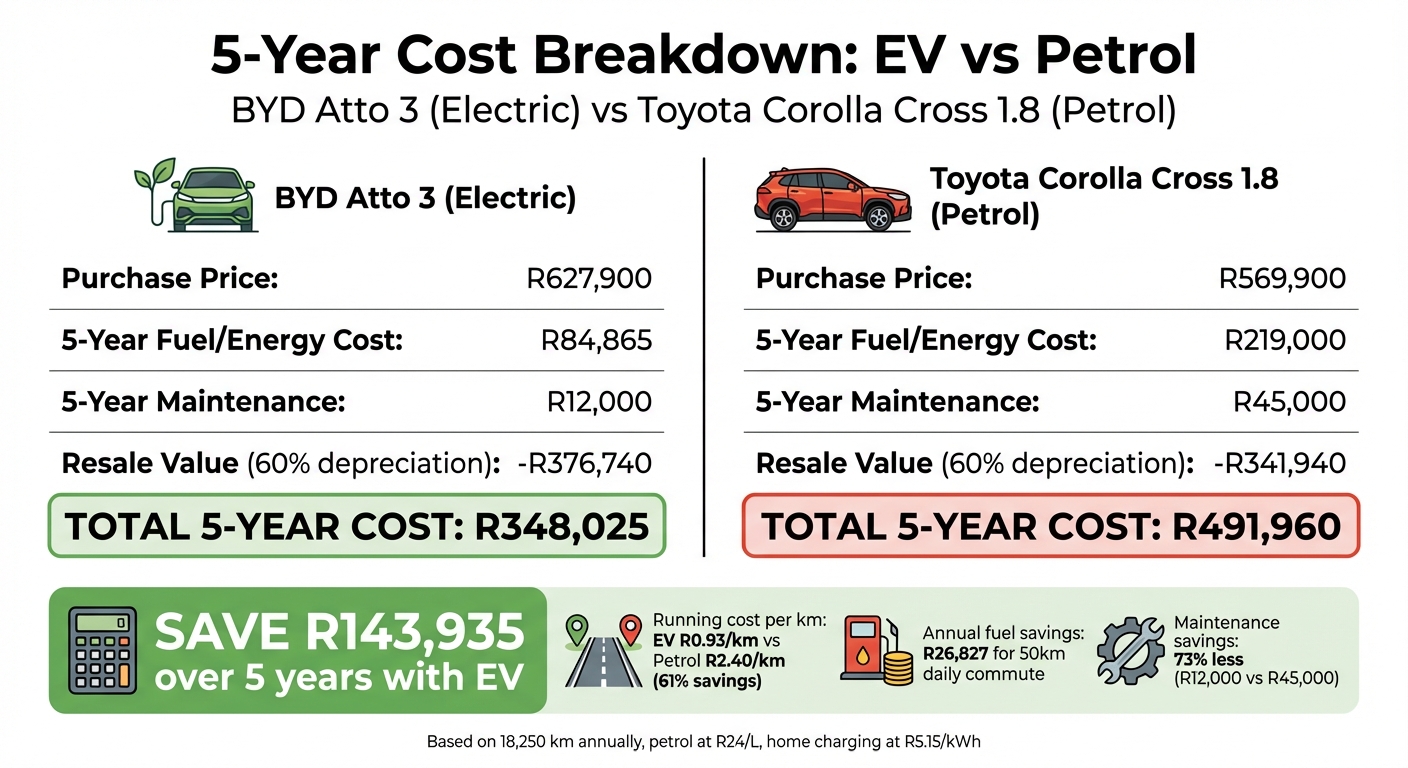
5-Year Cost Comparison: Electric vs Petrol Cars in South Africa
The upfront cost of an electric vehicle (EV) is just the beginning of the affordability story. When you consider fuel, maintenance, and depreciation over time, the total cost of ownership tilts heavily in favor of EVs. Although EVs are generally 10–15% pricier initially, the savings from lower energy and servicing costs often allow owners to recover that difference within 2–3 years. Let’s dive deeper into how these costs stack up over a five-year period.
EVs cost just R0.93 per kilometer to operate, compared to R2.40 per kilometer for petrol vehicles – a massive 61% difference. For someone driving 50 kilometers daily, this adds up to annual fuel savings of approximately R26,827. Additionally, EVs require significantly less maintenance because they have fewer moving parts. Now, let’s break down the five-year total cost comparison.
5-Year Total Cost Analysis
Looking at a five-year ownership period (18,250 kilometers annually), the financial advantage of EVs becomes clear. By factoring in fuel, maintenance, and depreciation, the following table compares the BYD Atto 3, a popular electric SUV, with the Toyota Corolla Cross 1.8, a comparable petrol vehicle:
| Cost Factor | BYD Atto 3 (Electric) | Toyota Corolla Cross 1.8 (Petrol) |
|---|---|---|
| Purchase Price | R627,900 | R569,900 |
| 5-Year Fuel/Energy Cost | R84,865 | R219,000 |
| 5-Year Maintenance | R12,000 | R45,000 |
| Resale Value (60% depreciation) | -R376,740 | -R341,940 |
| Total 5-Year Cost | R348,025 | R491,960 |
Even though the BYD Atto 3 has a higher upfront cost, its total five-year cost is R143,935 lower than the Corolla Cross. This cost advantage comes primarily from energy and maintenance savings. Charging an EV costs less than 40% of what you’d spend on petrol, while servicing costs are just 27% of those for a petrol vehicle.
"Electric vehicles cost R0.93/km to run versus R2.40/km for petrol – a 61% saving that translates to R26,900 annual savings for an average 50km/day commuter." – ChargePoint SA
These calculations assume petrol priced at R24.00 per liter and home charging at R5.15 per kilowatt-hour. If petrol prices rise to R27 per liter, which isn’t unlikely based on historical trends, EVs become 66% cheaper to operate.
Can You Afford an Electric Vehicle in South Africa?
Whether an electric vehicle (EV) fits your budget depends on your finances and driving habits. While EVs generally cost 10–15% more upfront than petrol-powered cars, many South African buyers recover this difference within 2–3 years thanks to lower fuel and maintenance expenses. These savings, highlighted earlier, make EV ownership an appealing option in the long run.
One of the biggest cost-saving factors? Charging at home. Home charging costs about R3.50 per kWh, compared to R7.35 per kWh at public DC chargers. This makes installing a home charging setup a worthwhile investment that pays off quickly.
Entry-level EVs like the BYD Atto 3 and GWM Ora bring electric mobility within reach for more people. Plus, with 8-year battery warranties, these models offer peace of mind for years to come.
To figure out your personal break-even point, try this simple calculation: Multiply your daily kilometers by R1.47, then multiply that by 365. Divide the EV’s price premium by this annual savings figure to see how quickly you’ll come out ahead. For most daily commuters, the break-even point is often under three years. However, having reliable home charging access is essential – without it, the cost advantage of owning an EV can shrink significantly.
For more information about financing options and a wide range of new and used EVs, visit EV24.africa. They provide clear pricing from top brands and even offer delivery across South Africa.
FAQs
How much does home charging really cost per month?
Home charging an EV in South Africa is relatively affordable, with costs ranging from $0.16 to $0.22 per kWh. This is significantly cheaper than using public chargers, which average around $0.40 per kWh. For a driver covering 1,000 km per month, the charging costs typically fall between $16 and $22, depending on electricity rates and the vehicle’s efficiency.
While the initial installation of a home charger can cost anywhere from $630 to $1,315, the long-term savings on charging make it a much more economical option compared to fueling a gas-powered car. This makes home charging a practical and budget-friendly choice for EV owners.
What happens if I can’t charge at home and rely on public chargers?
Relying only on public chargers for your EV can hit both your wallet and your schedule. In South Africa, public charging rates are much higher compared to what you’d pay for charging at home. On top of that, finding an available charger isn’t always guaranteed, especially during peak times. You might face long waits or delays due to slower charging speeds, which can throw off your plans. Using public chargers frequently also drives up your overall running costs, making a home charger a smarter, more budget-friendly, and dependable choice for most EV owners.
How long will it take me to break even on the higher EV price?
On average, it takes around 5 years to recoup the higher initial cost of an electric vehicle (EV) in South Africa. This calculation includes savings from lower fuel and maintenance costs over time, which helps make EVs a more economical choice in the long term.