
 Younes Rabeh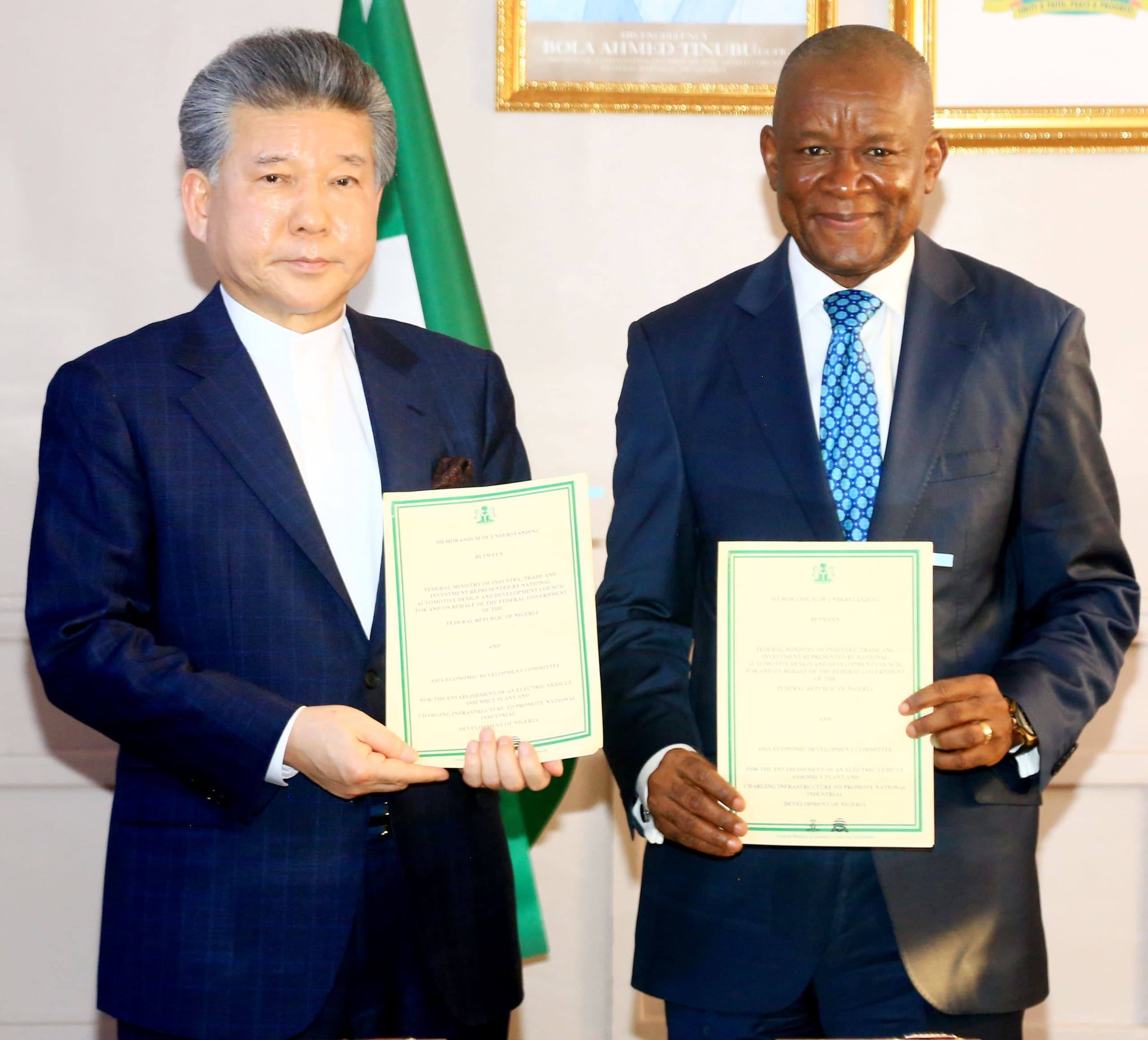
Nigeria is on track to become Africa’s first electric vehicle (EV) manufacturing country, following the signing of a landmark Memorandum of Understanding (MoU) between the Federal Government of Nigeria and South Korea’s Asia Economic Development Committee (AEDC).
This strategic agreement marks a decisive shift in Nigeria’s automotive and energy landscape, positioning the country as a future EV manufacturing and innovation hub for Africa.
A Landmark Agreement for Electric Mobility in Africa
The MoU was signed on January 30, 2026, by Senator John Enoh, Minister of State for Industry, on behalf of the Federal Government of Nigeria. The South Korean delegation was represented by Mr. Yoon Suk-hun, Chairman of the Asia Economic Development Committee.
The announcement was officially confirmed by the National Automotive Design and Development Council (NADDC), Nigeria’s automotive regulatory authority.
According to NADDC, the partnership is fully aligned with Nigeria’s long-term industrial and sustainability strategies, notably:
- the National Energy Transition Plan (ETP), and
- the National Automotive Industry Development Plan (NAIDP).
Together, these frameworks aim to reduce fuel dependency, strengthen local manufacturing, and accelerate Nigeria’s transition to clean and sustainable transportation.
Phased EV Manufacturing: From Assembly to Full Production
The EV manufacturing project will be implemented in multiple phases to ensure scalability and local capacity building.
Phase 1: Electric Vehicle Assembly
The initial phase will focus on EV assembly, enabling Nigeria to rapidly build production capabilities, develop a skilled workforce, and test market readiness.
Phase 2: Full Local Manufacturing
Subsequent phases will expand into full-scale local manufacturing, including deeper localization of components, technology transfer, and industrial automation.
Once fully operational, the plant is expected to reach an annual production capacity of up to 300,000 electric vehicles, while creating approximately 10,000 direct jobs, alongside thousands of indirect jobs across logistics, energy, technology, and services.
Driving Technology Transfer and Industrial Growth
The Director-General of NADDC, Otunba Oluwemimo Joseph Osanipin, described the initiative as a catalyst for long-term industrial transformation. According to the council, the project will accelerate:
- technology and skills transfer,
- human capital development,
- automotive research and innovation,
- foreign direct investment, and
- nationwide EV charging infrastructure deployment.
Speaking through NADDC’s Head of Policy, Planning and Statistics, Mr. Nura Sidi, the council reaffirmed that Nigeria is steadily building a globally competitive and sustainable automotive ecosystem.
Electric Vehicles in Nigeria: Momentum Despite Challenges
While Nigeria continues to face challenges related to electricity supply reliability, grid capacity, and road infrastructure, interest in electric vehicles has grown significantly over the past few years. Rising fuel prices, urban pollution concerns, and favorable government policy are accelerating EV adoption.
Government involvement in EV development dates back several years:
- In April 2021, the Nigerian Institute of Transport Technology (NITT), Zaria, established a 22-member task force to develop a locally made electric vehicle.
- In August 2022, the National Agency for Science and Engineering Infrastructure (NASENI) signed MoUs with Israeli and Japanese partners to support EV assembly and manufacturing in Nigeria.
These early initiatives laid the groundwork for the current large-scale manufacturing push.
Nigeria’s Long-Term EV Vision
Nigeria’s Energy Transition Plan, launched in 2022, outlines an ambitious target of 100% electric vehicle adoption by 2060, while Lagos State has committed to achieving full EV transition by 2050.
Electrifying transportation is seen as critical to:
- reducing carbon emissions,
- lowering fuel import costs,
- improving urban air quality, and
- unlocking value chains linked to batteries, minerals, and renewable energy.
Existing EV Assembly and Mobility Players in Nigeria
Nigeria already hosts a growing number of EV assemblers and mobility innovators, including:
- SAGLEV
- Innoson Vehicle Manufacturing (IVM)
- Jet Motor Company
- Spiro
- NEV Motors
- Electric Motor Vehicle Company (EMVC)
The new Nigeria–South Korea partnership is expected to scale and strengthen this ecosystem, rather than replace existing players.
Growing Global Interest in Nigeria’s EV Sector
Nigeria’s EV ambitions have also attracted significant international attention. In May 2025, China announced plans to establish EV factories and related manufacturing ventures in Nigeria as part of broader economic cooperation efforts.
These developments highlight Nigeria’s strategic importance as:
- Africa’s largest automotive market,
- a gateway to West African regional trade, and
- a future export base for electric vehicles and components.
Local EV manufacturing could also help unlock Nigeria’s mineral potential and promote local value addition instead of raw material exports.
A Turning Point for Africa’s Automotive Industry
If successfully executed, this initiative could mark a historic turning point for both Nigeria and the African continent. By transitioning from vehicle imports to electric vehicle manufacturing, Nigeria positions itself as a continental leader in green mobility, industrial policy, and sustainable development.
The project sets a precedent for how African countries can combine public policy, international partnerships, and private-sector investment to build future-ready industries.
Source
Nairametrics – “Nigeria set to become Africa’s first Electric Vehicle manufacturing country”
https://nairametrics.com/2026/02/01/nigeria-set-to-become-africas-first-electric-vehicle-manufacturing-country/