
 Thabo Nkosi
Africa’s used EV market is booming, with buyers prioritizing battery durability due to challenging climates and economic considerations. Here’s a quick look at five reliable EV models suited for Africa:
- BYD Dolphin: Features Lithium Iron Phosphate (LFP) batteries with low degradation (2% annually). Retains ~81.6% capacity after 8 years. Ideal for hot climates.
- BMW i3: Offers active cooling for better performance in heat. Later models (2017+) have improved battery life and range.
- Jaguar I-Pace: Luxury EV with a 90 kWh battery. Minimal wear but requires software updates to manage heat risks.
- GWM Ora 03: Budget-friendly with durable LFP batteries. Moderate range and affordable pricing.
- Dongfeng Box E1: Compact and efficient, with a 2.4% annual degradation rate in hot conditions.
Quick Comparison:
| Model | Battery Type | Annual Degradation | Cooling System | Price Range |
|---|---|---|---|---|
| BYD Dolphin | LFP | ~2% | Active (Liquid) | Varies by region |
| BMW i3 | Lithium-ion | ~2% | Active (AC-based) | $6,000–$25,000 |
| Jaguar I-Pace | Lithium-ion | ~2% | Liquid Cooled | $12,750–$38,050 |
| GWM Ora 03 | LFP | ~2% | Active | ~$31,815 (used) |
| Dongfeng Box E1 | Lithium-ion | ~2.4% | Active | Limited data |
For buyers, checking battery health, charging history, and warranty details is crucial. Models like the BYD Dolphin and GWM Ora 03 are excellent for affordability and durability, while the BMW i3 and Jaguar I-Pace cater to higher budgets with premium features. Always verify software updates and battery warranties before purchasing.
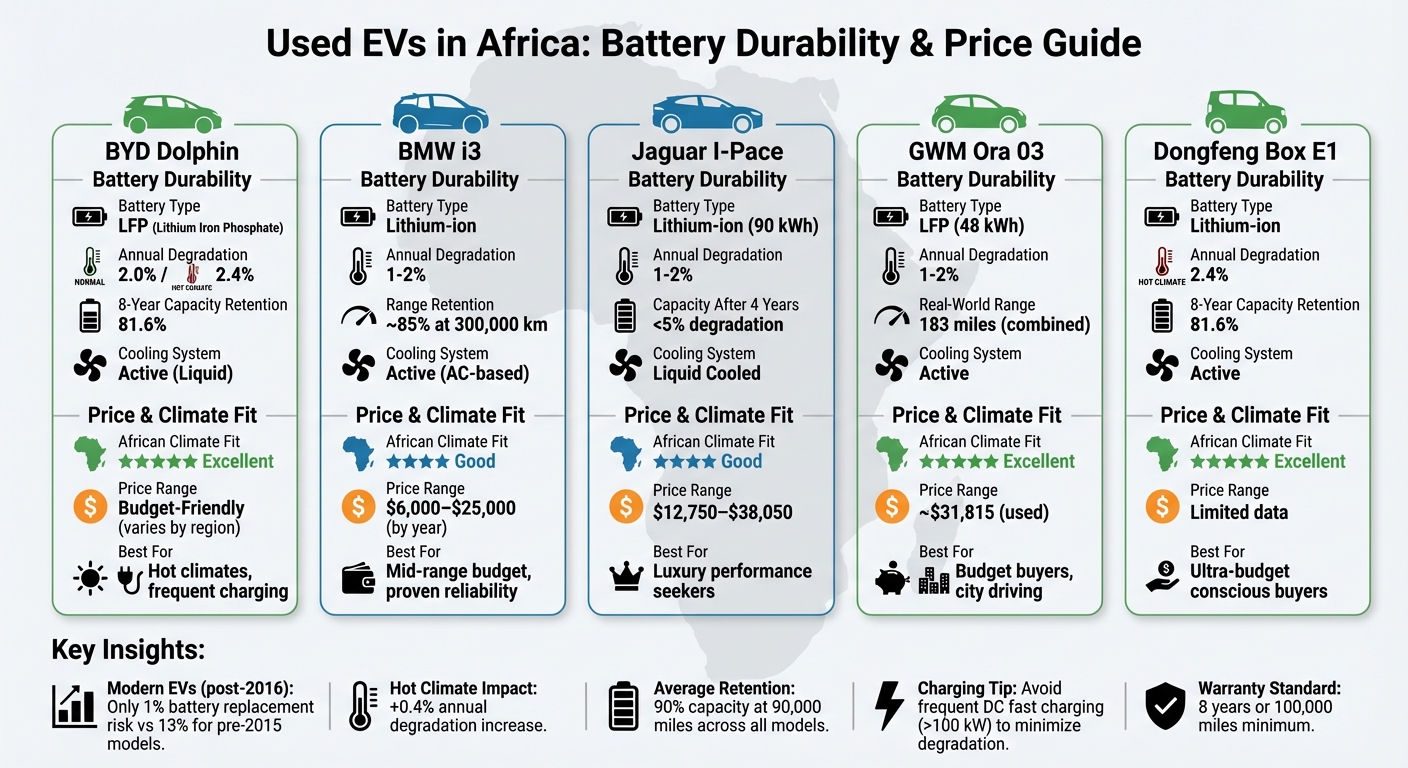
Top 5 Used EVs for Africa: Battery Durability and Price Comparison
1. BYD Dolphin
Battery Durability
In Africa, where conditions can be tough, having a reliable battery is critical. The BYD Dolphin has made a name for itself in the region’s used EV market, largely thanks to its Lithium Iron Phosphate (LFP) battery chemistry. This type of battery is built for longevity, offering a longer cycle life compared to other battery types, which is particularly beneficial in demanding environments. The Dolphin boasts a lower-than-average annual degradation rate of 2.0%, compared to the 2.3% average across all EVs.
Charlotte Argue, Senior Manager of Sustainable Mobility at Geotab, explains how climate affects battery life:
Hot climates impose a penalty on battery life, with vehicles operating in hot conditions degrading 0.4% faster per year than those in mild climates.
In African conditions, this means the Dolphin’s degradation rate could increase slightly to around 2.4% per year. Even so, this figure remains competitive, thanks to the durability of its LFP battery.
These strong durability stats also play a key role in maintaining the vehicle’s range over time.
Range Retention
After eight years of typical use, the Dolphin’s battery is estimated to retain around 81.6% of its original capacity. However, charging habits can make a big difference. For instance, frequent use of high-power DC fast charging (above 100 kW) speeds up battery degradation, pushing the annual rate to 3.0%. In contrast, sticking to AC or lower-power charging can keep it as low as 1.5%.
To preserve battery health, avoid excessive use of high-power DC fast charging. In Africa’s hot climate, it’s also wise to park in shaded areas and steer clear of leaving the battery at extreme charge levels for long periods.
These factors not only affect performance but also influence the resale value of used Dolphins.
Used Price Range
The Dolphin’s durable LFP battery and efficient design make it a budget-friendly choice in the used EV market. Even models with slightly lower battery health can still provide good value. When shopping for a used Dolphin, look for vehicles with a documented charging history that shows minimal use of high-power DC fast charging. These models will likely offer better long-term performance and value. Given its technical strengths, the Dolphin is a solid option for Africa’s challenging conditions.
How Chinese EV Makers Are Building a Lead in African Countries
2. BMW i3
After the impressive performance of the BYD Dolphin, the BMW i3 stands out as another strong contender in Africa’s used EV market.
Battery Durability
The BMW i3 is well-equipped to handle Africa’s challenging climate, thanks to its active AC refrigerant-based cooling system. This system helps maintain optimal battery temperature even in extreme heat. If you’re looking at models from 2017 onward, you’ll find batteries with 94 Ah and 120 Ah capacities, which are more resistant to wear and tear compared to the earlier 60 Ah versions from 2014–2016.
However, one issue to watch out for is the "Black Death" AC compressor failure. If this happens, metal shards can circulate through the cooling system and potentially damage the battery if not addressed quickly.
Range Retention
The BMW i3 has proven its ability to hold up over time. For instance, Shaun Maidment’s 2016 model hit 300,000 km (186,411 miles) by January 2022 and still retained about 85% of its original battery capacity, even under demanding highway conditions. BMW backs its batteries with an 8-year or 100,000-mile warranty, guaranteeing at least 70% capacity retention during that period.
As for range, it varies by generation:
- 2014–2016 models: 34–95 miles
- 2017–2018 models: 66–170 miles
- 2019–2021 models: 82–247 miles
Used Price Range
The price of a used BMW i3 depends on the model’s battery generation:
- 2014–2016 models: $6,000–$12,000
- 2017–2018 models: $12,000–$18,000
- 2019–2021 models: $18,000–$25,000
If you’re considering a BMW i3, models from 2017 or later are your best bet for durability and range. Be sure to conduct a battery degradation test before purchasing to avoid unexpected repair costs. With its reliable cooling system and proven performance in African conditions, the BMW i3 offers a dependable choice for those looking for a long-term investment. Its balance of performance and price makes it a noteworthy option in the used EV market.
3. Jaguar I-Pace
The Jaguar I-Pace combines luxury with solid battery performance, making it a standout choice in Africa’s used EV market.
Battery Durability
The I-Pace comes with a 90 kWh lithium-ion battery and an 8-year or 100,000-mile warranty, ensuring at least 70% of its original battery capacity during that time. Studies show that the battery experiences minimal wear over the years.
That said, high temperatures can be a concern. Some models have been recalled due to risks of thermal overload, requiring software updates to improve the battery management system’s ability to monitor and regulate heat. Before purchasing, check with a Jaguar dealer to confirm that these updates have been applied.
The vehicle’s reliable battery performance plays a key role in maintaining its range, as outlined below.
Range Retention
Used Jaguar I-Pace models generally maintain a range of 195 to 269 miles on a full charge. In real-world conditions, the I-Pace has been tested to achieve about 258 miles, slightly below its official WLTP rating of 292 miles.
A forum member from the Jaguar I-Pace Forum shared their experience:
Battery degradation is not a significant concern for the I-Pace. JLR is exaggerating in pampering the battery… OBD2 dongle confirms I still have 81 kWh net available after 4 years, that is less than 5% degradation.
– Grunt, Forum Member, Jaguar I-Pace Forum.
While the I-Pace is known for its performance, it trades some energy efficiency for power, with a rating of 76 MPGe (around 2.3 miles per kWh).
Used Price Range
The I-Pace is competitively priced in the used market:
- 2019 Model: $12,750–$14,000
- 2020 Model: $14,800–$16,325
- 2022 Model: $23,850
- 2024 Model: $38,050
However, it’s worth noting that the I-Pace depreciates by about 71.9% over five years – higher than the average 61.8% for luxury electric SUVs. Charging its 90 kWh battery takes roughly 13 hours using a 240V connection, while DC fast chargers can replenish up to 80% in about 40–46 minutes.
Despite some complaints about its infotainment system and slower charging speeds, the I-Pace scores a 4.1 out of 5 for its performance and luxury. For those with reliable access to charging and a preference for high-performance EVs, the I-Pace remains an appealing option – provided any thermal management updates have been handled.
sbb-itb-99e19e3
4. GWM Ora 03
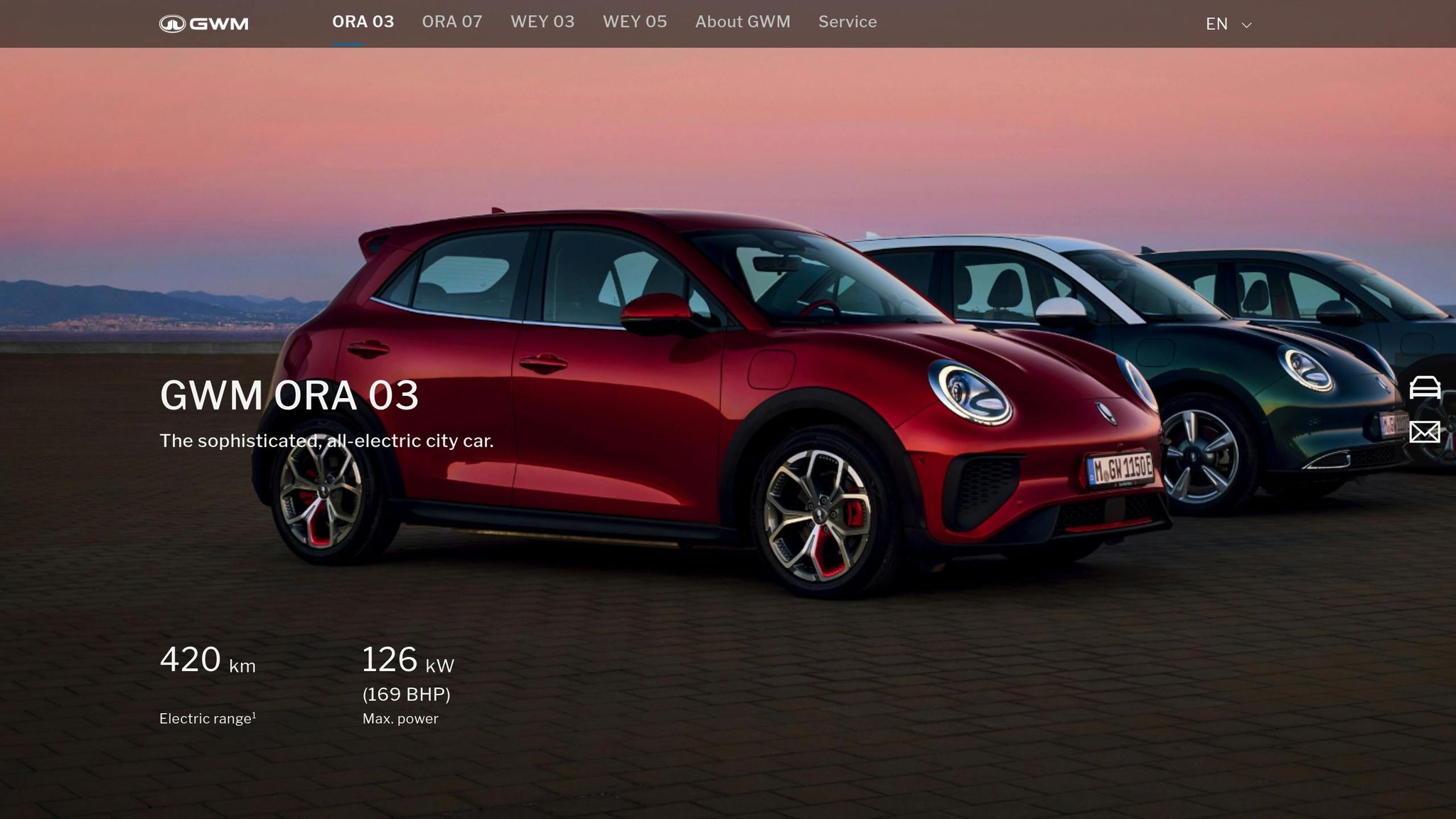
The GWM Ora 03 stands out as Africa’s most budget-friendly EV option, designed with battery technology that thrives in challenging climates, ensuring long-lasting performance.
Battery Durability
The Ora 03’s 48 kWh model features tough Lithium Iron Phosphate (LFP) batteries, which are particularly suited to high-temperature environments. These batteries come with an 8-year/99,419-mile warranty, offering peace of mind to buyers. Unlike older EVs that rely on Nickel Manganese Cobalt (NMC) batteries, LFP batteries are better equipped to handle heat, making them a smart choice for African conditions. The 48 kWh version offers a usable capacity of 45.4 kWh.
Range Retention
Real-world tests in South Africa highlight the Ora 03’s practical range. In December 2023, AutoTrader South Africa put the Ora 03 400 GT to the test at the Gerotek facility. Driving at a steady 75 mph with the air conditioning set to 70°F, the vehicle managed 124 miles in 1 hour and 34 minutes before hitting the recommended 10% battery level – roughly half of its advertised 248-mile range. George Mienie, AutoTrader’s CEO, explained the localized testing approach:
The tests are based on South African conditions rather than the cooler European testing scenarios.
He also stressed the importance of battery care:
In order to maintain good battery life, EVs should not be driven to lower than 10%.
In milder weather (around 73°F), the 48 kWh model achieves a combined real-world range of about 183 miles, while the 63 kWh version extends to roughly 242 miles. These numbers underline the Ora 03’s efficiency and reliability, especially given its affordability.
Used Price Range
The Ora 03 also delivers great value in the used car market. New 2026 models in comparable markets are priced at around $34,490 for the base Lux trim and $37,490 for the GT variant. Meanwhile, early 2023 used models are available for approximately $31,815, showing moderate depreciation that appeals to budget-conscious buyers. Charging the Ora 03 takes about 5 hours on an 11 kW connection, while DC fast charging peaks at 64 kW, making it suitable for daily needs. Buyers should ensure software updates are current to keep the warranty valid.
With a 4 out of 5 reliability rating and a 5-star safety rating, the Ora 03 proves to be a dependable choice. While its infotainment system has faced some criticism and its cargo space is limited to 8 cubic feet, these drawbacks are minor compared to its overall value and performance.
5. Dongfeng Box E1
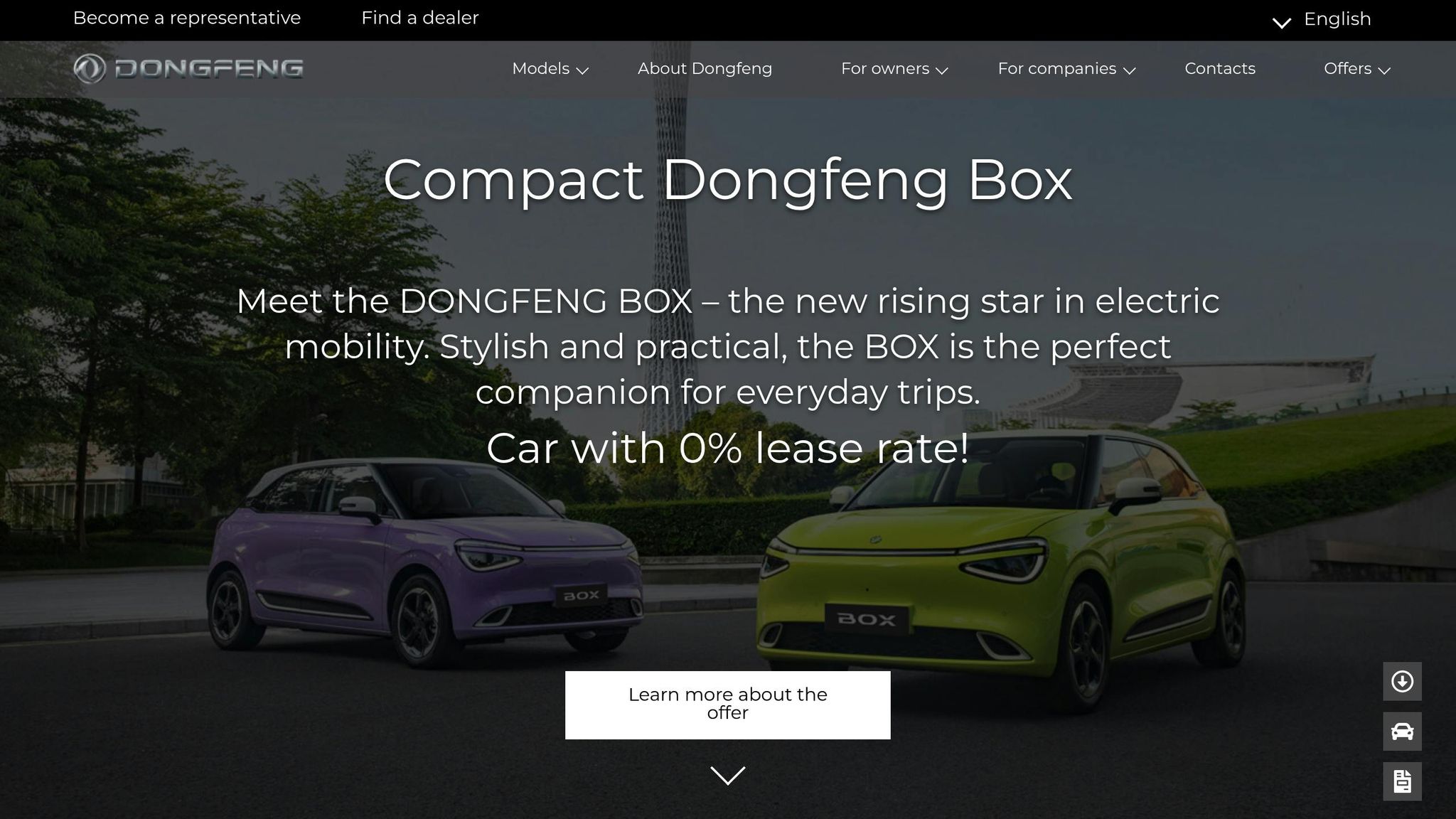
As Africa’s used EV market continues to grow, the Dongfeng Box E1 stands out as a budget-friendly and efficient choice designed to handle the region’s climate challenges. While real-world data on this model is limited, insights from broader research on light passenger vehicles provide helpful context.
Battery Durability
According to Geotab’s 2025 analysis, light passenger vehicles like the Box E1 experience an average annual battery degradation of 2.0%, which is lower than the 2.7% typically seen in larger EVs. Charlotte Argue, Senior Manager of Sustainable Mobility at Geotab, emphasized this durability:
Our 2025 analysis… confirms that overall, modern EV batteries are robust and built to last beyond a typical vehicle’s service life.
In Africa’s hotter climate, battery degradation increases by an additional 0.4% annually. This adjustment brings the Box E1’s estimated annual degradation rate to around 2.4%, which is still a solid performance compared to older EV technologies. This durability ensures the vehicle maintains a reliable range over time.
Range Retention
On average, EV batteries retain 93% of their capacity after 43,000 miles and 90% after 124,000 miles. For the Box E1, limited use of high-power fast charging is projected to result in an 81.6% capacity retention after eight years. Simple measures, like parking in shaded areas during extreme heat and reserving fast charging for essential trips, can further help extend battery life.
Used Price Range
The Box E1 not only offers reliable battery performance but also delivers cost efficiency. While specific pricing for used models in Africa is scarce due to limited market data on EVs in the region, the overall outlook is encouraging. Small electric vehicles like the Box E1 are expected to reach cost parity with gasoline-powered cars by 2030. By 2040, operating costs could drop below $24 per 62 miles. Additionally, independent battery health certificates, now standard in about 90% of EV sales in established markets, give buyers confidence when assessing a vehicle’s value.
Pros and Cons
When it comes to battery durability in African conditions, these five EV models showcase a mix of strengths and challenges. Modern post-2016 models, like the BYD Dolphin and GWM Ora 03, significantly lower the risk of battery replacement – down to about 1%, compared to 13% in older, pre-2015 vehicles. Both models feature active cooling systems, making them well-suited for extreme climates.
The BMW i3 and Jaguar I-Pace also include active thermal management systems, ensuring better battery performance in hot conditions. However, their premium status comes with higher maintenance costs – battery replacements for these models can cost as much as $15,000. According to Martin Reinholdsson, Test Manager at Kvdbil:
Age, climate, driving style and charging habits: They play in as fairly large factors on the wear
On the more budget-friendly end, the Dongfeng Box E1 offers solid performance with battery degradation rates comparable to its competitors. A study of 1,300 used EVs revealed that 80% retained 90% or more of their original battery capacity after several years of use, making it a practical long-term option.
Battery Performance Overview
| Model | Annual Degradation Rate | Range Retention (90,000 miles) | Battery Cooling | African Climate Fit |
|---|---|---|---|---|
| BYD Dolphin | 1-2% | ~90% | Active (LFP) | Excellent |
| BMW i3 | 1-2% | ~90% | Active | Good |
| Jaguar I-Pace | 1-2% | ~90% | Liquid Cooled | Good |
| GWM Ora 03 | 1-2% | ~90% | Active | Excellent |
| Dongfeng Box E1 | 1-2% | ~90% | Active | Excellent |
This comparison highlights the importance of considering warranties and maintenance when shopping for used EVs.
Warranty and Legal Considerations
Technical performance alone isn’t enough – legal and warranty protections are key to safeguarding a buyer’s investment. Federal law mandates that EV battery warranties last at least 8 years or 100,000 miles. This legal requirement complements the strong battery performance seen in these models.
Consumer Reports stresses the importance of verifying the remaining battery warranty before purchasing a used EV. Alex Knizek, Associate Director of Auto Test Development at Consumer Reports, explains:
The sweet spot for a used EV is one that’s still under its battery warranty but that’s depreciated enough for significant savings compared to a new one
Ensuring the warranty is transferable before finalizing a purchase is a crucial step for buyers entering this growing market.
Conclusion
For African buyers, the BYD Dolphin and GWM Ora 03 stand out as dependable choices, particularly when it comes to battery durability. Thanks to its advanced liquid-based cooling system and LFP battery technology, the BYD Dolphin performs exceptionally well in hot climates and under frequent charging demands. Plus, as these models age, used options often come with appealing price tags.
If you’re working with a higher budget, the BMW i3 and Jaguar I-Pace are worth considering. The BMW i3 is known for maintaining solid battery performance thanks to its active cooling system, while the Jaguar I-Pace combines luxury and performance at competitive prices. For example, some models with around 38,000 miles on the odometer can be found at attractive price points. However, it’s worth noting that premium models, while offering enhanced performance, often come with steeper maintenance costs.
For buyers seeking affordability without compromising reliability, the Dongfeng Box E1 is a noteworthy option. It showcases that even budget-friendly EVs can deliver dependable battery performance.
To ensure a smart purchase, always verify warranty details and conduct independent battery checks. When exploring listings on EV24.africa, check the remaining battery warranty and use diagnostic tools to assess the battery’s health. With South Africa’s used EV market expanding by 65% in early 2025, buyers now have access to a diverse range of reliable EVs tailored to Africa’s unique conditions.
FAQs
Are LFP batteries reliable in Africa’s hot climate?
Yes, LFP (Lithium Iron Phosphate) batteries perform exceptionally well in hot climates, such as those common across many regions of Africa. Their design allows them to handle high temperatures more efficiently than some other battery types, reducing the risk of overheating and helping to prolong their lifespan.
Beyond their heat resistance, LFP batteries are also recognized for their safety and durability. These qualities make them a reliable option for areas with consistently warm weather, ensuring steady and dependable performance even in demanding conditions.
What should I look for when buying a used electric vehicle in Africa?
When purchasing a used EV in Africa, one of the first things to evaluate is the battery health. On average, EV batteries lose about 2-3% of their capacity each year, so it’s important to ensure the battery is still in good shape. Vehicles equipped with lithium-iron-phosphate (LFP) batteries are a smart choice – they last longer, handle heat better, and can endure up to 10,000 charging cycles, making them particularly suitable for Africa’s warmer climates. Be sure to request a recent battery health report; a reading above 90% is a good indicator of strong performance.
Think about the total cost of ownership, not just the upfront price. While used EVs can be found starting at around $4,800, don’t forget to account for repair costs, warranty coverage, and any local tax incentives that might help reduce your expenses. Pay attention to the vehicle’s range, which typically falls between 124 and 311 miles per charge, and make sure it matches your daily driving needs. If you’re in a rural area, check whether there’s sufficient charging infrastructure nearby to support your EV.
Finally, make sure the EV is built to handle local conditions. Models with higher ground clearance, durable suspensions, and heat-resistant battery systems are better suited for navigating rough roads and enduring extreme temperatures. A thorough pre-purchase inspection is essential – it can confirm the state of the battery, verify the service history, and ensure the vehicle is compatible with local power grids. This step will help you find an EV that can reliably meet the demands of Africa’s varied environments.
What is the best used EV in Africa for affordability and reliable battery performance?
The BMW i3 stands out as a top choice for used electric vehicles in Africa, offering a combination of affordability and reliable battery performance. Its sturdy build and dependable battery make it particularly well-suited for handling diverse conditions, including the demands of hotter climates.
Thanks to its thoughtful design and efficient battery technology, the BMW i3 delivers consistent long-term performance. It’s an excellent option for anyone considering the switch to a pre-owned electric vehicle.