
 Thabo Nkosi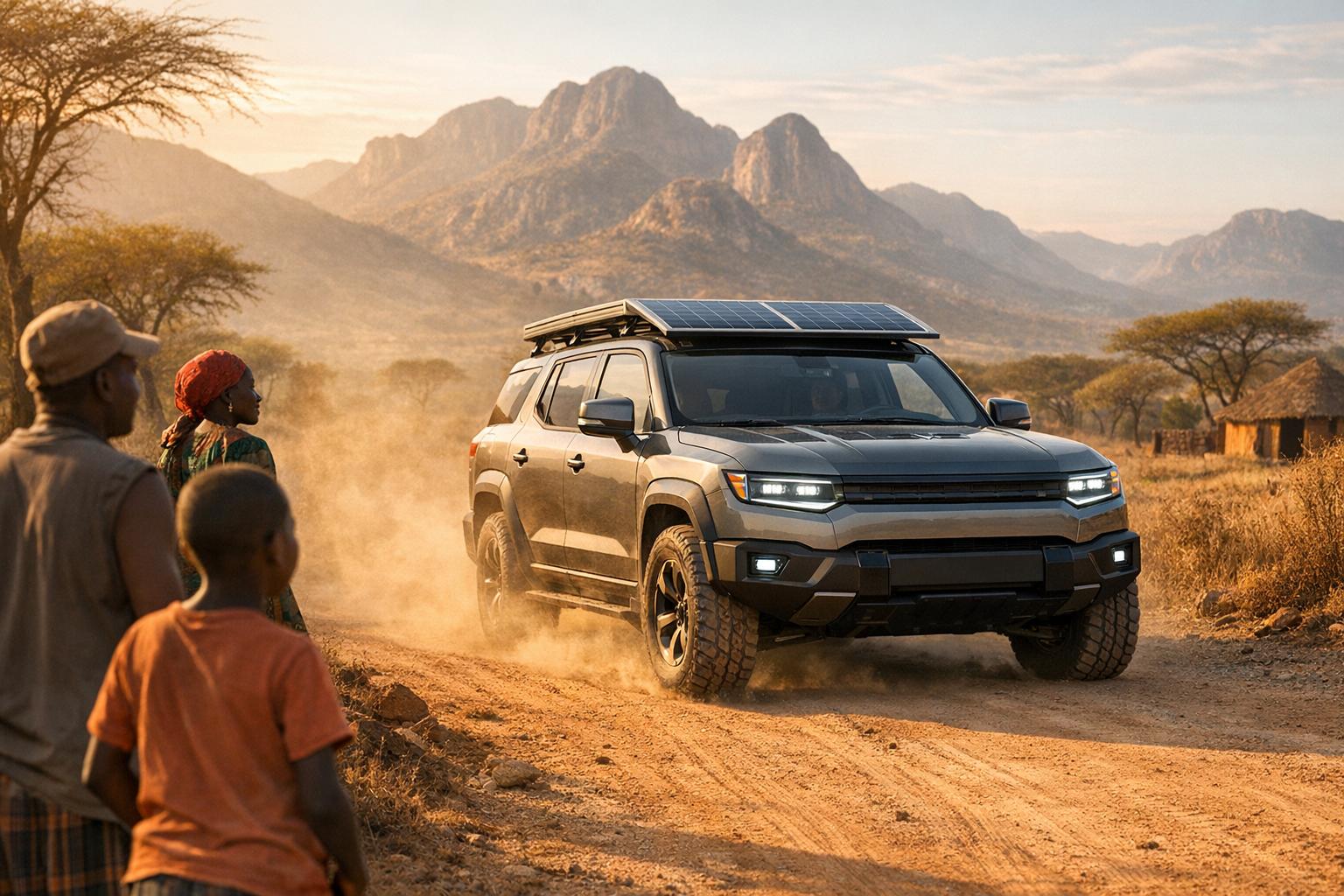
Electric vehicles (EVs) designed for African roads must handle tough conditions like potholes, unpaved paths, extreme heat, and inconsistent power grids. This guide highlights 25 EVs built for durability, affordability, strong battery performance, and rugged terrain. Key features include reinforced suspensions, high ground clearance, heat-resistant materials, and sealed battery compartments. These cars are also cost-effective, with lower fuel and maintenance expenses, and many support solar charging for areas with limited grid access. Models like the Chevrolet Silverado EV and Hyundai Ioniq 5 also excel in range, fast charging, and off-road capabilities. Ready to find the best EV for Africa? Explore options tailored to these challenges.
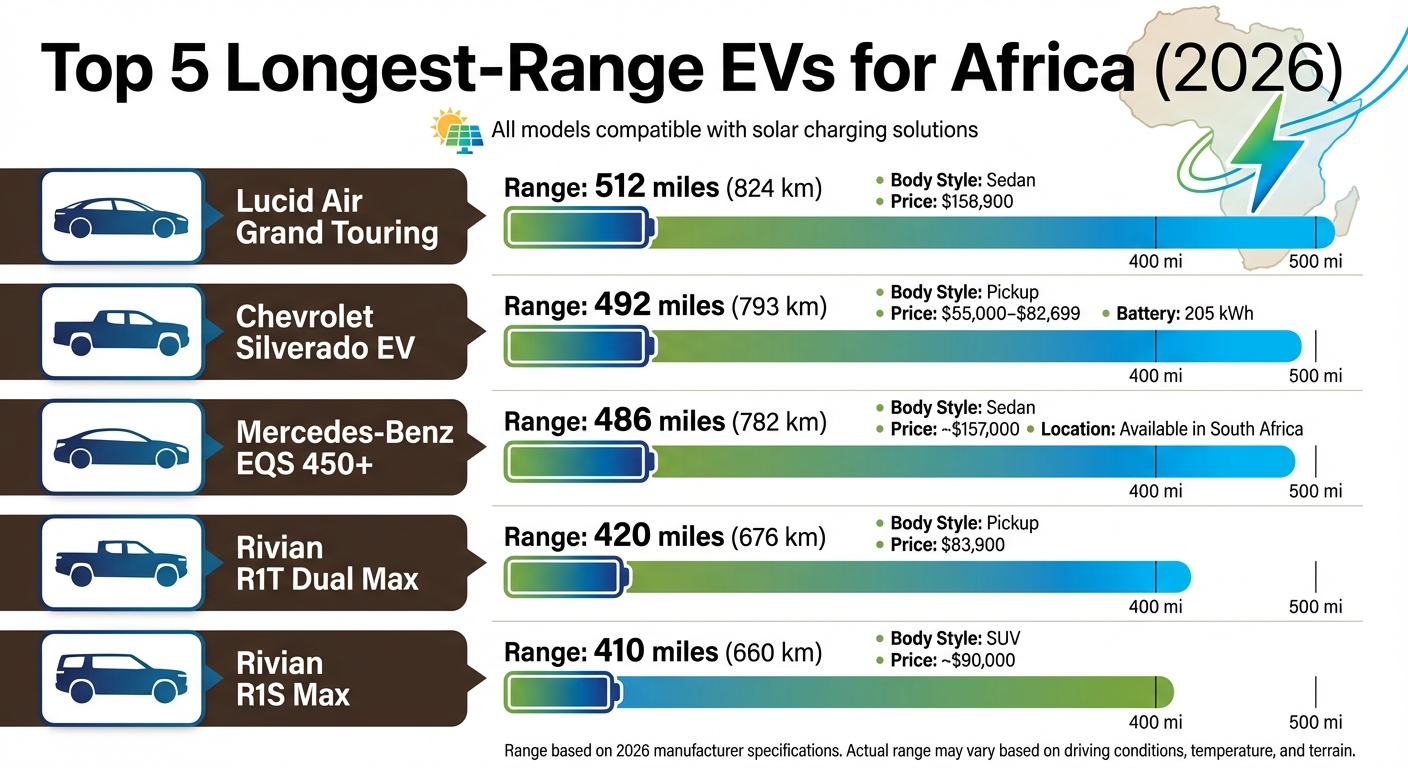
Top 5 Longest-Range Electric Vehicles for African Roads 2026
BYD makes bold move in South Africa as a key EV market for Africa
1. Durability
Durability is crucial for electric vehicles (EVs) to handle the challenging road conditions found in many parts of Africa. This is achieved through thoughtful design and specific features that enhance their resilience.
1. Reinforced Suspension Systems
EVs are equipped with reinforced suspension systems designed to absorb shocks from potholes, gravel, and uneven roads. These systems help protect essential components like the battery pack and undercarriage. Some models even include independent suspension and extra underbody shielding, ensuring they remain reliable on rough terrain.
2. High Ground Clearance
High ground clearance is essential for navigating obstacles like flooded streets and bumpy roads. Take the 2026 Kia EV3, for example – its compact SUV design makes it versatile enough for both urban and rural environments.
3. Sealed Battery Compartments
To ensure consistent performance in tough conditions, durable EVs feature sealed battery compartments. These compartments shield the battery cells and electrical connections from dust, mud, and water, keeping the vehicle running smoothly.
4. Heat-Resistant Materials
High temperatures can take a toll on vehicles, but EVs combat this with heat-resistant materials. Features like UV-protected paint, advanced thermal management systems, and heat-resistant plastics help prevent interior wear and reduce the risk of electronic malfunctions, extending the car’s lifespan.
5. Corrosion-Proof Undercarriage
Corrosion-proof undercarriages are another key feature. Using resistant materials and protective coatings, these undercarriages maintain the vehicle’s structural integrity even in salty or wet environments. For instance, the 2026 Nissan LEAF includes such measures to handle coastal conditions and standing water effectively.
6. Extended Warranty Coverage
To bolster trust in their durability, manufacturers often provide extended warranties. These warranties cover issues like battery degradation and major component failures, giving drivers added peace of mind about their EV’s long-term performance.
Durability is just one piece of the puzzle. Up next is affordability, a critical factor in making EVs a viable option for more drivers.
2. Affordability
Affordability isn’t just about the upfront price – it’s about what you’ll spend over the long haul. While electric vehicles (EVs) often come with a higher initial cost, they can lead to notable savings over time, especially in regions like Africa where fuel prices are steadily climbing. Let’s break down the key ways EVs can save you money.
Lower Fuel and Energy Costs
One of the biggest perks of EVs is how much you save on fuel. Charging an EV costs a fraction of what you’d spend on gasoline or diesel, and this gap keeps growing as fossil fuel prices rise. In South Africa, 75% of consumers cite lower fuel costs as a major reason for considering EVs. Research conducted by ETH Zurich and the Paul Scherrer Institute in January 2026 looked at over 2,000 locations across 52 African countries. They found that for a small car traveling about 31 miles (50 kilometers) daily, solar-powered charging costs are almost negligible compared to the overall cost of ownership.
"Our findings show that under certain conditions, e-mobility is feasible sooner than many people think." – Bessie Noll, Senior Researcher, ETH Zurich
Reduced Maintenance Costs
EVs are mechanically simpler than traditional vehicles, which means fewer things can go wrong. No oil changes, no transmission issues, and no exhaust system repairs. This simplicity translates to lower maintenance costs. In South Africa, 43% of consumers appreciate EVs for their reduced upkeep needs. This is especially appealing for those who drive long distances or live in remote areas where finding a service center can be a challenge.
Solar-Powered Charging Options
Solar charging is becoming a practical solution across Africa, offering a way to power EVs without relying on the grid. A small solar setup can easily handle the daily charging needs of a car traveling about 31 miles (50 kilometers). Christian Moretti from PSI highlights the benefits:
"These systems prove significantly cheaper and, in many contexts, more reliable than the grid."
This approach not only shields drivers from fluctuating energy prices but also provides a reliable alternative in areas with inconsistent grid access.
Financing and Incentive Programs
The upfront cost of EVs can be intimidating, but government incentives and international programs are helping to make them more accessible. Potential buyers should explore these options to offset the initial expense and make EV ownership more achievable.
Transparent Pricing Models
Transparency in pricing can make all the difference when evaluating EV ownership. Look for dealers and platforms that clearly outline purchase costs, warranty coverage, and estimated operational expenses. For example, EV24.africa offers detailed listings with clear pricing for both new and used EVs, making it easier for buyers to understand what they’re getting without hidden fees.
Higher Accident Repair Costs
One downside to EV ownership is the cost of accident repairs, which are about 6.7% higher than for traditional vehicles due to the expense of battery components. However, this is often offset by the money saved on routine maintenance. Many manufacturers now offer extended warranties, which can help reduce the financial impact of repairs.
| Cost Factor | Electric Vehicles | Traditional Vehicles |
|---|---|---|
| Fuel/Energy Cost | Lower | Higher and increasing |
| Routine Maintenance | Lower due to fewer parts | Higher |
| Accident Repair | ~6.7% higher | Standard costs |
Next, we’ll dive into battery performance – an essential consideration for Africa’s unique challenges.
sbb-itb-99e19e3
3. Battery Performance
Battery performance is the backbone of any electric vehicle (EV), especially when tackling Africa’s vast climates and distances. It’s the key factor that determines how practical an EV is for the continent’s unique roads and conditions.
Range Capacity for Long Distances
When it comes to traversing Africa’s sprawling landscapes, range matters – a lot. By 2026, a reliable EV range is around 300 miles (480 km), though premium models are pushing well beyond that. Leading the charge is the 2026 Lucid Air Grand Touring, boasting an impressive 512 miles (824 km) per charge. For those needing utility vehicles, the Chevrolet Silverado EV delivers 492 miles (793 km) thanks to its massive 205 kWh battery pack. In South Africa, the Mercedes-Benz EQS 450+ offers a range of 486 miles (782 km), priced at approximately $157,000.
Temperature Resilience
Africa’s climates can be tough on batteries, from freezing temperatures to scorching heat. In cold conditions (-15°C to -5°C or 5°F to 23°F), EVs can lose 20–30% of their range. On the other hand, high temperatures challenge battery efficiency, though modern thermal management systems help mitigate these effects. Driving at higher speeds, like 80 mph (130 km/h), also impacts range, often reducing it to 60–70% of the official WLTP rating.
Ultra-Fast Charging Capabilities
Fast charging is a must for long trips. BYD’s 2026 models, equipped with 1,500-volt silicon carbide technology, can add an impressive 248 miles (400 km) in just 5 minutes. Similarly, the Volvo EX60 gains 211 miles (340 km) in 10 minutes with a 400kW fast charger. Anders Bell, Chief Technology Officer at Volvo Cars, highlights this advancement:
"With our new electric vehicle architecture, we directly address the main worries that customers have when considering a switch to a fully electric car."
Many high-end EVs now feature 800-volt systems, enabling faster charging with less heat buildup. These innovations align well with Africa’s growing charging networks.
Charging Infrastructure Compatibility
Charging accessibility is improving across Africa. In 2026, Roam introduced "Roam Point" in Kenya, the first universal fast-charging network for light EVs. It uses Type 6 connectors and open-charge standards. Habib Lukaya, Roam’s Country Manager, explains:
"The Roam Point builds on the battery ownership model, which gives riders full control of their batteries, allowing them to ‘ride everywhere and charge anywhere’."
These charging stations provide 10–20 km of range in just 5 minutes for light vehicles.
Solar Charging Integration
Off-grid solar charging is becoming a viable solution for daily EV use in Africa. A 2026 study by ETH Zurich and the Paul Scherrer Institute found that solar-powered systems with stationary batteries offer a more dependable power source than many existing grids. A compact solar setup can meet the daily needs of vehicles averaging 31 miles (50 km), making it an effective off-grid option.
Real-World Efficiency
Driving conditions significantly influence efficiency. Urban driving, with the help of regenerative braking, can increase range by 10–20% compared to WLTP estimates. However, highway speeds tend to lower efficiency. For instance, the Lucid Air achieves a 146 MPGe rating, while the much heavier GMC Hummer EV manages only 53 MPGe despite its larger battery pack.
| Model | Max Range (Miles) | Max Range (KM) | Body Style | Price (USD) |
|---|---|---|---|---|
| Lucid Air Grand Touring | 512 | 824 | Sedan | $158,900 |
| Chevrolet Silverado EV | 492 | 793 | Pickup | $55,000–$82,699 |
| Mercedes-Benz EQS 450+ | 486 | 782 | Sedan | ~$157,000 |
| Rivian R1T Dual Max | 420 | 676 | Pickup | $83,900 |
| Rivian R1S Max | 410 | 660 | SUV | ~$90,000 |
4. Terrain Adaptability
With durable construction and reliable battery performance as a foundation, these vehicles are also designed to handle Africa’s varied and challenging terrains.
High Ground Clearance and Lifted Suspensions
African roads often go beyond the comfort of smooth highways. The 2026 Chevrolet Silverado EV Trail Boss, for instance, features a factory-lifted suspension that protects the battery pack from rocks, debris, and water. This makes it well-suited for rural routes where paved roads are scarce.
Dual-Motor All-Wheel Drive Systems
Tackling mountainous areas or muddy tropical roads requires excellent traction. Vehicles like the Chevrolet Equinox EV and Hyundai Ioniq 5 are equipped with dual-motor all-wheel drive (AWD) systems. These systems distribute power to all four wheels, ensuring better grip on loose or wet surfaces.
Four-Wheel Steering for Tight Spaces
Navigating narrow mountain passes or crowded urban streets can be tricky for larger vehicles. The Chevrolet Silverado EV addresses this challenge with four-wheel steering technology, which improves maneuverability. This allows the vehicle to handle tight corners and winding roads as if it were a smaller pickup. Combined with all-terrain tires and advanced thermal systems, this feature boosts off-road capabilities.
All-Terrain Tire Compatibility
Driving on desert sands or rocky landscapes demands durable and reliable tires. Vehicles with large wheel wells that can accommodate 35-inch all-terrain tires ensure better grip and resilience on sand, sharp rocks, and uneven surfaces.
Advanced Thermal Management for Extreme Heat
Off-road conditions in high temperatures can strain batteries. To counter this, the Hyundai Ioniq 5 and Kia EV9 utilize 800-volt architectures. This setup enhances energy flow and improves cooling efficiency, especially during rapid charging in extreme environments.
Solar Integration for Remote Travel
In areas where grid infrastructure is weak, solar-powered charging offers a practical and eco-friendly solution. Christian Moretti, a Research Scientist at PSI’s Laboratory for Energy Systems Analysis, explains:
"These systems [solar charging] are significantly cheaper than is often assumed, and in many contexts they are even more reliable than the existing electrical grid."
This technology supports off-grid operation, making it possible to travel in remote areas without relying on conventional charging networks.
Battery Swapping Systems
For remote travel, battery swapping systems provide a quick alternative to traditional charging. This approach is especially useful in areas lacking fast-charging stations, reducing downtime and extending the range for vehicles across diverse and challenging terrains.
Conclusion
Finding the perfect electric vehicle (EV) for African roads means focusing on models that can handle extreme heat, rugged terrain, and limited infrastructure. These vehicles are built with durability, cost-effectiveness, reliable battery technology, and the ability to tackle diverse terrains in mind – key factors for driving across Africa.
With nearly 50 new EVs set to launch globally in 2026, African buyers have more options than ever before to find a vehicle suited for their unique needs. Whether you’re navigating dusty rural paths, climbing steep mountain roads, or weaving through bustling city streets, there’s an EV out there for you. Options range from the affordable BYD Dolphin, priced at $21,200, to the off-road-ready Mini Countryman SE ALL4, which starts at $45,200.
EV24.africa makes the switch to electric mobility easier by offering a platform where African drivers can explore and compare trusted EV models in one convenient location. It’s a one-stop shop to help you find a vehicle that aligns with your driving requirements.
As Africa embraces greener transportation, choosing an EV tailored to local conditions is more than just a practical decision – it’s a step toward sustainability. The right EV not only minimizes your carbon footprint but also ensures reliable performance in Africa’s varied landscapes. Think about what you need most: a long range for extended trips, high ground clearance for rough roads, or advanced cooling systems for hot climates. Then, make your choice wisely.
Ready to start your electric journey? Visit EV24.africa to discover EVs built for Africa’s challenges.
FAQs
What features make electric cars suitable for driving on African roads?
Electric cars tailored for African roads are built to tackle the region’s demanding conditions. These vehicles are equipped with higher ground clearance and reinforced suspensions to handle potholes and unpaved roads with ease. Additionally, dust-proof filters and heat-resistant batteries ensure reliable performance even in scorching temperatures above 104°F.
Price and range are equally important factors. Many of these cars are available in the $13,200 to $35,000 price range, offering a driving range of 200–250 miles per charge. This makes them suitable for both daily city commutes and longer rural journeys. With limited charging infrastructure in many areas, some models include practical solutions like plug-in hybrid systems or range extenders, providing flexibility and peace of mind for drivers navigating various terrains.
What are the benefits of solar charging for EV owners in Africa?
Solar charging offers EV owners in Africa a practical way to tap into the continent’s plentiful sunlight to power their vehicles. By doing so, they can decrease dependence on the often-unreliable electrical grid. This approach not only slashes operating costs – eliminating the need for pricey diesel-generated electricity – but also reduces environmental impact, as solar-powered EVs produce zero tailpipe emissions, contributing to cleaner air.
In areas where power outages are frequent or charging infrastructure is limited, solar-equipped vehicles provide a dependable alternative. Even on overcast days, solar panels can add a few extra miles of range. For drivers in remote regions, a simple rooftop solar setup can be enough to keep batteries charged for daily commutes or taxi operations. This added flexibility eases range anxiety and makes EV ownership more accessible for both city dwellers and rural communities.
Africa’s intense sunlight also means that even modest solar panels can generate enough energy to cover typical daily travel needs. This turns sunlight into a free, renewable fuel source, perfectly suited to the region’s conditions.
What are the best electric vehicles for off-road driving in Africa?
For venturing off-road in Africa, a few electric vehicles shine for their ruggedness and performance. The Changan Hunter REEV takes the spotlight with an impressive range of 621 miles (approximately 1,000 km) and a built-in range extender, making it a dependable companion for long, challenging journeys. The Ford F-150 Lightning and Tesla Cybertruck are also strong contenders, boasting over 10,000 lbs of towing capacity and tough designs that can tackle rough terrains with ease. Meanwhile, the Toyota Hilux BEV earns praise for its robust suspension and high ground clearance, making it a trustworthy option for navigating tricky paths.
Other noteworthy models include the Kia Tasman EV, Rivian R1T, Chevrolet Silverado EV, GMC Sierra EV, and Maxus eTERRON9. These vehicles feature elevated ground clearance, off-road drive modes, and impressive payload capacities, ensuring they’re well-suited for Africa’s diverse and demanding landscapes. Whether it’s rocky trails or sandy paths, these EVs are engineered to deliver a reliable and smooth off-road experience.