
 Thabo Nkosi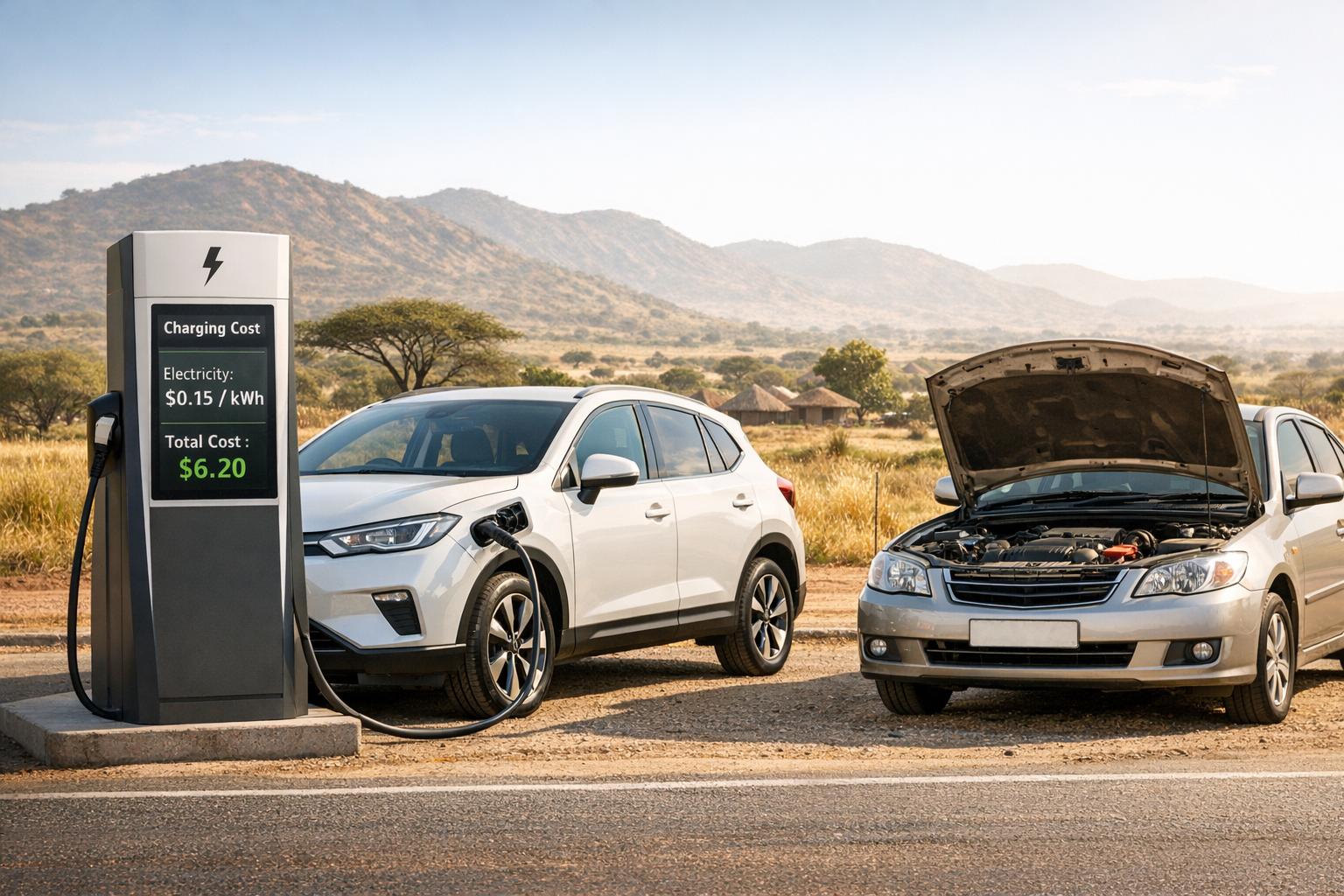
When deciding between an electric vehicle (EV) and an internal combustion engine (ICE) vehicle in Africa, the Total Cost of Ownership (TCO) matters more than just the upfront price. Here’s what you need to know:
- EVs cost less to operate: Driving 100 km in a light-duty EV in Kenya costs $0.62–$0.92, while an ICE vehicle costs $6.62. Maintenance for EVs is also cheaper, with fewer moving parts and no oil changes.
- Upfront costs are higher for EVs: EVs are more expensive to buy, but falling battery prices and government incentives like tax breaks and duty waivers are narrowing the gap.
- Government policies favor EVs: Countries like Rwanda and Ethiopia have eliminated import duties or banned ICE vehicles, while South Africa offers tax deductions for EV production.
- Charging vs. fueling: EV charging is much cheaper, but infrastructure is limited to urban areas. Solar off-grid systems are emerging as alternatives.
Key takeaway: EVs save money in the long run, especially for high-mileage drivers, but upfront costs and charging availability remain challenges.
Quick Comparison
| Feature | Electric Vehicles (EVs) | ICE Vehicles |
|---|---|---|
| Upfront Cost | Higher due to batteries and import costs | Lower; supported by used car market |
| Fuel/Energy Cost | $0.62–$0.92 per 100 km | $6.62 per 100 km |
| Maintenance | Lower (~$4,600 over 5 years) | Higher (~$7,800 over 5 years) |
| Infrastructure | Limited; urban-focused | Widespread; fuel stations everywhere |
| Government Policies | Favorable incentives | Facing bans and higher taxes |
EVs are a smart long-term choice for drivers covering significant distances daily. Use a TCO calculator to see what works best for your needs.
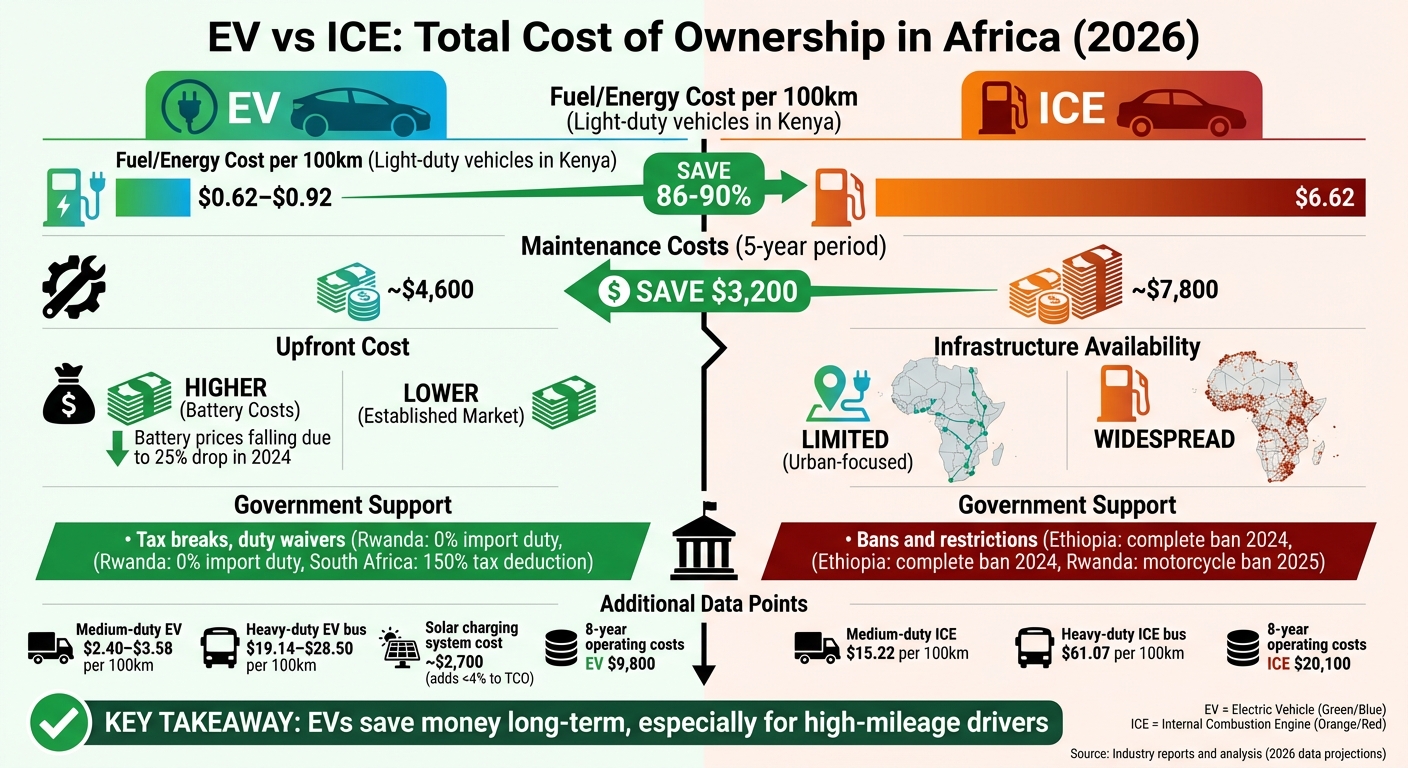
EV vs ICE Total Cost of Ownership Comparison in Africa 2026
1. Electric Vehicles (EVs)
Purchase Price
The cost of buying an electric vehicle (EV) in Africa can vary greatly, depending on whether you opt for a locally assembled model or an imported one. In Kenya, locally assembled electric buses are priced between $55,000 and $60,000, while those built in Uganda range from $58,800 to $90,000. On the other hand, imported buses from brands like BYD in South Africa can cost anywhere from $250,000 to $300,000. A global 25% drop in battery prices in 2024 has helped reduce manufacturing costs for African-made EVs by 2026. To bridge the price gap, several governments are offering fiscal incentives. For instance, Rwanda has eliminated import duties on EVs, and Ethiopia allows duty-free imports for Completely Knocked Down (CKD) kits. Additionally, affordable EV models from China are increasing competition and making EVs more accessible across the region. These shifting price dynamics are paving the way for significant savings in operating costs, especially in fuel and charging.
Fuel/Charging Costs
Switching to an EV in Africa brings substantial savings on fuel. For instance, in Kenya, covering 100 kilometers in a light-duty EV costs just $0.62 to $0.92, compared to $6.62 for a gasoline-powered vehicle – an 86% to 90% cost reduction. Medium-duty EVs cost between $2.40 and $3.58 for the same distance, far less than the $15.22 required for similar internal combustion engine (ICE) vehicles. For heavy-duty electric buses, the cost ranges from $19.14 to $28.50 per 100 kilometers, compared to $61.07 for diesel buses.
In areas with unreliable grid power, solar off-grid (SOG) charging systems are becoming a practical alternative. A solar system designed for a small EV driving about 31 miles (50 kilometers) daily costs around $2,700, including installation, and adds less than 4% to the total cost of ownership. South African consumers are particularly drawn to EVs due to these savings, with 75% citing lower fuel costs as their main reason for considering the switch.
Maintenance Costs
One of the key advantages of EVs is their lower maintenance costs, thanks to fewer moving parts and the absence of oil changes or major engine repairs.
"Maintenance… tends to be much lower for electric vehicles" – International Energy Agency
Over eight years, an EV may incur around $9,800 in operating costs, including both maintenance and charging. In comparison, a similar ICE vehicle could rack up about $20,100 in expenses during the same period. ICE vehicles typically require oil changes every 3,000 miles, costing about $130 each time, along with major servicing every 25,000 miles. EVs eliminate these recurring costs entirely, cutting lifetime operating expenses to less than half of those for petrol or diesel vehicles.
Government Incentives
Governments across Africa are stepping in with policies to encourage EV adoption and make ownership more affordable. For example, South Africa has introduced a 150% tax deduction for EV production, starting in 2026. This initiative aims to boost local manufacturing and lower the cost of vehicles and components. Such incentives are especially impactful for commercial operators like taxi services and delivery fleets, where high daily mileage enables faster recovery of upfront costs through fuel and maintenance savings.
2. Internal Combustion Engine (ICE) Vehicles
Purchase Price
ICE vehicles typically come with a lower upfront price tag. For example, the additional cost of battery electric vehicles has decreased to about 15% for small cars and 25% for SUVs in emerging markets. This price difference is especially critical for commercial operators in regions like Africa, where the motorization rate is only 43 vehicles per 1,000 people – far below the global average of 197. For many, every dollar counts. However, while ICE vehicles may be cheaper to buy initially, they often lead to higher operating costs down the line.
Fuel Costs
Fuel expenses represent a significant ongoing cost for ICE vehicles. For instance, driving 100 kilometers in a light-duty gasoline vehicle in Kenya costs $6.62, while medium-duty vehicles require $15.22. The cost skyrockets for heavy-duty diesel buses, which consume $61.07 for the same distance. These fuel prices are a major challenge for commercial operators like taxi drivers and delivery services, whose vehicles rack up hundreds of kilometers daily. Globally, fuel prices average about $1.16 per liter, including taxes, adding further strain.
Maintenance Costs
ICE vehicles demand frequent maintenance due to their intricate mechanical systems. Routine tasks like oil changes, spark plug replacements, and transmission fluid servicing can pile up quickly. Over five years, ICE vehicle maintenance expenses are estimated to be about three times higher than those of electric vehicles. Additionally, the average ICE engine lasts around 10 years, requiring consistent upkeep to maintain its performance. For commercial vehicles, such as public transport vehicles that handle 60% to 80% of urban trips, these recurring costs can become a significant financial burden. Similarly, ICE motorcycle fleets, which typically turn over every 5 to 10 years, face heavy servicing demands.
Government Incentives
ICE vehicles are also increasingly impacted by regulatory changes. While electric vehicles often enjoy tax breaks and duty exemptions, ICE vehicles face mounting restrictions. For example, Ethiopia became the first country to completely ban ICE vehicle imports in 2024, and Rwanda plans to prohibit ICE motorcycles in Kigali starting in 2025. These policy changes reflect a broader push to phase out traditional fuel-powered vehicles by imposing higher import duties and stricter emissions standards. Over time, these regulatory pressures make owning an ICE vehicle less appealing and further widen the cost gap between ICE and electric vehicles.
Chinese EVs You Can Buy in Kenya – Africa EV Show
sbb-itb-99e19e3
Pros and Cons
Deciding between an EV and an ICE vehicle in Africa requires weighing the pros and cons carefully. Both options come with unique benefits and challenges that impact your budget and daily driving experience.
Operating costs strongly favor electric vehicles. For instance, in Kenya, driving 62 miles (100 km) in a light-duty EV costs just $0.62 to $0.92, compared to a hefty $6.62 for an ICE vehicle. Over five years, EV maintenance costs average around $4,600, while ICE vehicles can set you back approximately $7,800. This cost difference makes EVs especially appealing for high-mileage commercial drivers.
Upfront costs and financing, however, remain a significant barrier for EV adoption. Even though battery prices dropped by over 25% in 2024, EVs still carry a higher sticker price compared to ICE vehicles. On the other hand, ICE vehicles benefit from well-established financing options and a thriving used car market, making them more accessible to many buyers.
Infrastructure availability gives ICE vehicles a clear edge. Fuel stations are widely available even in remote areas across the continent. Meanwhile, EV charging infrastructure is mostly limited to urban centers, making long-distance travel challenging. That said, solar off-grid (SOG) charging systems are emerging as a potential solution, with installation costs for a small four-wheeler setup (driving about 31 miles or 50 km daily) around $2,700.
| Feature | Electric Vehicles (EVs) | ICE Vehicles |
|---|---|---|
| Upfront Cost | Higher due to battery and import costs | Lower; supported by a strong used market |
| Fuel/Energy Cost | Much lower energy costs | Higher; vulnerable to oil price fluctuations |
| Maintenance | Lower (~$4,600 over 5 years) | Higher (~$7,800 over 5 years) |
| Financing | Challenging; higher risk premiums in Africa | Easier; established lending options |
| Infrastructure | Limited; concentrated in cities | Widespread; fuel stations everywhere |
| Long-term Value | High savings in total cost of ownership (TCO); resale value depends on battery health | Declining due to ICE bans and rising fuel taxes |
Understanding these differences is essential for making informed decisions, especially when using tools like the EV vs. ICE calculator. These trade-offs directly influence the total cost of ownership (TCO) analysis provided by the calculator. Policy changes are also reshaping the market. For example, South Africa has introduced a 150% tax deduction for EV production investments starting in 2026. Such measures indicate growing support for EVs, while ICE vehicles face increasing restrictions and challenges.
Conclusion
Electric vehicles (EVs) offer clear long-term savings across Africa, even though their upfront costs may be higher. One major advantage is that EVs generally require less maintenance because they have fewer moving parts compared to traditional vehicles. For drivers who cover significant distances, these reduced operating costs can add up quickly.
EV ownership is becoming more attainable. Falling battery prices and supportive policies, such as South Africa’s 150% tax deduction and Rwanda’s elimination of import duties, are making EVs more affordable than ever. The International Energy Agency highlights this shift:
"Electric mobility is an opportunity for more affordable vehicle ownership and for the power sector thanks to the flexibility of charging"
If you’re someone who drives long distances daily – whether for work or personal reasons – switching to an EV could make financial sense. The savings on fuel alone can offset the higher purchase price within just a few years.
To maximize these benefits, it’s crucial to calculate your total cost of ownership (TCO). A personalized TCO assessment can help you compare EV models based on your driving habits, electricity rates, and local incentives. Many countries in Africa now offer tax breaks or duty waivers that can significantly lower the initial cost. For businesses, the per-kilometer savings make EVs an even more compelling option.
The African EV market is growing fast, with over 30,000 EVs on the road as of May 2025. Taking the time to understand your TCO could translate into thousands of dollars in savings over the life of your vehicle.
FAQs
How do government incentives make EV ownership more affordable in Africa?
Government programs are making electric vehicles (EVs) much more affordable in Africa by cutting both upfront and ongoing costs. Many nations in the region offer tax breaks, VAT exemptions, and reduced import duties, which significantly lower the initial price of buying an EV. Some even go a step further by waiving registration fees or offering subsidies that directly reduce the purchase price.
These incentives don’t just stop at the purchase stage – they also help bring down the day-to-day expenses of owning an EV. For instance, some areas provide free or discounted parking and reduced taxes for EV owners, making them a financially appealing alternative to traditional internal combustion engine (ICE) vehicles. When you factor in the naturally lower fuel and maintenance costs of EVs, these policies make the switch to electric mobility both a practical and economical option for many drivers across Africa.
What are the biggest challenges in building EV infrastructure across Africa?
Developing an electric vehicle (EV) charging network in Africa comes with its own set of obstacles. One of the biggest challenges is the absence of reliable data. Without clear numbers on vehicle ownership, grid capacity, or the location of existing charging stations, governments and investors struggle to draft practical policies or justify large-scale investments.
Financing is another major roadblock. Limited access to funds slows down both private and public initiatives aimed at expanding charging networks or upgrading power grids to support EVs.
Then there’s the issue of underdeveloped power infrastructure. In many parts of Africa, the electricity grid isn’t built to handle the high-capacity, consistent power that fast chargers require. This problem is especially pronounced in rural and peri-urban areas, where charging stations are scarce. Most of the existing chargers are clustered in a handful of urban centers, creating an uneven distribution. This imbalance discourages people from adopting EVs, which in turn reduces demand and makes further investment less appealing. Breaking this cycle is critical to expanding EV infrastructure across the continent.
How does the cost of maintaining an EV compare to a gas-powered car over time?
Electric vehicles (EVs) are much easier on your wallet when it comes to upkeep. Maintenance costs for EVs are typically 40%–60% lower than those for gas-powered cars. To put it into perspective, EVs cost about $0.06 per mile to maintain, while internal combustion engine (ICE) vehicles average around $0.10 per mile.
If you drive 30,000 miles in a year, that difference adds up to a savings of roughly $1,200. This cost advantage comes from the simpler design of EVs – fewer moving parts mean less wear and tear. Plus, you can say goodbye to routine expenses like oil changes.