
 Thabo Nkosi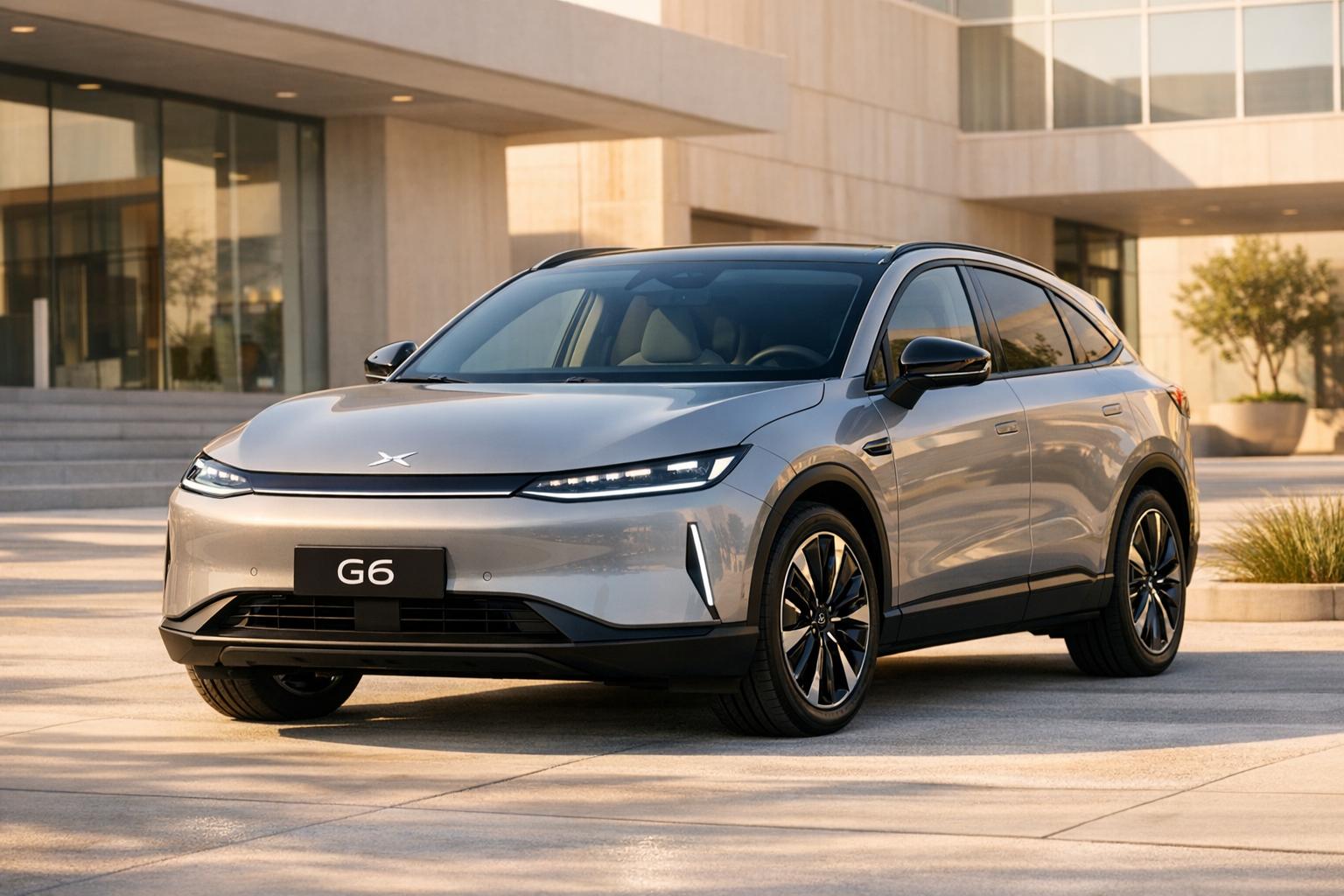
The XPENG G6 challenges the Tesla Model Y by offering premium features at a lower price. It combines advanced charging capabilities, a tech-rich interior, and a smoother ride, making it an appealing option for budget-conscious buyers. However, Tesla’s Model Y outpaces the G6 in brand reputation, storage space, and performance. Here’s a quick breakdown:
- XPENG G6: Lower price, 800-volt charging (up to 451 kW), wireless Apple CarPlay/Android Auto, and a more comfortable ride. Downsides include no front trunk and limited brand presence in Western markets.
- Tesla Model Y: Faster acceleration, extensive Supercharger network, larger storage, and proven reliability. However, it lacks features like Apple CarPlay and has a firmer ride.
Quick Comparison
| Aspect | XPENG G6 | Tesla Model Y |
|---|---|---|
| Price (Australia) | $59,800 AUD | $69,900 AUD |
| Charging Speed | Up to 451 kW (800V system) | Up to 250 kW (400V system) |
| Range | 270–342 miles | Up to 408 miles |
| Acceleration (0–62) | 6.2 seconds (Long Range) | 5.0 seconds (Long Range AWD) |
| Interior Features | Wireless Apple CarPlay/Android Auto | Tesla proprietary system |
| Storage | 571 liters, no front trunk | 854 liters + 117-liter front trunk |
| Warranty | 5 years/75,000 miles (up to 10 years) | 4 years/50,000 miles |
The G6 is ideal if you prioritize affordability and comfort, while the Model Y is better for performance and infrastructure. Your choice depends on what matters most to you.
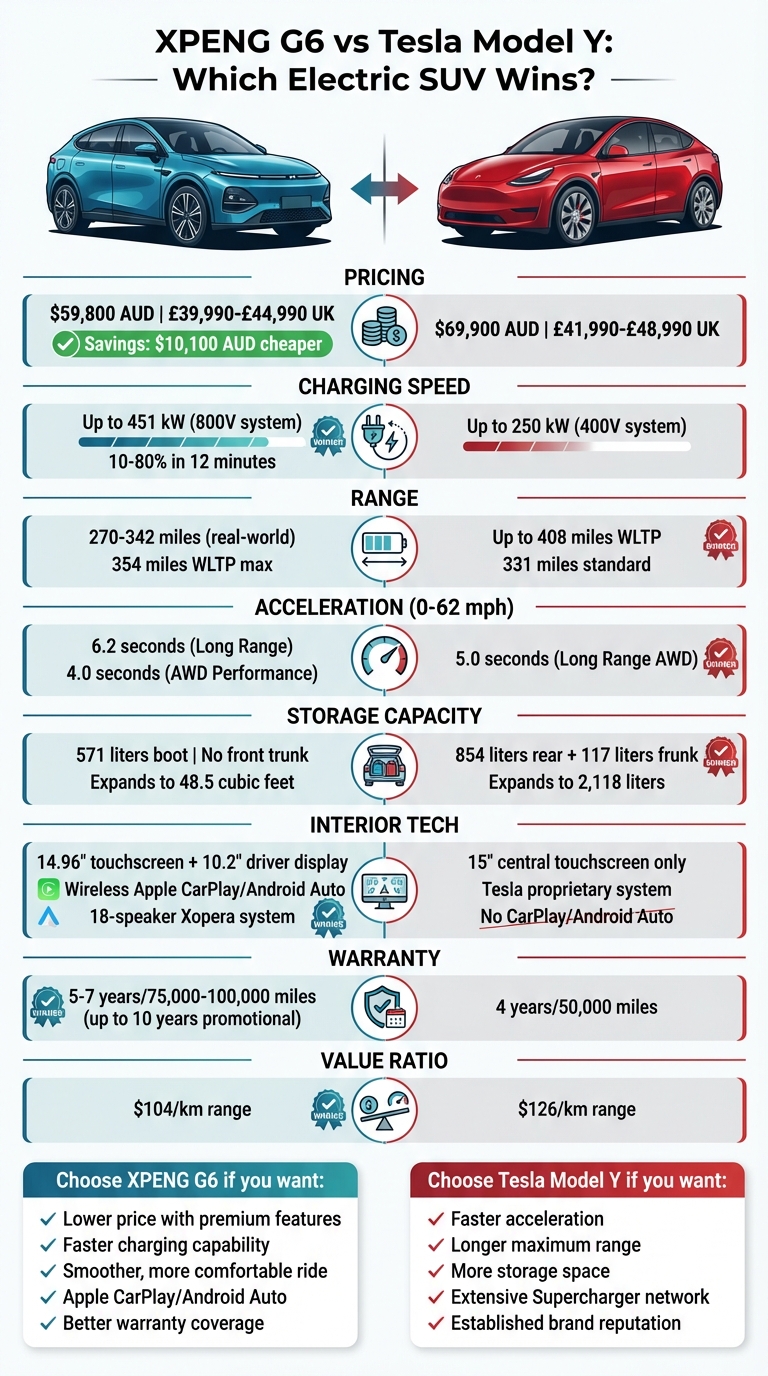
XPENG G6 vs Tesla Model Y: Complete Comparison Chart
1. XPENG G6
Performance
The XPENG G6 comes in three configurations to cater to a variety of driving needs: Standard Range RWD (255 hp), Long Range RWD (280 hp), and AWD Performance (470 hp, capable of 0–62 mph in just 4.0 seconds). Designed with comfort in mind, the G6 boasts a sleek 0.248 drag coefficient for better efficiency, though some reviews mention its steering feels a bit vague.
Battery Range
The G6 delivers a real-world range of 270–342 miles, depending on the model. This is slightly below its WLTP-rated maximum of 354 miles for the Long Range version. Energy consumption during testing averages between 15.9 and 18.0 kWh per 100 km, which is highly efficient. To maintain performance in extreme temperatures, the G6 is equipped with an intelligent thermal management system, including a heat pump.
Charging Capabilities
With its advanced 800-volt system, the 2025 Long Range model offers peak charging speeds of 451 kW, enabling a 10–80% charge in just 12 minutes. The original Long Range variant supports up to 280 kW, while the Standard Range maxes out at 215 kW. It features a CCS2 charging port and includes Vehicle-to-Load (V2L) capability at 3.3 kW, allowing it to power external devices. For home charging, an 11 kW connection can fully recharge the battery in 7.5 to 9.5 hours. These capabilities make it a strong contender in its class.
Interior Features
Step inside, and you’ll find a tech-forward cabin with a 14.96-inch touchscreen complemented by a 10.2-inch digital instrument cluster – a combination not offered in the Tesla Model Y. Standard features include wireless Apple CarPlay and Android Auto, along with an 18-speaker Xopera sound system and vegan leather seats. The G6 also provides generous storage, with 20 cubic feet of cargo space that expands to 48.5 cubic feet when the rear seats are folded. However, unlike some competitors, it does not include a front trunk.
"This is the most compelling, sub-$60k electric family SUV on the market that I’ve driven so far."
- Matt Campbell, Senior Contributor, CarExpert
Pricing and Value
The G6 delivers impressive performance and tech for its price. In the UK, the Standard Range starts at £39,990 (around $49,200), while the Long Range begins at £44,990 (approximately $55,400). This positions it £5,000–£7,000 below the Tesla Model Y. In Australia, the Long Range is priced at $59,800 AUD (roughly $39,100 USD), a savings of about $10,100 compared to the equivalent Model Y. Additionally, the G6 comes with a 5-year/75,000-mile warranty, with some markets offering promotional extensions up to 10 years/137,000 miles.
2. Tesla Model Y
Performance
The Tesla Model Y outpaces the XPENG G6 when it comes to acceleration. The Long Range AWD version of the Model Y can go from 0 to 62 mph in about 5.0 seconds, noticeably quicker than the G6 Long Range RWD, which takes 6.2 seconds. With 286 kW of power and 510 Nm of torque, the Model Y feels more responsive in comparison to the G6 in a similar trim. It also delivers sharper handling and firmer steering, though this comes at the cost of ride comfort. Critics often describe the Model Y’s suspension as "dreadful", whereas the G6 provides a smoother and more comfortable ride. Beyond handling and speed, the Model Y also stands out with its battery performance.
Battery Range
Tesla recently launched a Standard Long Range variant in Europe, which boasts an impressive 657 km (408 miles) WLTP range, significantly surpassing the XPENG G6 Long Range’s maximum of 354 miles. This model also achieves an efficiency rating of 12.7 kWh per 100 km, making it one of the most energy-efficient options available. Even the standard Model Y trims, with a range of around 533 km (331 miles), are well-suited for long-distance trips. Combined with Tesla’s expansive Supercharger network, the Model Y remains a strong contender for road trips and extended drives.
Charging Capabilities
The Model Y supports peak charging speeds of 250 kW on Tesla’s V3 Superchargers, which is slightly behind the XPENG G6’s 280 kW capability. This difference is due to Tesla’s 400-volt system, which limits its charging speed compared to the G6’s 800-volt architecture. However, Tesla more than makes up for this with its extensive and reliable Supercharger network, offering widespread accessibility for drivers. Interestingly, the G6 is set to access Tesla Superchargers starting in 2025, thanks to a firmware update, which will help close the gap in charging infrastructure.
Interior Features
Inside, the Model Y sticks to a minimalist approach, with all functions controlled through a single 15-inch central touchscreen. Unlike the XPENG G6, the Model Y does not support Apple CarPlay or Android Auto, relying entirely on Tesla’s proprietary software system. While the cabin design may feel basic compared to the G6’s twin-screen setup, many drivers appreciate the clean and uncluttered aesthetic. The Model Y also offers impressive storage space, with a 117-liter front trunk (frunk) and an 854-liter rear cargo area – far exceeding the G6’s 571 liters. Folding down the rear seats expands the total storage capacity to a massive 2,118 liters.
Pricing and Value
When it comes to pricing, Tesla has been working to stay competitive. In the U.S., the new Standard trim starts at approximately $35,000 USD, based on a Canadian price of $49,990 CAD. In the UK, the Standard Model Y is priced at £41,990, while the Long Range RWD version costs £48,990, placing it just £2,000 to £4,000 higher than comparable XPENG G6 models. In Australia, however, the price difference is more pronounced, with the Long Range AWD priced at $69,900 AUD, compared to the G6’s $59,800 AUD. Tesla justifies its higher price tag with faster acceleration, larger storage capacity, and access to its Supercharger network. Meanwhile, the G6 offers a more budget-friendly option for buyers interested in advanced features. Ultimately, Tesla positions the Model Y as a high-performance, premium vehicle, while the G6 appeals to those prioritizing affordability without sacrificing modern technology.
Xpeng G6 Review (2025): A Tesla Model Y Copy…But Better?!
sbb-itb-99e19e3
Pros and Cons
When comparing the XPENG G6 and Tesla Model Y, it’s clear that each car brings its own strengths and challenges to the table. Your decision will ultimately hinge on what you value most – whether it’s affordability and comfort or performance and infrastructure.
The XPENG G6 shines when it comes to value for money. It’s packed with premium features right out of the gate, including wireless Apple CarPlay, Android Auto, a 10.2-inch digital driver display, ventilated front seats, and an 18-speaker audio system – all at a considerably lower price point. Reviewers have also praised its smooth ride, with one noting:
"We’d happily accept the slightly more laid-back dynamics of the Xpeng G6 for the big improvement in ride comfort." – Independent
However, the G6 isn’t without its flaws. Its steering has been criticized as "vague" and "rubbery", which can make the driving experience less engaging. Practicality also takes a hit, as it lacks a front trunk (frunk) and, in some versions, even a glovebox. Additionally, the reliance on touchscreen controls for basic functions like mirror adjustments and climate settings can be frustrating. Being a relatively new brand in Western markets, XPENG also faces questions about long-term reliability and resale value.
On the other hand, the Tesla Model Y is all about performance and convenience. It boasts quicker acceleration, going from 0 to 62 mph in just 5.0 seconds compared to the G6’s 6.2 seconds. It also offers significantly more storage space, with an 854-liter rear compartment and a 117-liter frunk. Tesla’s extensive Supercharger network is a major advantage for long-distance travel, and its minimalist interior design appeals to those who prefer a clean, streamlined look.
Here’s a quick comparison of the two vehicles:
| Aspect | XPENG G6 | Tesla Model Y |
|---|---|---|
| Price Advantage | $10,100 cheaper (Australia) | Higher, but performance justifies cost |
| Charging Speed | Up to 280 kW (800V system) | Up to 250 kW (400V system) |
| Smartphone Integration | Wireless CarPlay & Android Auto | Proprietary system only |
| Acceleration (0-62 mph) | 6.2 seconds | 5.0 seconds |
| Ride Comfort | Smoother and more comfortable | Firmer; some reviews call it "dreadful" |
| Storage | 571-liter boot, no frunk | 854 liters rear + 117-liter frunk |
| Brand Reputation | Unproven in Western markets | Established with an extensive network |
| Warranty | 7 years/100,000 miles (UK) | 4 years/50,000 miles (standard) |
Each vehicle offers a distinct experience. The G6 leans toward comfort and affordability, while the Model Y emphasizes speed, utility, and Tesla’s well-established ecosystem.
Conclusion
The choice between the XPENG G6 and the Tesla Model Y boils down to what matters most to you – affordability with premium features or performance paired with practicality.
If you’re working within a budget but still want advanced features, the XPENG G6 is a strong contender. It offers US$10,100 in savings (Australia), along with standout perks like standard wireless Apple CarPlay and Android Auto, ventilated seats, an 18-speaker audio system, and ultra-fast charging with its 800-volt architecture capable of up to 280 kW charging speeds. Add to that its softer suspension and a dedicated 10.2-inch driver display, and the G6 prioritizes comfort and value.
On the other hand, for those who prioritize performance and convenience, the Tesla Model Y shines. With a 0-62 mph time of 5.0 seconds, 854 liters of storage (including a front trunk), and access to Tesla’s extensive Supercharger network, it delivers both speed and practicality. Its sportier handling further enhances the driving experience.
When comparing value, the G6 boasts a more favorable price-to-range ratio at US$104/km, compared to the Model Y’s US$126/km. However, if brand reputation and a well-established charging network hold more weight for you, the Model Y justifies its higher price tag.
FAQs
How does the XPENG G6 compare to the Tesla Model Y?
The XPENG G6 and Tesla Model Y are both midsize electric SUVs, but they cater to slightly different priorities. The G6 comes in at a lower starting price compared to the Model Y, making it a more budget-friendly choice. It also boasts a longer claimed range of up to 354 miles, edging out the Model Y’s EPA-estimated 326 miles. That said, the Model Y takes the lead in power and energy efficiency.
When it comes to practicality, the G6 shines with more cargo space, making it a solid pick for families or those who travel often. It also includes a traditional touchscreen that supports Apple CarPlay and Android Auto, which some might find more user-friendly than Tesla’s proprietary interface. The G6 further stands out with its smoother ride, especially on rough roads, offering a more comfortable driving experience. However, the Model Y benefits from Tesla’s extensive Supercharger network, which significantly simplifies charging on long trips.
In summary, the G6 appeals with its affordability, comfort, and family-friendly features, while the Model Y impresses with its performance, efficiency, and unmatched charging convenience.
How fast does the XPENG G6 charge compared to the Tesla Model Y?
The XPENG G6 features DC fast charging with speeds reaching up to 280 kW, enabling the battery to go from 10% to 80% in roughly 20 minutes. Tesla’s Model Y also supports fast charging, but comparing the two directly can be tricky since the speed depends on factors like the type of charger and charging conditions. That said, the G6’s charging system is built to make recharging fast and hassle-free, especially for extended journeys.
Is the XPENG G6 a good option for budget-conscious EV buyers?
Yes, the XPENG G6 stands out as a great option for budget-conscious buyers seeking a long-range electric vehicle. With a starting price of $54,800 USD for the Standard Range model and $59,800 USD for the Long-Range version, it delivers impressive value compared to similar EVs. The Long-Range model boasts an estimated range of 354 miles on a single charge and supports ultra-fast DC charging, which can take the battery from 10% to 80% in under 20 minutes. Inside, the G6 offers a roomy cabin, a 15-inch touchscreen with both Apple CarPlay and Android Auto, and a dedicated driver display – combining modern technology with a premium touch at a competitive price.
That said, there are a few trade-offs to keep in mind. XPENG is still establishing itself in markets like the U.S., which means the long-term resale value and service network are still evolving. Additionally, the G6 doesn’t offer an all-wheel-drive option in some regions and lacks a proprietary charging network like Tesla’s Superchargers. Even so, its mix of range, advanced tech, and affordability makes it an appealing choice for buyers focused on features and value rather than brand recognition.