

 Thabo Nkosi
The Leapmotor C01 is a sleek electric sedan that combines performance, range, and affordability. Its standout feature is the Cell-to-Chassis (CTC) technology, which integrates the battery into the chassis for better handling, increased cabin space, and improved safety. With options for pure electric and Extended Range Electric Vehicle (EREV) variants, it caters to both urban and long-distance drivers.
- Range: Up to 445 miles (717 km) for the electric version and 793 miles (1,276 km) for the EREV.
- Performance: Comes in rear-wheel drive (RWD) and all-wheel drive (AWD) options, with the top model delivering 536 hp and 0-62 mph in 3.7 seconds.
- Interior: Features a triple-screen layout, Nappa leather seats, and a panoramic sunroof.
- Price: Starts at $26,800, offering luxury features at a fraction of the cost of competitors.
The C01 is designed for various driving conditions, including regions with limited charging infrastructure. The EREV variant is particularly practical for areas where charging stations are scarce. Its combination of range, comfort, and pricing makes it a strong contender in the electric vehicle market.
2024 Leapmotor C01 EREV Sedan in-depth Walkaround

Specifications and Available Variants
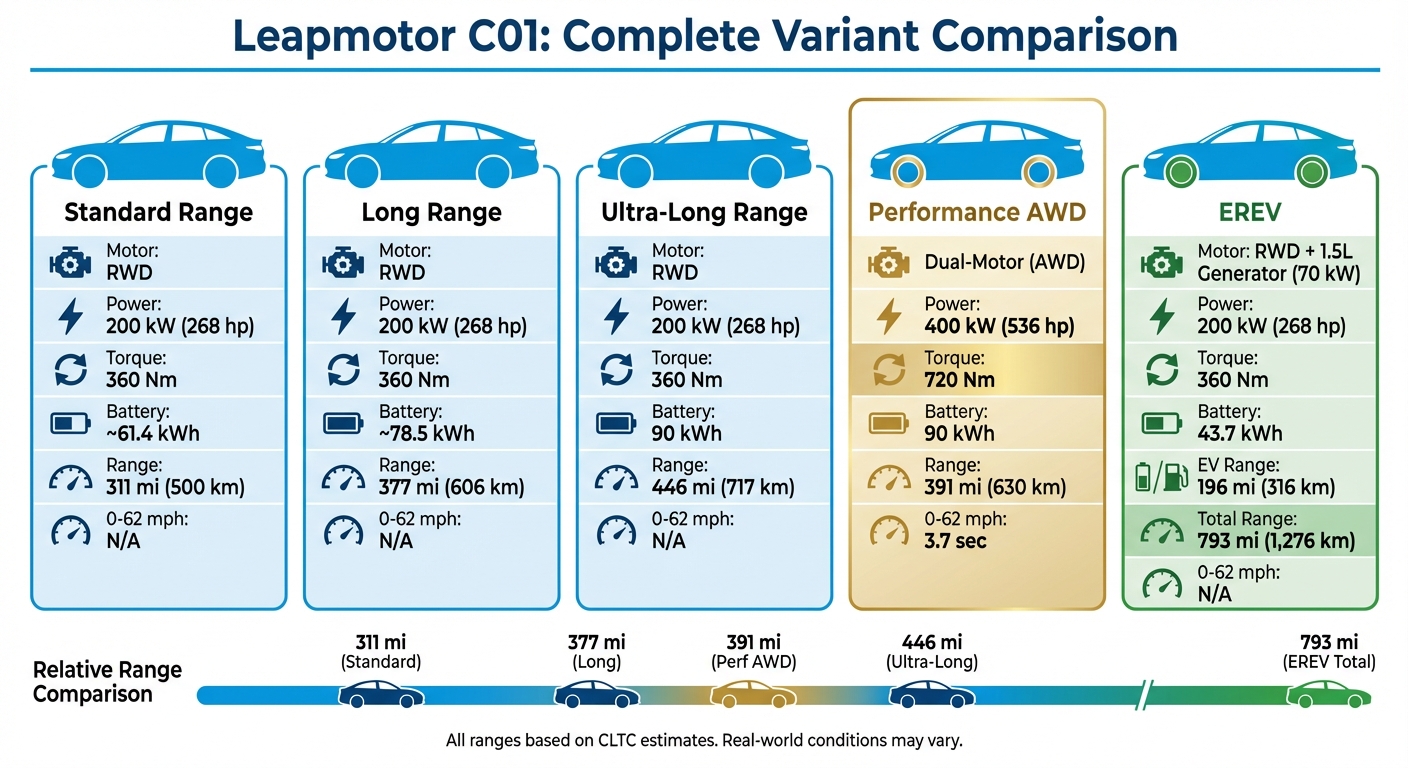
Leapmotor C01 Variants Comparison: Range, Power, and Performance Specs
Available Models and Performance
The C01 lineup comes in five distinct configurations. All rear-wheel-drive (RWD) models are equipped with a 200 kW (268 hp) motor that delivers 360 Nm of torque. For those seeking more power, the flagship Performance model features a dual-motor all-wheel-drive (AWD) setup, offering an impressive 400 kW (536 hp) and 720 Nm. This powerhouse accelerates from 0 to 62 mph in just 3.7 seconds.
The electric options include three battery capacities: approximately 61.4 kWh for the Standard Range, about 78.5 kWh for the Long Range, and 90 kWh for the Ultra-Long Range. Additionally, there’s an Extended Range Electric Vehicle (EREV) variant that incorporates a 1.5-liter turbocharged engine rated at 70 kW. This engine functions solely as a generator, enhancing overall range.
These configurations highlight the versatility of the C01 lineup, setting the stage to explore the battery technology that drives its performance.
Battery Technology and Range
The C01 relies on NMC (Nickel Manganese Cobalt) battery technology, which strikes a balance between energy density and thermal stability. According to CLTC estimates, the Standard Range model offers a range of 311 miles (500 km), while the Long Range and Ultra-Long Range models deliver approximately 377 miles (606 km) and 446 miles (717 km), respectively. Despite its higher power output, the Performance AWD variant achieves an estimated 391 miles (630 km).
In real-world driving conditions, such as those found in African regions with high temperatures and varied traffic conditions, these range figures may vary slightly. The EREV variant, equipped with a 43.7 kWh battery, provides a pure electric range of 196 miles (316 km). When combined with the gasoline generator, the total range extends significantly to 793 miles (1,276 km).
Variant Comparison Table
| Variant | Motor Layout | Power Output | Battery Capacity | CLTC Range | 0-62 mph |
|---|---|---|---|---|---|
| Standard Range | RWD | 200 kW (268 hp) | ~61.4 kWh | 311 mi (500 km) | N/A |
| Long Range | RWD | 200 kW (268 hp) | ~78.5 kWh | 377 mi (606 km) | N/A |
| Ultra-Long Range | RWD | 200 kW (268 hp) | 90 kWh | 446 mi (717 km) | N/A |
| Performance AWD | Dual-Motor (AWD) | 400 kW (536 hp) | 90 kWh | 391 mi (630 km) | 3.7 sec |
| EREV | RWD + Generator | 200 kW (268 hp) | 43.7 kWh | 196 mi EV / 793 mi total | N/A |
Range, Charging, and Infrastructure
Range Performance in African Conditions
The C01 offers a theoretical range of 326 to 445 miles for its battery-electric models, but real-world conditions – like high temperatures and heavy air conditioner use – can reduce this range. Its aerodynamic design, with a low drag coefficient of 0.226 Cd, helps maintain efficiency, especially on highways.
That said, the car’s ground clearance, which ranges from 4.7 to 5.5 inches (120 mm to 140 mm), might be a drawback on the unpaved or rough roads often found in many African regions. For urban drivers commuting on paved roads, the range should meet everyday needs. However, frequent use on dirt roads could impact both range and the vehicle’s long-term durability.
For those concerned about range limitations, the EREV (Extended Range Electric Vehicle) variant offers a practical solution. With its 1.5-liter generator, this model extends the total range to an impressive 793 miles, making it a reliable option in areas where charging stations are scarce. This flexibility makes understanding the vehicle’s charging and range dynamics even more important.
Charging Speed and Options
The C01 supports DC fast charging, which can replenish the battery from 30% to 80% in about 30 to 40 minutes – adding roughly 1.2 miles of range per minute. However, in Africa, current DC fast-charging infrastructure typically delivers around 2 kilometers of range per minute, which is slower compared to traditional diesel refueling rates.
For those charging at home or work, the standard 11 kW AC charger takes approximately 8 hours to fully charge the battery. This is ideal for overnight charging but slightly slower than the Tesla Model 3 Long Range, which can charge in about 6.5 hours under similar conditions.
Working with Current Infrastructure
Africa’s charging network is still developing, which makes the C01’s flexible charging options a key advantage for long-distance travel. The vehicle is compatible with most public charging stations, although some regions may require specific connectors or adapters to match local standards. Leapmotor also benefits from the Stellantis Group’s established sales and service network in important markets like South Africa, Morocco, and Mauritius, ensuring better support for drivers.
For extended journeys, drivers should plan for 30 to 40-minute stops at DC fast-charging stations to maintain optimal battery levels between 30% and 80%. In Kenya, for example, Kenya Power is actively expanding its EV infrastructure by installing 45 charging stations across six counties. Managing Director Dr. Joseph Siror noted their commitment to creating an environment where motorists can travel more easily, saying, "to create an enabling environment… through the provision of adequate power supply and the requisite infrastructure, such as charging stations, that will enable motorists to travel with ease".
The EREV variant stands out as a practical choice for regions with limited charging stations. Its range-extending generator makes it particularly well-suited for rural areas or cross-border trips where charging infrastructure might not yet be fully established.
sbb-itb-99e19e3
Performance, Comfort, and Technology
Driving Experience and Comfort
The AWD 630 Pro+ variant of the C01 impresses with its acceleration, going from 0 to 62 mph in just 3.66 seconds. On the other hand, the RWD models complete the same sprint in 7.2 to 7.6 seconds.
The car’s suspension system features a double-wishbone setup in the front and a five-link independent design at the rear – an arrangement often seen in luxury vehicles. This combination improves ride quality, especially on uneven roads. Adding to its engineering finesse, the Cell-to-Chassis (CTC) technology integrates the battery cells directly into the vehicle’s frame. This innovation lowers the center of gravity by 15% and trims 33 pounds from the overall weight. Testers have noted the C01’s remarkable stability, particularly for a car measuring 16.5 feet in length, as it navigates winding mountain roads with ease.
The Continental MK100 ESC High Plus system boosts traction on loose surfaces, although the ground clearance of 4.6 to 5.5 inches may limit its capability on deeply rutted terrains. Meanwhile, the 1.84-square-meter panoramic sunroof, made from double-layer laminated Low-E glass, not only keeps the cabin quiet but also provides excellent heat insulation. A low drag coefficient of 0.226 Cd further reduces wind noise, making highway drives quieter and more enjoyable.
Together, these features create a driving experience that balances performance with comfort, making the C01 equally suited for city commutes and more rugged journeys.
Interior Design and Technology
The C01’s interior is designed to complement its performance with advanced technology and thoughtful features.
At the heart of the cockpit is a triple-screen layout, featuring 10.25-inch, 12.8-inch, and another 10.25-inch display. Powered by the Qualcomm Snapdragon 8295 chip (with earlier models using the 8155), the system ensures smooth and responsive operation. Unlike some competitors that sacrifice traditional dashboards, the C01 retains clear, driver-focused instrumentation.
A standout feature is the facial recognition system, which can adjust up to 25 personalized settings, including seat position, mirrors, and climate preferences. This is particularly handy for families with multiple drivers. The Android virtual machine supports over 99% of popular apps and offers seamless integration with OPPO phones, Apple iWatch, and Siri, enabling remote functions like unlocking the car and adjusting the climate control. The Leapmotor Pilot driver-assistance system, equipped with 28 high-precision sensors (10 cameras, 12 ultrasonic radars, and 5 millimeter-wave radars), provides 23 autonomous driving functions. These include Navigation Assist Pilot (NAP), which handles tasks like automated lane changes and ramp navigation. Such features are invaluable for long drives and enhance driver confidence.
Optional features take luxury to another level. The "Boss Seat" allows rear passengers to move the front seat forward by 4 inches and recline the backrest by 10 degrees with a single button press. Other comforts include seats with heating, ventilation, and six massage modes. The system also offers 12GB of RAM and 128GB of storage, along with options for either a 6- or 12-speaker audio setup.
Features Across Trim Levels
| Feature | Standard/Long Range (RWD) | Performance (630 Pro/Pro+) |
|---|---|---|
| Front Suspension | Double-wishbone independent | Double-wishbone independent |
| Rear Suspension | Five-link independent | Five-link independent |
| Drive Layout | Rear-Wheel Drive | All-Wheel Drive |
| 0-62 mph | 7.18s – 7.61s | 3.66s – 4.26s |
| Infotainment Chip | Snapdragon 8155 / 8295 | Snapdragon 8155 / 8295 |
| Screen Setup | Triple (10.25" + 12.8" + 10.25") | Triple (10.25" + 12.8" + 10.25") |
| ADAS Hardware | 28 sensors (Leapmotor Pilot) | 28 sensors (Leapmotor Pilot) |
| Upholstery | Nappa Leather (Optional/Trim dependent) | Nappa Leather / Suede Headliner |
All trim levels come with the advanced suspension system and the triple-screen infotainment setup. However, the performance variants stand out with dual-motor all-wheel drive and upgraded interior materials. The Leapmotor Pilot system is standard across the lineup, offering conveniences like 360-degree cameras and one-touch automatic parking. These features strengthen the C01’s reputation as a versatile and capable vehicle, ready to tackle a variety of driving conditions.
Ownership Costs and Practicality in Africa
Pricing and Value Analysis
The Leapmotor C01 starts at around $40,090 for the base model, offering a compelling option for buyers looking for an executive-class sedan. With 544 horsepower and a range of 391 miles (630 km), the C01 delivers impressive performance and range at a price that’s $10,000 to $50,000 less than many premium competitors.
For regions with limited charging infrastructure, the EREV variant is a smart choice. It features a 1.5-liter turbocharged engine that acts as a generator, extending the car’s usability without relying entirely on charging stations. This feature makes it particularly well-suited for long-distance travel in areas where charging networks are still developing. These pricing and design advantages contribute to lower overall operating costs, making the C01 a practical and appealing option.
Operating Costs and Maintenance
Long-term costs are a key factor for any car owner. For the BEV version, charging its 90 kWh battery is typically more affordable than filling up a gasoline-powered sedan, although electricity costs vary by region. The EREV variant, on the other hand, offers an average fuel consumption of 4.9 L/100 km (≈48 mpg) when the battery is depleted, striking a balance between electric and traditional fuel efficiency. With a 47-liter fuel tank, the EREV can cover significant distances even when charging isn’t an option.
Maintenance needs differ between the two variants. The BEV version benefits from fewer moving parts, focusing primarily on the high-voltage system and the Cell-to-Chassis (CTC) structure, which requires less frequent servicing compared to conventional vehicles. The EREV variant, however, requires standard engine upkeep, including oil changes, filter replacements, and spark plug maintenance for its 1.5-liter generator. Both options are cost-effective when paired with home charging, and fast-charging capabilities further minimize downtime.
Charging Setup and Support Resources
As Africa’s charging infrastructure continues to expand, setting up home and workplace charging stations is essential for getting the most out of the C01. Home charging can be done using a standard 240-volt outlet, while workplace charging is becoming more available in urban areas, though accessibility may vary between countries. The C01 is equipped with Type 2 connectors, ensuring compatibility with most public charging stations, and adapters are available for additional flexibility.
For route planning, platforms like EV24.africa provide useful tools to help drivers navigate the continent’s charging network. The EREV variant’s 316 km all-electric range offers peace of mind for drivers in areas with fewer charging stations. Together, these resources and features make the C01 a practical and adaptable choice for African drivers looking to embrace electric mobility.
Conclusion
The Leapmotor C01 is designed to address the driving needs of Africa’s varied terrains while adapting to the continent’s developing charging infrastructure. Its groundbreaking CTC technology, which integrates the battery directly into the chassis, delivers practical advantages for long-distance travel across cities and borders. For regions where charging stations are still sparse, the EREV option offers unmatched flexibility, making it a versatile choice for diverse driving scenarios.
This sedan blends functional design with advanced engineering. With a spacious trunk offering 17.5 cubic feet (496 liters) of storage and a length of 16.6 feet (5,050 mm), it balances practicality with style. Its body construction, made of 73.9% high-strength steel, ensures durability and safety. The AI-driven BMS system provides cell-level protection, keeping performance consistent in various climates, while 28 high-precision sensors enable 23 autonomous driving features, enhancing safety and convenience.
Affordability meets sophistication in the C01. Thanks to Leapmotor’s collaboration with Stellantis Group, owners gain access to established service networks in key markets like South Africa and Morocco, adding reliability to the ownership experience.
For African drivers looking to embrace electric mobility, the Leapmotor C01 offers a thoughtful combination of advanced technology, reliable range, and cost-effective ownership. Whether choosing the pure electric model for city and regional commutes or the EREV version for added flexibility, the C01 is built to tackle the continent’s unique challenges with its extended range, sturdy build, and practical pricing.
FAQs
What is Cell-to-Chassis technology, and how does it improve the Leapmotor C01?
Cell-to-Chassis (CTC) technology takes a different approach to battery integration by embedding the battery directly into the vehicle’s chassis and underbody. Unlike traditional designs, this method eliminates the need for a separate battery module, along with the brackets and fasteners that typically come with it.
For the Leapmotor C01, this design choice brings some clear advantages. By cutting down on components, the car sheds about 33 pounds, which boosts energy efficiency and allows for a longer driving range. On top of that, the streamlined design creates 14.5% more room for the battery, making space for a larger pack capable of delivering up to 445 miles per charge. Beyond range improvements, this integration enhances the car’s weight distribution, strengthens structural rigidity, and improves handling – all while keeping production costs in check by reducing the number of parts required.
What is the Leapmotor C01 EREV, and when is it most practical to use?
The Leapmotor C01 EREV (Extended Range Electric Vehicle) takes a unique approach to plug-in hybrids. It features a 200 kW (roughly 268 hp) electric motor that powers the wheels, complemented by a 1.5L turbocharged gasoline engine rated at 68 kW. But here’s the twist: the gas engine doesn’t drive the wheels at all. Instead, it acts solely as a generator, recharging the battery whenever its charge runs low.
With its flexible battery options, the C01 EREV delivers an all-electric driving range of about 186 miles. Once the battery is depleted, the generator extends the range by an additional 186 to 250 miles, depending on conditions.
This setup is perfect for those who want the best of both worlds: the everyday convenience of electric-only driving and the reassurance of a gasoline-powered backup for longer trips. It’s an ideal solution for reducing range anxiety, especially in areas where charging stations might be scarce, all while maintaining a quiet and smooth driving experience.
What charging options and times are available for the Leapmotor C01 in areas with limited infrastructure?
At the moment, there isn’t detailed information about the Leapmotor C01’s charging options or times in areas with limited charging infrastructure. While the car is recognized for its impressive range, it’s unclear if it supports slower AC charging, DC fast charging, or other charging methods when conditions are less than ideal.
If you’re considering purchasing the Leapmotor C01 and live in a region with limited charging facilities, it’s a good idea to reach out to Leapmotor representatives or your local dealer. They can provide insights into the vehicle’s compatibility with the charging solutions available in your area.