
 Thabo Nkosi
Insuring an electric vehicle (EV) in Africa is more expensive than gas-powered cars, with premiums typically 10–25% higher. This is due to the high cost of EVs, expensive lithium-ion battery replacements, and limited repair facilities. For example, replacing a battery can cost $5,000–$16,000, while EV repairs are about 25% pricier than traditional vehicles. South Africa leads the African EV market, but challenges like import duties (25% for EVs vs. 18% for gas cars) and limited infrastructure keep premiums elevated.
To reduce costs, consider installing certified charging stations, leveraging safety features, and bundling insurance policies. As the market matures, rates are expected to become more competitive. For now, expect higher premiums but fewer long-term repairs due to EVs’ simpler mechanics.

EV vs Gas Car Insurance Costs in Africa: Key Statistics and Cost Factors
What Does EV Insurance Cost in Africa?
Typical Premium Ranges
The cost of insuring an electric vehicle (EV) in Africa can vary significantly depending on the car’s value and your location. However, one thing is clear: EV insurance premiums are generally 10% to 25% higher than those for gas-powered cars. This increase is mainly due to the higher purchase price of EVs and the expensive components they rely on.
In South Africa, the leading country for EV adoption on the continent, insurers often limit comprehensive coverage to EVs valued below R1.2 million (around $63,000). If your EV exceeds this value, finding standard coverage can be challenging, and you may face much higher premiums. A big factor in these costs is the battery pack, which includes pricey materials like nickel, cobalt, and lithium. Replacing one of these batteries can set you back anywhere from $5,000 to $16,000.
"Electric car insurance is more expensive than insuring a car that runs on an internal combustion engine at the moment… because they cost a lot to buy." – Ernest North, Co-founder, Naked Insurance
These factors highlight why EV insurance tends to cost more than coverage for traditional gas-powered cars.
EV Insurance vs. Gas Car Insurance Costs
When comparing EV insurance to that of gas-powered vehicles, the difference boils down to cost. EVs are more expensive upfront, and this directly impacts insurance rates. For example, as of late 2024, the average price of a new EV is $55,544, compared to $49,270 for gas vehicles – a $6,000 gap that significantly affects replacement value. On top of that, EV repairs are, on average, 25% more expensive than those for gas-powered cars.
That said, EVs have some advantages. They come with fewer moving parts – no oil filters, spark plugs, or complex fuel systems – resulting in less frequent repairs over time. This has led some insurers to offer eco-friendly discounts. Ernest North from Naked Insurance predicts, "Cover for mid-range electric vehicles will lower within the next two years", as insurers collect more claims data and the market matures. For now, though, expect to pay more for an EV policy compared to a similar gas-powered vehicle.
What Affects EV Insurance Prices?
Vehicle Value and Battery Replacement Costs
The cost of your EV plays a major role in determining your insurance premium. Insurers assess risk based on the vehicle’s replacement value, and because EVs generally have higher price tags than gas-powered cars, they’re more expensive to insure. This pricing gap directly influences coverage costs.
One of the biggest contributors to these higher premiums is the lithium-ion battery pack, which can cost thousands of dollars to replace. For example, EV options in South Africa range from the GWM Ora, priced around $36,000 (R686,950), to the Jaguar i-PACE, which costs approximately $105,000 (R1,999,900). Even minor accidents can lead to significant battery damage, prompting insurers to classify the vehicle as a "total loss" rather than opting for repairs. This risk keeps premiums elevated.
"The rechargeable lithium-ion (Li+) battery pack is a critical component of an EV, and they cost thousands to replace – which affects the cost of insurance."
– Nedbank Staff Writer
These costs also bring challenges when it comes to repairs and sourcing parts.
Repair Services and Parts Availability
The scarcity of EV repair shops in Africa adds another layer to insurance costs. In South Africa, only a handful of workshops are equipped to handle EV repairs, and working on these vehicles requires specialized training in high-voltage systems and complex electronics. This limited expertise means longer repair timelines and higher service charges, both of which push premiums higher.
Adding to the challenge, EV-specific parts often need to be imported due to the limited number of electric cars sold locally – just about 1,000 in South Africa during 2022. Replacement parts for EVs are roughly 2.7% more expensive than those for gas-powered vehicles.
"The average claims cost of EVs or hybrids are likely to be higher because the electronics of these vehicles are expensive."
– Tarina Vlok, MD of Elite Risk
Beyond repair and parts costs, your driving habits and where you live also play a big role in determining your insurance rate.
Driver History and Location
Your driving record and location are key factors in shaping your EV insurance premium. Insurers evaluate risk based on your age, claims history, and driving behavior. Many EVs come with advanced telematics systems that provide detailed driving data, which can reward safe drivers with lower premiums.
Where you live also matters. In Africa’s developing EV market, drivers in rural areas often face higher premiums. This is due to increased risks of breakdowns, higher towing costs, and challenges like loadshedding, which can strain batteries and complicate charging. Access to specialized repair facilities is another consideration, as most accredited EV technicians are concentrated in major cities.
EV Insurance Costs by African Region
South Africa
South Africa is at the forefront of the EV insurance market in Africa, though specialized EV policies are still uncommon. Instead, electric vehicles are typically insured under standard comprehensive plans that cover accidents, fire, and theft.
For standard vehicles, comprehensive insurance in South Africa generally costs between $42 and $74 per month (R800–R1,400). However, EV premiums tend to be higher, largely due to their price and the country’s 25% import duty on electric vehicles – significantly higher than the 18% duty for petrol and diesel cars. The market for EVs is expanding quickly, with sales of new energy vehicles rising by an impressive 82.7% from Q1 2023 to Q1 2024, totaling 3,042 units sold. Currently, major insurers like Santam price EV and hybrid premiums similarly to traditional vehicles, though this may shift as more claims data becomes available.
Kenya and Nigeria
Outside South Africa, other regions face unique challenges and opportunities. In East Africa, Kenya stands out with an insurance penetration rate of 2.14%, which is higher than neighboring countries like Tanzania (0.62%) and Uganda (0.74%). While specific data on EV insurance costs in Kenya is scarce, the country’s relatively developed insurance sector suggests a promising foundation for EV adoption.
In contrast, Nigeria faces steeper hurdles. The country’s vehicle price index is 105.57 – significantly higher than South Africa’s 74.98 – making cars more expensive relative to income levels. High import costs, limited charging infrastructure, and a shortage of repair facilities also contribute to elevated insurance premiums in Nigeria.
Other African Countries
In many emerging markets across Africa, insurance challenges go beyond premium costs, reflecting broader economic and infrastructure issues. For instance, the Democratic Republic of Congo has one of the highest global vehicle price indices at 155.7, making both car ownership and insurance unaffordable for many.
High import duties, limited availability of spare parts, and inadequate charging infrastructure further complicate EV insurance in these markets. Ethiopia, for example, has an insurance penetration rate of just 0.3%. However, as EV adoption grows and governments introduce incentives – like South Africa’s recent $50.6 million (R964 million) investment in the EV transition – insurance products and pricing are likely to adapt, potentially making them more accessible.
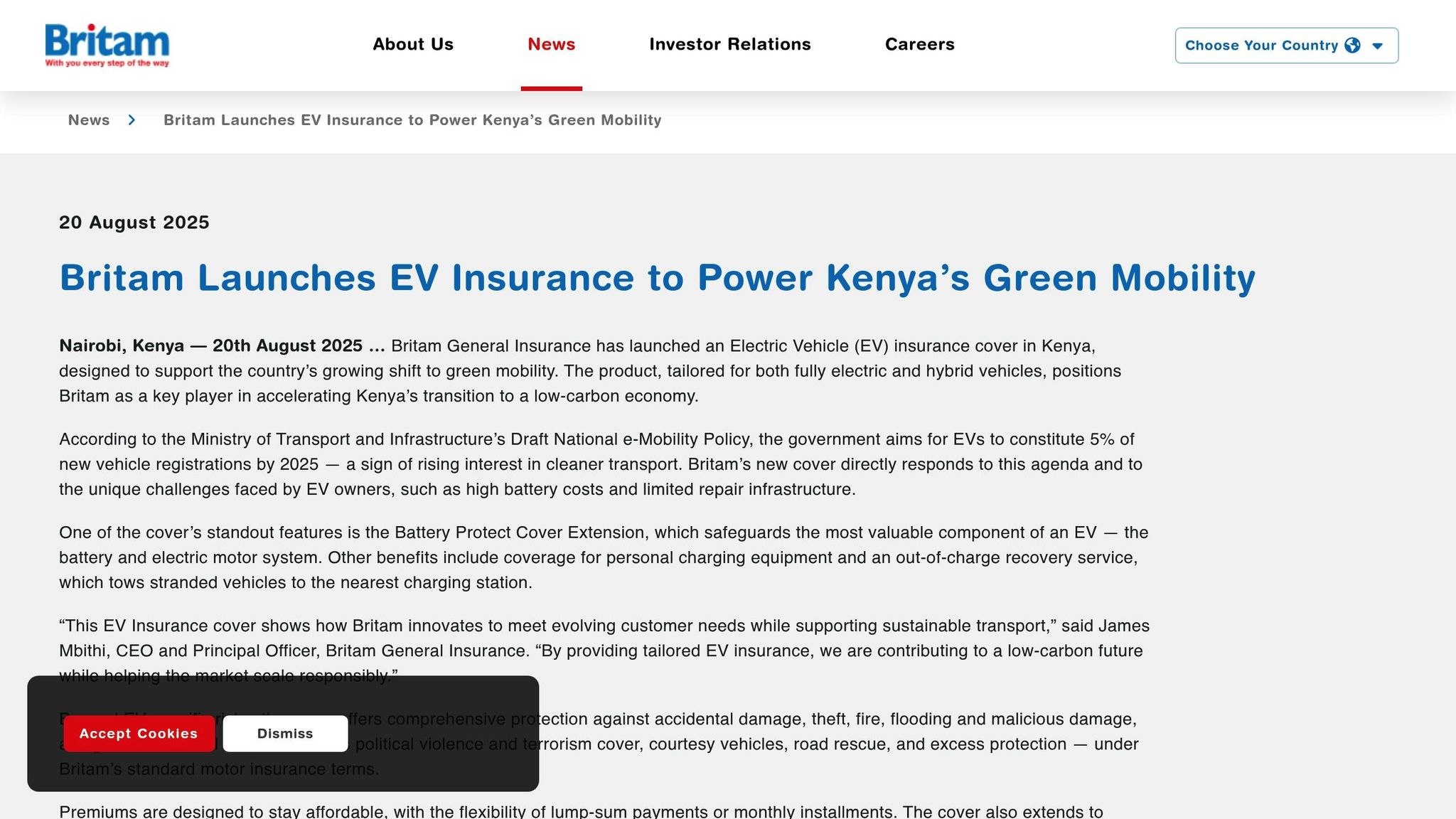
Britam launches electric vehicle insurance cover to back Kenya’s transition to green mobility
sbb-itb-99e19e3
EV-Specific Coverage Options
Specialized insurance for electric vehicles (EVs) goes beyond standard policies to address the unique risks and requirements of EV ownership.
Battery and Charging Equipment Coverage
In many African countries, comprehensive insurance policies typically cover EV batteries for damage caused by accidents, impacts, or theft, but they exclude wear and tear. Given that replacing a battery pack can cost thousands of dollars, this has a major impact on both premiums and total loss evaluations.
In Kenya, GA Insurance offers a dedicated "Electric Vehicle (EV)" policy. This policy not only covers the vehicle itself but also includes accessories like charging cables and the battery, protecting them against loss or damage. However, in South Africa, EV coverage is generally included within standard comprehensive motor insurance policies rather than being offered as a standalone product.
Home charging stations, on the other hand, are usually excluded from vehicle insurance policies. To cover them, homeowners need to add these stations to their home insurance plans. It’s important to ensure that the installation is done by a certified professional, as improper setup could lead to claim denials. For businesses running public charging stations, commercial insurance is crucial to safeguard against risks like vandalism, electrical fires, and third-party liability for injuries or property damage.
Maintenance Plans and Roadside Assistance
Towing an EV requires special equipment, such as flatbed or lowbed trucks, since standard towing methods can damage the vehicle. This is particularly important for situations involving flat batteries or motor failures.
In South Africa, Elite Risk offers tailored roadside assistance specifically for EV batteries.
"We can arrange for a tow truck or a lowbed truck to take your EV to your home. Within limits of course." – Tarina Vlok, MD of Elite Risk
It’s essential for EV owners to confirm that their insurance includes coverage for "flat battery" towing. Additionally, repairs should only be carried out by accredited motor body repairers who are trained in EV electronics. These specialized repair facilities often charge higher fees due to the advanced training required, which can influence both service costs and insurance claims.
Commercial Fleet Insurance
In September 2025, King Price Insurance became the first South African insurer to introduce specialized coverage for commercial EV fleets, partnering with logistics company Everlectric. This partnership insures over 200 EVs and uses real-time data to manage risks, including battery failures.
Jacques Pienaar, Head of Commercial Underwriting at King Price, highlighted the importance of data-driven solutions:
"Insuring EV fleets is different, which required us to develop a model grounded in data-sharing and collaboration. This approach gave us the confidence to move forward." – Jacques Pienaar, Head of Commercial Underwriting at King Price
The coverage addresses risks such as component malfunctions and battery issues, while theft and hijacking risks remain lower for EVs compared to traditional fleets.
Many commercial operators are now adopting an "EV-as-a-service" model, which bundles vehicle leasing, maintenance, charging infrastructure, and insurance into a single monthly fee. Paul Plummer, CCO of Everlectric, commented on the benefits:
"Our clients don’t worry about downtime or power. We make it easy for businesses to go electric." – Paul Plummer, CCO of Everlectric
This integrated approach simplifies fleet management and ensures all specialized EV components are adequately insured.
How to Lower Your EV Insurance Costs
Given the unique challenges of insuring electric vehicles (EVs), there are practical steps you can take to reduce your premiums. In Africa, EV insurance rates tend to be 10%–25% higher than those for traditional cars. However, by managing risk effectively and showing responsible EV ownership, you can help bring down these costs. Here are some actionable strategies to consider.
Install Certified Charging Stations
Getting a certified charging station professionally installed at home can make a big difference in your insurance costs. In South Africa, a standard wallbox charger costs roughly $500 to $1,333, with installation fees ranging from $55 to $140. While this might seem like a hefty upfront expense, it’s worth it. A properly installed system minimizes risks like electrical fires, shocks, or battery damage – issues that could otherwise drive up your premiums.
"If your home charging setup is incorrectly installed, it could cause damage and have a negative impact on your insurance costs." – Nedbank
Some insurers even offer discounts for installing certified eco-friendly infrastructure. Considering that replacing an EV battery can cost up to 40% of the vehicle’s original value, a safe charging setup is essential.
Leverage Safety Features to Lower Costs
Modern EVs are packed with advanced safety features, such as collision-avoidance systems, that can lower your risk profile and, in turn, your insurance premiums. Participating in telematics programs – where your driving habits are monitored – can also lead to discounts. When shopping for insurance, be sure to highlight your vehicle’s Advanced Driver Assistance Systems (ADAS). And, of course, maintaining a clean driving record remains one of the most effective ways to keep your premiums down.
"The safety features of electric cars can help you get into fewer accidents and get a better risk profile. This could lead to lower monthly insurance payments." – Insurance.co.za Content Team
Bundle Insurance with Your EV Purchase
Bundling your EV insurance with other policies, such as home insurance, can result in savings. For example, if you’re purchasing through EV24.africa, look into bundled coverage options. These packages not only streamline the management of your policies but can also reduce your overall insurance costs. As the EV market grows and insurers gain more experience with claims data, premiums are expected to become more competitive, making bundled options even more appealing.
Conclusion
Insuring an electric vehicle in Africa comes with its own set of challenges, but knowing what drives the costs can help you make more informed choices. Premiums remain higher due to factors like the elevated value of EVs, costly battery replacements, and a lack of extensive repair networks. That said, the situation is gradually improving. Industry professionals, including Ernest North from Naked Insurance, anticipate that insurance premiums for mid-range EVs will likely drop within the next two years as the market gains maturity and more claims data becomes available.
As the industry evolves, rates are expected to come down with better market data. To reduce your premiums in the meantime, consider installing certified charging stations, opting for advanced safety features, and bundling your policies. These steps align with broader market developments, helping to shape the future of EV insurance.
If you’re exploring the EV market – whether it’s your first purchase or you’re switching insurers – EV24.africa is a valuable resource. The platform provides transparent pricing and detailed listings across 54 African countries, offering access to EVs from leading brands like Tesla, BYD, and Hyundai. It also connects you with financing options that make EV ownership more attainable. With the expansion of charging infrastructure and repair services, the overall cost of owning an EV, including insurance, is expected to become more affordable over time.
With this knowledge in hand, you’re well-equipped to navigate the exciting and evolving EV market in Africa.
FAQs
Why does EV insurance cost more than insurance for gas-powered cars in Africa?
Electric vehicle (EV) insurance often costs more than insurance for traditional gas-powered cars. Why? It comes down to the higher upfront price of EVs and the specialized components they rely on, like lithium-ion batteries. These batteries, along with other EV-specific parts, are expensive to fix or replace, making them a bigger financial risk for insurance companies.
On top of that, in many parts of Africa, EV repair services and parts are hard to come by. This limited availability not only drives up repair costs but also leads to longer wait times for fixes. Insurers account for these challenges when setting premiums to ensure they can handle potential claims.
What are the best ways to lower my EV insurance costs in Africa?
Lowering the cost of insuring your EV in Africa often comes down to reducing the risks that insurers factor into your premium. A good starting point is to shop around and compare quotes from different providers. Each insurer evaluates things like your vehicle’s value and your driving history differently, so prices can vary significantly. If you already have other types of insurance, you might save money by bundling them with your auto policy, which many companies reward with discounts.
Another way to cut costs is by increasing your deductible – the portion you pay out of pocket if you file a claim. A higher deductible usually means a lower monthly premium. Adding security upgrades like anti-theft alarms, tracking devices, or telematics systems can also work in your favor. These features show insurers that your car is less likely to be stolen or damaged, which can translate into savings. Even where you park your EV matters – keeping it in a locked garage or a well-lit, secure area can reduce your premium.
To keep repair costs manageable, stick to regular maintenance and use manufacturer-approved parts. If your EV’s warranty already provides solid coverage for the battery, you might even opt for a policy that excludes battery protection to save more. By combining these practical strategies, you can keep your insurance expenses in check while ensuring your EV stays protected.
What factors impact the cost of electric vehicle insurance across Africa?
The cost of insuring an electric vehicle (EV) in Africa hinges on several factors, many of which vary significantly by region. One major influence is the price of the vehicle itself, along with the cost of key components like lithium-ion batteries. Since these batteries are expensive to repair or replace, they can drive up insurance premiums. Similarly, the availability of spare parts plays a big role – areas with limited supply chains often face higher premiums due to increased repair costs. Import duties and taxes on EVs, which differ from country to country, further add to the overall expense, indirectly impacting insurance rates.
Another critical factor is the density of charging infrastructure and the reliability of the electric grid. Regions with fewer public chargers or frequent power outages are often viewed as higher risk by insurers. On top of that, driver-specific factors – such as age, driving history, and the local crime or accident rates – are also taken into account. These variables can differ greatly between cities like Nairobi, Lagos, and Cape Town, leading to noticeable differences in premiums across the continent. Together, these elements paint a complex picture of EV insurance costs in Africa.