
 Thabo Nkosi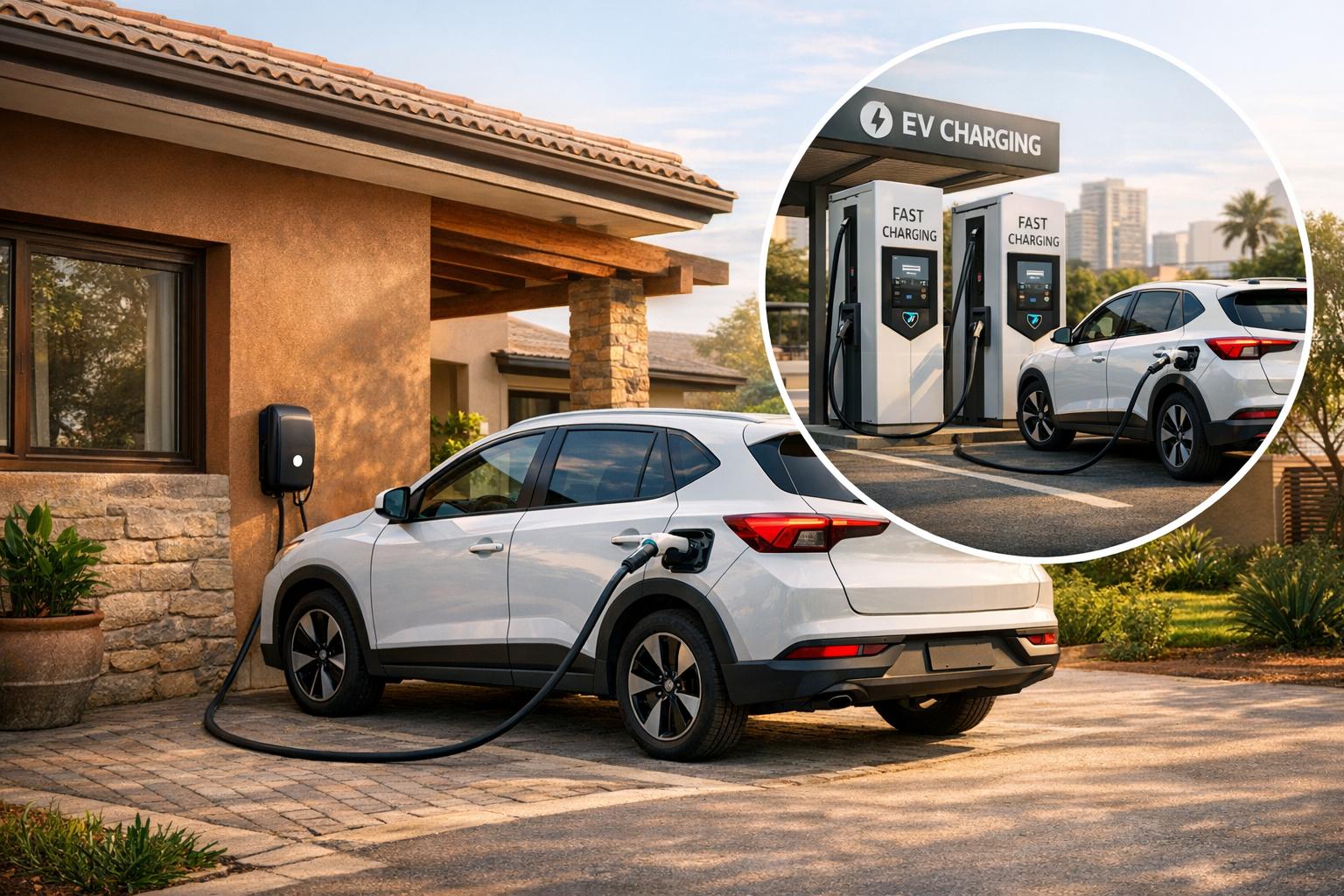
Fast charging and home charging are two primary options for powering electric vehicles (EVs) in Africa, each with unique advantages and challenges. Here’s how they compare:
- Fast Charging: Ideal for quick top-ups, it uses high-power DC chargers to replenish batteries in 15–60 minutes. It’s great for long trips, commercial fleets, or urban EV users without home charging access. However, it costs more (around $0.39–$0.41 per kWh in South Africa) and can strain the battery and the grid, especially in areas with unreliable electricity.
- Home Charging: Powered by standard AC outlets or dedicated wallboxes, it’s slower (6–12 hours for a full charge) but cheaper ($0.17–$0.22 per kWh) and gentler on the battery. It’s best for daily commutes under 62 miles if you have reliable electricity and private parking. Solar panels can help offset grid issues in rural areas.
Quick Comparison
| Feature | Fast Charging | Home Charging |
|---|---|---|
| Speed | 15–60 minutes (80% charge) | 6–12 hours (full charge) |
| Cost | $0.39–$0.41 per kWh | $0.17–$0.22 per kWh |
| Location | Public stations (urban/highways) | Private parking required |
| Battery Impact | Higher stress, faster wear | Gentler on battery |
| Grid Dependence | High, may need upgrades | Lower, works with residential power |
Key Takeaway: Choose fast charging for convenience and long-distance travel, and opt for home charging for cost savings and daily use. Combining both methods often works best, depending on your lifestyle and access to infrastructure.

Fast Charging vs Home Charging for EVs in Africa: Cost, Speed and Infrastructure Comparison
Fast Charging: Pros, Cons, and When to Use It
How Fast Charging Works
Fast charging can add between 5 and 30 kilometers of range per minute by utilizing high-power DC charging (22–350 kW) to replenish the battery. Many electric vehicles (EVs) are capable of charging from 10% to 80% in just 18 to 30 minutes. In Africa, these chargers are mostly located along major highways and in urban centers. This placement addresses grid reliability issues in the region. For instance, South Africa leads globally in the proportion of fast chargers, with these units comprising 53% of its public charging infrastructure. However, the high installation costs – reaching tens of thousands of dollars per charger – mean they are generally limited to high-traffic areas.
Benefits of Fast Charging
Fast charging is a game-changer for minimizing downtime, which is critical for commercial fleets like taxis, vans, and buses that need to stay operational. In densely populated urban areas across Africa, where many residents live in apartments without access to private parking, public fast-charging hubs offer an essential alternative to charging at home. Additionally, fast chargers play a crucial role in easing range anxiety – a concern cited by over 90% of EV owners surveyed in Nigeria and Kenya. This makes long-distance travel far more practical. But while the benefits are evident, fast charging does come with its own set of challenges.
Drawbacks of Fast Charging
One of the most pressing issues is grid reliability. Sub-Saharan Africa experiences frequent power outages, with a System Average Interruption Duration Index (SAIDI) of 39.30 hours compared to just 0.87 hours in OECD countries. These outages, coupled with load shedding, can disrupt the operation of grid-connected fast chargers. Moreover, high-power chargers place significant demand on the grid, often requiring expensive and time-intensive upgrades. Another concern is the potential long-term impact on battery health. Frequent fast charging, especially in harsh conditions like extreme heat and dust, may accelerate battery degradation over time.
When to Choose Fast Charging
Fast charging is particularly advantageous in specific scenarios across Africa:
- Commercial Fleet Operations: For fleets that need to stay on the road, fast charging is indispensable. For example, in 2023, Rwanda-based Ampersand facilitated 140,000 monthly battery swaps for over 1,700 customers in Kigali and Nairobi. This allowed commercial two-wheeler drivers to collectively cover 1.4 million kilometers every week.
- Intercity Travel: For trips exceeding 100 kilometers, fast charging provides a quick and efficient way to top up mid-journey. In March 2025, CHARGE launched South Africa’s first off-grid, solar-powered EV charging station in Wolmaransstad, North West. This station is part of a broader initiative to support long-distance highway travel.
- Urban Charging Needs: In cities where home charging isn’t an option, public fast-charging hubs are essential. In November 2025, Roam introduced "Roam Point" in Nairobi, Kenya’s first universal fast-charging station for light electric vehicles. With Type 6 connectors, drivers can gain 10–20 kilometers of range in under five minutes. Habib Lukaya, Roam’s Country Manager, highlighted the station’s benefits:
"The Roam Point builds on the battery ownership model, which gives riders full control of their batteries, allowing them to ‘ride everywhere and charge anywhere’".
Home Charging: Pros, Cons, and When to Use It
How Home Charging Works
Home charging relies on either Level 1 AC charging through a standard 220V outlet or Level 2 charging via a dedicated wallbox. With Level 1 charging, you get about 3 to 5 miles of range per hour, making it a practical option for overnight charging. On the other hand, Level 2 charging uses a specialized wallbox unit, delivering anywhere from 12 to 81 miles of range per hour, depending on the equipment. Both methods use AC power, which is easier on your battery compared to the rapid but more intense DC fast charging.
Benefits of Home Charging
Plugging in at home ensures your vehicle is ready to go each morning. For many car owners in Sub-Saharan Africa, where daily driving distances are often less than 62 miles, Level 1 overnight charging is more than enough. The cost advantage of home charging is clear – residential electricity rates are typically far cheaper than fuel or public fast charging. Even in Kenya, where residential electricity costs exceed 20 cents per kilowatt-hour, the savings add up over time. For instance, an electric two-wheeler can cost about 25% less to operate over five years compared to its gas-powered counterpart, thanks to reduced fuel and maintenance expenses.
Home charging also helps extend battery life since it avoids the stress caused by frequent DC fast charging. In rural areas, solar power can further enhance the practicality of home charging. As McKinsey & Company points out:
"Electric two-wheelers have a small battery, they can be charged via a mini-grid, making them suitable for use in locations with low access to reliable electricity-grid infrastructure".
While the benefits are clear, it’s important to keep the limitations in mind.
Drawbacks of Home Charging
One of the biggest challenges is grid reliability. In Sub-Saharan Africa, fewer than half of grid-connected users experience dependable service, with SAIDI (System Average Interruption Duration Index) reaching 39.30 hours annually, compared to just 0.87 hours in OECD countries. Installing Level 2 charging equipment can also be costly, ranging from $200 to $1,000. Older homes may even require electrical panel upgrades to handle the increased load. Additionally, finding off-street parking can be a hurdle, especially in crowded urban areas or multi-family housing situations.
When to Choose Home Charging
Home charging works best for households in suburban areas with private parking and predictable daily commutes under 62 miles. If you have access to solar panels, you can sidestep the issue of grid unreliability and enjoy nearly free "fueling". Starting with a standard outlet is a practical option, and you can always upgrade to Level 2 equipment as your needs evolve. The U.S. Department of Energy highlights this flexibility:
"For EV charging, the stability and planning benefits of household electricity rates offer an attractive alternative compared to traditional types of transportation".
For those with short commutes, Level 1 charging is often sufficient, eliminating the need for a $200–$1,000 investment in specialized equipment.
Fast Charging vs. Home Charging: Direct Comparison
Main Differences Between Fast Charging and Home Charging
In South Africa, charging your electric vehicle (EV) at a public DC fast charger costs between R7.00 and R7.35 per kWh ($0.39–$0.41 USD), while home charging is significantly cheaper, ranging from R3.00 to R4.00 per kWh ($0.17–$0.22 USD). That’s a price difference of 75% to 140% in favor of home charging. For example, powering up a Mercedes-Benz EQA, which has a 70 kWh battery, would cost around R245 at home compared to R515 at a public fast charger.
Hilton Musk from Rubicon compares the charging business model to that of fiber internet, where provider margins play a role in pricing. The cost of setting up fast charging stations ranges from $50,000 to over $200,000, while home charging installations are much more affordable, typically costing anywhere from a few hundred dollars to $10,000. The table below outlines the key differences between these two charging methods to help you decide which one suits your needs.
| Criteria | Fast Charging | Home Charging |
|---|---|---|
| Charging Speed | 30–60 minutes for 80% charge | 6–12 hours for a full charge |
| Cost per kWh | R7.00–R7.35 ($0.39–$0.41 USD) | R3.00–R4.00 ($0.17–$0.22 USD) |
| Accessibility | Found in urban centers, highways, and malls | Requires access to private parking |
| Battery Impact | Can cause higher stress; 3%–9% capacity loss over 50,000 miles | Gentler on the battery |
| Grid Dependence | High; may need infrastructure upgrades | Lower; works with standard residential power |
Which Charging Method Fits Your Needs
Choosing between fast charging and home charging depends on your lifestyle and driving habits. For urban commuters with private parking, home charging is a clear winner. It can save you R10,000 to R15,000 annually and reduce your per-kilometer costs from R1.20–R1.50 (fast charging) to just R0.50–R0.80, assuming you drive about 20,000 km a year.
For rural drivers dealing with unreliable electricity – South Africa’s System Average Interruption Duration Index (SAIDI) stands at 39.30 hours annually, compared to just 0.87 hours in OECD countries – combining home charging with solar panels offers a more stable and self-sufficient solution. Meanwhile, commercial fleets benefit from dedicated depot charging setups, ensuring a 1:1 charger-to-vehicle ratio for consistent operations.
| Use Case | Best Charging Option | Notes |
|---|---|---|
| Urban Commuter | Home Charging | Cuts annual costs by R10,000–R15,000 |
| Long-Distance Driver | Fast Charging | Critical for intercity travel |
| Rural Driver | Home Charging with Solar Panels | Avoids issues caused by grid instability (SAIDI: 39.30 hours) |
| Commercial Fleet | Depot Charging + Fast Charging | Ensures operational reliability with a 1:1 charger-to-vehicle ratio |
sbb-itb-99e19e3
How to Choose the Right Charging Strategy
What to Consider Before Deciding
Start by assessing your daily driving habits. If your typical commute is under 62 miles (100 km) per day, a Level 1 or Level 2 home charger can easily cover your needs without frequent visits to public charging stations. However, if you’re a commercial driver covering much longer distances, you’ll need to plan for Level 3 DC fast charging to keep up with the demand.
Another key factor is parking access. If you don’t have a dedicated parking spot with a power outlet, home charging might not be an option. In that case, you’ll need to rely on public fast chargers or battery-swapping stations. Before installing a home charger, consult a certified electrician to confirm that your electrical panel can support a 240V Level 2 circuit.
Don’t overlook grid reliability, either. In regions like West Africa, where power outages can average 44 hours per month, consistent home charging can be a challenge. Pairing your setup with solar panels or battery storage can help you stay charged during blackouts. Additionally, smart Level 2 chargers with timers can save you money by allowing you to charge during off-peak hours when electricity rates are lower.
These considerations are especially relevant as Africa’s EV charging infrastructure evolves to meet growing demand.
What’s Coming Next for EV Charging in Africa
New technologies are addressing these challenges head-on. Battery-swapping networks are expanding quickly; for instance, in 2023, Spiro raised about $60 million to roll out over 1,000 battery-swapping stations for electric two-wheelers. These stations allow riders to exchange depleted batteries for fully charged ones in just minutes.
Fast-charging infrastructure is also gaining momentum. Globally, the number of ultra-fast chargers (150 kW or higher) grew by more than 50% in 2024, while the cost of this equipment dropped by 20% between 2022 and 2024. In West Africa alone, projections suggest nearly 986,000 chargers will be needed by 2050 to support the anticipated rise in EV usage. Meanwhile, home charging is becoming more accessible, with Level 2 chargers now priced between $200 and $1,000.
Conclusion: Combining Both Charging Methods
For most EV owners in Africa, a mix of home and fast charging works best. Home charging is typically the most economical option for daily commutes, while fast chargers serve as a reliable backup for long-distance travel or emergencies when home charging isn’t available.
"Home charging remains the most popular way to charge for EV owners. However, more public chargers are needed to support mass adoption of EVs among segments of the population without access to home chargers." – IEA Global EV Outlook
When you’re ready to make the leap to electric vehicles, check out EV24.africa to find models tailored to your driving needs and charging setup. Your charging strategy should fit seamlessly into your lifestyle – not the other way around.
How Does EV Charging Work In South Africa? | Rubicon

FAQs
How do the costs of fast charging compare to home charging for EV owners in Africa?
Fast charging is generally about twice as expensive per kilowatt-hour compared to charging your EV at home. For example, in many African countries like South Africa, residential electricity rates typically fall between $0.13 and $0.15 per kWh, which makes home charging a more budget-friendly option. On the other hand, fast charging stations often charge between $0.30 and $0.40 per kWh, reflecting the higher costs associated with power demand and station upkeep.
For everyday EV use, home charging tends to be the most cost-effective solution, especially in areas with consistent electricity supply. That said, fast charging stands out for its speed and convenience, making it a practical choice for road trips or when you’re pressed for time.
How does the reliability of the power grid affect fast charging and home charging for EVs in Africa?
The reliability of the power grid is a key factor for both fast charging and home charging of electric vehicles (EVs) in Africa. Let’s break it down:
Fast chargers demand a lot of power – typically between 50 and 150 kW – in short bursts. This high energy draw can put significant pressure on local grids, especially in areas where the infrastructure is already weak. In extreme cases, it might even lead to overloads or blackouts. Urban areas, with their more robust grids and better demand management systems, are generally better equipped to handle these networks.
On the other hand, home charging operates at a much lower power range, typically between 3 and 7 kW, and spreads the energy load over several hours. While this is easier on the grid, it still presents challenges in rural areas where outages and voltage fluctuations are common. These interruptions can make charging unreliable, often forcing EV owners to consider backup options like generators or battery storage.
To address these challenges, smart-charging strategies can make a big difference. Techniques like scheduling charging during off-peak hours or aligning with times when renewable energy is available can help reduce strain on the grid. Ultimately, a stable and upgraded grid is essential to support both fast and home charging, paving the way for broader EV adoption across Africa.
How does fast charging affect the long-term health of an EV battery?
Fast charging, while incredibly convenient for those on the go, can take a toll on your battery over time. High charging currents, especially when used in colder temperatures or when the battery is close to being fully charged, can strain the battery. This wear and tear may result in reduced capacity and a shorter overall lifespan.
Although fast charging is great for quick top-ups, relying on it too often can mean sacrificing your battery’s long-term health for short-term convenience. To help your battery last longer, try mixing fast charging with slower, more gradual charging at home whenever you can.