
 Thabo Nkosi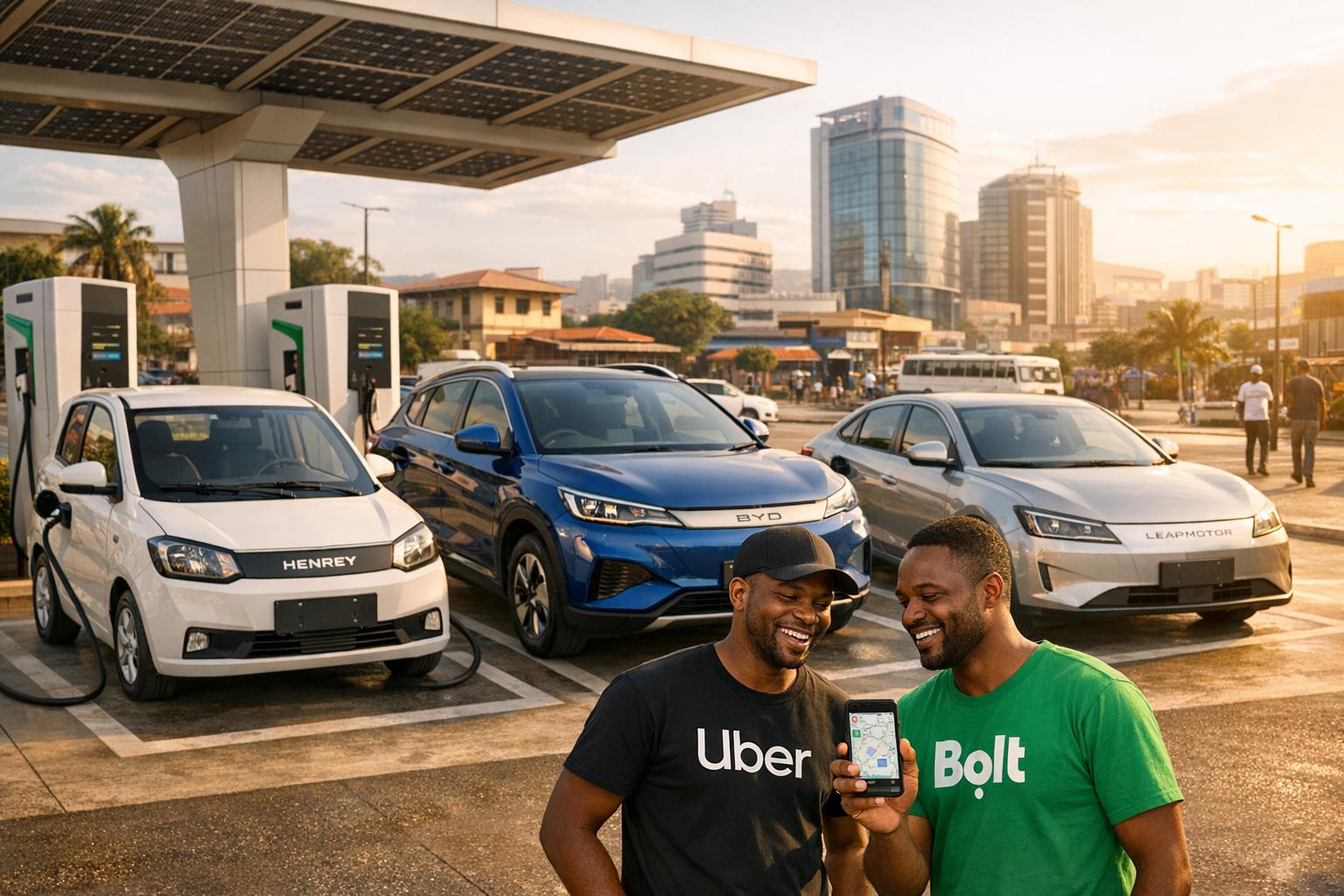
Africa’s ride-hailing market is shifting toward electric vehicles (EVs), driven by cost savings rather than environmental concerns. EVs reduce operating costs by 30–40% and increase net income by 15–25%. For example, in Kenya, taxi drivers save around $25 daily by switching to compact EVs. Key players like Uber and Bolt are introducing EV options to cater to both budget and premium ride-hailing services.
Here’s a quick look at the top EVs for ride-hailing in Africa:
- Henrey Minicar: Affordable rental model with maintenance, insurance, and unlimited battery swaps. Ideal for budget services with a 4-seat capacity and battery-swap stations for quick turnarounds.
- BYD Models: Premium EVs like the Atto 3 cater to upscale services. They offer long range, passenger comfort, and home charging options but come with higher upfront costs.
- Leapmotor C16: Designed for larger groups (6 passengers) with extended range options and a petrol generator for areas with limited charging infrastructure.
Quick Comparison:
| Vehicle | Price | Seats | Range | Charging | Best For |
|---|---|---|---|---|---|
| Henrey Minicar | $220/week rental | 4 | Battery-swap | Solar-powered swap stations | Budget ride-hailing |
| BYD Atto 3 | ~$62,000 | 5 | 275 miles | Home or public charging | Premium services |
| Leapmotor C16 | TBD | 6 | 323–391 miles | Petrol generator option | Larger groups, premium |
These EVs address diverse needs, from cost-effective daily use to premium services. Platforms like EV24.africa help drivers access flexible rental plans and connect with EV infrastructure across the continent.

Best EVs for Ride-Hailing in Africa: Vehicle Comparison Chart
1. Henrey Minicar

Affordability
The Henrey Minicar skips the hefty $11,000 upfront cost by offering a rental model through Valternative Energy. For around $220 per week, drivers get a package that includes insurance, maintenance, and unlimited battery swaps. This setup slashes operating costs by 30–40% compared to gas-powered options. Early users have reported a boost in their net take-home income by 15–25%, while drivers in Kenya save approximately $25 daily on fuel expenses. Beyond cost savings, the Minicar also delivers dependable performance, thanks to its quick battery-swap system.
Range per Charge
Designed for city life, the compact four-seater Henrey Minicar is built to handle busy urban streets. Its standout feature? A rapid battery-swap system. When the battery runs low, drivers can stop at one of over 100 solar-powered swap stations scattered across Johannesburg and replace it with a fully charged unit in under a minute. This efficiency allows drivers to complete 20–30% more trips per shift compared to gas-powered vehicles, which typically take 5–10 minutes for refueling.
Charging Infrastructure Compatibility
Instead of relying on traditional charging methods, the Henrey Minicar taps into Valternative Energy’s battery-swap network, bypassing the challenges of unreliable power grids. These swap stations are powered by solar panels and hybrid backup systems, ensuring a consistent supply of charged batteries regardless of grid stability. As 234drive aptly put it:
"Uber has cracked the code on electric ride-hailing in emerging markets – not with hours-long charging waits, but with battery swaps that take under 60 seconds."
This innovative battery-swap model showcases how the technology can scale effectively in regions with infrastructure limitations. It also aligns perfectly with the fast-paced demands of ride-hailing, where quick turnarounds are essential.
2. BYD Models

Affordability
BYD models are part of Uber’s strategy to cater to the premium ride-hailing market, standing in contrast to budget-friendly options like the Henrey Minicar. While Uber uses budget EVs for services like Uber Go, BYD vehicles – such as the Atto 3 crossover SUV – are reserved for upscale services like Uber Comfort and Uber Premier. This premium positioning aligns with their impressive range and performance capabilities.
Range per Charge
Ride-hailing drivers typically cover around 136 miles (219 km) daily. BYD’s higher-range vehicles are well-suited for this, eliminating the need for midday charging stops. Drivers can complete their shifts and recharge overnight at home, making their workday more efficient. Switching to electric also offers significant savings, with drivers cutting costs by about $5,200 annually. These models provide both the range and performance needed for long, demanding routes.
Charging Infrastructure Compatibility
BYD vehicles rely on standard plug-in charging, with most sessions taking between 30 and 60 minutes. However, in areas where power outages are frequent, this method can pose challenges. Unlike battery-swap systems, BYD sticks to conventional plug-in charging. As 234Drive highlighted:
"The dual-brand strategy suggests Uber will segment its South African electric fleet by service tier as the market matures, reserving BYD vehicles for Uber Comfort or Uber Premier categories."
To overcome public charging limitations, BYD drivers often depend on reliable home setups or private charging facilities.
Passenger Comfort
BYD models are designed to elevate the passenger experience. The BYD Atto 3 crossover SUV, for instance, offers exceptional comfort and spacious interiors, justifying the higher fares associated with premium services. This makes it an ideal choice for business travelers, airport transfers, and other high-end urban mobility needs.
3. Leapmotor Vehicles

Affordability
Leapmotor is stepping into Africa’s premium ride-hailing market with the C16, a full-size crossover SUV designed to cater to higher-end services like UberXL or Uber Comfort. With its 2+2+2 seating arrangement, this vehicle can comfortably fit up to six passengers, making it an excellent choice for premium ride-sharing. While specific pricing for Africa hasn’t been disclosed yet, the C16 is clearly positioned for a more upscale audience, aligning with its extended range and advanced features.
Range per Charge
The C16 offers impressive range options, starting with 323 miles (520 km) on a 67 kWh battery. For those needing even more, higher-capacity batteries (ranging from 74.9 to 81.9 kWh) can extend the range to 391 miles (630 km). There’s also an Extended Range Electric Vehicle (EREV) variant that includes a 1.5-liter petrol engine acting as a generator. This setup adds approximately 143 miles (230 km) of extra range, making it a reliable option for regions where charging infrastructure is limited.
Charging Infrastructure Compatibility
Leapmotor tackles the challenge of Africa’s charging infrastructure by equipping the C16 with China’s GB/T charging standard. Since this differs from Africa’s more commonly used CCS2 standard, drivers will need adapters for fast charging. However, the EREV model sidesteps this issue by generating its own power through the onboard petrol engine, ensuring uninterrupted operation even in areas with sparse or unreliable charging networks.
Passenger Comfort
The C16 is packed with features to enhance passenger comfort and elevate the ride experience. A 14.6-inch central touchscreen and a 15.6-inch drop-down screen for rear passengers provide entertainment, while a 21-speaker audio system creates a high-end atmosphere. With a wheelbase of 111 inches (2,825 mm) and an overall length of 193 inches (4,915 mm), the C16 ensures spacious legroom across all rows. Its six-passenger design makes it ideal for premium ride-sharing categories, offering both luxury and practicality.
sbb-itb-99e19e3
Kenyan Startup Targets to Dethrone Bolt, Uber in Ride-Hailing Space

Pros and Cons
Deciding on the best EV for ride-hailing in Africa involves balancing factors like affordability, operational efficiency, and what passengers expect. Each vehicle caters to a specific market segment, and understanding their upsides and limitations can help you align the right car with your business goals. Here’s a closer look at the strengths and challenges of two popular options to guide your choice.
The Henrey Minicar stands out in the budget category thanks to its incredibly low operating costs. Its rental model includes maintenance, insurance, and battery-swapping services, which removes the need for a hefty upfront investment. On the flip side, its four-seat capacity limits comfort and cargo space, making it less ideal for airport transfers or premium ride services.
For those targeting the premium segment, BYD models bring advanced features, particularly in range and comfort. The BYD Seal, for instance, offers a real-world range of 275 miles and can charge from 10% to 80% in just 36–40 minutes. It also boasts high safety ratings, with 89% adult occupant protection. However, the steep price tag of around $62,000 makes it less accessible for entry-level drivers.
| Vehicle | Key Advantages | Key Disadvantages |
|---|---|---|
| Henrey Minicar | Extremely low operating costs; rental model covers maintenance, insurance, and battery swapping | Limited to four seats, which impacts comfort and cargo space; not ideal for premium or luggage-heavy trips |
| BYD Seal | Impressive 275-mile range; quick charging (36–40 minutes to 80%); premium safety and comfort features (89% protection) | High upfront cost (~$62,000) makes it less accessible for new drivers |
Conclusion
Choose an electric vehicle (EV) that aligns with your market needs and service tier. In bustling urban centers like Nairobi and Lagos, the Henrey Minicar offers a practical solution, cutting daily fuel expenses by about $25. Its leasing model also eliminates the need for upfront capital, making it an accessible choice for drivers in these high-demand areas.
For those seeking a balance between cost and performance, the BYD Seagull is a strong contender. Priced at approximately $10,800, it delivers a 252-mile range and charges up to 80% in just 30 minutes, making it a reliable and efficient option. On the other hand, the Leapmotor C16 is tailored for larger ride-hailing services like UberXL or Bolt XL, with seating for six passengers. Its Extended Range Electric Vehicle (EREV) option, powered by a small petrol generator, adds about 143 miles – perfect for regions where charging infrastructure is still developing.
These models address diverse operational needs as EV adoption grows across the continent. South Africa stands out as a leader in integrating EVs into ride-hailing services, providing valuable insights for drivers considering the transition. Meanwhile, in areas with limited access to charging stations, the Leapmotor C16 EREV ensures drivers can complete longer trips without worry.
Ready to take the next step? Visit EV24.africa to explore a variety of EV listings, pricing details, and financing options for the Henrey Minicar, BYD models, and Leapmotor vehicles. The platform serves all 54 African countries and connects you to essential EV infrastructure, helping you make an informed choice for your business.
FAQs
How much money can ride-hailing drivers save by using EVs in Africa?
Switching to electric vehicles (EVs) offers a game-changing opportunity for ride-hailing drivers in Africa to cut down on operating costs. Here’s why: electricity is typically much cheaper than gasoline or diesel, and EVs are built with fewer moving parts. This translates to less frequent repairs, reduced tire wear, and fewer brake replacements – essentially, lower maintenance bills.
On top of that, several African governments are stepping in with incentives like tax breaks and reduced import duties, making EV ownership even more affordable. For instance, in Kenya, ride-hailing drivers using electric motorbikes have reported slashing their operating costs by 30–35%. And here’s the bonus: passengers enjoy lower fares too.
In short, EVs can trim total operating expenses by about one-third, positioning them as a smart, cost-effective choice for ride-hailing drivers across the continent.
How do battery-swap stations work for the Henrey Minicar?
Battery-swap stations offer Henrey Minicar drivers a fast and efficient way to keep moving. In just about a minute, a drained battery can be swapped for a fully charged one – making the process as quick as filling up at a gas station. Here’s how it works: the car is positioned on a platform that aligns perfectly with its under-floor battery compartment. Then, robotic systems take over, removing the empty battery and replacing it with a fully charged one automatically.
This system is all about speed and convenience. The Henrey Minicar’s battery is specifically designed for quick mechanical coupling, ensuring the swap is smooth and hassle-free. For ride-hailing drivers, this means less time waiting around and more time on the road, keeping their operations efficient and productive.
Why are BYD vehicles a great choice for premium ride-hailing services in Africa?
BYD electric vehicles stand out as an excellent choice for premium ride-hailing services, blending long driving ranges, advanced safety features, and superior passenger comfort. At the heart of these vehicles is the Blade Battery technology, which provides high energy density and impressive heat resistance. This ensures reliable performance and safety, even during extended use. The 6-year/150,000 km warranty further adds to their appeal, offering drivers durability and peace of mind for high-mileage operations.
Passenger comfort is another highlight. Take the BYD Tang EV, for example – it boasts a roomy 7-seat design and Vehicle-to-Load (V2L) functionality, which allows drivers to power small devices during trips. Meanwhile, the BYD Atto 3 delivers a quiet, smooth ride with its robust motor, dependable battery, and advanced safety features. This makes it an ideal option for both business and family passengers looking for a premium travel experience.
With their winning combination of range, reliability, and passenger-focused features, BYD vehicles are perfectly suited to elevate ride-hailing services across Africa.