
 Thabo Nkosi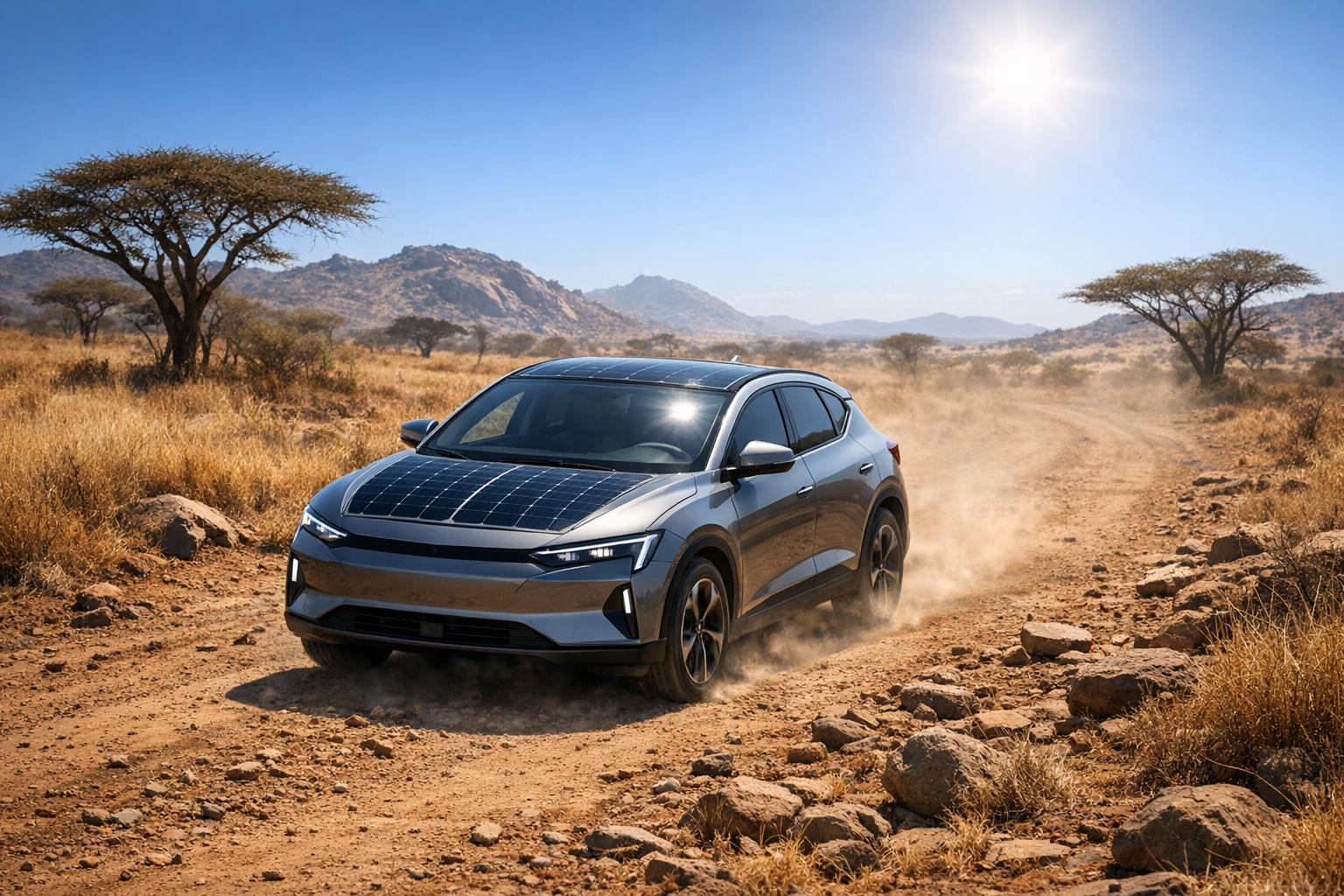
Electric vehicles (EVs) are gaining traction worldwide, but Africa’s extreme heat, rough roads, and unreliable power grids pose unique challenges. Here’s a quick breakdown of the key issues and solutions:
- Heat Impact: High temperatures (often above 95°F) strain EV batteries and cooling systems, reducing efficiency and accelerating wear. Liquid cooling systems and preconditioning can help mitigate these issues.
- Road Conditions: Poorly maintained roads, potholes, and dust can damage EV components, especially the battery pack. Models with reinforced builds, higher ground clearance, and durable suspensions are better suited for these conditions.
- Power Challenges: Frequent outages and voltage fluctuations hinder EV charging. Solar-powered charging setups and Vehicle-to-Load (V2L) features are practical solutions in areas with unstable grids.
- Cost and Accessibility: New EVs are expensive, with prices starting around $44,499. However, lower long-term maintenance and fuel costs make them an appealing option for some buyers.
For Africa, choosing the right EV means prioritizing features like thermal management, rugged designs, and compatibility with local infrastructure. Models like the BYD Atto 3, equipped with advanced cooling and reinforced structures, are tailored for these demands. However, challenges like limited charging infrastructure and lack of skilled mechanics remain barriers to widespread adoption.
Key Takeaway: EVs can work in Africa, but success depends on selecting models designed for high heat, tough roads, and unreliable electricity. Platforms like EV24.africa simplify the search for such vehicles, ensuring better performance in challenging environments.
The EV Revolution No One Expected | Burkina Faso Builds Its Own Electric Cars
How African Heat Affects EV Performance
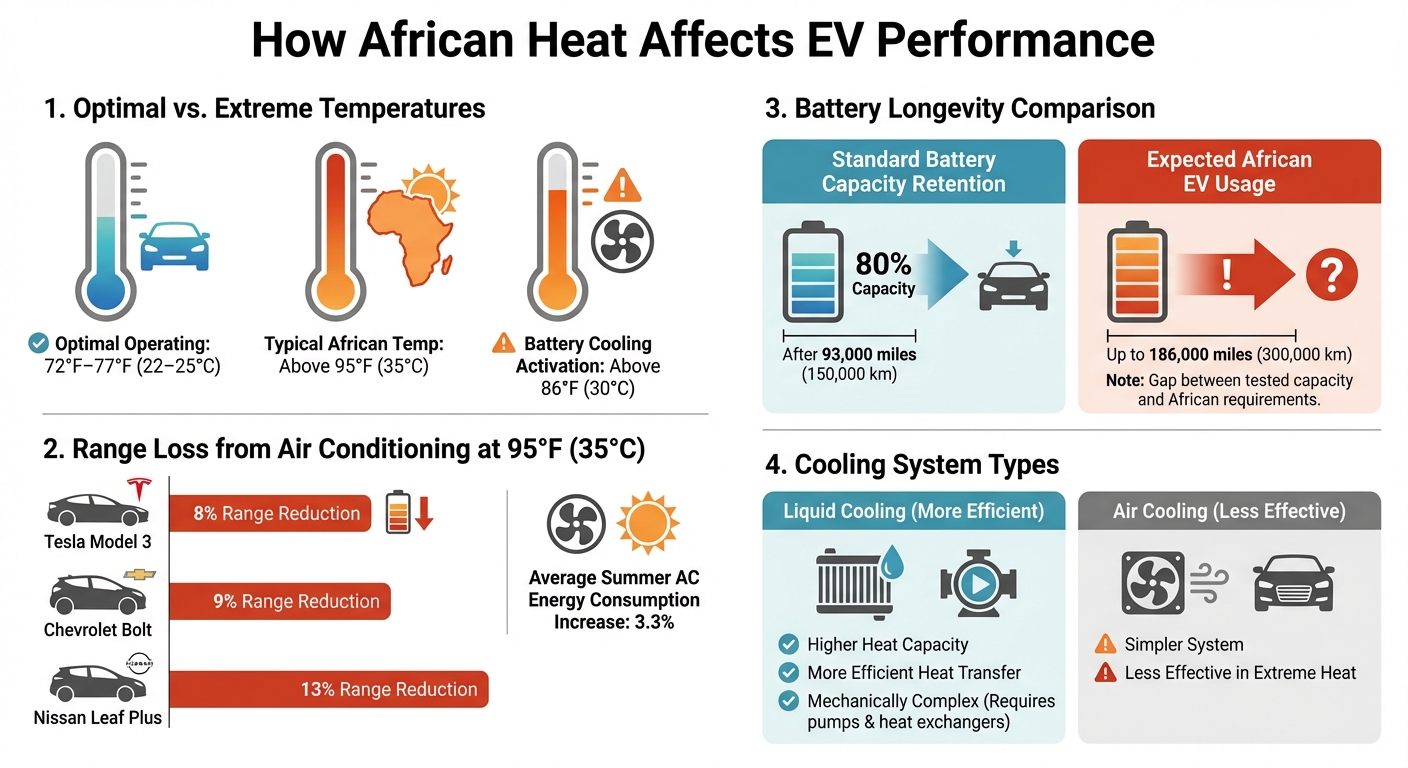
EV Performance in Extreme Heat: Range Loss and Temperature Impact Comparison
Electric vehicles (EVs) are designed to perform best within a sweet spot of 72°F–77°F (22–25°C). However, in many parts of Africa, temperatures often soar beyond 95°F (35°C), putting significant stress on both the batteries and cooling systems. These conditions make understanding how heat impacts EV durability and efficiency a critical concern. To maintain performance, the thermal management system has to work extra hard – keeping the cabin cool and preventing the battery pack from overheating. This increased workload directly affects driving range and highlights the importance of addressing specific challenges related to batteries and air conditioning.
Battery Efficiency Problems in Extreme Heat
When temperatures exceed 86°F (30°C), EVs automatically activate their cooling systems, which consume energy even if the air conditioning (AC) isn’t in use. High heat also speeds up battery aging by increasing internal cell resistance. For instance, tests reveal that vehicles like the Tesla Model S and Nissan Leaf can retain 80% of their battery capacity after 93,000 miles (150,000 km). However, in Africa, where EVs are expected to cover up to 186,000 miles (300,000 km), these figures may fall short.
Liquid cooling systems, which are more effective than air cooling, help manage heat better due to their higher heat capacity and efficient transfer. But this comes at a cost – these systems are mechanically more complex, requiring additional components like pumps and heat exchangers.
Air Conditioning and Energy Consumption
Beyond the battery, climate control systems further increase energy demands in hot weather. Running the AC in extreme heat can significantly reduce driving range. For example, at 95°F (35°C), the range drops by 8% in the Tesla Model 3, 9% in the Chevrolet Bolt, and 13% in the Nissan Leaf Plus. On average, summer AC use adds about 3.3% more energy consumption. A practical way to reduce this load is by preconditioning the vehicle while it’s still plugged into a charger. This allows the cabin to cool using grid electricity rather than draining the battery during your journey.
Road Conditions and EV Durability in Africa
Africa’s road infrastructure presents a unique set of challenges for electric vehicles (EVs). While high temperatures are one concern, the state of many roads across the continent adds another layer of difficulty. Unpaved roads, flooding during rainy seasons, and potholes subject vehicles to significant physical stress, which can be especially hard on EVs. Unlike traditional cars, EVs have heavy battery packs mounted underneath, making them more susceptible to damage on rough terrain. Tackling these road-related issues is just as important as addressing heat concerns to ensure EVs can perform reliably in Africa. Let’s dive into the specific obstacles EVs face on the continent’s rugged roads.
Damage from Potholes and Rough Surfaces
The battery pack is not only the most sensitive part of an EV but also the most expensive. Driving on poorly maintained roads can damage the battery and strain the suspension system. This is a particularly pressing issue for commercial vehicles like minibuses and two-wheelers (commonly known as boda bodas or okadas), which make up a significant portion of the vehicle fleet in some sub-Saharan countries – up to 50% in certain cases. These vehicles often carry heavy loads and travel long distances every day, increasing wear and tear.
Most EVs imported into Africa are designed for markets with smooth, well-maintained roads, meaning they often lack the reinforced suspensions and underbody protection needed to handle Africa’s challenging terrain. However, there’s hope. As McKinsey & Company highlights:
"A number of start-ups are already investing in the region’s nascent electric two-wheeler space to design vehicles at a cost and durability suitable for the local market."
Dust and Debris Impact on EV Systems
Rough roads aren’t the only problem – dust and debris are also major threats to EVs. These particles can clog air filters and accumulate around heat exchangers, reducing the efficiency of cooling systems. In hotter climates, where cooling systems are already working overtime, this can lead to overheating and faster wear on components.
The issue is compounded by a lack of trained mechanics in many African countries. Diagnosing and repairing complex EV systems, especially high-voltage components, requires specialized knowledge that is often scarce. A cooling system failure that might be a routine fix in developed countries can become a significant problem in regions without the necessary expertise or resources.
Unreliable Power Supply and Charging Issues
Beyond physical and environmental challenges, infrastructure problems also hinder EV performance. Many areas in Africa experience frequent power outages, which disrupt charging and contribute to faster battery wear. For instance, the System Average Interruption Disruption Index (SAIDI) for sub-Saharan Africa in 2020 was 39.30, a stark contrast to just 0.87 in OECD high-income countries. In 34 African nations, fewer than half of those connected to the grid have access to reliable electricity.
Lemma Teshome Tufa, a researcher on EV adoption in sub-Saharan Africa, explains:
"Frequent and lengthy power outages have far-reaching socio-economic consequences, which complicate the process of EV charging."
Unstable grids and voltage fluctuations during charging can degrade battery cells, shortening their lifespan and reducing their storage capacity. For many EV owners in regions with unreliable electricity, installing solar panels or backup power systems isn’t just a luxury – it’s practically a necessity.
EV Design Solutions for African Conditions
Electric vehicle (EV) manufacturers are tailoring their designs to meet the unique challenges of Africa’s extreme heat and rugged terrain. These adjustments include specialized cooling systems to combat high temperatures and reinforced structures to handle rough roads. Let’s take a closer look at how these innovations are addressing these challenges.
Advanced Cooling Systems for Hot Climates
In regions where temperatures often soar above 95°F (35°C), managing battery heat is a top priority. Advanced cooling systems play a critical role in maintaining performance and preventing battery degradation. Unlike basic air-cooling systems, liquid cooling is far more efficient, reducing energy waste while keeping batteries at optimal temperatures.
Take the BYD Atto 3, for instance. Available on EV24.africa, it comes equipped with a high-efficiency heat pump system that ensures superior thermal management. This system doesn’t just cool the battery – it also recycles residual heat from the environment, powertrain, and batteries, optimizing energy use. Adding to its efficiency, the Atto 3 features an integrated 8-in-1 electric powertrain, which combines key components into a compact unit for better space utilization and thermal control. Together, these features keep battery temperatures within the ideal range of 59°F to 95°F (15°C to 35°C), significantly extending battery life and ensuring reliability in hot climates.
Reinforced Builds for Difficult Roads
Africa’s uneven roads, often marked by potholes and unpaved stretches, demand vehicles with robust designs. Protecting the battery pack from potential damage requires more than just advanced suspension systems. The BYD Atto 3, for example, is built with 85% high-strength steel, including 11% hot-formed steel capable of withstanding up to 1,500 MPa of tensile strength. Its battery is securely housed beneath the floor, shielded by beam structures designed to absorb impacts. With a ground clearance of 6.9 inches (175 mm), this EV can navigate uneven terrain without risking underbody damage.
In addition to purpose-built EVs, some companies are retrofitting existing rugged vehicles with electric powertrains. This approach combines proven durability with the efficiency of electric technology. As Mikael Gange, co-founder of Kabisa, highlights:
"Compared to a diesel engine which can weigh 150kg, an electric one is only 42kg, so the whole vehicle is lighter and more efficient".
A testament to these advancements came in September 2024, when the Kabisa team completed a 1,491-mile (2,400-kilometer) journey from Kigali, Rwanda, to Nairobi, Kenya, and back. Using a Radar RD6 electric pickup, they demonstrated that well-designed EVs can handle East Africa’s challenging road conditions over extended trips.
sbb-itb-99e19e3
Best EV Models for African Heat and Roads
When choosing an EV for Africa’s challenging conditions, it’s essential to focus on features that can withstand the region’s heat and rugged terrain. One critical factor is battery chemistry. Lithium Iron Phosphate (LFP) batteries perform better in hot climates, offering greater stability compared to other types. Additionally, models equipped with active thermal management systems help maintain ideal battery temperatures between 68°F and 77°F (20°C to 25°C), which is crucial when outdoor temperatures soar above this range.
Ground clearance is another key consideration for handling potholes and unpaved roads. Look for vehicles with at least 6.9 inches (175 mm) of clearance when unladen – this ensures smoother off-road performance. In regions with unreliable electricity, Vehicle-to-Load (V2L) capability becomes a game-changer, enabling your EV to power external appliances during outages. These design features not only enhance durability but also impact range efficiency under extreme conditions.
Thermal performance also plays a significant role in driving range. Extreme temperatures can reduce an EV’s range by 23% to 40%, making larger batteries a practical choice for African environments. As Paul Maric from CarExpert explains:
"EVs suffer significant range reduction in very cold and very hot temperatures. The optimum operating temperature for a battery-powered vehicle is between 20-25 degrees Celsius."
To protect against wear and tear, prioritize models with warranties covering 8 years or 160,000 km (approximately 99,419 miles). While new EVs come with a higher upfront price – ranging from $44,499 to $47,499 – their five-year total cost of ownership can be up to 25% lower due to savings on fuel and maintenance.
Model Comparison Table
| Model | Battery Size | Battery Chemistry | Ground Clearance | Range (WLTP) | Cooling System | Starting Price |
|---|---|---|---|---|---|---|
| BYD Atto 3 Standard | 49.92 kWh | Lithium Iron Phosphate (LFP) | 6.9 in (175 mm) | 214 mi (345 km) | Active thermal management | $44,499 |
| BYD Atto 3 Extended | 60.48 kWh | Lithium Iron Phosphate (LFP) | 6.9 in (175 mm) | 261 mi (420 km) | Active thermal management | $47,499 |
The BYD Atto 3 models, available on EV24.africa, are well-suited for African conditions. Both variants include PM2.5 filtration to handle dusty environments, a camping mode for stationary climate control, and V2L capability for backup power. The extended range version also supports faster DC charging at 88 kW, compared to 70 kW for the standard model, making it a better option in areas with limited charging infrastructure.
Maintenance Tips for EV Owners in Africa
Keeping your electric vehicle (EV) running smoothly in Africa’s unique conditions – like intense heat and rugged roads – requires a bit of extra care. Here are some practical tips to help you get the most out of your EV.
Heat Protection Strategies
Extreme heat can take a toll on your EV’s battery, but small changes can make a big difference. Park in the shade whenever possible to reduce the strain on your battery and lower the energy needed to cool the cabin and battery pack. If your EV has a mobile app, use it to precondition the car while it’s plugged in – this way, the cooling system doesn’t drain your battery. Charging during cooler times of the day, like early mornings or late evenings, also helps avoid overheating the battery.
On particularly hot days (above 90°F or 32°C), consider limiting your charge to 50–80%. This can prevent excess heat buildup inside the battery. To stay comfortable while driving, use ventilated seats if available and keep air conditioning settings moderate to save energy without sacrificing comfort.
Driving and Maintenance for Rough Roads
Africa’s rough roads can be tough on any vehicle, but you can take steps to protect your EV. Start by keeping your tire pressure at the recommended level and avoiding unnecessary weight in the car. Smooth, gradual acceleration not only extends your driving range but also helps protect your car’s underbody from damage.
Routine inspections are key. Check components like the battery pack enclosure and suspension parts regularly, especially after driving on rough terrain. Use your EV’s onboard systems to monitor battery health and catch potential issues early. These small habits, paired with your EV’s built-in durability features, can keep your car in great shape for challenging environments.
Using EV24.africa for Vehicle Selection
If you’re shopping for an EV suited to African conditions, EV24.africa is a great resource. Their platform provides detailed specs on models, including ground clearance, battery chemistry, and thermal management systems. You can use filters to find vehicles with features like LFP batteries, active cooling, and V2L capability – perfect for handling extreme heat and tough roads. Plus, they offer structured financing and expert guidance to help you choose a reliable EV for your needs.
Conclusion
Electric cars are well-suited for African heat and rugged roads – if you pick the right model. EVs with advanced thermal management systems, reinforced designs, and effective cooling technologies are proving their reliability. For instance, at 95°F (35°C), a properly engineered EV loses about 17% of its range when using air conditioning – less than the up to 25% efficiency drop experienced by gas-powered vehicles.
The key takeaway? Smart vehicle selection is critical. Greg Brannon, Director of Automotive Engineering at AAA, explains it best:
"As long as drivers understand that there are limitations when operating electric vehicles in more extreme climates, they are less likely to be caught off guard by an unexpected drop in driving range".
This highlights the importance of opting for models equipped with liquid cooling systems, higher ground clearance, and proven durability for tough terrain.
Still, challenges like unreliable power grids, limited charging stations, and a lack of skilled mechanics remain hurdles for EV adoption. Yet, progress is underway. Countries such as Rwanda and Ethiopia are eliminating import taxes on EVs, and solar-powered charging solutions are becoming more accessible. For commercial drivers, the potential to cut operating costs by up to 80% is a game-changer.
Ultimately, preparation is everything. Look for models with features like liquid cooling and reinforced builds. Research local charging infrastructure, check battery health if buying used, and focus on vehicles designed for extreme conditions. Platforms like EV24.africa make it easier to find EVs with critical features like active cooling and higher ground clearance. The technology is here – now it’s all about finding the right fit for your environment and needs.
FAQs
How does Africa’s extreme heat impact electric car batteries and performance?
Electric car batteries don’t get along well with extreme heat, and that’s a challenge in many parts of Africa, where daytime temperatures often hover between 95°F and 113°F. Such high heat speeds up the chemical aging process inside lithium-ion batteries, causing them to lose capacity more quickly and shortening their lifespan. Here’s a striking fact: for every 18°F increase beyond the ideal range of 68°F–86°F, battery degradation can jump by 20%–30%. So, while an EV in a cooler climate might hold onto 80% of its battery capacity after eight years, the same car in a consistently hot area could see that drop to just 60%–70%.
On top of that, extreme heat makes the air conditioning system in an EV work overtime, cutting the driving range by as much as 15%–20% on sweltering days. The good news? Newer battery technologies are stepping up to address these issues. Enhanced thermal management systems and advanced battery chemistries are making a difference. If you live in a hot climate and want to get the most out of your EV’s battery, look for models with active cooling systems and try to avoid fast charging all the way to 100% when the weather is scorching.
What upgrades do EVs need to handle Africa’s heat and rough roads?
Electric vehicles (EVs) made for Africa’s tough roads and extreme temperatures need specific upgrades to perform reliably. For starters, higher ground clearance and stronger suspensions are a must. These features help vehicles handle potholes, uneven surfaces, and rocky trails without risking damage to the battery or drivetrain. Many EVs now come with ground clearances of about 9 inches and specially adjusted shock absorbers to make bumpy rides more manageable.
Another key feature is all-wheel drive (AWD) or selectable 4×4 systems, which help maintain traction on tricky surfaces like loose sand, mud, or steep hills. Pair that with rugged tires that have reinforced sidewalls, and you’ve got added protection against punctures. These tires also support heavier loads, making them ideal for families or businesses traveling in remote areas.
To further protect critical components, manufacturers are adding underbody skid plates, sealed battery enclosures, and improved water-wading capabilities – some models can handle depths of up to 27 inches. These additions shield EVs from dust, debris, and occasional flooding, ensuring they can handle Africa’s demanding roads and unpredictable climate with ease.
How can EV owners in Africa charge their vehicles with unreliable power grids?
EV owners in Africa can tackle the challenges of unreliable power grids by making smart vehicle choices, adopting renewable energy solutions, and using efficient charging methods. Plug-in hybrids (PHEVs) and range-extended EVs (REEVs) provide added flexibility by relying on a gasoline engine or onboard generator when grid power isn’t available. Fully electric vehicles, on the other hand, are a better match for regions with dependable charging infrastructure.
To reduce reliance on the grid, many owners are turning to renewable energy systems like rooftop solar panels, portable solar kits, or even community solar farms. These systems can store energy in home battery setups, ensuring a steady power supply for EV charging while offering a greener alternative to grid electricity.
Efficient charging practices also play a key role. Charging during off-peak hours or using programmable chargers can help ease grid demand and minimize the chance of outages. Shared solar-powered charging hubs or localized micro-grids are another option, making renewable energy solutions more affordable and practical for entire communities. By blending these approaches, EV owners can keep their vehicles charged and ready, even in areas where electricity supply is unpredictable.