
 Thabo Nkosi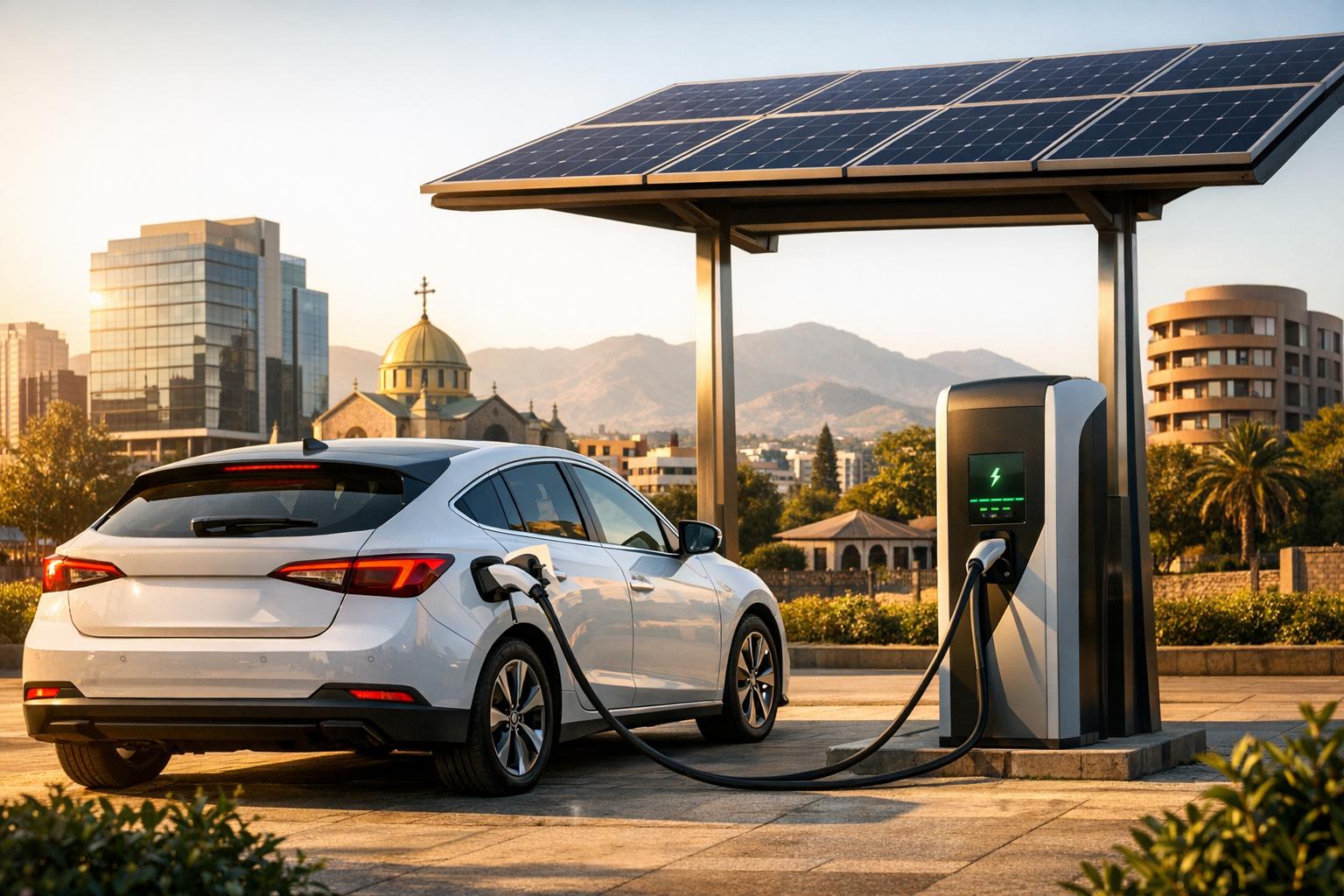
Ethiopia is transforming its transportation industry by embracing electric vehicles (EVs). Here’s the big picture:
- Policy Shift: In January 2024, Ethiopia banned imports of gas-powered private cars, making EVs the only option for new vehicle purchases.
- Tax Incentives: EVs face significantly lower taxes (15%) compared to gas-powered cars (up to 200%). Locally assembled EVs enjoy even greater tax breaks.
- Growing EV Market: By late 2025, about 115,000 EVs are on Ethiopian roads, representing 8.3% of the total vehicle fleet.
- Lower Costs: EV owners spend around $4 per month on charging, compared to $27 for gasoline.
- Infrastructure Expansion: Over 2,200 charging stations are planned, supported by renewable energy sources like hydropower.
Ethiopia’s EV market includes affordable Chinese models (e.g., BYD) and luxury options like Tesla. Local assembly is also gaining momentum, with nine companies producing EVs domestically. The country is positioning itself as a leader in clean energy transportation while reducing reliance on fossil fuel imports.
Explore how Ethiopia is reshaping its future with electric mobility.
Ethiopia’s ICE Vehicle Ban Boosts Chinese EVs, Local Assembly
What’s Driving EV Market Growth in Ethiopia
Ethiopia’s rapid adoption of electric vehicles (EVs) is being fueled by three main factors: bold government policies, a growing network of charging stations, and economic realities that are making gas-powered cars less appealing.
Government Policies and Incentives
Ethiopia has taken a strong stance on EV adoption, starting with groundbreaking policy changes. In January 2024, the country became the first to ban the import of non-electric private vehicles. Transport Minister Alemu Sime made it clear:
"Automobiles cannot enter Ethiopia unless they are electric."
This ban is paired with a tax structure that heavily favors EVs. Gas-powered cars are hit with a 15% value-added tax (VAT), up to 100% excise tax, a 10% surtax, and a 3% withholding tax. Meanwhile, fully assembled EVs face only a 15% customs duty, and locally produced EVs enjoy even lower or zero duties. A draft strategy also proposes non-monetary perks like special license plates and access to free or leased land for after-sales services.
These measures not only encourage EV purchases but also create the groundwork for necessary infrastructure.
Charging Infrastructure Expansion
To support the EV shift, Ethiopia has introduced a regulatory framework addressing licensing, service tariffs, power standards, and safety for charging stations. Plans are in motion to build 2,226 charging stations – 1,176 in Addis Ababa and 1,050 in other regions – with public chargers spaced every 50–120 kilometers.
By April 2025, two ultra-fast charging stations in Addis Ababa became operational, each capable of charging up to 32 vehicles at the same time. This is a step up from the 13 public charging stations reported in mid-2025. Additionally, the nearly completed Grand Ethiopian Renaissance Dam (97.6% finished as of January 2025) is set to generate over 5,000 megawatts of surplus electricity, ensuring a reliable power supply for the growing EV demand.
This infrastructure push is complemented by economic factors that make EVs an increasingly attractive option.
Economic Factors Behind EV Adoption
Ethiopia spends a staggering $4.5–$5 billion annually on fossil fuel imports, despite having one of the lowest vehicle ownership rates globally – just 6.7 vehicles per 1,000 people. This highlights the urgent need for a more efficient and sustainable system.
Affordable Chinese EVs, like BYD models priced around $34,000 in Addis Ababa, are entering the market. Operating costs are another major draw: EV owners reportedly spend about $4 per month on charging, compared to $27 for gasoline. In January 2025, the Utopia Green Fund was introduced to help buyers overcome the high upfront costs. The fund offers interest-free lease payments and savings-based financing for up to 10 years. Combined with ongoing fuel shortages – drivers often wait hours in line for gasoline – these factors make switching to EVs a practical and economical choice for many Ethiopians.
EVs vs. Gas-Powered Vehicles: A Comparison
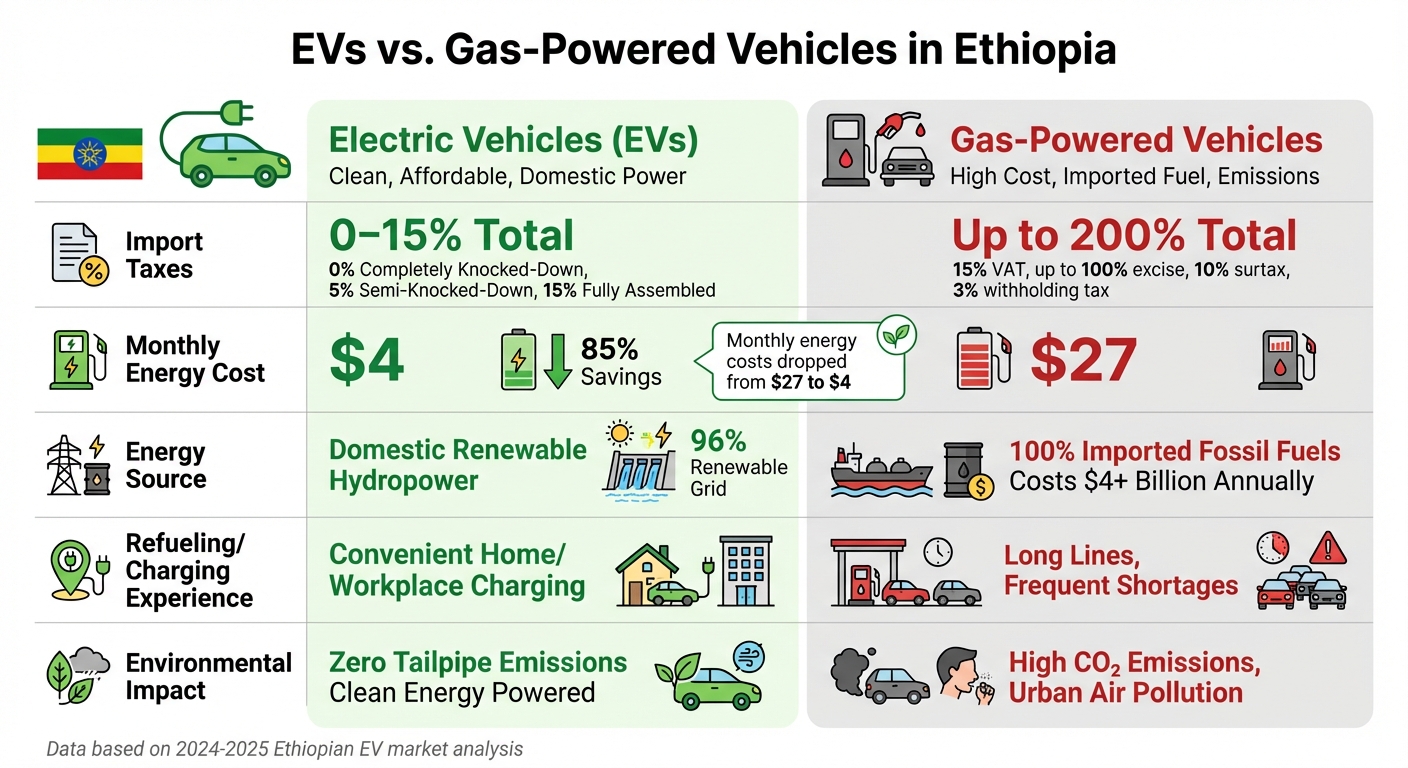
Electric vs Gas-Powered Vehicles in Ethiopia: Cost and Tax Comparison
In Ethiopia, electric vehicles (EVs) come with clear advantages: lower running costs, quicker charging options, and reduced reliance on imported energy compared to traditional gas-powered cars.
Gas-powered vehicles face steep import taxes, reaching up to 200% due to a combination of 15% VAT, up to 100% excise tax, 10% surtax, and 3% withholding tax. In contrast, fully assembled EVs are taxed at only 15%, while locally assembled EVs benefit even more, with semi-knocked-down kits taxed at 5% and completely knocked-down kits at 0%. This favorable tax structure gives locally assembled EVs a strong edge.
Take the example of Kemeriya Mehammed Abduraheman, a development consultant in Addis Ababa. In September 2025, she switched to a BYD EV and slashed her monthly energy costs from 4,000 birr (roughly $27) for gasoline to just about $4 for electricity.
"I’ve been able to save on costs, I’ve been able to save on time."
– Kemeriya Mehammed Abduraheman, Development Consultant
This stark difference in cost and convenience is a big reason why more Ethiopians are embracing EVs.
Why EVs Outperform Gas-Powered Cars
Here’s a quick comparison that highlights why EVs are becoming the smarter choice:
| Feature | Gas Vehicles | Electric Vehicles |
|---|---|---|
| Energy Source | 100% imported fossil fuels (costing over $4 billion annually) | Domestic renewable hydropower |
| Monthly Energy Cost | Around $27 | Around $4 |
| Import Taxes | Up to 200% (VAT, excise, and surtax combined) | 15% customs duty for fully assembled units |
| Refueling/Charging | Long lines and frequent gas shortages | Convenient home or workplace charging |
| Environmental Impact | High CO₂ emissions and urban air pollution | Zero tailpipe emissions, powered by clean energy |
Ethiopia’s electricity grid is remarkably clean, with 96% of its energy coming from renewable hydropower. This makes EVs an environmentally friendly choice, as they run on local, renewable electricity rather than expensive, imported oil. Jane Akumu, Program Officer at the United Nations Environment Programme, sums it up well:
"They really are a clean-energy country. Why are you importing oil while you have local electricity that you can actually use for your vehicles?"
The economic benefits are just as compelling. Ethiopia spends over $4 billion annually on fossil fuel imports. Transitioning to EVs powered by domestic renewable energy – such as that generated by the Grand Ethiopian Renaissance Dam – keeps more money within the country while significantly cutting down on carbon emissions.
sbb-itb-99e19e3
Electric Vehicle Models Available in Ethiopia
Ethiopia’s electric vehicle (EV) market is growing steadily, thanks to supportive policies and improving infrastructure. This progress has paved the way for a variety of EV models catering to different consumer preferences.
Chinese manufacturers dominate the market, with BYD emerging as a leading player due to its competitive pricing and availability. In 2024, electric vehicles accounted for over 60% of all newly registered personal vehicles in the country.
The market offers a mix of options, ranging from budget-friendly Chinese models to high-end imports like the Tesla Cybertruck, which sells for over $100,000 in Addis Ababa. Local assembly is also on the rise, with nine Ethiopian companies assembling vehicles from semi-knocked-down kits (SKD) for brands such as Kia, Hyundai, Isuzu, Peugeot, and IVECO.
Popular EV Models and Specifications
BYD models are a common sight on Ethiopian roads, offering a lineup that includes the Seagull, Yuan Up, Yuan Plus, Song Plus, Song L, Tang L, Bao 5, and Bao 8. The average price of a BYD vehicle hovers around $34,000, though rising demand has significantly driven up costs in recent years.
Locally assembled vehicles from South Korean brands like Hyundai and Kia are also available, alongside commercial EVs from Isuzu and IVECO. Tesla, while limited to the luxury segment, occasionally makes an appearance with its futuristic Cybertruck. Public transportation is also evolving, with Addis Ababa recently acquiring 110 electric buses at around $136,363 each.
| Manufacturer | Popular Models | Origin | Price Range (USD) | Notes |
|---|---|---|---|---|
| BYD | Seagull, Yuan Up, Yuan Plus, Song Plus, Song L, Tang L, Bao 5, Bao 8 | China | ~$34,000 | Most popular; prices have risen sharply in recent years |
| Tesla | Cybertruck | USA | $100,000+ | High-end luxury; limited availability |
| Hyundai | Various models | South Korea | Varies | Assembled locally from SKD kits |
| Kia | Various models | South Korea | Varies | Assembled locally from SKD kits |
Where to Buy EVs: EV24.africa

For those looking to explore Ethiopia’s growing EV market, EV24.africa is a go-to platform. It offers a wide selection of new and used electric vehicles, featuring brands like Tesla, BYD, Leapmotor, ROX, Dongfeng, Geely, Hyundai, Toyota, and Suzuki. The platform provides transparent pricing and financing options, making EV ownership more accessible.
With projections estimating over 500,000 EVs on Ethiopian roads within the next decade, having a reliable marketplace like EV24.africa is crucial. It not only simplifies the buying process but also supports Ethiopia’s shift toward electric mobility, offering options for both budget-conscious buyers and luxury enthusiasts alike.
What’s Next for Ethiopia’s EV Market
Ethiopia’s electric vehicle (EV) market is gearing up for a major transformation. The government has set an ambitious target of 148,000 EVs on the roads by 2030. However, some officials are aiming even higher. Bareo Hassen Bareo, Head of Green Mobility at the Department of Transport, confidently stated:
"In 10 years, we will have more than 500,000 EVs."
Currently, EVs account for about 8.3% of all vehicles in Ethiopia, signaling a strong foundation for growth. Achieving these goals will require significant advancements in infrastructure and manufacturing.
Building the Charging Network
A robust charging network is essential to support the expansion of EVs. Ethiopia currently operates about 100 charging stations, but projections indicate over 2,300 will be needed. To address this, the government has approved a regulatory framework requiring charging stations to be installed every 31 to 75 miles (50 to 120 kilometers) along major transport routes. This ensures that EV drivers will have consistent access to power, a critical step for widespread adoption.
The near-completed Grand Ethiopian Renaissance Dam (GERD), now operating at 97.6% capacity, is another key piece of the puzzle. By doubling the nation’s electrical output, the dam will provide a renewable energy backbone to power the growing network of charging stations.
Local Manufacturing and Economic Opportunities
Ethiopia is also positioning itself as a hub for EV manufacturing in the region. The government’s tiered tax incentives encourage local production, and nine Ethiopian companies are already assembling vehicles using Semi-Knocked Down (SKD) kits. Looking ahead, the country plans to establish a local EV battery manufacturing plant, which could significantly reduce dependence on imported parts.
One standout example of local progress is the Belayneh Kindie Metal Engineering Complex, which has assembled 216 electric minibuses since mid-2023. Half of these vehicles have already been sold to government agencies and transport providers. General Manager Besufekad Shewaye shared:
"Since mid-2023, we have imported completely dismantled electric vehicles, assembled 216 electric minibuses, and made them available to the Ethiopian market."
This shift from assembly to full-scale manufacturing could have a major economic impact. Currently, Ethiopia spends over $4 billion annually on fossil fuel imports. Expanding local EV production could help redirect a portion of those funds into the domestic economy.
Emerging Business Prospects
The growing EV market is also creating opportunities in the after-sales sector. A shortage of trained mechanics and spare parts has opened doors for businesses specializing in EV maintenance, parts distribution, and battery recycling. To encourage private investment in these areas, the government is offering free or leased land for the development of EV service centers and charging infrastructure.
Ethiopia’s push toward electric mobility is not just about reducing emissions – it’s also about fostering economic growth and technological advancement. With the right mix of infrastructure, policy support, and private sector engagement, the country could become a leader in the regional EV market.
Conclusion: Ethiopia’s Electric Vehicle Future
Ethiopia is on the verge of a major shift in transportation, with electric vehicles (EVs) taking center stage. By 2024, the country is expected to have 115,000 EVs on the roads, with over 60% of new personal vehicle registrations being electric. Policies like banning non-electric imports and imposing high taxes on gas-powered cars have significantly influenced consumer preferences, pushing the nation toward a greener future.
Instead of spending $4 billion annually on fossil fuels, Ethiopia is redirecting resources to bolster its economy. The Grand Ethiopian Renaissance Dam will soon double the country’s electricity capacity to over 5,000 megawatts, ensuring ample power for EVs. Meanwhile, plans for charging stations every 31–75 miles and local vehicle assembly initiatives are laying the groundwork for a robust EV infrastructure.
Platforms like EV24.africa are making the transition to electric mobility easier than ever. With a wide range of EVs, complete with detailed specs, transparent pricing, and financing options, they’re simplifying the process for consumers.
The benefits are clear: charging an EV costs around $4, a fraction of the $27 typically spent on gasoline. Beyond the savings, adopting EVs contributes to a cleaner, healthier environment. Ethiopia’s move toward electric mobility isn’t just a policy – it’s an opportunity for individuals to be part of a transformative change. Explore EV24.africa today and take the first step toward a greener future.
FAQs
What are the advantages of driving an electric car in Ethiopia?
Switching to an electric vehicle (EV) in Ethiopia can bring noticeable advantages, both financially and environmentally. With around 96% of the country’s electricity coming from hydropower, charging an EV is far cheaper than relying on imported gasoline or diesel. To put it in perspective, an EV owner in Addis Ababa could slash their monthly fuel costs from roughly $27 for gasoline to just $4 for electricity. On top of that, Ethiopia’s planned 2024 ban on importing gasoline and diesel vehicles is expected to save the nation billions in fuel expenses annually. Add to this the tax breaks and reduced customs duties, and EVs become more accessible, with used models starting at approximately $35,000.
But the benefits go beyond just saving money. EVs come with environmental and lifestyle improvements, too. Since they produce zero tailpipe emissions, they can help Ethiopia curb greenhouse gas emissions and move closer to its climate goals. Plus, EVs spare drivers the hassle of long lines at fuel stations, offer quieter and smoother rides, and require less maintenance due to their simpler mechanics. With government incentives, interest-free financing options, and a growing network of charging stations, making the switch to an EV has never been more practical in Ethiopia.
What steps is Ethiopia taking to expand its EV charging network?
Ethiopia is making strides in building a nationwide electric vehicle (EV) charging network to meet the needs of its growing EV market. Public charging stations are being strategically placed every 30 to 75 miles along key highways, ensuring drivers can travel longer distances with confidence. The network also includes residential chargers, public stations at malls and parking lots, and fast chargers designed for fleets and taxis.
To boost EV adoption, the government has rolled out supportive policies. These include banning the import of new gasoline and diesel vehicles, allowing duty-free entry for EV parts, and offering tax breaks for EVs assembled locally. These initiatives align with Ethiopia’s ambitious goal of putting 500,000 EVs on the road by 2030, supported by a well-developed charging infrastructure.
What incentives does the Ethiopian government provide to encourage electric vehicle adoption?
The Ethiopian government is taking steps to make electric vehicles (EVs) more affordable and accessible. Fully assembled EVs face a 15% import duty, while partially assembled kits are taxed at just 5%, and completely knocked-down (CKD) kits are entirely exempt from customs duties. On top of that, EV imports are not subject to value-added tax (VAT), surtax, or excise duties, making them far more cost-effective compared to gasoline or diesel vehicles.
For companies assembling EVs within Ethiopia, the government offers even more perks. These include tax exemptions on parts and lower costs for local production, encouraging domestic manufacturing. To accelerate the transition to electric mobility, Ethiopia has also announced a 2024 ban on importing new gasoline and diesel cars, effectively positioning EVs as the leading choice for new vehicle buyers.