
 Thabo Nkosi
Kenya’s electric vehicle (EV) market is growing fast. By September 2025, EV registrations jumped from 2,694 in 2023 to 9,047. This growth is driven by tax breaks, cheaper charging costs, and better infrastructure. Here’s what you need to know:
- Prices: New EVs start at KSh 5 million ($38,000), while used options begin at KSh 544,402. Import duties and taxes affect final costs.
- Charging: Public stations are available in major cities, with home charging being the cheapest. Costs range from KSh 8–60 per kWh, depending on the time and type of charger.
- Incentives: Fully electric cars are VAT-exempt, with reduced excise and import duties. Policies also support charging infrastructure expansion.
- Savings: EVs cost 30–50% less to charge compared to fueling gas cars, with lower maintenance expenses due to fewer moving parts.
Switching to an EV in Kenya is becoming more practical with affordable options, government support, and a growing charging network.
Chinese EVs You Can Buy in Kenya – Africa EV Show
Electric Car Prices in Kenya
Getting a handle on electric vehicle (EV) pricing in Kenya is essential when weighing the costs of ownership and maintenance over time. Prices for EVs in Kenya can vary greatly, depending on whether you’re buying a brand-new model or a used one. The Kenya Revenue Authority (KRA) provides a Current Retail Selling Price (CRSP) list, which acts as a reference point for calculating import duties and taxes on used vehicles. As of July 1, 2025, this list gives a clear idea of the baseline costs you might encounter when importing a used EV.
The Cost of New Electric Cars
New EVs in Kenya come with a hefty price tag. For example, a Tesla Model 3 costs over KSh 10 million – more than double what it costs in Europe. On average, a brand-new EV in Kenya is priced at around $38,000 (roughly KSh 5 million). These high prices are primarily due to a 25% import duty, though some incentives help reduce the overall cost.
The Case for Used Electric Cars
Used EVs present a more affordable alternative, even though they still carry higher upfront costs compared to gas-powered vehicles, largely due to import taxes. However, the long-term benefits are clear: EVs have charging costs that are 30–50% lower and require far less maintenance. For buyers on a budget, these savings can make the initial investment worthwhile over a 3–5 year ownership period.
Budget-Friendly Electric Cars in Kenya
If you’re looking for affordable EV options, several models on the KRA’s CRSP list fall within a reasonable price range. Prices start at about KSh 544,402 and go up to just over KSh 3 million. Here are some standout models:
- Toyota C+Walk T: At KSh 544,402, this compact hatchback is one of the cheapest options but is best suited for short urban trips.
- Dongfeng EX1 Nano Box: This SUV offers practical styling and is priced at KSh 1,583,128.
- Neta N01 SUV: A more spacious option, listed at KSh 2,673,728.
- Other choices include the Dongfeng Nammi 01 hatchback (KSh 2,005,296), the Toyota C+Pod G hatchback (KSh 2,637,475), and the Mitsubishi Minicab MiEV Van (KSh 3,060,147).
Keep in mind that these CRSP prices are used to calculate taxes, so the final cost will be higher once import duties and other fees are factored in.
Comparing New and Used EVs
The price difference between new and used EVs is striking. While a new Tesla Model 3 costs over KSh 10 million, used options are significantly more affordable. Below is a quick look at some of the most budget-friendly used EVs from the July 2025 CRSP list:
| Make | Model | Body Type | CRSP (KSh) |
|---|---|---|---|
| Toyota | C+Walk T | Hatchback | 544,402 |
| Dongfeng | EX1 Nano Box | SUV | 1,583,128 |
| Dongfeng | Nammi 01 | Hatchback | 2,005,296 |
| Toyota | C+Pod G | Hatchback | 2,637,475 |
| Neta | Neta N01 | SUV | 2,673,728 |
| Mitsubishi | Minicab MiEV Van | Van | 3,060,147 |
The KRA periodically updates the CRSP list, which directly affects affordability. According to Elijah Ntongai, a business editor at TUKO.co.ke:
"The listed prices will be used to determine the taxes importers must pay at the point of entry, which is likely to result in higher prices for Kenyan consumers, as dealers may pass on the increased costs".
If you’re considering importing an EV, it’s a good idea to check the most recent CRSP list to get an accurate estimate of total costs. These pricing dynamics are shaping Kenya’s EV market as the country works to expand its charging infrastructure.
Charging Infrastructure in Kenya
Kenya’s charging network is growing rapidly, particularly in urban areas. This progress is being driven by both government initiatives and private operators who are working to expand the infrastructure beyond Nairobi.
Public charging stations are now operational in 11 out of Kenya’s 47 counties. These stations support three main connector types: Type 2 (AC), CCS2 (DC), and GB/T (a standard widely used in imported Chinese EVs and electric buses). Most stations offer slower AC chargers (7kW–22kW) or faster DC chargers (50kW–150kW+), with the latter capable of delivering an 80% charge in just 20–40 minutes.
Public Charging Stations in Major Cities
Nairobi boasts the most extensive network of public chargers, with installations at key locations like Sarit Centre, Two Rivers Mall, and Jomo Kenyatta International Airport (JKIA). The Well in Karen stands out as a hub, featuring both AC (Type 1 and Type 2) and DC (CHAdeMO and CCS2) connectors. Other major cities, including Mombasa, Nakuru, and Machakos, also host chargers, strategically placed along key routes like the Nairobi–Mombasa highway.
Charging costs depend on location and time. The Energy and Petroleum Regulatory Authority (EPRA) has set e-mobility tariffs at around KSh 16 ($0.12) per kWh during peak hours and KSh 8 ($0.058) per kWh during off-peak hours. Public AC charging typically costs KSh 35–45 per kWh, while DC fast charging ranges from KSh 45–60 per kWh. Apps like PlugShare, the AEMP map, and network-specific tools such as ChargeNet help drivers locate stations, check availability, and view connector types in real time.
Home Charging Solutions
For EV owners in Kenya, home charging remains the most affordable option. Most vehicles can charge using a standard three-pin socket (Level 1), though this takes over 12 hours for a full charge. Installing a Level 2 wall box charger can significantly reduce charging time to 4–8 hours.
The cost of installing a Level 2 charger ranges between KSh 50,000 and KSh 150,000. Standard home electricity rates are KSh 20–30 per kWh, but off-peak charging (typically between 10 PM and 6 AM) costs as little as KSh 8 per kWh – up to 60% less than standard rates. Charging an EV at home can be 30–50% cheaper than fueling a gas-powered car, especially with petrol prices hovering around KSh 200 per liter.
Charging Network Expansion Plans
Kenya Power is leading an ambitious push to expand the charging network. In May 2025, CEO Dr. Joseph Siror announced plans to install 45 new EV charging stations across six counties – Nairobi, Nyeri, Kisumu, Eldoret, Nakuru, Mombasa, and Taita Taveta – within one year. The $1.9 million (KSh 258 million) project averages about KSh 6.5 million per station.
"Kenya Power is committed to enabling the country’s transition to electric mobility to catalyse the reduction of carbon emissions."
– Dr. (Eng.) Joseph Siror, Managing Director and CEO, Kenya Power
The government envisions 1,000 EV charging stations by 2027 and 10,000 by 2030. To support this, the 2024 National Building Code now requires that 5% of parking spaces in all new commercial buildings be reserved for EV charging.
Private operators are also stepping up. BasiGo, for instance, is setting up 16 electric bus charging depots along key transport routes in Nairobi to support its growing fleet. Kenya’s national grid, with a capacity of 3,321 MW to 3,713.4 MW, comfortably exceeds current peak demand, leaving ample room for scaling EV infrastructure. Electricity consumption for e-mobility is projected to hit 5.04 GWh by the end of the financial year on June 30, 2025 – a 300% rise from the previous year.
Battery swapping is gaining traction, especially for commercial fleets like boda bodas and taxis, as it eliminates charging downtime. Meanwhile, solar-powered charging hubs are emerging as a renewable energy solution, helping to ease pressure on the grid.
sbb-itb-99e19e3
Owning and Maintaining an Electric Vehicle in Kenya
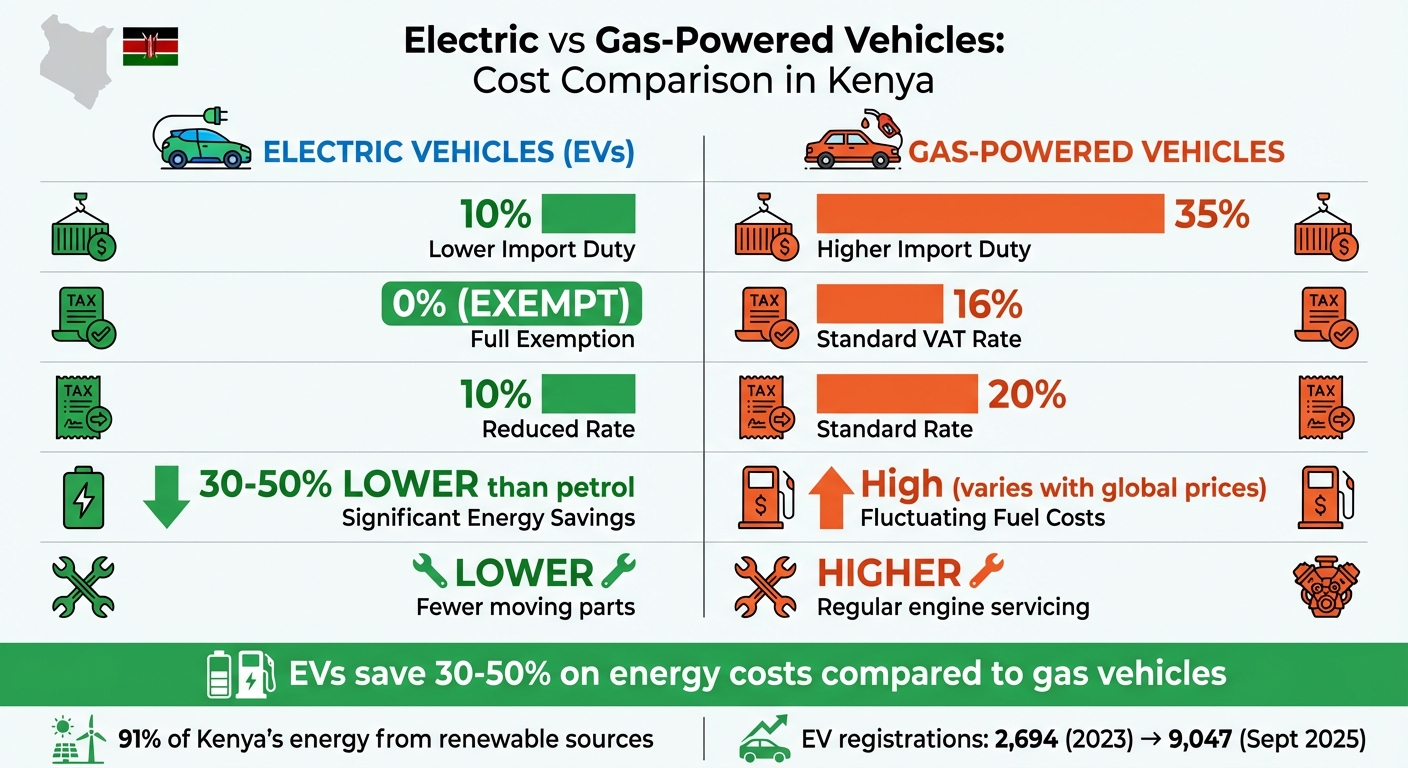
Electric vs Gas-Powered Vehicles Cost Comparison in Kenya
Government Incentives and Tax Benefits
Kenya has introduced several tax breaks to make electric vehicles (EVs) more accessible. Fully electric cars are exempt from the 16% VAT, while excise duty is reduced to 10%, and import duties are slashed to 10% compared to the 35% charged on gas-powered vehicles. These perks are automatically applied by the Kenya Revenue Authority during customs clearance.
The National E-Mobility Policy, enacted in March 2024, formalized these tax exemptions and set an ambitious goal: achieving 100% electric vehicle adoption by 2040. EV owners also enjoy additional benefits like reduced registration fees and a special e-mobility electricity tariff approved by EPRA, designed to cut charging costs further.
Battery Maintenance and Lifespan
In Kenya, EV batteries generally last between 8 and 15 years, but the country’s warm climate makes proper care essential. High temperatures in areas like Nairobi, Mombasa, and Kisumu can speed up chemical degradation, which negatively impacts battery performance and range over time. To combat this, parking in shaded areas, using covered garages, or employing reflective sunshades can help protect the battery from overheating.
Following the 80/20 charging rule – keeping the battery charged between 20% and 80% – is key to maintaining battery health. Avoid charging to 100% or letting the battery drain completely, as both can strain the battery’s chemistry. DC fast charging should be reserved for emergencies or long trips because it generates heat that accelerates wear. For daily use, Level 2 home charging is recommended and can result in about 10% better battery health over eight years.
Driving habits also play a role. Smooth acceleration, efficient use of regenerative braking on hilly roads, and avoiding overloading on rough terrain help reduce strain on the battery. Should a replacement be necessary, battery costs in Kenya typically range from KSh 100,000 to KSh 300,000, or roughly $730 to $2,190, depending on the model and capacity.
These simple maintenance practices not only extend battery life but also lead to significant cost savings over time.
Cost Comparison: EVs vs. Gas-Powered Vehicles
Switching to an EV in Kenya could save you 30% to 50% on energy costs compared to fueling a gas-powered car. EVs also have fewer moving parts, which means lower maintenance costs – no oil changes, spark plugs, or fuel filters to worry about. Plus, regenerative braking reduces wear on brake pads, cutting down on repair expenses.
Here’s a quick comparison of costs:
| Feature | Electric Vehicles (EVs) | Gas-Powered Vehicles (ICE) |
|---|---|---|
| Import Duty | 10% | 35% |
| VAT | 0% (Exempt) | 16% |
| Excise Duty | 10% | 20% |
| Fuel/Energy Cost | 30–50% lower than petrol | High (varies with global prices) |
| Maintenance | Lower (fewer moving parts) | Higher (regular engine servicing) |
With 91% of Kenya’s energy coming from renewable sources as of July 2023, and EV registrations jumping five-fold to 3,753 by the end of 2023, the shift to electric mobility is gaining momentum. These economic advantages, paired with Kenya’s renewable energy infrastructure, make EVs an increasingly appealing option.
Conclusion
Kenya’s electric vehicle (EV) market has seen remarkable growth, with registrations jumping from 2,694 in 2023 to 9,047 by September 2025. This surge is fueled by government incentives like reduced excise duty (down to 10%) and VAT exemptions for fully electric vehicles. Additionally, the expanding charging network – aiming for 10,000 stations by 2030 – makes owning an EV more convenient than ever. For EV owners, the benefits are clear: energy costs are 30–50% lower compared to gas-powered vehicles, and over 80% of charging is powered by Kenya’s renewable energy grid, often at affordable off-peak rates. With charging options now available in major cities and even at home, EV ownership is becoming a practical and sustainable choice.
Whether you’re eyeing a budget-friendly used EV or a brand-new model from names like Tesla, BYD, or Leapmotor, EV24.africa has you covered. They handle everything – from sourcing and shipping to customs clearance and registration – making the process seamless. Explore their website for transparent pricing, detailed specifications, and flexible financing options. You can also join their WhatsApp channel for real-time updates on new arrivals and exclusive offers. With delivery services and expert support, they ensure your EV journey is smooth from start to finish.
Kenya is embracing the electric mobility revolution – and the future is already here.
FAQs
What are the main benefits of owning an electric car in Kenya?
Owning an electric car in Kenya comes with several perks that make it an appealing option for drivers. Let’s start with cost savings. Thanks to government incentives like 0% excise duty, reduced import taxes, and VAT exemptions, the upfront cost of buying and registering an electric vehicle (EV) is significantly lowered. On top of that, electricity is far cheaper than gasoline, and EVs require less maintenance since they have fewer moving parts. This means fewer trips to the mechanic and longer intervals between services.
Electric vehicles also contribute to environmental responsibility. Kenya’s electricity grid is powered by over 80% renewable energy sources, including geothermal, wind, and solar. This makes EVs an eco-conscious choice, helping to cut down greenhouse gas emissions and reduce your carbon footprint.
Lastly, the charging infrastructure in Kenya is expanding quickly. Public charging stations are popping up across major cities and highways, while home charging solutions are also readily available. This growing network makes it convenient to keep your EV charged and ready to go. With these financial, environmental, and practical advantages, electric cars are becoming an increasingly smart choice for Kenyan drivers.
What charging options are available for electric vehicle owners in Kenya?
Kenya is steadily expanding its charging infrastructure to keep up with the rising number of electric vehicles (EVs). EV owners can choose between AC chargers for slower, overnight charging at home or work and DC fast chargers, which can provide roughly 50 miles of range in just 20–30 minutes. These fast chargers are being strategically placed in urban hubs like Nairobi and along key highways, making longer trips much easier.
Many of these fast-charging stations are set up at existing fuel stations through collaborations with major energy companies, offering convenience and a sense of familiarity for drivers. With a growing network of both public and private charging points, EV owners in Kenya have access to dependable charging options, whether they’re at home, at work, or on the move.
What should I consider when deciding between a new or used electric car in Kenya?
When deciding whether to buy a new or used electric vehicle (EV) in Kenya, it’s essential to weigh costs and incentives. New EVs benefit from Kenya’s tax perks, such as 0% import duty and reduced VAT (16%), but they come with a higher upfront price tag. On the other hand, used EVs – if they are under 8 years old, right-hand drive, and have at least 80% battery capacity – can also skip import duty and often come at a lower base price. For instance, a used Nissan Leaf might cost around $10,400, while a new Tesla Model Y could set you back $51,880. Don’t forget additional import fees like VAT (16%), the Import Declaration Fee (2%), and the Railway Development Levy (1.5%).
Battery health and warranty are crucial considerations. New EVs typically include warranties that cover the battery for 8 years or 100,000 miles, giving you added peace of mind. Used EVs may have limited or expired warranties, and a battery with only 80% capacity will have a shorter range and could require an expensive replacement sooner. Always check the battery health of any used EV before making a purchase.
Lastly, evaluate charging compatibility and support. Kenya already has over 200 charging stations, including home chargers and fast chargers along major routes. New EV models often come with better dealer support and are compatible with the latest charging technologies. For used EVs, ensure the charging system matches Kenya’s infrastructure and confirm that spare parts and servicing are accessible for your chosen model. By carefully considering these factors, you can make a choice that aligns with your needs and budget.