
 Thabo Nkosi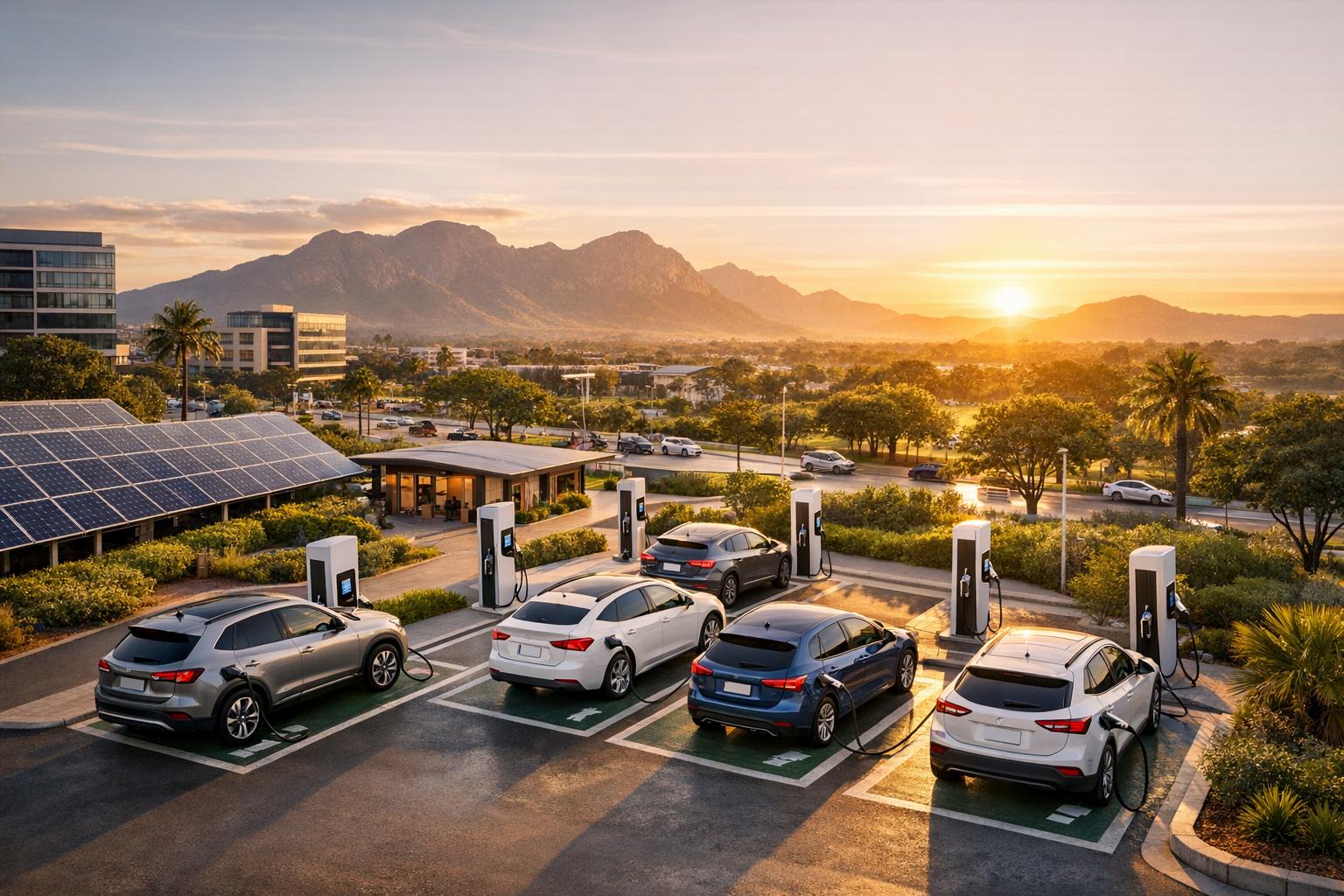
Africa’s electric vehicle (EV) market is growing, but charging infrastructure remains uneven. Here’s what you need to know about EV charging in 2025:
- South Africa leads with over 500 public charging stations and a strong highway network.
- Rwanda has 200 stations, mostly for electric motorbikes, supported by tax breaks and free land for chargers.
- Egypt operates 135 Infinity EV stations and plans to expand significantly.
- Kenya focuses on battery-swapping for motorcycles and aims to assemble 1,000 electric buses by 2027.
- Ethiopia has banned internal combustion engine vehicles and uses renewable energy for EV infrastructure.
Challenges like unreliable power grids are being addressed with off-grid solar-powered chargers. Apps like ChargePocket and PlugShare help drivers locate stations, while platforms like EV24.africa offer tailored solutions for African EV owners.
Despite obstacles, government policies and private investments are accelerating progress. By late 2025, 12 countries are expected to have the infrastructure needed for EV adoption.
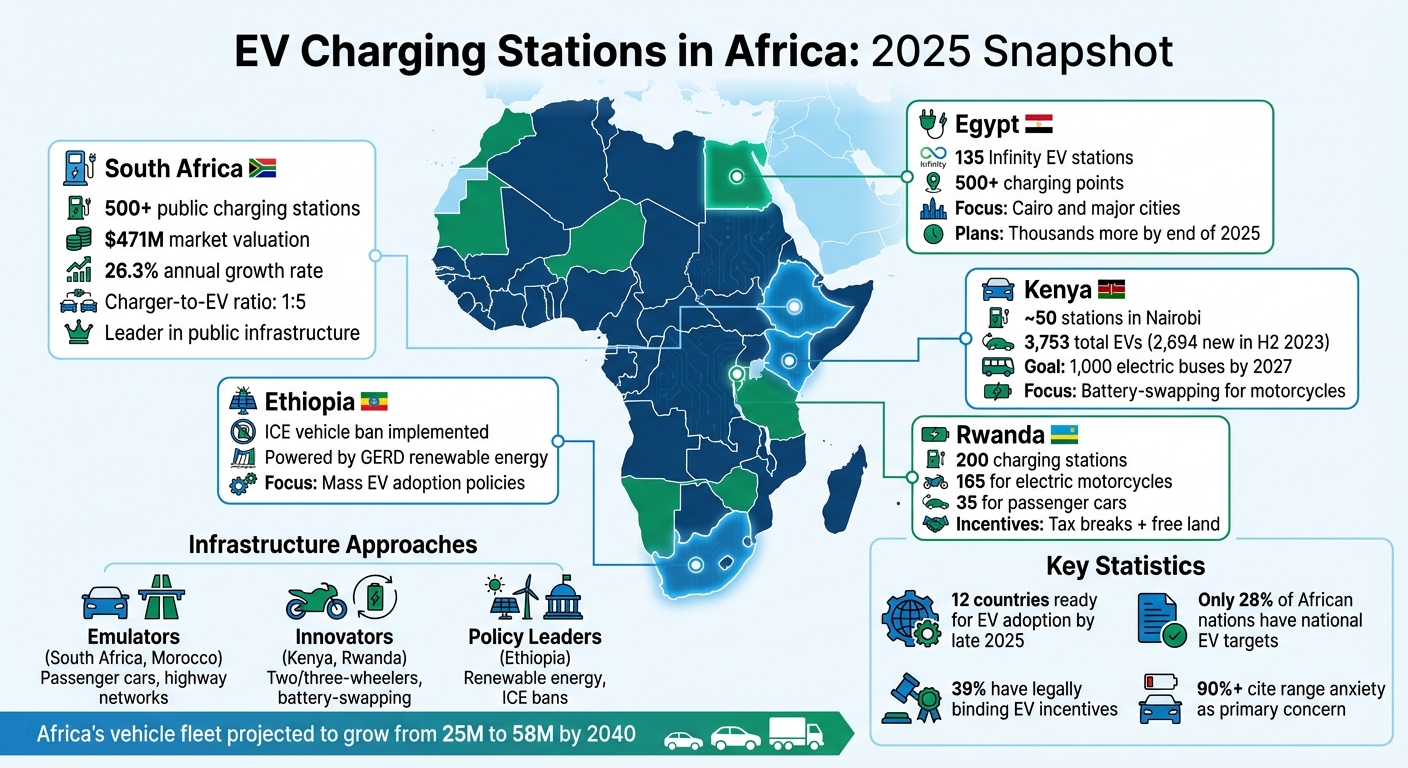
EV Charging Infrastructure Across Africa 2025: Country Comparison
UYILO E-Mobility Programme | South Africa’s Solar-Powered EV Charger: The True African Solution
Major EV Charging Networks and Locations in Africa
Africa’s EV charging infrastructure is developing unevenly, with certain regions standing out as leaders. By June 2025, South Africa had established over 500 public charging stations, creating a roughly 1:5 charger-to-EV ratio. The country’s EV charging market reached a valuation of $471 million in 2025, growing at an annual rate of 26.3%.
In Egypt, the Infinity EV network operates 135 charging stations, offering more than 500 charging points, primarily in Cairo and other major cities. Meanwhile, Kenya saw 2,694 new EV registrations between July and December 2023, bringing its total EV count to 3,753 vehicles. Nairobi alone hosts about 50 charging stations.
The approaches to EV infrastructure vary across the continent. South Africa and Morocco, labeled "Emulators", focus on passenger cars and highway networks, aligning with global trends. On the other hand, "Innovators" like Kenya and Rwanda prioritize two- and three-wheelers, employing creative financing and battery-swapping models. Below are regional highlights of these developments.
East Africa: New Charging Hubs
East Africa is carving out its niche by emphasizing electric public transport and micro-mobility solutions. In Kigali, Rwanda, around 200 charging stations have been set up, with 165 dedicated to electric motorcycles and 35 serving passenger cars. The Rwandan government has incentivized this growth by offering rent-free land for charging stations and waiving taxes on imported equipment.
Kenya is also making strides, aiming to assemble 1,000 electric buses by 2027. Kenya Power has committed $1.9 million over three years to install charging stations to support this goal. In July 2024, BasiGo announced plans to locally assemble these buses, signaling a shift toward electrifying public transportation. Additionally, Kenya’s National Building Code 2024 mandates that commercial buildings allocate 5% of parking spaces for EV charging. These efforts reflect a broader push for EV adoption in the region.
"Kenya has also put in place policies to incentivise the deployment of EV charging infrastructure to ensure sufficient coverage." – Maurice Njagi, Industrial Development Officer, Ministry of Investments, Trade and Industry
Ethiopia is gearing up for mass EV adoption with bold policies, including a ban on internal combustion engine vehicles. The country plans to utilize power from the Grand Ethiopian Renaissance Dam (GERD) to support its charging infrastructure. In November 2025, the Africa Centres for Disease Control and Prevention in Addis Ababa launched a project to install four charging stations for a new fleet of five electric SUVs and sedans.
South Africa: Leading Public Charging Infrastructure
South Africa leads the continent in EV charging infrastructure, with a well-established network that caters to both urban and off-grid needs. GridCars, the largest network, operates over 450 charging points as of June 2025, connecting key urban centers. Companies like GridCars and Rubicon focus on high-traffic areas such as shopping malls and business districts, while Zero Carbon Charge targets rural highways and farm stops. In September 2024, Zero Carbon Charge began preparing to install 120 off-grid charging stations along major routes, relying on Chinese hardware to ensure reliability during power outages.
The country offers both AC (slow) and DC (fast) charging options. AC chargers, commonly found in residential areas and office parks, take 6–8 hours for a full charge. In contrast, DC fast chargers can power up to 80% in under an hour, making them ideal for long journeys.
Highway Charging Infrastructure
Africa’s highways are gradually being equipped with EV charging stations, a critical step for reducing range anxiety and enabling long-distance travel. South Africa’s "Electric Highway" project connects major cities along national routes like N1, N2, and N3. EV owners can use apps like PlugShare or GridCars’ ChargePocket to check real-time charger availability along these routes.
"This infrastructure expansion ensures electric car owners can confidently travel longer distances without range anxiety." – Nissan
Zero Carbon Charge is addressing grid reliability issues by deploying 120 off-grid, solar-powered charging stations. These stations use battery storage to ensure consistent availability, even during power outages.
In regions with limited highway infrastructure, careful planning is essential. However, progress is being made. Ghana has announced plans to install 200 EV charging stations to support its national network, while Kenya Power is gradually extending its coverage beyond Nairobi. Efforts are also expanding to include heavy-duty vehicles like electric buses and trucks, alongside passenger cars.
Off-Grid and Renewable Energy Charging Solutions
Grid reliability remains a significant hurdle for electric vehicle (EV) adoption across Africa. Only eight countries on the continent meet high reliability standards, while sub-Saharan Africa’s System Average Interruption Duration Index (SAIDI) stands at a staggering 39.30, compared to just 0.87 in OECD nations. This challenging reality has driven the development of charging solutions that don’t rely entirely on the region’s often unstable power grids.
Off-grid and renewable energy charging stations are increasingly important in countries with unreliable grids. By combining solar panels with battery storage, these systems can operate independently during power outages. This makes them especially well-suited for charging electric two- and three-wheelers, which often require less complex infrastructure.
Solar-Powered Charging Stations
Solar-powered charging stations are a key part of the off-grid solution. These stations use photovoltaic panels paired with battery storage to provide reliable energy in areas where grid power is weak or nonexistent. This approach is particularly effective for commercial fleets of motorcycles and tuk-tuks, which have lower charging demands than passenger vehicles.
In East African countries like Kenya, Rwanda, and Uganda, startups are crafting business models tailored to work around grid limitations. For instance, Ampersand in Rwanda has introduced battery-swapping networks that allow commercial drivers to exchange drained batteries for fully charged ones in just a few minutes. This setup not only minimizes downtime but also capitalizes on the cost advantages of electric two-wheelers, which are 25% cheaper over a five-year life span compared to their gasoline-powered counterparts, thanks to savings on fuel and maintenance.
Meanwhile, Ethiopia is taking a different path by leveraging its large-scale renewable energy projects. The country plans to use electricity generated by the Grand Ethiopian Renaissance Dam (GERD) to power its EV charging infrastructure. In addition, Ethiopia has implemented aggressive policies, such as a ban on internal combustion engine vehicles starting in June 2025, to accelerate its shift toward electric mobility.
Zero Carbon Logistics Initiatives
Off-grid solutions are also being adopted for larger-scale applications, including institutional logistics. For example, in November 2025, the Africa Centres for Disease Control and Prevention in Addis Ababa issued a request for bids to install four charging stations and supply five electric vehicles (three SUVs and two sedans). The installations were expected to be completed within 90 days of contract signing. This move highlights growing confidence in off-grid charging technologies for organizational fleets.
In markets like Kenya, where mobile money usage is widespread (40% of people over 15 have access), pay-as-you-go charging and battery-swapping models are thriving. These innovations not only make EV adoption more accessible but also align with Africa’s broader push to establish a more resilient and expansive EV charging network by 2025.
sbb-itb-99e19e3
Tools and Apps for Finding Charging Stations
Locating a reliable charging station in Africa can be a challenge, but several digital tools are making it easier. These apps provide real-time updates on station locations, availability, and payment options, helping EV owners navigate the continent’s growing charging network.
Top Apps for EV Charging in Africa
One standout tool is ChargePocket, which is particularly popular in South Africa. The app features a live map with details for over 450 public charging stations within the GridCars National Charging Network. Through ChargePocket, users can check station details, manage their charging sessions, and even handle payments directly from their smartphones. For convenience, GridCars stations are also integrated into Google Maps, simplifying navigation to chargers located at fuel stations and smaller towns along major routes like the N1, N2, and N3 highways.
PlugShare takes a community-driven approach, featuring over 400 verified charging stations in South Africa as of 2025. It allows users to read reviews, check real-time station availability, and plan routes using feedback from other EV drivers. Another option, ActiveCharge, connects users to multiple charging networks through a single app, streamlining access to various service providers. Some premium EV brands even include integrated locator tools for their chargers.
To avoid unnecessary detours, always verify a station’s real-time status before heading out. For longer trips, focus on fast-charging DC stations and consider solar-powered chargers with battery backups, which can help mitigate issues caused by power outages.
Additionally, platforms like EV24.africa are designed to meet the specific needs of African EV owners, offering more tailored solutions.
Using EV24.africa for Electric Vehicle Needs
Beyond general-purpose apps, EV24.africa stands out as an all-in-one platform that enhances the EV ownership experience. It provides detailed guides to charging stations compatible with Africa’s unique infrastructure.
For commercial users, EV24.africa offers a fleet management tool designed for taxi and ride-hailing operators. This platform enables real-time monitoring and smart charging schedules, helping businesses reduce downtime. It also addresses rural challenges by offering solar-powered, off-grid charging solutions, which are crucial in areas with unstable power supply.
The service extends beyond charging, with logistical support at over 20 African ports and after-sales services, including warranty coverage for batteries and motors. This makes EV24.africa particularly valuable for drivers planning long-distance trips.
"EV24.africa is establishing essential infrastructure to support Africa’s electric transition at scale." – Younes Rabeh, Business Manager, EV24.africa
Future Expansion and Government Programs
African governments are setting varied goals to develop electric vehicle (EV) infrastructure, but progress is mixed. Only 28% of African nations have adopted at least one national EV target, and just 39% have introduced legally binding incentives for EVs. Even with these modest numbers, some countries are taking bold steps that could transform transportation across the continent. These efforts highlight the potential for regional initiatives and partnerships to drive change.
Regional Charging Targets for 2025
Ethiopia is tackling its reliance on costly fossil fuels by banning petrol and diesel imports, effectively pushing a shift toward electric vehicles. In Kenya, Nairobi’s Bus Rapid Transit system now includes dedicated lanes exclusively for electric buses, signaling a strong commitment to urban e-mobility. Rwanda is taking a different approach by offering tax exemptions on EV sales and providing free land for charging station development, making EV adoption more accessible.
Meanwhile, Egypt has announced plans to install thousands of EV chargers nationwide by the end of 2025, catering to passenger cars and taxis alike.
Partnerships Driving EV Infrastructure Development
To meet these ambitious targets, partnerships are playing a crucial role in pooling resources and expertise. Public-private collaborations are particularly vital for expanding charging networks across the continent. For instance, in September 2025, Spiro, Africa’s largest electric motorcycle company, teamed up with the Catholic Church in Kenya to roll out solar-powered battery-swapping stations. This partnership leverages the Church’s extensive network, covering 1,170 parishes and 5,830 mission stations, to improve charging access in rural areas where grid reliability remains a hurdle.
In South Africa, Audi announced plans in January 2025 to build 70 ultra-fast (150 kW) public charging stations across 33 locations, enabling vehicles to recharge in under an hour. Similarly, Ampersand, in collaboration with TotalEnergies, is setting up battery-swapping stations at 141 solar-powered service stations across Kenya and Rwanda. Ampersand’s CEO, Josh Whale, highlighted the benefits of this partnership, stating, "We can develop far quicker than we previously expected by using TotalEnergies’ outstanding knowledge to expand our network of battery exchange stations".
"The most effective e-mobility policies don’t just focus on the drivers; they focus on the builders. By making it easier and cheaper for companies to install chargers, governments accelerate the entire ecosystem."
- Younes Rabeh, African EV Market News
Conclusion
Africa’s journey toward establishing a robust EV charging network is steadily gaining momentum. By late 2025, 12 African nations are projected to be well-prepared for EV adoption, with Seychelles, Morocco, Mauritius, and South Africa leading the way. The continent is charting three distinct paths: South Africa and Morocco are expanding public networks for passenger vehicles, Kenya and Rwanda are focusing on battery-swapping solutions for two-wheelers, and other countries are exploring innovative alternatives.
The current landscape presents both hurdles and opportunities. While many regions still face infrastructure gaps, progress is being made through strategic collaborations and off-grid solutions, as previously discussed. Governments, private enterprises, and energy providers are working together to drive this development forward.
One of the most pressing challenges is addressing range anxiety. Over 90% of vehicle owners in Nigeria and Kenya identify this as their primary concern. Ensuring access to functional charging stations, clear route planning, and transparent pricing will significantly enhance the EV ownership experience. As charging networks expand beyond urban areas to highways and rural regions, reliable tools will play a critical role in building user confidence.
The future of EV adoption in Africa depends on investment, sound policies, and accurate data. With the vehicle fleet in six major African countries expected to grow from 25 million to 58 million by 2040, the groundwork being laid today will shape the continent’s transportation landscape for decades. For a seamless EV experience, platforms like EV24.africa provide essential support in navigating Africa’s growing charging network.
FAQs
How is Africa improving power grid reliability for EV charging stations?
Africa is taking significant steps to improve its electricity infrastructure, aiming to ensure reliable power for electric vehicle (EV) charging. Countries across the continent are upgrading their power grids to better handle the demands of renewable energy sources, such as solar and wind. These modernized grids are designed to manage intermittent energy flows, integrate battery storage systems, and maintain stable power for EV chargers. Efforts also include extending high-voltage transmission lines and adding smart monitoring systems to keep the power supply consistent.
In regions where electricity access is unreliable, solar-powered mini-grids are being introduced. These systems are particularly effective in rural and off-grid areas, offering a dependable and independent energy source for EV charging. By combining nationwide grid upgrades with localized renewable energy solutions, Africa is making strides toward creating a reliable and accessible EV charging network, with progress expected to continue well into 2025 and beyond.
How do apps like ChargePocket enhance the EV charging experience in Africa?
Currently, there isn’t any confirmed information regarding ChargePocket’s involvement in Africa’s EV charging infrastructure. Without concrete details or credible sources, it’s challenging to assess how this app might impact the charging experience across the region. Should new details emerge, we’ll gladly update this section to include relevant insights.
How are countries like Kenya and Rwanda advancing battery-swapping solutions for electric vehicles?
Kenya is making strides in the battery-swapping ecosystem through the Kenya E-Mobility Battery Initiative (KeEBI). This initiative introduces "swap-and-go" stations in urban areas, where EV drivers can trade their drained batteries for fully charged ones in just a few minutes. With electric vehicle registrations surging from 475 in 2022 to 2,694 in 2023, the country is also prioritizing local refurbishment and recycling of used batteries. This approach not only cuts costs but also builds a more efficient and sustainable supply chain.
Meanwhile, Rwanda is taking a bold step with modular, swappable battery packs to support a large-scale e-bike conversion project aimed at transforming over 100,000 motorbikes. Startups in Kigali have set up compact swap hubs at markets and transit points, allowing riders to replace batteries in less than 30 seconds. To ease pressure on the national grid, these hubs rely on affordable solar charging during nighttime hours, aligning with Rwanda’s commitment to advancing e-mobility despite its limited electricity resources.