
 Thabo Nkosi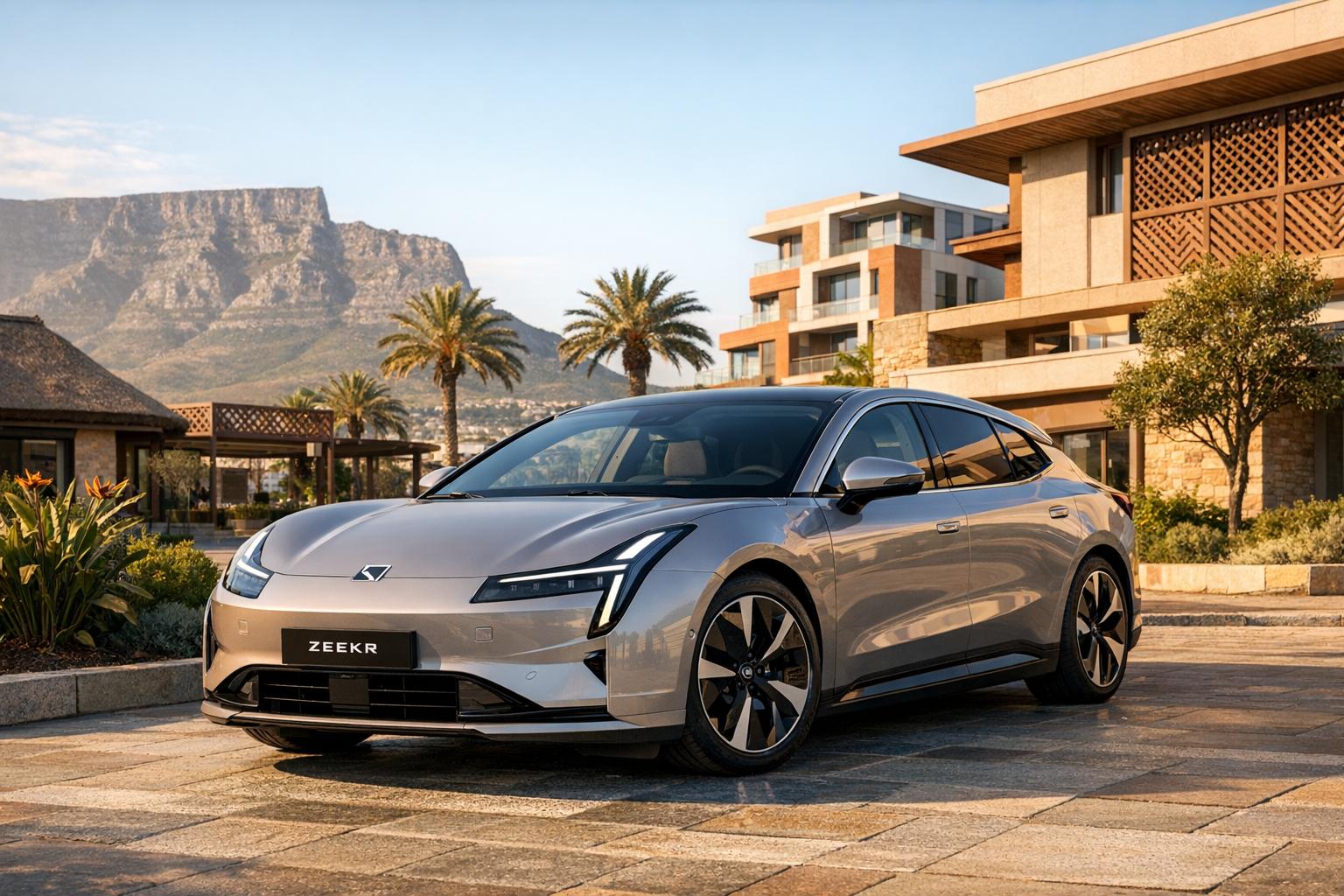
- Zeekr Overview: A luxury EV brand from Geely, Zeekr offers advanced battery tech, high performance, and cutting-edge features. Over 1.82 million units sold globally by early 2025.
- Available Models:
- Zeekr 007: Sedan with fast charging (800V), advanced safety, and pricing starting at $31,902.
- Zeekr 7X: SUV with up to 802 km range, AWD performance, and prices from $38,014.
- Zeekr 009 & Mix: Spacious MPVs for families/businesses, with FOB costs starting at $64,647 and $39,422, respectively.
- Import Process: EV24.africa simplifies importing with clear pricing, customs handling, and delivery options. Import duties for EVs in South Africa are 25%, making final costs higher than FOB.
- Charging Costs:
- Home charging with Eskom: ~$0.12/kWh.
- Public DC fast charging: ~$0.32/kWh.
- Home setup (wallbox): $800–$1,400 upfront, pays off in 1–2 years.
- Warranty & Support:
- 5-year/93,000-mile vehicle warranty.
- 8-year/99,000-mile battery warranty.
- Software updates via OTA and growing local service networks.
- Performance on SA Roads: Zeekr vehicles handle urban and rural roads well, with adjustable air suspension and reinforced safety features.
Quick Tip: Factor in import duties, taxes, and charging infrastructure before purchasing. EV24.africa can guide you through the process, ensuring a smoother experience.
The BEST EV I’ve driven this year…Zeekr 7X review (inc. 0-100 & braking)
Zeekr Models Available for South Africa
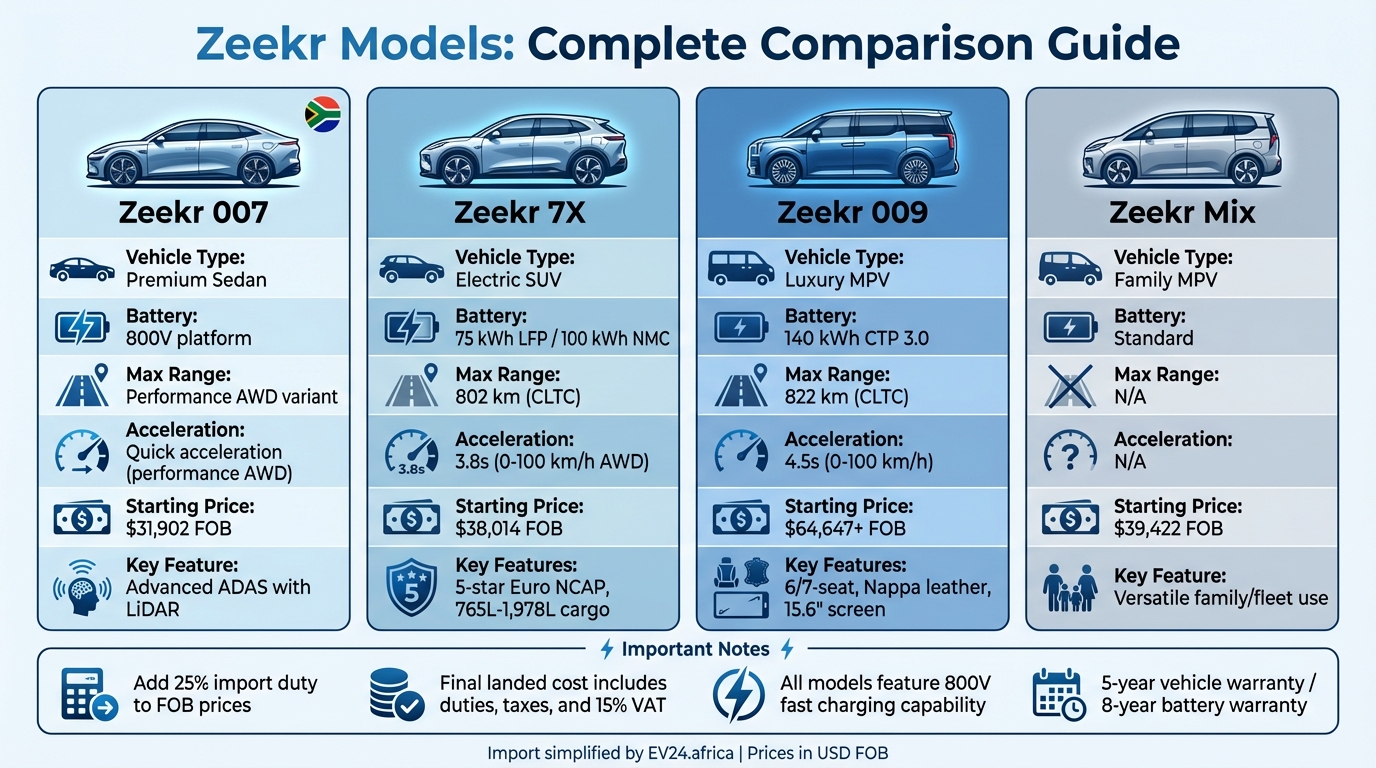
Zeekr Models Comparison: Specs, Range, and Pricing for South Africa
Zeekr 007: Premium Electric Sedan
The Zeekr 007 stands out as a sleek, executive sedan built on the advanced SEA (Sustainable Experience Architecture) 800V platform. This cutting-edge architecture allows for much faster charging compared to the more common 400V systems. The sedan is equipped with the Haohan 2.0 advanced driver-assistance system (ADAS), featuring LiDAR technology and dual Nvidia Orin X chips that deliver a powerful 508 TOPS of computing capability.
For performance enthusiasts, the 007 AWD variant offers quick acceleration and an impressive range. With a FOB starting price of around $31,902, it provides an attractive entry point into Zeekr’s premium segment. The 800V system is especially practical in South Africa, where ultra-fast DC charging infrastructure is steadily growing. Now, let’s look at Zeekr’s SUV offering, designed for versatility and performance.
Zeekr 7X: Electric SUV
The Zeekr 7X is a mid-size crossover that competes strongly in the electric SUV category. It received a 5-star Euro NCAP safety rating in 2024/2025, earning 91% for adult protection and 90% for child safety. The 7X comes with two battery options: a 75 kWh LFP battery or a 100 kWh NMC battery. The AWD performance model delivers 475 kW (646 hp), reaching 0 to 100 km/h in just 3.8 seconds. For those seeking even more power, the 2026 Zeekr 7X Ultra model delivers 795 hp (585 kW) and achieves 0 to 100 km/h in a blistering 2.98 seconds.
With a range of up to 802 km (CLTC) for the RWD Max version, the 7X is well-suited for long drives between South African cities. It also offers practical storage, with a 765-liter boot expandable to 1,978 liters, plus a 62-liter front trunk. Its "Magic Carpet" air suspension adjusts the ground clearance from 147 mm to 217 mm, making it adaptable to smooth highways and rugged rural roads alike.
"The Zeekr 7X is the world’s first pure electric SUV to conquer Bilutu Peak, the highest fixed dune on Earth."
– Mark Andrews, CarNewsChina
Thanks to its 800V charging system, the 7X can recharge from 10% to 80% in just 13 minutes using a 360 kW DC station. However, actual charging times in South Africa will depend on local infrastructure. Frank Li, Vice President of Zeekr International, highlighted: "The Zeekr 7X delivers the kind of intelligent design, long-range confidence, and ultra-fast charging that South African drivers seek." Pricing for the 100 kWh version starts at approximately $38,014 FOB. Let’s now explore Zeekr’s spacious MPV options, tailored for families and businesses.
Zeekr 009 and Mix: Large Family and Business Vehicles
Zeekr also offers MPVs designed for families and businesses that need extra space and comfort. The Zeekr 009 is a luxury MPV measuring 5,209 mm in length with a 3,205 mm wheelbase. It holds the distinction of being the world’s first MPV with an intelligent front grille and a 1.47 m integrated tail light bar. Perfect for families or executive transport, the 009 is powered by a massive 140 kWh CTP 3.0 Kirin battery, delivering a maximum CLTC range of 822 km. Despite its size, the AWD version accelerates from 0 to 100 km/h in just 4.5 seconds with 400 kW of peak power.
Inside, the 009 offers premium "Sofaro" first-class seats made from Nappa leather. Rear passengers can enjoy a 15.6-inch central ceiling screen, with newer models featuring up to 30 Yamaha speakers. Available in 6-seat and 7-seat configurations, the 009’s FOB pricing ranges from $64,647 to $66,056.
For a more versatile option, the Zeekr Mix is designed for families or fleet use, with pricing starting at approximately $39,422 FOB.
| Model | Type | Battery Capacity | Max Range (CLTC) | 0‑100 km/h | Starting Price (FOB) |
|---|---|---|---|---|---|
| Zeekr 007 | Premium Sedan | 800V platform | N/A | Performance AWD | $31,902 |
| Zeekr 7X | Electric SUV | 75 kWh / 100 kWh | 802 km (RWD Max) | 3.8 s (AWD) | $38,014 |
| Zeekr 009 | Luxury MPV | 140 kWh | 822 km | 4.5 s | $64,647+ |
| Zeekr Mix | Family MPV | Standard | N/A | N/A | $39,422 |
Pricing, Import Process, and Ownership Costs
Pricing in USD and ZAR
If you’re in South Africa and considering a Zeekr, understanding the full pricing and related costs is crucial. The total landed cost includes the base price, import duty, Ad Valorem tax, and 15% VAT. For instance, the Zeekr 009 is listed at a landed cost of $85,000 (around R1,530,000 ZAR at an exchange rate of R18.00 to $1) on the EV24.africa platform. This is higher than the FOB (Free on Board) price, which starts at $64,647. A key factor here is the 25% import duty applied to electric vehicles in South Africa – significantly higher than the 18% duty for traditional gasoline cars.
"One of the biggest drawcards of purchasing an electric vehicle (EV) in South Africa is not worrying about fuel costs. However, the cost of EVs is still a sore point, given the higher import duties when compared to an internal combustion engine (ICE) vehicle." – Nafisa Akabor, Tech Journalist
On top of the vehicle cost, you’ll need to budget for additional expenses like R330 for transfer fees, R500–R800 for a roadworthy certificate, and R500–R1,500 annually for licensing. Once you’ve accounted for these, the next step is understanding how EV24.africa simplifies the import process.
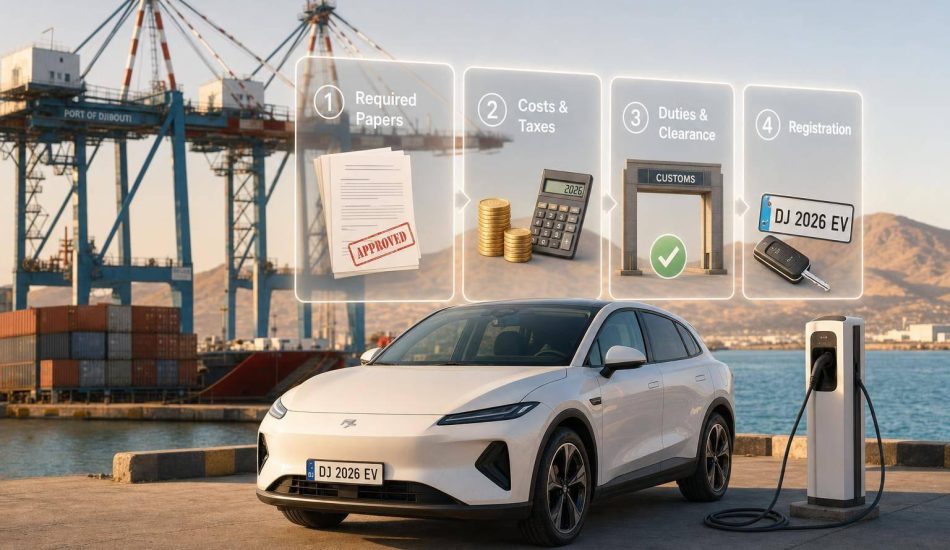
How to Import Through EV24.africa
EV24.africa has streamlined the import process, making it straightforward from purchase to delivery. After choosing your Zeekr model, you can select between two shipping options: Roll-on/Roll-off (RoRo) for a cost-effective solution or Container shipping for added protection during transit. The platform takes care of customs clearance and local registration, removing the administrative burden.
You can choose delivery to major ports like Cape Town, Durban, or Port Elizabeth, or opt for a door-to-door service for maximum convenience. EV24.africa provides clear, upfront quotes with no hidden fees and allows for flexible payment options. From order confirmation to delivery, the process typically takes 6–10 weeks, depending on shipping routes and customs clearance times.
Operating Costs Compared to Gas Vehicles
Charging an EV at home through Eskom costs approximately R2.18 per kWh for the first 600 kWh of monthly usage. For a 63 kWh battery, this translates to a charging cost of around R137–R217, compared to about R463 at a public DC fast charger. This means you’re looking at an estimated cost of R0.35 per kilometer when charging at home, which is significantly less than the R1.50–R2.00 per kilometer you’d spend on a comparable gasoline vehicle.
In October 2024, tech journalist Nafisa Akabor tested a 63 kWh EV in South Africa. Charging from 17% to 98% at a public AC station, the EV consumed 55.889 kWh at a total cost of R328.76, with a rate of R5.88 per kWh. Had the same charging session been done at home, the cost would have been between R137 and R217, offering over 60% savings.
These operational savings extend beyond charging. Zeekr vehicles come with a 5+5 year warranty (10 years total if serviced at recommended intervals), an 8-year high-voltage battery warranty, and 3 years of roadside assistance. Additionally, maintenance costs for EVs are 40–60% lower than those for gasoline vehicles, as there’s no need for oil changes, transmission servicing, or exhaust system repairs. For home charging, installing a 7.4kW wallbox charger (costing R15,000–R25,000) can pay for itself in just 18–24 months through savings on charging costs.
sbb-itb-99e19e3
Charging Infrastructure and Setup
Charging Standards and Network Compatibility
Zeekr vehicles are equipped with the Type 2 plug for AC charging and the Combined Charging System (CCS 2) for DC fast charging – both widely used in South African public charging networks like GridCars and Rubicon. This ensures compatibility and ease of use across the country.
For AC charging, the capacity depends on the model. The Zeekr X Privilege AWD supports up to 22 kW, while the Long Range RWD and Core RWD models are capped at 11 kW. When it comes to DC fast charging, these vehicles can handle up to 150 kW, allowing you to charge from 10% to 80% in less than 30 minutes. The cost? DC fast charging runs about $0.41 per kWh, while AC charging is slightly cheaper at $0.33 per kWh.
"DC chargers have two purposes: speed and convenience, with current-gen chargers being able to handle 200km in 20 minutes, which is suited for when you are far from home or doing extensive intercity travel." – Winstone Jordaan, MD, GridCars
Next, let’s explore how to set up charging solutions at home and work.
Setting Up Home and Workplace Charging
For everyday charging needs, installing a Level 2 wallbox at home is a practical solution. These chargers range from 7.4 kW to 22 kW, depending on your home’s electrical setup. Most South African homes with single-phase power can accommodate up to 7.4 kW, while homes with three-phase power can support 11 kW or even 22 kW. To ensure safety, hire a licensed electrician to install the wallbox with a 6 mm² power supply cable and secure a Certificate of Compliance (CoC).
If a full wallbox installation isn’t feasible, consider alternatives like a blue 32-amp single-phase CEE socket (7.4 kW) or a red 16-amp three-phase CEE socket (11 kW). However, avoid standard household outlets – they only provide 3.7 kW and could pose fire risks. For streamlined support, EV24.africa can assist with installations, aligning with the import process mentioned earlier.
Public Charging and Road Trips
Once your home and workplace charging setups are in place, public charging stations become essential for longer journeys. These stations are conveniently located at shopping centers like the Mall of Africa, vehicle dealerships, and along national highways to facilitate intercity travel. High-speed 200 kW DC chargers can add around 124 miles (200 km) of range in just 20 minutes. However, your Zeekr’s onboard system will adjust the actual charging speed based on the battery’s temperature and state of charge.
For optimal efficiency, start charging when your battery reaches 20%. Use network apps like GridCars to locate CCS 2-compatible stations and check real-time availability before hitting the road. Keep in mind that public AC chargers often require you to bring your own Type 2-to-Type 2 cable, while DC chargers usually come with tethered cables. During load-shedding, many dealership charging stations operate in separate electricity blocks, providing a reliable backup option.
After-Sales Support and Local Conditions
Warranty Coverage and Software Updates
Zeekr offers a warranty package that aligns with global EV expectations. The vehicle warranty covers 5 years or 93,000 miles (150,000 km), while the battery and drive motor are protected for 8 years or 99,000 miles (160,000 km). This extended battery warranty ensures coverage for the most expensive EV component, often outlasting typical ownership periods. Additionally, the package includes 5 years of 24/7 roadside assistance.
Keeping your Zeekr up-to-date is simple, thanks to over-the-air (OTA) software updates. These updates improve system performance, refine intelligent driving features, and eliminate the need for dealership visits. Maintenance intervals are spaced at every 2 years or 24,850 miles (40,000 km), a stark contrast to traditional gas-powered vehicles that often require service every 6,200 to 9,300 miles (10,000 to 15,000 km). Combined with an expanding local service network, this warranty and maintenance plan offers peace of mind for owners.
Service and Parts Availability
Zeekr backs its vehicles with a robust after-sales support system, ensuring access to dedicated services and readily available parts. After a decade-long absence, Geely, Zeekr’s parent company, re-entered the South African market in late 2025. This return leverages Geely’s established global presence, which includes brands like Volvo, Lotus, and Polestar. Zeekr vehicles are built on Geely’s Sustainable Experience Architecture (SEA), giving owners access to advanced battery technologies, cutting-edge battery management systems, and an integrated EV supply chain.
For buyers importing through EV24.africa, additional support is available to address gaps in the dealer network as Geely continues to expand its footprint. To ensure smooth ownership, it’s a good idea to confirm the location of certified repair facilities and the availability of parts in your area. Zeekr emphasizes a "user-driven" approach, aiming to anticipate and meet the needs of its customers.
Performance on South African Roads
Zeekr vehicles are well-equipped to handle South Africa’s varied road conditions and climate. The Zeekr 7X’s active air suspension allows ground clearance adjustments from 6.8 inches (172 mm) to 8.5 inches (217 mm), with some configurations reaching 9.1 inches (232 mm). This flexibility ensures the vehicle remains capable on both urban roads and light off-road terrain.
"The adjustable air suspension gives up to 232 millimeters ground clearance, meaning light off-road duties are possible. On normal settings, it rides well on the blacktop, the steering is accurate and the brakes commendable." – Tony Davis, Motoring Writer
The 7X also boasts reinforced anti-collision beams designed to withstand side impacts of up to 65 tons. With a powerful 475 kW (646 HP) powertrain, the vehicle delivers impressive acceleration, making highway overtaking effortless. Additional features like heated and ventilated seats ensure comfort in extreme temperatures, while a 12-year corrosion warranty provides long-term protection against coastal conditions.
Final Thoughts for South African Buyers
Zeekr, built on Geely’s SEA platform, is a premium EV that combines cutting-edge technology with proven reliability. This same platform powers well-known brands like Volvo and Polestar. The brand’s global success is evident, with sales skyrocketing from 6,007 units in 2021 to an impressive 222,123 units in 2024.
For South African buyers, one of the biggest hurdles – importing an EV – has been simplified by EV24.africa. This service streamlines the process, making Zeekr more accessible. Coupled with competitive pricing, extended driving range, luxurious features, and lower running costs compared to gas-powered cars, Zeekr offers a strong value proposition.
The Zeekr 7X and 009 models bring spacious interiors and elevated seating, ideal for South African roads. Additionally, a robust warranty ensures peace of mind for long-term ownership.
Charging infrastructure is another key consideration. Zeekr vehicles support ultra-fast charging, allowing you to go from 10% to 80% in under 30 minutes with 150-300 kW chargers. However, it’s essential to confirm the availability of high-capacity charging stations along your usual routes to fully enjoy this capability.
Combining high performance, advanced safety features, and strong support, Zeekr stands out as a premium EV option. With the global expertise of Zeekr and the local support of EV24.africa, South African buyers can look forward to a seamless EV ownership experience.
FAQs
What are the costs and taxes for importing a Zeekr EV into South Africa?
Importing a Zeekr EV to South Africa comes with several costs and taxes that can add up quickly. First, there’s a 25% customs duty on the vehicle’s FOB (Free on Board) price. On top of that, a 15% VAT applies to the total amount, including the customs duty. If you’re importing a higher-end model, you might also face an additional luxury tax of up to 30%, which can significantly increase the final bill.
Shipping fees are another important factor, typically ranging from $1,500 to $4,500, depending on the method you choose. Beyond that, there are other necessary expenses like registration, roadworthiness testing, insurance, and potential storage fees. For instance, importing a Zeekr with an FOB price of $38,000 could result in approximately $9,500 in customs duty, $5,700 in VAT, and $2,000 to $3,000 in shipping fees, not counting the additional local costs.
These figures highlight the importance of factoring in all related expenses when determining the total cost of bringing a Zeekr EV to South Africa.
What kind of warranty and support does Zeekr offer for its EVs?
Zeekr provides a warranty package specifically designed for the unique needs of electric vehicles, offering coverage for the battery and other essential EV components. Their maintenance plans take into account the reduced upkeep that EVs require compared to traditional gas-powered cars.
Electric vehicles have fewer moving parts, which translates to less frequent maintenance. Instead of oil changes or extensive brake servicing, Zeekr prioritizes software updates, battery health monitoring, and fast-charging capabilities. This approach not only extends the warranties on key EV systems but also minimizes the need for regular mechanical upkeep. As a result, owning a Zeekr becomes more convenient and cost-efficient in the long run.
What kind of charging options are available for Zeekr vehicles in South Africa?
Zeekr electric vehicles are built to support lightning-fast charging speeds. For example, the 007 sedan can charge from 10% to 80% in just about 10 minutes when connected to an 800-volt fast charger. Although Zeekr hasn’t introduced its own charging network in South Africa yet, its cars are fully compatible with the country’s expanding public fast-charging infrastructure.
Cities like Cape Town and Johannesburg are steadily increasing their high-power DC charging options, with many stations now offering speeds of 150 kW or more. This growing network enables Zeekr drivers to recharge quickly, whether they’re navigating urban streets or traveling along major routes. With South Africa’s charging infrastructure on the rise, Zeekr’s timing for entering the market aligns well with the needs of local EV enthusiasts.