
 Thabo Nkosi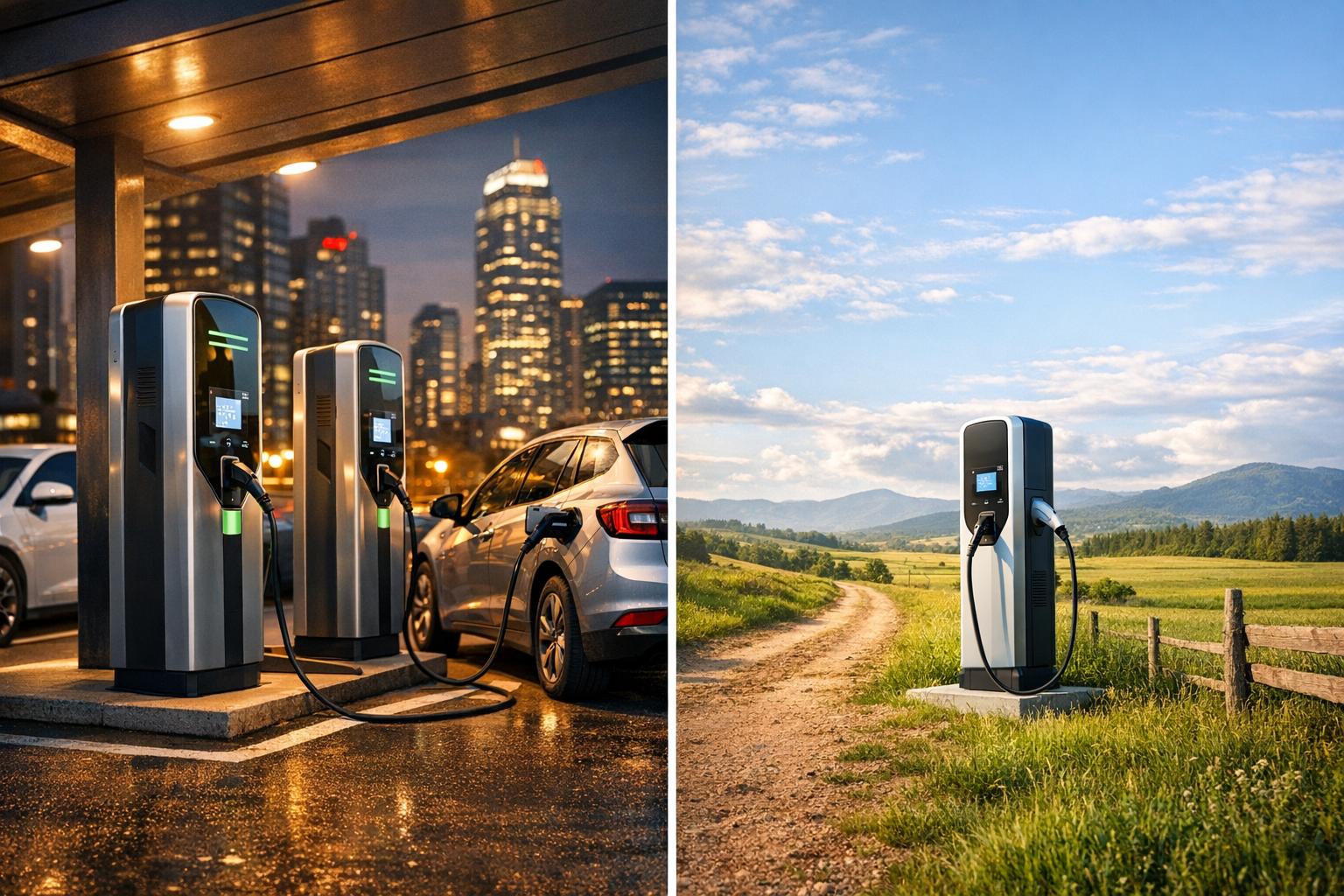
Urban and rural EV charging differ significantly in cost, availability, and convenience. Here’s a quick breakdown:
- Urban Areas: Offer dense networks of chargers, including public Level 2 and DC fast chargers. However, costs can add up with parking fees, idle fees, and higher public charging rates. Home charging averages $0.17–$0.20 per kWh, while public fast charging can cost $0.40–$0.60 per kWh.
- Rural Areas: Sparse charging infrastructure means most charging happens at home. Home electricity rates in rural areas are often lower ($0.12–$0.17 per kWh), but DC fast chargers can be pricier ($0.40–$0.60+ per kWh). Long detours to reach chargers and fewer backup options make planning essential.
Key Considerations:
- Costs: Home charging is the cheapest option, but urban drivers without it face higher public charging expenses. Rural drivers often rely on home setups but may pay more for occasional fast charging.
- Availability: Urban areas have more chargers but face issues like overcrowding and reliability. Rural areas lack sufficient public chargers, with 66% of low-population counties having none.
- Driving Habits: Urban drivers benefit from shorter commutes and dense charging networks, while rural drivers need EVs with longer ranges and fast-charging capabilities for extended trips.
Quick Comparison:
| Factor | Urban Charging | Rural Charging |
|---|---|---|
| Home Charging Cost | $0.17–$0.20/kWh | $0.12–$0.17/kWh |
| Public Level 2 | $0.20–$0.40/kWh | $0.25–$0.40/kWh |
| DC Fast Charging | $0.35–$0.60+/kWh | $0.40–$0.60+/kWh |
| Charger Density | High (90% of U.S. chargers) | Low (45% of rural counties have fast chargers) |
| Challenges | Parking fees, reliability issues | Long detours, sparse infrastructure |
Whether you’re navigating city streets or rural highways, understanding these differences helps you plan better and choose the right EV for your needs.
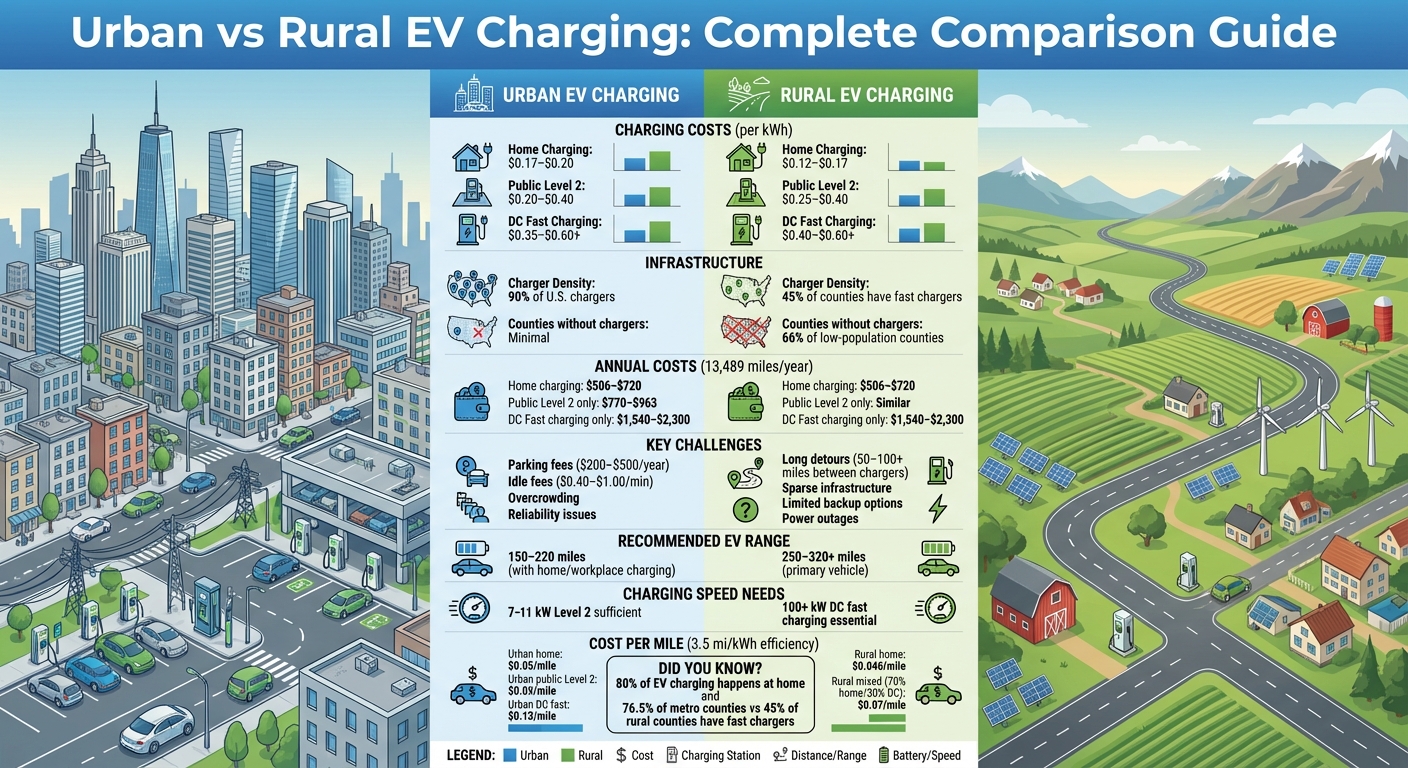
Urban vs Rural EV Charging Costs and Infrastructure Comparison
Evaluating Your EV Charging Profile
Assessing Your Driving Patterns
Start by tracking your daily mileage for 2–4 weeks using your car’s trip computer or odometer. This will give you a clear picture of how far you typically drive each day and help establish a baseline for your energy needs. Knowing this baseline is key to figuring out whether home charging will cover most of your needs or if you’ll need to rely on public chargers more frequently.
Next, break down your mileage into urban and rural driving. Consider what percentage of your annual driving happens in city environments versus rural highways or small towns. Use your primary ZIP codes to help estimate this. Why does this matter? Urban areas in the U.S. tend to have more public charging stations and competitive pricing. On the other hand, rural regions often lack public chargers, which could mean longer detours and potentially higher costs. For instance, if 80% of your driving is urban, you can likely depend on home and local public chargers. But if 60% of your miles are rural, you might need to lean more on home charging or plan for extended trips to DC fast chargers.
Think about any regular long trips you take, like visiting family monthly or going on quarterly business trips. For each trip, note the one-way distance, round-trip total, and the typical route. Are you sticking to major interstates with plenty of DC fast chargers, or are you driving through rural areas where chargers are few and far between? Timing also plays a role – winter driving, higher speeds, and nighttime travel can all increase energy consumption, especially on rural routes with limited charging options.
Understanding Your EV’s Capabilities
Once you’ve mapped out your driving habits, it’s time to evaluate your EV’s technical specs to fine-tune your charging profile. Start by looking up your EV’s battery capacity in kWh, usable battery capacity, and EPA-rated range in miles. These details are usually available in your owner’s manual or on the manufacturer’s website. For cost comparisons, focus on kWh since it’s the standard unit for both public charging fees and your home electricity bill. This allows you to calculate costs per kWh and per mile across different electricity rates in urban and rural areas.
Pay attention to your EV’s efficiency, measured in miles per kWh, during typical city and highway driving. City driving often yields better efficiency due to lower speeds and regenerative braking. In contrast, highway or rural driving – especially at speeds over 70 mph – can significantly increase energy consumption. For example, an EV rated at 3.6 miles per kWh might achieve 4.0 miles per kWh in city traffic but drop to 3.0 miles per kWh on high-speed interstates. These real-world efficiency numbers are much more useful than brochure ratings when estimating costs for specific trips.
Finally, check your EV’s onboard AC charger power (e.g., 7.2 kW, 9.6 kW, or 11 kW) and maximum DC fast-charging rate (e.g., 50 kW, 100 kW, or 150+ kW). A higher AC charging rate is especially helpful for overnight Level 2 charging at home or work, which can be a lifesaver in rural areas where public chargers are scarce. On the other hand, a high DC fast-charging rate is crucial for long-distance highway travel or rural trips with limited charging options. In urban areas, where slower public or workplace Level 2 chargers are common, a strong AC charging capability can often be just as important as a high DC fast-charging rate.
Urban EV Charging Factors
Urban Charging Costs
Residential electricity rates typically fall between $0.13 and $0.30 per kWh. For example, at an average rate of $0.20 per kWh, charging a 60 kWh battery would cost around $12, providing a driving range of 220–260 miles. Opting for time-of-use plans can significantly reduce costs – for instance, a 50 kWh charge could drop from $15 (at $0.30 per kWh) to just $6 (at $0.12 per kWh).
Public Level 2 chargers are another option, usually priced at $0.20–$0.25 per kWh. A typical 40 kWh session would cost $8–$10, translating to about $0.06–$0.08 per mile. For someone driving the U.S. average of 13,489 miles annually and relying solely on public Level 2 chargers, this adds up to approximately $770–$963 per year. On the other hand, DC fast chargers are the priciest, ranging from $0.40 to $0.60 per kWh. A 40 kWh session at these rates could cost $16–$24, leading to yearly expenses of $1,540–$2,300 – almost double the per-mile cost of Level 2 charging.
Workplace charging offers a more affordable alternative for urban drivers. By 2024, about 30% of U.S. urban employers were offering free or subsidized charging, up from 20% in 2022. Retail locations like supermarkets, malls, and apartment complexes also frequently provide complimentary Level 2 charging, potentially saving regular users between $500 and $1,000 annually. When comparing charging options, pay attention to how fees are structured – whether per kWh, per hour, or as a flat session fee – as this can greatly impact your total expenses.
While keeping costs in mind, accessibility plays an equally important role in urban EV charging.
Urban Charging Accessibility
Balancing cost and access is essential when planning urban EV charging. However, a high number of chargers in a city doesn’t guarantee fair distribution. Studies show that underserved communities often have far fewer public charging stations within a 3-mile radius compared to wealthier neighborhoods.
Even in areas with an abundance of chargers, the ratio of chargers to vehicles matters. In cities with high EV adoption, popular charging stations can hit up to 70% occupancy during peak hours, leading to wait times of 5 to 15 minutes. Despite networks reporting over 95% uptime, a comprehensive study revealed that only about two-thirds of public chargers were fully functional, with greater reliability issues in under-resourced areas.
To navigate these challenges, apps like PlugShare and ChargePoint can help you locate chargers, check their real-time availability, and read user reviews. It’s wise to identify at least three charging spots near your home or workplace and have a backup plan to avoid unnecessary delays.
Access-related issues can also lead to hidden costs that are often overlooked.
Hidden Costs of Urban Charging
Urban EV charging comes with additional expenses that can quickly add up:
- Parking fees: Charging in city garages often incurs parking costs of $2–$5 per hour, which could total $200–$500 annually, especially in downtown areas.
- Detours: Driving extra miles to reach a charger can increase your travel distance by 10–20%, resulting in an additional $100–$300 per year.
- Idle fees: If your car remains plugged in after charging is complete, you may face fees of $0.40–$1.00 per minute.
- Membership plans: Many charging networks offer subscription plans, usually costing $5–$10 per month (or $60–$120 annually). For example, Electrify America Pass+ costs about $6.99 per month and can reduce per-kWh rates by around 25%.
Regional pricing differences also play a role. For instance, in California, urban public charging rates average $0.31 per kWh due to state tariffs, while cities in the Northeast, like New York, may tack on congestion surcharges of up to $0.10 per kWh. To better manage your expenses, track your total session costs, including charging fees, parking, and other related charges.
| Hidden Cost | Urban Estimate | Annual Impact (13,489 miles) |
|---|---|---|
| Parking Fees | $2–$5 per hour | $200–$500 |
| Detours | 10–20% extra time/miles | $100–$300 |
| Membership Fees | $5–$10 per month | $60–$120 |
Rural EV Charging Considerations
Rural Charging Costs and Availability
Charging an electric vehicle (EV) in rural areas comes with its own unique cost structure. Public DC fast chargers typically range from $0.40 to $0.60 per kWh, with some Tesla Superchargers in remote regions charging up to $0.50 per kWh. For a 40 kWh session, this translates to $16–$24, a sharp contrast to the $6.80 it costs for the same session using home charging rates [6,7,12]. Adding to the complexity, charging costs vary significantly by state. For instance, Alaska has the highest average public charging rate at $0.51 per kWh, while Kansas averages a much lower $0.26 per kWh.
Beyond costs, rural areas struggle with sparse charging infrastructure. A 2024 analysis revealed that 66% of U.S. counties with fewer than 25,000 residents lack even a single public charger. In these regions, chargers are often spaced 50 to 100+ miles apart, making home charging the primary option for most drivers. In fact, home charging accounts for about 80% of rural EV charging. At an average residential rate of $0.17 per kWh, annual home charging costs for the typical 13,489 miles driven range between $506 and $720. These challenges are further compounded by the limited availability of chargers across rural landscapes.
For areas with unreliable power grids, solar-powered charging stations could serve as a backup. However, such off-grid solutions remain rare outside of major transportation corridors [8,13].
Additional Costs and Challenges
In rural areas, detours to reach a charging station can significantly increase both time and energy usage. For example, a 30-mile round-trip detour could add 20–50% more miles to a journey. Additionally, DC fast-charging sessions can take anywhere from 30 to 60 minutes, especially when limited charger availability forces drivers to plan around specific locations.
Reliability is another pressing issue. Many public chargers in rural regions are either partially functional or completely out of service, with underserved communities feeling the brunt of these gaps [4,5]. When the only available charger is down, it can throw off an entire route. On top of this, rural areas often face more frequent power outages due to storms, long distribution lines, and limited grid redundancy. The lack of nearby EV dealerships or certified service centers makes resolving technical issues even more challenging.
Backup Planning for Rural Charging
Given the challenges of rural EV charging, having a backup plan is essential. Start by mapping out at least two alternative charging locations and downloading offline maps to counteract spotty cell coverage [3,5]. Apps like PlugShare can also help verify charger functionality before you arrive. To stay prepared, consider carrying a portable Level 1 or Level 2 EVSE (costing $300–$1,500) and connector adapters to ensure compatibility across different charging networks. It’s also wise to maintain a battery buffer of 20–25% charge to account for unexpected outages [2,3,14].
For extended rural trips, selecting an EV with a 300+ mile range can minimize the need for frequent charging stops, reducing exposure to infrastructure gaps.
| Backup Item | Purpose | Estimated Cost |
|---|---|---|
| Portable EVSE | Charge at locations without dedicated EV outlets | $300–$1,500 |
| Connector Adapters | Ensure compatibility across various networks | Varies by brand |
| Offline Maps | Navigation without relying on cell service | Free (pre-download) |
Comparing Urban and Rural Charging
Cost Comparisons
For an electric vehicle (EV) averaging 3.5 miles per kWh, the cost of charging depends heavily on where and how you charge. Charging at home costs around $0.18 per kWh, translating to $0.05 per mile. On the other hand, using a DC fast charger at $0.45 per kWh bumps the cost to $0.13 per mile – more than double. Public charging in urban areas typically costs $0.20–$0.40 per kWh for Level 2 stations, while DC fast chargers range from $0.35–$0.60+ per kWh. In rural areas, DC fast chargers can be even pricier due to lower usage and fewer competing stations. However, rural home charging through local cooperatives often offers the lowest rates, between $0.12 and $0.25 per kWh, making it a budget-friendly option for those with home charging access.
Let’s break this down for a driver covering 1,000 miles per month in an EV averaging 3.5 miles per kWh (286 kWh monthly). Charging at home in an urban setting at $0.18 per kWh would cost $51 per month, or $0.05 per mile. Switching to urban public Level 2 chargers at $0.30 per kWh increases the monthly cost to $86, or $0.09 per mile. Relying on DC fast charging at $0.45 per kWh brings the total to $129 per month, or $0.13 per mile. In contrast, rural drivers charging at home through a cooperative at $0.16 per kWh would pay just $46 monthly, or $0.046 per mile – the most economical choice. A mixed rural approach – 70% home charging at $0.16 per kWh and 30% DC fast charging at $0.45 per kWh – would cost about $71 per month, or $0.07 per mile. Clearly, home charging remains the most affordable option, but limited access in rural areas can lead to higher costs.
| Charging Context | Typical Cost per kWh | Cost per Mile (3.5 mi/kWh) | Power (kW) | 0–80% Charge Time (60 kWh battery) |
|---|---|---|---|---|
| Urban Home Level 2 | $0.15–$0.30 | $0.04–$0.09 | 7–11 kW | 5–7 hours |
| Urban Public Level 2 | $0.20–$0.40 | $0.06–$0.11 | 6–19 kW | 3–8 hours |
| Urban DC Fast | $0.35–$0.60 | $0.10–$0.17 | 50–350 kW | 20–40 minutes |
| Rural Home Level 2 | $0.12–$0.25 | $0.03–$0.07 | 7–11 kW | 5–7 hours |
| Rural Public Level 2 | $0.25–$0.40 | $0.07–$0.11 | 6–19 kW | 3–8 hours |
| Rural DC Fast | $0.40–$0.60+ | $0.11–$0.17+ | 50–150 kW | 30–60 minutes |
Scenario Comparison
A 300-mile round trip highlights the challenges of urban versus rural charging. With an EV boasting a 250-mile EPA range but a practical 200-mile trip range (to leave a buffer), urban drivers have it easier. They can rely on abundant fast chargers along interstates, likely needing just one 30–40 minute charging stop and a quick top-off at home before and after the trip. Rural drivers, however, face fewer charging options. They may need to detour 10–20 miles to find a charger, adding 6 kWh of energy use (at 3.5 miles per kWh) and 20 or more minutes of extra driving each way.
When it comes to costs, the urban driver charging mostly at home at $0.18 per kWh would spend $15 for the trip (86 kWh total). The rural driver, forced to rely more on DC fast charging at $0.45 per kWh due to limited home access and sparse stations, might spend $25–$30 for the same journey, plus the cost of extra detour miles. Time-wise, the rural driver could lose an additional 40–60 minutes between detours and less convenient charging options. This disparity means rural trips can cost 40–60% more in energy and take significantly longer, even when charging rates are similar, due to detours, lower charger density, and extra planning.
Non-Financial Factors
The differences between urban and rural charging go beyond just dollars and cents. Range anxiety is a more pressing issue in rural areas, where 66% of U.S. counties with fewer than 25,000 residents lack even one public charger. As of early 2025, only 45% of rural counties had a fast-charging port. In contrast, 90% of public charging stations are concentrated in urban areas, making it easier for city drivers to find alternatives if a charger is down or occupied. Rural drivers, however, often have to contend with long waits or significant reroutes when a charger isn’t available.
Reliability also varies. Urban chargers tend to be better maintained, thanks to higher usage and competition, while rural stations, being less frequently used, may have higher costs or delayed maintenance. Frequent reliance on DC fast charging, common for rural drivers without home charging, can also lead to faster battery wear compared to the gentler charging provided by Level 2 home setups. Plus, rural drivers often need to plan trips meticulously, downloading offline maps for areas with poor cell service and maintaining a larger state-of-charge buffer (15–20%) to avoid getting stranded. These non-financial factors – like battery health, peace of mind, and time flexibility – can weigh heavily on drivers, often more so than a few extra dollars per charge in areas where infrastructure lags behind EV adoption.
sbb-itb-99e19e3
Tailoring EV Choices to Charging Realities
Matching EV Range to Charging Needs
When choosing an EV, it’s important to align its range with your driving habits and charging options. Start by evaluating your average daily mileage and longest regular trips. For instance, if you have a 40-mile urban commute or a 180-mile rural round trip to visit family, these numbers will guide your decision. Add a 20–30% buffer to account for factors like weather, hilly terrain, unexpected detours, and long-term battery wear. For a 180-mile trip, an EV with a range of at least 240–260 miles (EPA-rated) is a safer bet.
Urban drivers with access to reliable home or workplace charging and a daily commute of 20–40 miles can do well with compact EVs offering ranges between 150 and 220 miles. These vehicles are particularly effective in areas with a dense public charging network. On the other hand, rural drivers face unique challenges: longer distances between towns and significantly fewer public chargers. In fact, over 60% of low-population U.S. counties lack even a single public charger. For primary vehicles frequently used on highways or for trips to distant towns, a range of 250–300 miles is more practical. For those living in exurbs who mix urban and rural driving – like weekend trips to visit family or recreation spots – a range of 240–280 miles is often ideal, ensuring they can handle 150–200 mile round trips without relying on a potentially crowded or offline charger.
Choosing the Right Charging Capabilities
Charging speed is another critical factor. Urban drivers who primarily use Level 2 (240V) chargers can add 20–40 miles of range per hour of charging. For rural drivers, however, it’s wise to prioritize EVs with 100 kW or higher DC fast-charging capabilities for long journeys. Since more than 80% of EV charging occurs at home, make sure your EV’s onboard charger supports 7–11 kW when using a 240V Level 2 outlet – common in U.S. homes – to fully recharge overnight.
Rural EV owners often depend heavily on home Level 2 charging due to the scarcity of public charging stations. However, DC fast charging becomes essential for longer trips, towing, or driving in extreme weather. Nearly half of rural counties in the U.S. still lack fast-charging options, making it critical for rural drivers to choose models that can handle high-power DC fast charging – ideally 100 kW or more. Under optimal conditions, a vehicle with 100 kW peak charging can add around 150–200 miles of range in 30–40 minutes. Models with 150–250 kW DC capabilities offer even greater flexibility, particularly at newer high-power stations.
Thermal management also plays a key role in charging efficiency and battery health. For rural or highway-focused drivers who rely on fast charging over long distances, features like thermal preconditioning can significantly reduce charging times and make remote routes more predictable.
Using EV24.africa for Vehicle Selection
Once you’ve determined your technical requirements, EV24.africa is a helpful tool for comparing EVs based on the features that matter most to your charging environment. You can filter listings by EPA range, battery size, AC charging power, DC fast-charge rate, and thermal management options. For city dwellers with convenient home charging, focus on compact EVs with moderate ranges (150–220 miles) and good efficiency rather than maximum DC charging speeds. Suburban or exurban drivers commuting 40–70 miles daily might prefer models with 220–280 miles of range and 11 kW AC charging for quick overnight recharges. Rural drivers or those who frequently take road trips should prioritize vehicles with 250–320+ miles of range, 100–150 kW DC charging capability, and efficient thermal management.
For example, when browsing a listing, start by noting the battery size and rated range to ensure it meets your longest routine trip with a safety margin. Next, review the charging specs, including maximum AC charging power (e.g., 7.4 kW vs. 11 kW) and DC fast-charging performance (e.g., 100 kW vs. 170 kW). Also, check the connector types and whether the vehicle includes thermal management features like liquid cooling or battery preconditioning. Comparing two models side by side – one optimized for urban use and another for mixed urban-rural driving – can highlight how differences in range, charging speed, and thermal management affect trip planning in areas with limited charging infrastructure.
Finally, use EV24.africa’s spec tables to directly compare key features across brands like Tesla, Hyundai, BYD, and Toyota. This structured approach ensures you make an informed decision, whether you’re searching on EV24.africa or another regional marketplace.
Drivers of electric vehicles face charging deserts as stations remain concentrated near cities
Conclusion
Deciding between urban and rural EV charging comes down to weighing costs and convenience against your lifestyle. Urban areas house nearly 90% of U.S. EV charging stations, offering unmatched accessibility but often at a higher price. In contrast, as of Q1 2025, only 45% of rural counties have at least one fast charger, compared to 76.5% of metropolitan counties. For rural EV owners, this means relying heavily on home charging – where over 80% of all EV charging happens nationwide – and carefully planning longer journeys.
To help navigate these realities, consider key factors like electricity rates, availability of charging stations, driving distances, and your vehicle’s range. Public charging tends to cost more than home charging, so rural drivers should prioritize an EV with sufficient range and invest in a reliable Level 2 home charger. Urban drivers, on the other hand, must balance the convenience of public charging with hidden costs like parking fees. These considerations are essential for building a charging strategy that works for you.
Long-term convenience also varies depending on location. Rural areas are expanding their EV infrastructure at a slower rate – 34% growth compared to 29% in urban areas as of May 2024. However, initiatives like Electrify America’s 30 solar-powered rural stations in California highlight progress. Planning routes and backup charging options can help rural drivers avoid range anxiety. Urban EV owners enjoy denser charging networks but should remain mindful of potential reliability issues, especially in underserved areas where chargers per capita can be 64% lower.
This checklist can guide you in choosing the right EV for your charging needs. Whether you’re exploring compact urban models with ranges of 150–220 miles or long-distance SUVs with 250–320+ miles for rural highways, the goal is to minimize costs, avoid surprises, and make your transition to electric driving as smooth as possible. As charging infrastructure continues to grow across the country, this checklist ensures you’re ready to enjoy the perks of EV ownership – from lower maintenance costs ($4,200 vs. $4,500 for gas vehicles over five years) to cleaner air and greater energy independence.
FAQs
What are the key differences in EV charging costs between urban and rural areas?
Urban EV charging tends to come with a higher price tag. This is largely due to elevated electricity rates, the sheer demand for charging, and the convenience of having more stations readily available. On the flip side, rural charging is often less expensive, but it comes with its own challenges – fewer charging stations and longer distances between them, which can increase travel-related costs.
When deciding where and how to charge your EV, it’s important to weigh a few key factors: electricity rates, the availability of charging stations, and the distance you’ll need to cover to reach one. Striking the right balance between affordability and convenience can make a big difference in your overall charging experience.
What challenges do EV owners face when charging in rural areas?
EV charging in rural areas comes with its own set of challenges. One major hurdle is the scarcity of charging stations, which often forces drivers to travel longer distances just to recharge their vehicles. On top of that, rural regions sometimes deal with an unreliable electricity supply, complicating the situation further. Installing and maintaining charging infrastructure in these areas can also be more expensive, adding another layer of difficulty. Together, these factors make it harder for EV owners to plan trips and manage their charging needs effectively.
What should I consider when choosing an EV for urban or rural charging needs?
When choosing an EV, it’s crucial to consider how well it aligns with your charging options. If you live in a city, you’ll likely find plenty of charging stations, but electricity rates might be higher. In this case, an EV with fast-charging capabilities and a longer range can help minimize downtime and keep things efficient.
On the other hand, rural areas often have fewer charging stations. Here, an EV with an extended battery range and home charging compatibility becomes a practical choice, offering convenience and flexibility.
It’s also a good idea to research local electricity rates so you can estimate your charging expenses and make sure the EV fits within your budget. By matching your vehicle to your environment, you can enjoy a more seamless and cost-effective driving experience.