
 Younes Rabeh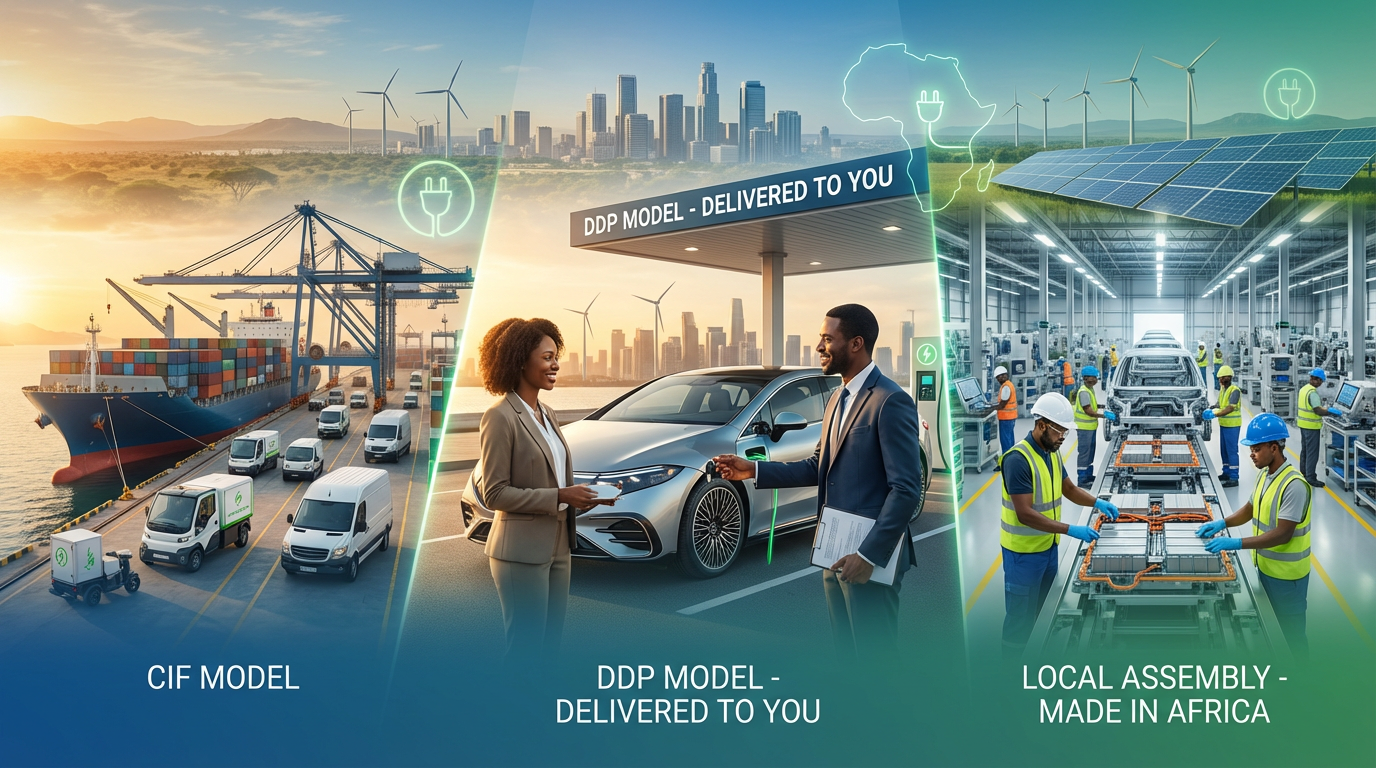
⚙️ 1. CIF: The Fast-Track Model for Market Entry
The CIF model has been the backbone of Africa’s first EV imports. It’s simple, flexible, and ideal for early-stage markets. Vehicles are shipped fully built, insured, and delivered to the port. ✅ Advantages: Low upfront investment, fast deployment, and quick access to multiple markets. ⚠️ Limitations: Buyers must handle customs, registration, and logistics locally — often leading to fragmented customer experiences.
At EV24.africa, this model has allowed early access to EVs like the BYD Dolphin, Leapmotor T03, and Dongfeng Nammi, across over 10 African countries within a single year.
🚚 2. DDP: The Full-Service, Trust-Building Model
DDP goes a step further — the vehicle is not just shipped, it’s delivered ready to drive. Taxes, customs, and registration are handled before the customer ever sees the car. ✅ Advantages: Simplifies adoption for private and corporate buyers; strengthens brand trust and transparency. ⚠️ Limitations: Requires strong local partners and precise compliance with every country’s tax system.
EV24’s DDP approach in Côte d’Ivoire and Senegal, backed by Auto24’s local presence, has proven that this model can turn hesitation into action — especially for fleet and institutional clients.
🏭 3. Local Assembly: The Long-Term Industrial Vision
While CIF and DDP open the market, local assembly builds it. As African governments promote industrialization and green transition policies, CKD (Completely Knocked Down) assembly becomes strategic. ✅ Advantages: Job creation, lower duties, eligibility for incentives, and better adaptation to local needs. ⚠️ Limitations: High initial setup costs, need for technical skills, and supply chain complexity.
Countries like Kenya, Ghana, and Morocco are already moving in this direction — and the momentum is growing.
🔋 4. The Hybrid Approach: Africa’s Unique Advantage
In reality, the winning formula isn’t “CIF vs DDP vs Assembly” — it’s a smart mix. Africa’s diversity demands flexibility:
- Use CIF for testing and first imports,
- Shift to DDP once trust and demand grow,
- Build assembly capacity as volumes justify it.
That’s exactly how EV24.africa is structuring its 2025–2026 roadmap: scalable, multi-market, and deeply rooted in local ecosystems.
💬 Conclusion
Africa’s EV boom won’t be built in one way — it’ll be built in waves. From CIF shipments to DDP deliveries and, eventually, local assembly plants, every step brings the continent closer to sustainable, affordable, and locally integrated e-mobility.
The question isn’t which model is best — but when and where to use each.